
Author:qinbafrank
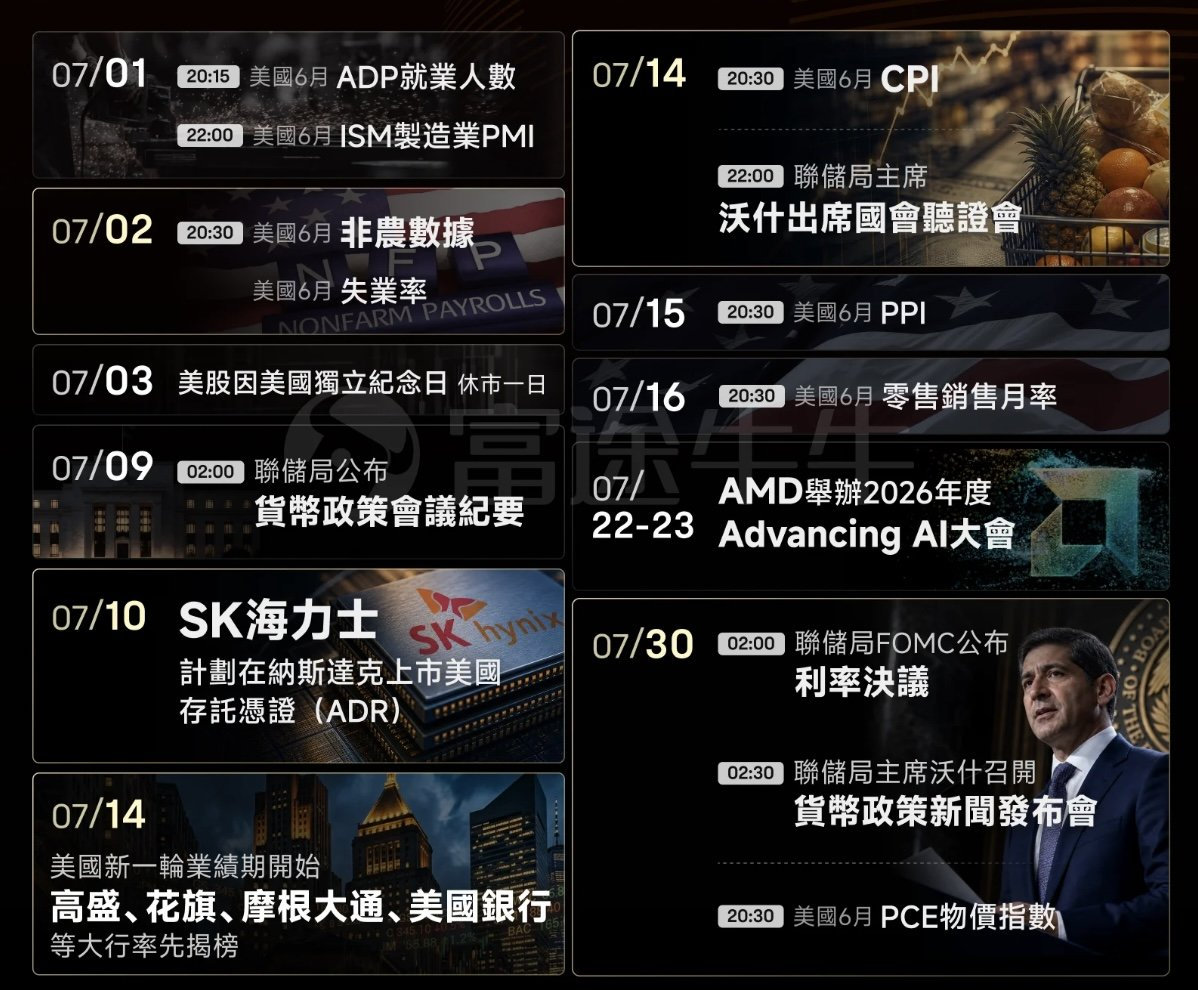
The selling pressure at the end of June has just passed, and we are now faced with the "Meta surplus computing power test." From a personal perspective, the market simulation for July is: the S&P is likely to oscillate at a high level, while the NASDAQ and semiconductor fluctuations will be significantly amplified. The real turning point is the June CPI on July 14, followed by the start of Q2 earnings reports and the interest rate meeting at the end of the month. Last week, the first trading day of July startled the market with Meta, raising concerns about computing power surplus.
Last Friday we discussed: Meta is unlikely to give up on cutting-edge large models, and launching cloud services is a natural progression, but what really determines the market direction is whether the large model ARR and super-large cloud company performance can continue to exceed expectations.
There are several main lines impacting the market in July:
1) AI fundamentals: discussions on token economics will deepen, with AI trading shifting gears;
2) June CPI; after a significant drop in oil prices, will CPI follow the same pace;
3) Q2 earnings season starts, with the core focus being whether cloud business growth can continue to exceed expectations;
4) Interest rate meeting at the end of the month;
Let's sort out the several main lines mentioned above in detail
1. AI Fundamentals: Discussions on token economics will deepen, AI trading shifts gears;
From recent events regarding AI fundamentals
1) TrendForce reports that Samsung is reportedly pushing for a maximum sequential increase of 20% in DRAM ASP in Q3, and SK hynix is also said to have canceled parts of the long-term contract price ceilings, allowing spot price increases to more fully reflect in contract prices. This indicates that HBM, server DRAM, and enterprise-level storage remain tight, and AI demand has not collapsed comprehensively;
2) Blackstone/QTS exiting the large data center in Virginia: The real bottleneck for AI infrastructure is "power + approval + community resistance." The demand for AI infrastructure is not absent but is increasingly constrained in terms of implementation: electricity, land, environmental protection, community politics, and regulatory approvals;
3) Coinbase CEO Brian Armstrong tweeted that Coinbase significantly reduced AI spending while achieving record token usage through low-cost default models, complexity routing, better caching, compressing context, and transparency of costs.
This indicates that companies are increasingly valuing token efficiency, focusing on the input-output ratio, and trying various ways to optimize cost structures.
Ultimately, it still revolves around whether the large model ARR and super-large cloud company performance can continue to exceed expectations. This is the fundamental point of the market logic.
Considering the information mentioned above, the comprehensive judgment for the main line of AI in July is: AI is not collapsing but is transitioning from "overall enthusiasm" to a revaluation period focused on "efficiency, ROI, price, and utilization."
The most likely occurrence in July is internal rotation rather than a simultaneous rise in the entire AI sector.
2. June Non-Farm Weak + Oil Price Decline, How will June CPI Likely Move?
For CPI, the key is oil prices and gasoline. The May CPI was 4.2% year-on-year and 0.5% month-on-month, with energy prices rising 23.5% year-on-year, which was an important reason for the rally in broad inflation at the time. However, the situation reversed in June: U.S. gasoline prices fell continuously, with Reuters reporting a drop of approximately 15% from the peak in May. According to the Cleveland Fed's real-time inflation forecast, the broad CPI in June is expected to be around -0.06% month-on-month, while core CPI is expected to be around +0.23%.
The year-on-year figures for the broad CPI and core CPI in June are likely to be lower than in May, the key is the degree of deviation from market expectations. A weaker broad CPI is favorable for valuation and duration assets; the market knows that inflation will ease with the fall in oil prices, but the critical focus is on the slope of the decline in broad CPI and core CPI (looking at month-on-month). Particularly, core CPI must be able to stay below 0.3%, otherwise the market will worry about the slowdown in the decline.
3. Earnings Season Begins, Facing a Performance Test
However, the key point of the earnings season is that expectations are already very high, and the margin for error is low. FactSet expects Q2 2026 S&P 500 EPS to grow approximately 23.3% year-on-year, and the full-year 2026 EPS growth to be around 24.1%. This expectation is very high, meaning the market not only expects companies to beat estimates but also to raise guidance significantly.
If the following situations occur in the earnings season, U.S. stocks will come under pressure:
AI capital expenditures are revised upward, but revenue guidance is not revised upward;
Gross margins are compressed due to memory, electricity, depreciation, and financing costs;
Management's statements on AI ROI are vague;
Cloud growth does not meet expectations; advertising/consumer/business IT budgets weaken.
Conversely, if big cloud vendors like Google Cloud, AWS, and Microsoft Cloud continue to significantly exceed expectations, then the market will indeed see AI commercialization continue to accelerate after a quarter's turning point.
Of course, the latest disclosed annualized ARR data from the two major model vendors is also a crucial core influencing variable, indicating the growth situation.
4. After Expectations of Rate Hikes Cooling, Is "No Rate Hike" Likely in July?
The July meeting is likely to hold, with no rate hike; however, Powell may not provide the dovish confirmation the market desires. A more likely statement will be "not in a hurry to act, but our inflation target remains 2%, and future actions will depend on data."
This means:
If the CPI on July 14 is very soft, the market will continue to lower the odds for a rate hike in July, leading to a short-term rebound in U.S. stocks;
If core CPI remains sticky, the market will shift focus to September, and long-term yields and real interest rates may rise, which could suppress NASDAQ valuations.
The real source of risk in the market is that expectations are too full and leverage is very high. Previously, in mid-June, we discussed that "the real risk in the market lies in crowded trades; leverage is a bit too full. The scale of leverage in U.S. stock brokerage accounts is $1.3 trillion, a historical high; this actually lays risk and hidden dangers, and a similar deleveraging situation as early June will occur in the second half of the year. The market is in a high-leverage, crowded trading state, and any slight disturbance in macro or industry can easily lead to a stampede; deleveraging generally happens very quickly and sharply." The recent plunge triggered by Meta is a manifestation of this crowded deleveraging at a high level.
July U.S. Stock Path Simulation
1) Base Scenario:
High-level oscillation, first a rebound followed by oscillation, the index is not easy to collapse directly, but the NASDAQ/semiconductor fluctuations are larger. Waiting for earnings to provide further clear signals.
Trigger Conditions:
June CPI headline shows a clear cooling, core CPI does not explode;
July FOMC essentially holds;
Q2 earnings can still beat overall;
AI news continues to differentiate but does not exhibit systemic collapse.
The path is roughly as follows:
Early July: weak non-farm numbers, falling oil prices, rising expectations for no rate hike in July, providing a basis for index rebound.
Mid-July CPI: If the CPI headline is negative or close to 0, the market will first trade on "inflation relief + Fed inaction in July"; but if core CPI is still at 0.3%, the rebound will be constrained.
Late July earnings + FOMC: The index may oscillate at high levels, with individual stocks dramatically differentiating based on AI ROI, cloud revenue, and capex guidance. If FOMC holds but is more hawkish in wording, "good news may be priced in."
Range Judgment:
The S&P 500 is likely to oscillate in the range of 7,250-7,700; QQQ is likely to fluctuate in the range of 690-735.
The monthly result may be: S&P down 2% to up 3%, NASDAQ/QQQ down 4% to up 3%. In this scenario, the market is not in a bear market, but rather in a "valuation digestion after a significant rise."
2) Bullish Scenario:
Very soft CPI + declining core inflation + strong earnings, the index continues to squeeze higher.
Conditions are:
June headline CPI month-on-month is negative, core CPI ≤0.2%; 10-year U.S. treasury yields continue to decline; Powell's speech no longer reinforces rate hikes; major tech earnings show AI revenue, cloud revenue, and advertising revenue can all cover capital expenditures; Meta selling computing power is interpreted by the market as "increasing ROIC" rather than "computing power surplus."
In such a scenario, July will see:
Semiconductors stop declining, platform giants lead the way again, S&P challenges 7,700-7,800, QQQ returns above 730.
But even in this scenario, I don't think July will be a very smooth unilateral rise, as leverage is too high and the AI narrative has already shown cracks.
3) Bearish Scenario: Probability around 20%
AI ROI skepticism spreads + sticky core CPI + high leverage risk reduction, leading to a 5%-10% pullback in July.
Trigger conditions may include:
Core CPI ≥0.3%;
September rate hike probabilities rise again;
U.S. treasury real interest rates rise;
Anthropic's official ARR/other third-party token data weaken;
AI cloud leasing prices decline;
Major tech earnings admit that AI capex continues to be revised upward while revenue realization is slow;
Semiconductor/memory price increases are reinterpreted as "cost pressure" rather than "strong demand."
In this case, the stocks most likely to fall are:
Those that had the largest prior gains, were most crowded, and rely heavily on forward AI narratives.
Including semiconductors, AI power devices, certain data centers, neocloud, and stocks concentrated in leveraged ETF positions.
In terms of indices, S&P 500 may retest 7,100-7,250, QQQ may pull back to the 660-685 range.
Due to the significant scale of margin and leveraged ETFs, the declines may not be gradual but rather concentrated over two to three days to kill valuations. Deleveraging usually occurs rapidly and sharply.
Overall Personal Judgment on the Main Line for July
1) No rate hike in July is very likely, but this is no longer new good news. What truly impacts the market is whether the CPI can also lower the odds of a rate hike in September.
2) The headline CPI for June is likely to show clear softening, even potentially negative month-on-month; however, the core CPI is the key factor determining NASDAQ valuations. If the core is around 0.2%, there is room for a rebound; if core CPI exceeds 0.3%, rebounds are likely to fail.
3) AI fundamentals are not entirely bad, but are shifting from "computing power scarcity" to "utilization rates and monetization capabilities." Meta selling computing power, Coinbase reducing AI expenses, controversies over Anthropic token consumption, rising memory prices, and data center projects being hindered all indicate that AI demand is still present, but the linear extrapolation of AI capex is being questioned by the market.
4) The most dangerous thing in July is not macro conditions but positions. Margin financing is at record highs, the VIX remains low, and momentum trading is crowded. Once negative combinations arise from CPI, AI news, or earnings reports, pullbacks will be amplified.
5) July is more likely to be a month of "index consolidation with a slight bullish/bearish trend and a major internal reshuffle." I am more optimistic about platform-based AI monetization companies, strong cash flow cloud and software leaders, and those with real pricing power like memory/electricity/data center bottleneck assets; I am more cautious about purely relying on linear extrapolation of AI capex, valuations that are already saturated, and hardware chains and leveraged stocks that have risen too much recently.
In simple terms, as mentioned at the beginning: July for U.S. stocks is very likely a month of AI trading transitioning from beta bull markets to alpha differentiation. The S&P is likely to oscillate at a high level, while the NASDAQ and semiconductors will experience significantly amplified fluctuations; the real watershed moment is the July 14 CPI, followed by the Q2 earnings reports and the FOMC on July 28-29.
免责声明:本文章仅代表作者个人观点,不代表本平台的立场和观点。本文章仅供信息分享,不构成对任何人的任何投资建议。用户与作者之间的任何争议,与本平台无关。如网页中刊载的文章或图片涉及侵权,请提供相关的权利证明和身份证明发送邮件到support@aicoin.com,本平台相关工作人员将会进行核查。


