On July 4th, Doubao and Tongyi Qianwen announced that the intelligent agent feature will be discontinued.
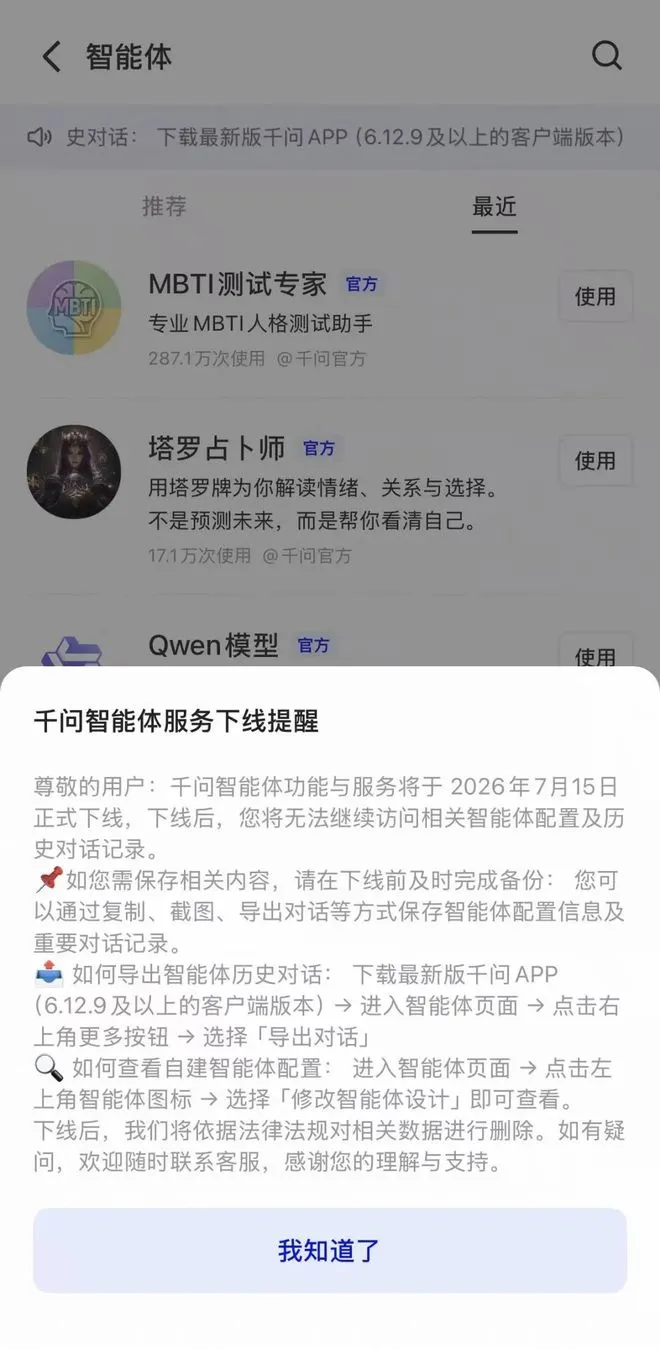
Doubao released a "Doubao Intelligent Agent Feature Discontinuation Notice," confirming that the intelligent agent feature will go offline on July 15th, and will redirect users to ByteDance's Cat Box App for related needs.
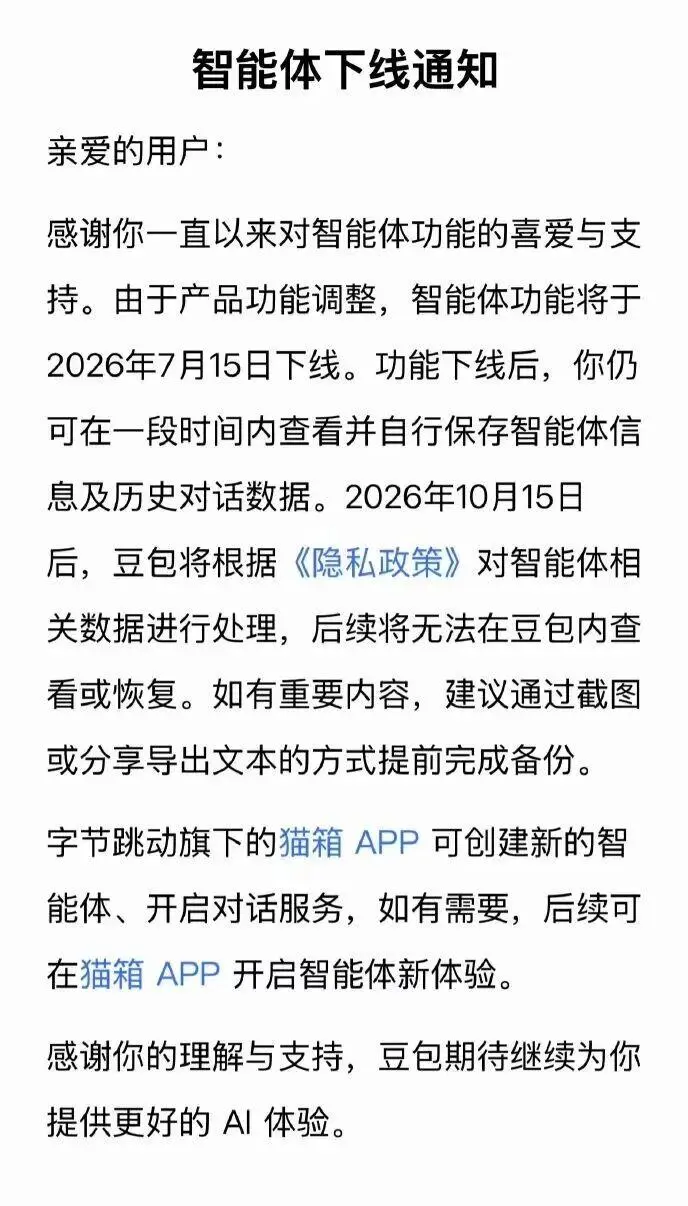
On the same day, Tongyi Qianwen pushed a discontinuation reminder to users, stating that the personalized interaction intelligent agent and user-created intelligent agent features will go offline on July 10th, and after July 15th, the Qianwen intelligent agent features and services will be completely offline, and users will no longer have access to related intelligent agent configurations and historical conversation records.
This adjustment affects the most core personalized usage scenarios of the AI platform's end-users— including role-playing, exclusive assistants, and vertical tool-type intelligent agents.
For Doubao and Qianwen, user-created intelligent agents were previously a key means to attract end-users and accumulate UGC content, and the complete discontinuation of this feature signifies a directional shift in the platform's traffic strategy.
New regulations force downline date, not a coincidence
The downline date chosen by Doubao and Qianwen, July 15th, coincides with the effective date of the "Interim Measures for the Management of Artificial Intelligence Personification Interaction Services."
This measure strictly regulates "personalized emotional interaction services," requiring platforms to implement anti-addiction mechanisms, identity verification for minors, and content review among other responsibilities.
Regulatory rectification actions have already begun. On June 26th, the Shanghai Municipal Cyberspace Administration announced the first phase results of the "Clearing and Rectifying AI Application Chaos" special action, with over 14,000 illegal intelligent agents being removed, among which the "One-Click Undress" and gambling-related intelligent agents under Xiyu (MiniMax) became key rectification targets.
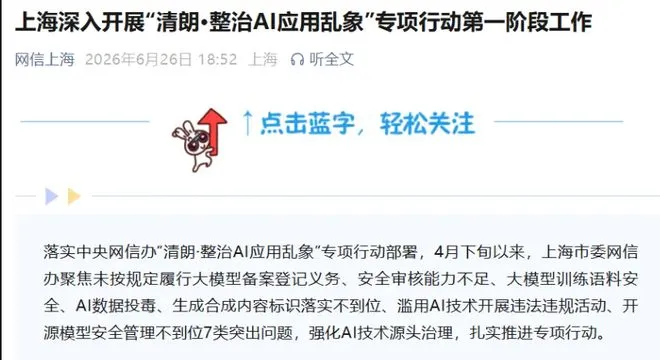
Currently, the Shanghai Municipal Cyberspace Administration has completed regulatory training for nearly a hundred key platforms, supervising enterprises to fulfill their compliance obligations.
Against this backdrop, Doubao and Qianwen actively aligned with the regulatory timeline, choosing to complete the discontinuation of features on the day the new regulations take effect, which is widely interpreted in the industry as a proactive response to mitigate compliance risks and fulfill platform responsibilities.
User transition arrangements and data processing timetable
Both platforms are providing a transitional window for existing users to save their data.
From Doubao's side, after the feature goes offline, users can still view and manually save intelligent agent information and historical conversation data for a period of time; after October 15th, Doubao will process the relevant data according to its privacy policy, at which time the data will not be viewable or recoverable.
Doubao advises users to back up their data in advance through screenshots or text exports, and to migrate their intelligent agent creation and conversation features to the Cat Box App.
Tongyi Qianwen similarly advises users to save important content through copying, screenshots, or exporting conversations before the offline date, as access to related intelligent agent configuration information and historical conversation records will not be possible afterward.
As leading platforms successively retract their C-end intelligent agent layouts, the competitive logic of the AI application market is undergoing fundamental changes.
Compliance capability and a sustainable business loop will replace user scale and feature richness, becoming the core dimension of platform competition in the next stage.
High consumption and low efficiency, commercial logic is also difficult to sustain
In addition to regulatory pressure, the difficulties of commercial monetization are also an inherent driver of this adjustment.
Analysis suggests that personalized idle chat and niche role-based intelligent agents usually generate scattered, high-frequency, lightweight dialogue calls, consuming high computing power while having low individual commercial value, representing a typical "high consumption, low efficiency" business model.
As AI applications transition from "land grabbing" to "value verification," such UGC intelligent agents may bring short-term traffic and user activity data but are difficult to convert into direct commercial revenue, and their economic rationality is being questioned.
Tongyi Qianwen's B-end transformation actions have already shown signs. On June 3rd, Qianwen officially announced the full opening of Agent and Skill access permissions to third-party enterprises and developers across the industry, with leading brands like Luckin Coffee, KFC, Mixue Ice City, and Eastern Airlines being the first to initiate service testing.
This strategic shift indicates that the platform is reallocating resources from low-value C-end UGC ecology to high-value B-end enterprise service scenarios.
免责声明:本文章仅代表作者个人观点,不代表本平台的立场和观点。本文章仅供信息分享,不构成对任何人的任何投资建议。用户与作者之间的任何争议,与本平台无关。如网页中刊载的文章或图片涉及侵权,请提供相关的权利证明和身份证明发送邮件到support@aicoin.com,本平台相关工作人员将会进行核查。


