

Every Monday, Wednesday, and Friday, focusing on the cryptocurrency market, Japan, South Korea, A-shares, and Hong Kong stocks, reviewing the market with data and seizing opportunities with trends, produced by PANews.
Bitcoin recovers to $61,000, first inflow after 10 days of BTC ETF outflows
The cryptocurrency market has rebounded overall, with Bitcoin quickly rising from a 21-month low of $57,800, surging over 5% on Thursday to touch $62,200. Weaker-than-expected U.S. June non-farm payroll data significantly reduced the Federal Reserve's rate hike probability, and the weakening dollar, combined with rotation of funds from AI technology stocks, provided breathing room for Bitcoin.
Options and order book data show a large concentration of sell orders in the $62,000-$65,000 range, while there is significant buying interest in the $55,000-$57,000 range. Well-known analyst PlanB warns that since the current price has dropped below the 200-week moving average (around $62,600) but remains above the realized price of $52,000, referencing historical cycles, the true bear market bottom may not have arrived yet.
Trader CrypNuevo believes that the previous continuous appearance of long lower shadows in the market and the failure to effectively break below $57,000 indicate that market makers are quietly establishing long positions, and as long as $61,000 holds, $65,000 will become the next target. Ted Pillows believes that if $65,000 is effectively broken through by spot demand, Bitcoin has the opportunity to rapidly rise 8%-10%; if it cannot break through, it may retest the $57,000 support.
Next, the market will focus on U.S. inflation data, the Fed's policy path, and changes in spot ETF fund flows. If $65,000 is effectively broken, the market is expected to open the door to $70,000; if it faces resistance again near $62,000, the $55,000 or even $52,000 area may be tested again.
Today's highlights:
EigenCloud (EIGEN) will unlock about 36.82 million tokens on July 1, worth approximately $8.7 million
Sui (SUI) will unlock about 13.72 million tokens on July 1, worth approximately $9.4 million
GoPlus Security (GPS) will unlock about 708 million tokens on July 1, worth approximately $6.3 million
Upbit 24-hour trading volume ranking: XRP, BTC, ETH, SLX, BIRB
Bitcoin spot ETF: +$222 million, turning to net inflow after 10 days of outflows
Ethereum spot ETF: +$29.08 million
HYPE spot ETF: +$2.2395 million
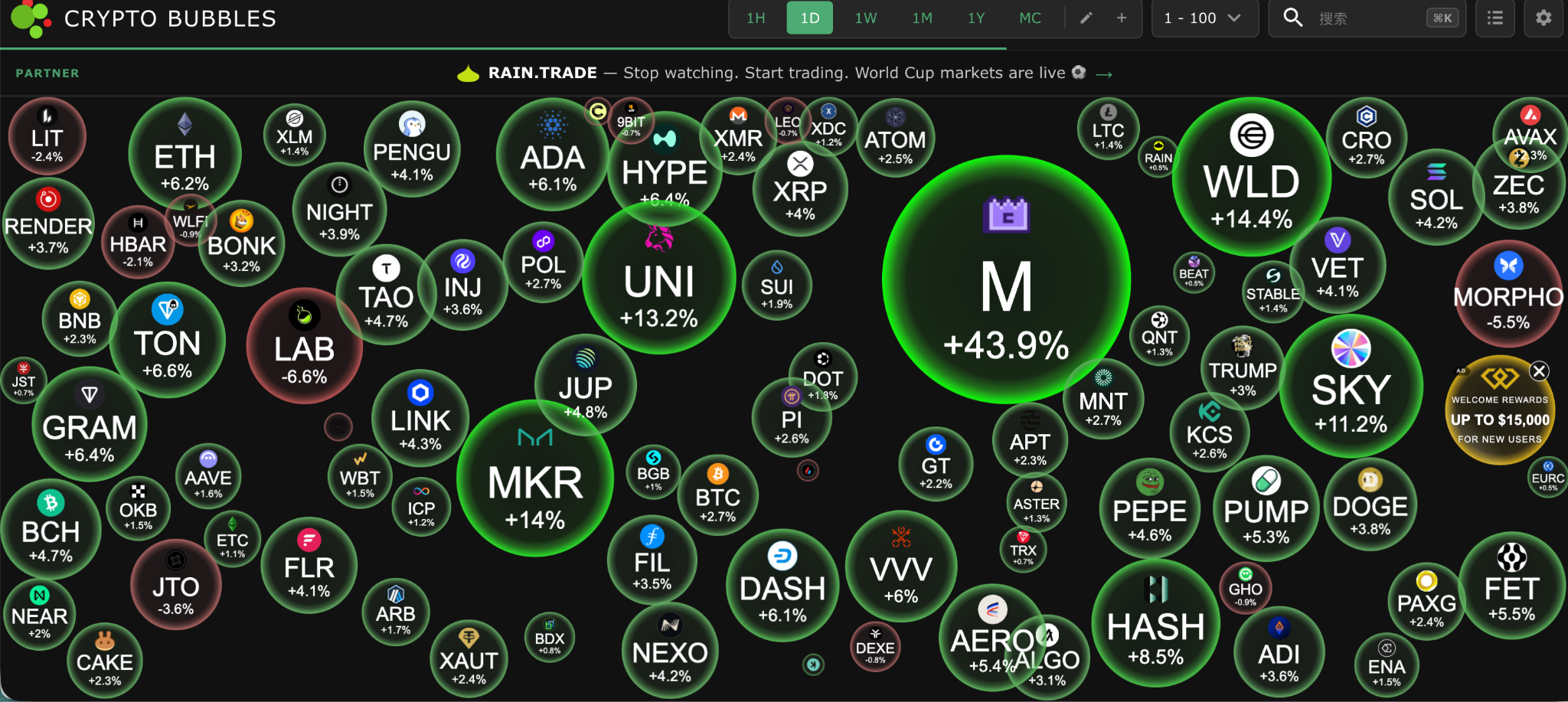
The largest gains among the top 100 market cap cryptocurrencies today: M up 43.9%, WLD up 14.4%, MKR up 14%, UNI up 13.2%, SKY up 11.2%.
Japanese stocks rebound sharply, yen strengthens
After two consecutive days of AI panic selling, the Japanese stock market finally welcomed a breathing opportunity, with the Nikkei 225 index rising 1.47%, breaking free from a weak fluctuation trend within the week.
The core reasons for the market rebound come from two aspects: first, weak U.S. employment data has lowered expectations for Fed rate hikes; second, Japan's June services PMI final value rose to 52.2, a significant improvement from 50 in May, indicating that domestic demand recovery is supporting the economy.
Previously hit hard by the plunge in U.S. semiconductor stocks, Japanese chip stocks fully rebounded, with memory chip giant Kioxia soaring more than 9%, and Rohm Semiconductor rising 14%. Nomura Securities strategist Maki Sawada stated that the market is currently experiencing a rotation from AI and semiconductors to consumer and cyclical stocks, and if semiconductor leaders narrow their downward trend, the Nikkei index is likely to stabilize again.
The dollar against the yen, after continuously breaking through new highs at 162.8, fell below the 161 mark today, dipping to a low of about 160.48. In the next two days, the Japanese market will closely monitor changes in global risk appetite after the U.S. Independence Day holiday, and whether the yen exchange rate will challenge the 160 mark again. The market is also paying attention to whether Bank of Japan's assessment of inflation persistence changes, which will determine the performance of financial and export stocks in the next phase.
Korean stocks crash and rebound, storage giants surge
The Korean market had a V-shaped reversal, with KOSPI initially dropping over 3%, then skyrocketing and triggering a circuit breaker, eventually closing up 5.76% at 8,088 points, marking the largest single-day gain in recent phases.
The catalyst for the market frenzy came from a market rumor: Anthropic is in talks with Samsung Electronics for customized AI chip collaboration, leading the market to rapidly reprice Samsung’s foundry and HBM business prospects.
Samsung Electronics surged nearly 9%, and SK Hynix rose nearly 11%, becoming the absolute core force driving the index's surge.
Another positive factor comes from expectations of rising storage prices, with South Korean media reporting that Samsung plans to increase the average selling price of DRAM by 20% in the third quarter, with sever DRAM and LPDDR increases possibly exceeding 20%. In the context of continuous expansion of AI infrastructure, the market generally expects the storage industry to maintain a high prosperity cycle until 2027.
Next, attention needs to be paid to:
The South Korean National Assembly plans to hold a meeting on July 6 to review the issue of single-stock leveraged ETFs for Samsung Electronics and SK Hynix. Related product scale has skyrocketed 431% over the past year, with regulators worried it amplifies market volatility and harms retail investors' interests.
South Korea will officially launch a 24-hour won trading mechanism on July 6, with trading hours extending from Monday morning to Saturday morning. After the won hit a 17-year low in the first half of the year, the South Korean Treasury is strengthening its all-weather monitoring capability to address potential exchange rate volatility risks.
A-shares and Hong Kong stocks: Robotics takes over AI as the new main line, commercial aerospace erupts simultaneously
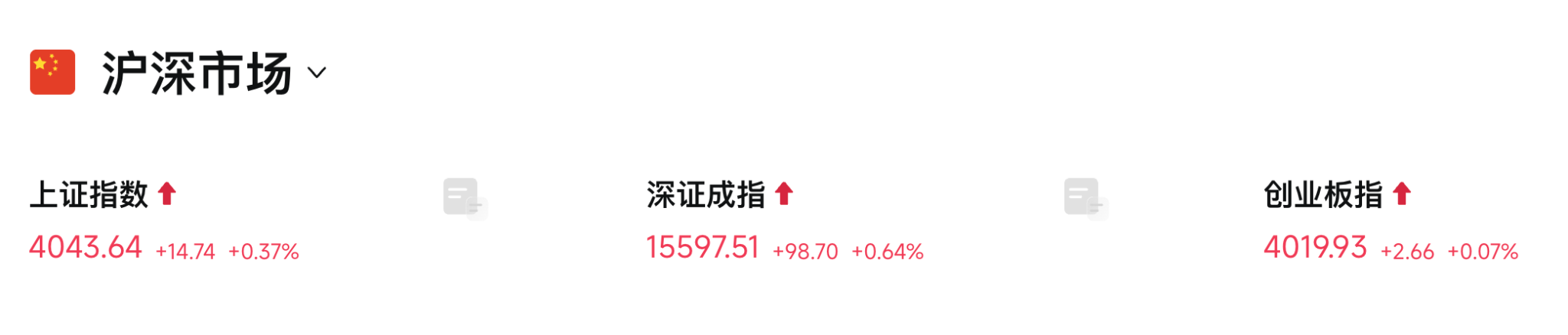
The A-share market welcomed a comprehensive corrective rally, with the Shanghai Composite Index rising 0.37%, the Shenzhen Component Index rising 0.64%, and the ChiNext Index rising 0.07%, with more than 3,500 stocks in the market rising, indicating a clear recovery of risk appetite.
Robotics becomes the strongest main line of the day: Yushu Technology obtained IPO registration approval for the Sci-Tech Innovation Board, just a step away from becoming the "first humanoid robot stock," fully igniting market sentiment. Kailong Technology hit the 20% limit up, while more than 30 stocks including New Rui Electronics, Wolong Electric Drive, Shenglong Co., Leisai Intelligent, Huaming Equipment, and Zhongchao Holdings hit limit up. Yushu Technology plans to raise 4.2 billion yuan for robotic models, body research and development, and manufacturing base construction, with its humanoid robots having reached a cumulative offline total of 11,000 units.
Commercial aerospace erupts simultaneously: Shuangfei Group hit the 20% limit up, while Jinfa Technology, Lushan New Materials, Daye Co., and Chengchang Technology all closed limit up. The successful launch of the Ocean No. 2 E satellite has become an important event catalyzing funds to chase the aerospace sector.
The semiconductor sector shows obvious differentiation: Expectations of price increases from Samsung and SK Hynix stimulated a strong upward move in storage, with Demingli hitting the limit up, and Beijing Junzheng and Puran shares rising more than 10%, with Jiangbolong and Baiwei Storage also following suit.
Hong Kong stocks also strengthened synchronously, with the Hang Seng Index rising 1.7%, the Hang Seng Technology Index rising 2.22%, and the Hang Seng Biotechnology Index soaring 3.56%.
The robotics concept remains strong: Aisdon surged 30%, UBTECH rose nearly 17%, and Horizon Robotics and Micron Robotics also moved higher.
The semiconductor sector has shown high-level differentiation: SMIC fell over 3%, Hua Hong Semiconductor fell over 5%, and Zhaoyi Innovation Hong Kong stocks fell over 5%, with the market beginning to worry that funds will again concentrate on leading stocks as AI trading heats up.
Institutions generally expect that in the second half of the year, robotics, commercial aerospace, computing power hardware, and precious metals will remain the most resilient four main lines in A-shares, while whether Hong Kong tech assets can attract overseas funds to flow back will determine whether the Hang Seng Technology Index can challenge new highs.
免责声明:本文章仅代表作者个人观点,不代表本平台的立场和观点。本文章仅供信息分享,不构成对任何人的任何投资建议。用户与作者之间的任何争议,与本平台无关。如网页中刊载的文章或图片涉及侵权,请提供相关的权利证明和身份证明发送邮件到support@aicoin.com,本平台相关工作人员将会进行核查。


