Author: Claude, Deep Tide TechFlow
Deep Tide Introduction: At the "The World is Flat" conference in London on July 1, Robinhood launched its self-built Ethereum Layer 2 network, Robinhood Chain, onto the mainnet, while also rolling out a full product line of tokenized stocks, Morpho-driven 7% stablecoin lending, Lighter perpetual futures, and AI agent trading, and announced its entry into Canada, securing a license in Singapore, and preparing for its crypto business in the UK. This brokerage is no longer satisfied with being a stock app for retail investors, but instead wants to integrate stocks, tokens, derivatives, prediction markets, and AI agents into a single entry point. On the day the news was released, HOOD rose by about 8.35% during trading, reporting around $108.65.
Robinhood held a press conference at the Old Royal Naval College in Greenwich, London, where CEO Vlad Tenev called it "the most grand global expansion and product vision to date." A complete stack from underlying public chains to upper applications was presented on stage:
its own chain, its own stablecoin, tokenized stocks, DeFi lending, AI trading, and multi-continent distribution.
According to reports from multiple media outlets including The Block, Forbes, and The Defiant, the core of this press conference was that Robinhood Chain officially transitioned from testnet to production environment. Surrounding this chain, Robinhood seamlessly connected its previously fragmented crypto activities into a closed loop.
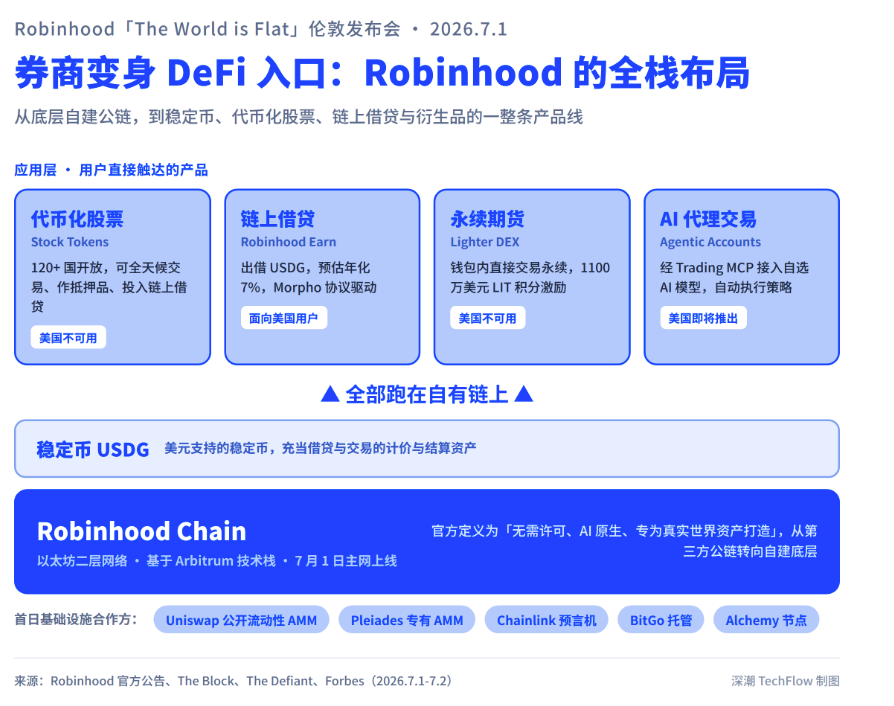
Robinhood Chain Mainnet Launch, Uniswap, Chainlink Entering on First Day
Robinhood Chain is an Ethereum Layer 2 network built on the Arbitrum technology stack, showcasing as a testnet at the Consensus conference in Hong Kong last February, and moving to the mainnet on July 1. Robinhood defines it as a "permissionless, AI-native chain built for real-world assets."
The line-up of initial partners is impressive. According to The Defiant, Uniswap has deployed a dedicated automated market maker (AMM) on the chain, serving as the main public liquidity venue; a company named Pleiades has deployed its own AMM as a proprietary market venue. Additionally, Alchemy provides node infrastructure, BitGo offers custodial services, and Chainlink provides oracle and data services.
The positioning of this chain is to bring Robinhood's previously third-party public chain dependent tokenized asset business under its own control. Tokenized stocks, on-chain lending, mortgages, integrated trading—all can run on a network that it controls. This step allows Robinhood to enter the expanding camp of "corporate self-built public chains," with Coinbase's Base and Stripe's Tempo as similar examples, as funding and attention shift from neutral, developer-led public chains towards networks backed by these enterprises.

Stock Tokens Launch in Over 120 Countries, Tokenized Stocks Can Be Traded and Used as Collateral 24/7
The press conference also launched the new generation of tokenized stock product, Stock Tokens, which is open through Robinhood Wallet in over 120 countries, with specific availability depending on local regulations.
According to FinanceFeeds, these tokenized stocks support round-the-clock trading and can be used as collateral or invested in decentralized lending platforms. Spot trading is conducted through multiple decentralized exchanges including Uniswap, Rialto, Lighter, 1inch, and Arcus developed by the dYdX team.
However, the product is still restricted in major markets.
Stock Tokens are not open to residents of the United States or American residents, and are similarly restricted in Canada, the UK, Switzerland, the UAE, and sanctioned markets. Robinhood's earlier generation of tokenized US stock products will launch in June 2025 for users in the EU and European Economic Area, covering over 200 stocks and ETF tokens, operating under Robinhood Europe within the MiFID II framework. In comparison, this move shifts the entire technology stack of tokenized stocks onto its self-built chain.
Robinhood Earn Integrates Morpho, Stablecoin Lending at 7% APY
Robinhood also rolled out Robinhood Earn to US users, officially deemed the first decentralized lending product directly available within the main Robinhood app.
According to Robinhood's official announcement, users can lend USD-supported stablecoin USDG through self-custody wallets, with an estimated annual yield of around 7%. The underlying lending infrastructure is driven by the Morpho protocol. According to DefiLlama data, Morpho currently has a total locked value of about $6.6 billion across multiple chains. The supporting parties of the product also include Steakhouse, Ethena, Spark, and Maple. To address losses from network attacks or smart contract vulnerabilities, Robinhood has procured insurance through Lloyd's of London and RELM.
In the current interest rate environment, a 7% yield on stablecoins is a significant figure, signaling Robinhood's intent: to directly compete with those DeFi protocols that have long offered similar returns, but with mainstream distribution and app infrastructure that the latter does not possess. It should be noted that on-chain lending is completed through users' own self-custody wallets, Morpho is an independent lending protocol, not affiliated with Robinhood, which neither holds users' crypto assets nor private keys—the yield carries the actual risk of principal loss.
Wallet Integrates Lighter Perpetual Futures, US Users Shut Out
The revamped Robinhood Wallet has added native integration with Lighter. Lighter is a decentralized derivatives exchange based on Ethereum, where qualified users in certain jurisdictions can trade perpetual futures directly within the wallet.
According to The Block, this product is not open to residents of restricted areas including the UK, the US, Canada, Switzerland, the UAE, and Singapore. This means Robinhood has opened this derivatives entry point to overseas users while shutting out its American base.
Behind this is a layer of investment relations. Lighter completed a $68 million financing last November, being valued at $1.5 billion, with investors including Robinhood Ventures. In this cooperation, Lighter has promised to invest $11 million worth of its native token LIT into the Robinhood community. According to Robinhood, qualifying users can earn double points by trading perpetuals through the Robinhood wallet and one point through Lighter's web interface, with points directly redeemable for LIT. Tenev himself publicly congratulated Lighter founder Vladimir Novakovski and his team on their mainnet launch. Perpetual trading carries leverage, with risks including total principal loss, a point that Robinhood emphasizes repeatedly in disclosed documents.
Establishing in Canada, Getting Licensed in Singapore, UK on the Way, Europe Expanding Perpetuals to Commodities and Forex
This press conference also serves as a declaration of multi-continent expansion.
According to FX News Group, Robinhood has officially commenced operations in Canada through the acquisition of WonderFi, announcing this on Canada Day; the subsidiary in Singapore has obtained a capital markets services license from the Monetary Authority of Singapore (MAS), paving the way for future brokerage services; Robinhood's crypto business in the UK is "coming soon," aiming to complement the existing stock, options, and futures product lines in Robinhood UK. Robinhood states that it currently serves nearly 28 million customers across 38 countries on three continents.
In Europe, perpetual futures have now broken into the realm of crypto assets. According to Robinhood's announcement, qualifying European users can now trade perpetual contracts linked to commodities, ETFs, and forex, including gold, silver, QQQ, EUR/USD, WTI and Brent crude oil, and EWY, with leverage of up to 10 times, rolled out in batches. After stretching its crypto perpetual offerings to 30 European countries last year, this has become one of Robinhood's fastest-growing products in Europe. The US market has also introduced maker order types, offering fees as low as 0% for professional and high-tier traders providing liquidity.
Robinhood also announced it would extend the AI agent trading capabilities for stocks and options launched last month in the US into the crypto space, soon releasing Agentic Accounts for crypto. Users can connect their chosen AI models to Robinhood's data sources and tools through Trading MCP, allowing the agent to continuously scan the market and execute strategies when the market shifts, but funding allocation and safety barriers are still controlled by the users themselves. During the press conference, Robinhood also set a Guinness World Record for "AI agents purchasing the most products in three minutes" using the Agentic Trading platform and AI consumer functionality.
The Other Side of Expansion: 10% Layoffs, Crypto Revenue Halved in Q1
However, behind this aggressive product narrative lies a not-so-pleasing recent financial backdrop.
According to The Block, this expansion comes just weeks after Robinhood announced layoffs of about 10%, with the company estimating a one-time charge of about $28 million for reorganization, citing a shift to a more streamlined and "high-performance" operational model. The crypto business itself has just experienced a weak first quarter: crypto revenue fell 47% year-on-year to $134 million, and trading volume in the native app dropped 48% to $24 billion.
The immediate response from the capital markets to this press conference is positive. According to TheStreet, on the day the news was released, HOOD rose by about 8.35% during trading, reporting around $108.65. Wall Street is also doubling down: Goldman Sachs keeps a buy rating and raises its target price to $121, while Deutsche Bank increases its target price from $105 to $113. Nevertheless, HOOD is still in a downturn this year, having previously fallen about 25% from its highs. For investors, the real question is whether Robinhood can turn crypto from a cyclical trading revenue line into a larger infrastructure and distribution business—a self-built chain gives it a foundation, wallet integration provides an entry for DeFi trading, and the rest remains to be validated by time.
免责声明:本文章仅代表作者个人观点,不代表本平台的立场和观点。本文章仅供信息分享,不构成对任何人的任何投资建议。用户与作者之间的任何争议,与本平台无关。如网页中刊载的文章或图片涉及侵权,请提供相关的权利证明和身份证明发送邮件到support@aicoin.com,本平台相关工作人员将会进行核查。


