Original Author: Shao Jiadian
This year, the business of AI Token going overseas has obviously heated up. It seems straightforward: domestic models have certain advantages in integration, engineering implementation, and cost control, while overseas developers and small to medium enterprises need affordable, stable, and easily accessible AI services. By setting up an API gateway to connect models like DeepSeek, Zhiyu, Tongyi, and charging based on usage, it looks like a light-asset business. However, because it appears simple, many projects initially focus only on three things: can the price be lowered, can the concurrency be sustained, and can the payment process be smooth. Yet, what truly determines whether this business can be sustained long-term is often not these three factors, but another three lines: where the model capability comes from, whether you have the right to resell it to overseas customers;
how the downstream clients' data flows, whether it can be proven that domestic data hasn't mixed in, or been misused;
which countries the services are sold to, and whether local regulators will pursue you according to AI, data, or consumer protection rules.
Token is merely a billing unit, not a compliance shield. The business is called "AI Token going overseas," but the risk doesn't lie in the word Token, but in the underlying supply chain, data flow, and target market.
Where the models come from: It's not enough to just get the Key and resell
Many teams' first reaction is: “The interface works, downstream customers are willing to pay, so why can't we sell?”
The problem lies here. A typical API Key usually only indicates that you can call it; it does not mean you can repackage, aggregate, white-label, distribute, and sell this capability to overseas customers. This is not just a contract small print issue, but a question of whether this business actually has a legitimate source.
There are roughly three situations for obtaining goods.
The first is to sign directly with the model vendor. This path is the clearest, but the contract needs to check hard points: can the API be resold, can it be white-labeled or repackaged, does the authorized region cover the target overseas countries, are there any restrictions on the downstream client's industry, can downstream customer data be used for training, and can the model name and capability promotion be used externally.
The second is to obtain goods through official distributors, authorized agents, cloud vendors' MaaS, or Token factories. MaaS can be simply understood as Model as a Service, where cloud vendors turn model capabilities into a purchasable and callable cloud service. This path may not necessarily have issues, but you cannot just take their word for it that “we are legitimate.” You need to check upper-level authorization documents, distribution rights, authorized regions, billings, and how to migrate downstream customers if the upstream supply is suddenly cut off.
The third is wholesale low-priced quotas. Low price itself is not a problem; bulk procurement, inference optimization, and cloud resource discounts may bring about low prices. But if the low prices come from account pools, educational discounts arbitrage, shared accounts, non-public interfaces, reverse calls, or even credit card fraud, then it's not a cost advantage but rather a way to bring someone else's risks into your business.
To determine whether the source of goods is reliable, one simple question can be asked:
For every call I sell, can I trace back to which upstream, which authorization, which invoice it comes from?
If the answer is negative, caution is advised. For example, if you sell 5 million Token calls externally each month, but the upstream procurement record only supports 1 million; or if a downstream customer asks “Is it officially authorized?” and the salesperson can only vaguely reply “There is no problem with the channel.” At this point, the risk has already moved beyond theory and is now a matter of future supply interruptions, account closures, claims, or even inquiries about the source of the interface.
In terms of execution, at least four things need to be done:
Authorization chain must be closed: From model vendors, cloud vendors, distributors to you, and then to overseas customers, each level must have written evidence;
Business scope must be closed: Calling, aggregating, reselling, white-labeling, overseas sales, and downstream customer industries must all be within the authorized scope;
Data responsibility must be closed: Who received the downstream customer's data, how long it is kept, whether it is used for training, and whether it is passed to third parties should be written into the DPA and sub-processor list;
Billing evidence must be closed: Upstream procurement contracts, invoices, and payment records must correspond to downstream orders, usage, and collections.
This isn't about making the “documents look good,” but about being able to clearly explain in the future if problems arise: I am selling AI capabilities that are sourced, authorized, and traceable, not just call quotas pieced together from various gray interfaces.
How the data flows: Foreign data can come back to the domestic side, but do not mix in domestic data
The AI Token going overseas often encounters a problem: overseas customers send prompts, files, voice, logs, received by domestic servers or domestic models for inference, and then the results are returned to the overseas customers, is this acceptable?
According to the regulations of the National Cyberspace Administration of China “Regulations on Promoting and Standardizing Cross-Border Data Flows” (Order No. 16), if personal information is collected and generated overseas, it can be processed domestically and then provided back to overseas, as long as no domestic personal information or important data is introduced during processing, the relevant data exit safety assessment, standard contracts, and certification processes can be exempted.
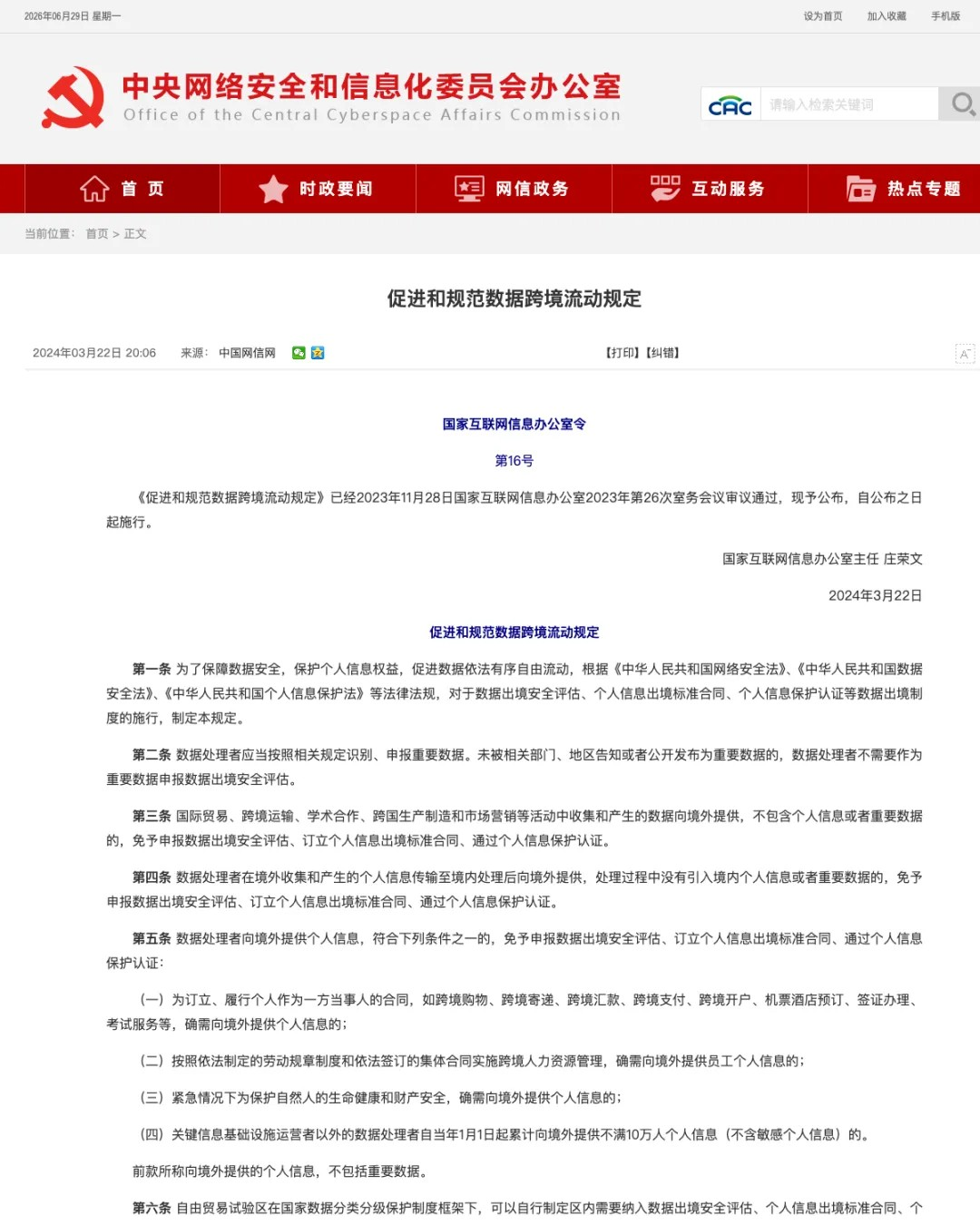
Image source: Official website of the Central Cyberspace Affairs Commission “Regulations on Promoting and Standardizing Cross-Border Data Flows”
In business language, this means:
The data from overseas customers can come in for processing and then go out; however, to apply this exemption, the premise is that no domestic personal information can mix into this workflow, nor can important data be introduced.
This door is indeed open, but it should not be understood as “as long as the customer is overseas, anything can be done.” Enterprises still have to bear data security, network security, and personal information protection responsibilities. What needs to be truly proven is: this chain is foreign to receive, domestic to calculate, and foreign to return, with a clear process and clean boundaries.
The five types of “mixing” that are most likely to cause problems are:
Mixing in domestic users: Initially, it’s overseas business, but domestic users can also register, call, and upload data;
Mixing in domestic business data: Analyzing domestic operational data, profile tags, and client lists together;
Mixing in storage resources: Domestic and foreign data share the same database, log system, and training sample pool without isolation;
Mixing in operational actions: Engineers import domestic data into the overseas workflow for debugging, or randomly copy overseas data to local;
Mixing in important data: Once important data are introduced, they cannot be processed under the ordinary exemption logic and need to return to stricter paths such as safety assessments.
The biggest fear is that the technical team thinks “legal will write a good clause,” and legal thinks “the technical team knows how to handle it,” ultimately no one has clarified the data flow.
It is suggested to create at least one internal data flow diagram to clarify these issues:
Where did the prompts, files, voices, and images input by the overseas customer go;
Did they pass through domestic servers, domestic models, or domestic operations staff;
Are input and output retained, how long, and who can see it;
Are logs desensitized, and can they be deleted;
Is the data used for training, fine-tuning, or quality assessment;
Which underlying models, cloud service providers, and log service providers can access the data.
If this diagram cannot be drawn, no matter how beautifully the privacy policy and DPA are written, it’s hard to reassure overseas business clients. What they truly care about is: Has my data been used for training? Has it been passed to third parties I don’t know about? If regulators or big clients ask, can you provide evidence, rather than just saying “we take privacy very seriously.”
Where services are sold: It’s not where the company is registered, but where it is ultimately used
Many overseas teams like to place their companies in Hong Kong, Singapore, BVI, or other offshore locations, thinking this will allow them to evade major market regulations.
This idea is very dangerous. The compliance of the target market does not look at the company's registration documents but where the downstream clients are, where the end-users are, what scenarios the services enter, and where the data flows to.
Why is the target market important? Because fines for overseas regulation are not symbolic.
In the EU, as long as personal data of EU users are processed, privacy compliance cannot be treated as a standard document. GDPR has different penalties for different violations, and serious violations involving basic processing principles, personal rights, and transfers to third countries can face fines up to €20 million or 4% of the previous year’s global turnover, whichever is higher.
The EU AI Act does not regulate the concept of “AI” but rather how AI is ultimately used. For certain explicitly prohibited AI application scenarios, the maximum fine can reach €35 million, or 7% of the previous year's global turnover, also taking the higher amount. In other words, going overseas with AI is not about “selling first and then figuring it out”; once this set of APIs is involved in high-risk or prohibited uses, the platform must at least prove it has boundaries, screening, and suspension mechanisms.
Although the U.S. does not have a unified AI law, there are various regulatory entry points for children’s privacy, finance, healthcare, employment, and consumer protection. For example, products aimed at children might trigger COPPA; entering credit, insurance, hiring, and healthcare Q&A may also attract industry regulation or consumer protection rules.
These rules may seem aimed at downstream products, so why should an API intermediary platform care? The reason is simple: the platform is not selling a static piece of code, but a continuously callable AI capability. If downstream clients incorporate this capability into apparently sensitive or illegal scenarios, and the platform has no mechanisms to prohibit uses, handle abnormal calls, or cooperate with investigations, it will be hard to say, “We are just a technical channel; how others use it has nothing to do with me.”
Of course, this doesn't mean the platform has to treat every caller as an audited party, nor does it mean a complex approval process should be set up at front-end registration. A more realistic approach is to first delineate the red line through service terms: clearly prohibit illegal, infringing, circumventing upstream restrictions, and abusing interfaces, while reserving the right to limit flow, suspend, terminate services, and cooperate in investigations. When business clients, sensitive industries, high-concurrency calls, or large customer due diligence arise, then escalate to usage clarifications, special clauses, log retention, and auditing cooperation.
Additionally, the platform’s external promotions should also be restrained. If no authorization has been obtained, do not write “official direct connection”; if underlying models may switch, do not let others mistakenly assume that a certain model is fixed; if model outputs may have hallucinations, do not promise “absolute accuracy”; if upstream interfaces have usage and scenario restrictions, do not promise “unlimited use.”
In summary, remember that going overseas does not mean leaving regulations behind but rather entering others' regulations.
Connect the three lines: Don’t just look at single points, but the entire business chain
Source, data, and target market are not three unrelated documents but one business chain.
Looking at an API gateway project, if its model source mixes account pools, shared quotas, or reverse interfaces, and the upstream cannot clarify, then there is a problem with the source; if the overseas customer’s prompts and files go back to the domestic side for inference, but the platform cannot clarify whether they are retained, trained, or transferred to third parties, then there is a problem with the data; if EU downstream customers integrate it into products aimed at EU users, and the platform has not prepared a DPA or sub-processor list under GDPR, nor has it imposed restrictions on high-risk AI usages, then the target market also has problems.
At this point, the project cannot just ask three things:
Can the price be lowered further;
Can concurrency be increased further;
Can the payment process be faster.
They also need to ask three other questions:
What does the contract actually allow me to sell regarding the model capabilities;
Which systems has the downstream customer data passed through, and can evidence be produced if issues arise;
In which countries and industries are downstream customers using, and have I set red lines and an upgrade review mechanism.
If these three questions can be answered clearly, then Token is just a measurement unit for AI services; if not, Token becomes just a name that packages the supply chain, data, and risks of overseas regulation.
Doing compliance solidly will make the business last longer
The opportunity for AI Token going overseas is real. Chinese teams have certain advantages in model integration, engineering implementation, and cost control, and overseas customers do indeed require cheaper, more stable, and better accessible AI services.
However, in the most promising sectors, one cannot rely on gray channels to rush time.
Unclear sources will eventually face supply cuts, account closures, and customer claims; unclear data will frighten away major clients and regulators will also not trust; unclear target markets may mean today’s growth could turn into complaints, delistings, investigations, and financing due diligence hurdles tomorrow.
Compliance does not mean writing risks into exemption clauses, but rather making the business chain into a system that can be explained, audited, and delivered to clients.
What Token really aims to sell overseas is not just cheaper calling quotas, but a supply chain of AI capabilities that can withstand scrutiny.
免责声明:本文章仅代表作者个人观点,不代表本平台的立场和观点。本文章仅供信息分享,不构成对任何人的任何投资建议。用户与作者之间的任何争议,与本平台无关。如网页中刊载的文章或图片涉及侵权,请提供相关的权利证明和身份证明发送邮件到support@aicoin.com,本平台相关工作人员将会进行核查。


