Author: 137Labs
Chapter One: Grayscale Re-examines Solana, What Signals Has It Released?
In recent years, whenever the market mentions Solana, the first two keywords that often come to mind are high performance and Meme.
As a representative project in the last round of public chain competition, Solana quickly rose due to advantages such as high throughput, low transaction fees, and fast confirmations. It also became one of the most active ecosystems during the last Meme craze due to phenomenal applications like BONK, dogwifhat (WIF), and Pump.fun. However, this label also somewhat obscures the deeper changes within the Solana ecosystem.
Recently, global digital asset management institution Grayscale released a new research report titled "Solana: Crypto's Financial Bazaar," which re-assesses Solana's value logic. The most noteworthy aspect of this report is not the renewed emphasis on Solana's technical performance, but rather a new judgment: Solana is evolving from a high-performance public chain to an application platform that supports large-scale economic activities.
Grayscale did not even define Solana as the "fastest blockchain," but instead used the somewhat symbolic concept of Crypto's Financial Bazaar.
"Bazaar" is not a traditional financial market but more like a digitally operating city: developers continuously build applications, users keep trading, paying, lending, and investing, with funds, information, and value flowing freely across the network, ultimately forming a continuously growing economic activity.
This statement signifies a fundamental change in Grayscale's focus on Solana.
If, in the last bull market, institutions debated whether Solana's TPS could surpass other public chains; today, institutions are more concerned about whether Solana can continually attract developers, retain users, and form genuine network effects.
This is not only a revaluation of Solana's value but also a shift in the entire valuation logic of the public chain sector.
Chapter Two: Public Chain Competition Enters the Second Half: The Competition is No Longer About TPS, But Economic Activity
Reflecting on the development of Layer1 public chains over the past few years, it is evident that the competitive logic has undergone significant changes.
In 2021, the market was primarily concerned with performance.
Ethereum emphasized security and decentralization, Solana relied on high throughput for rapid ascension, and the BNB Chain attracted a large number of users with low costs. Subsequently, new public chains like Aptos, Sui, and Base entered the market, and TPS, Gas Fee, and block production speed became the core metrics for assessing a public chain's competitiveness.
However, as the infrastructure gradually matures, these technical indicators began to homogenize.
More and more public chains can achieve second-level confirmations and extremely low transaction costs, making it increasingly difficult to form long-term competitive barriers solely based on performance.
Grayscale pointed out in its report that what truly determines the long-term value of a public chain today is no longer performance, but the real economic activities occurring on the chain. In other words, the evaluation criteria have shifted from "infrastructure capability" to "business operational capability."
Institutional investors' concerns have also shifted from "how many transactions can be processed per second" to:
• How many real users are there daily?
• How many real transactions take place?
• How much real income is generated?
• Can it form a continuously growing application ecosystem?
This line of thought is actually highly similar to the development path of the internet.
In the early days of the internet, the capital markets competed over server performance, bandwidth, and access speed; but once it entered a mature stage, what mattered more was how many users the platform had, how many merchants it engaged, how many transactions occurred, and how much cash flow it generated.
The same goes for the development of public chains.
TPS determines the theoretical upper limit of a chain, while the true determinant of its value is how much economic activity occurs on that chain each day.
From this perspective, Solana's advantages are beginning to change.
According to Grayscale's statistics, Solana now has over 1,000 decentralized applications (dApps), with a daily transaction volume exceeding 100 million and approximately 4.3 million daily active unique users, with on-chain applications continuously contributing to revenue and transaction volume.
These data indicate that Solana's competitive advantage is gradually shifting from "leading in performance" to "applications thriving."
For institutions, a network capable of continuously generating revenue and continually attracting developers and users is clearly more attractive for its long-term value than merely having high TPS.
Therefore, Grayscale did not continue to discuss underlying protocols but instead focused the entire report on the application layer.
Chapter Three: Three Representative Applications Outline Solana's New Growth Flywheel
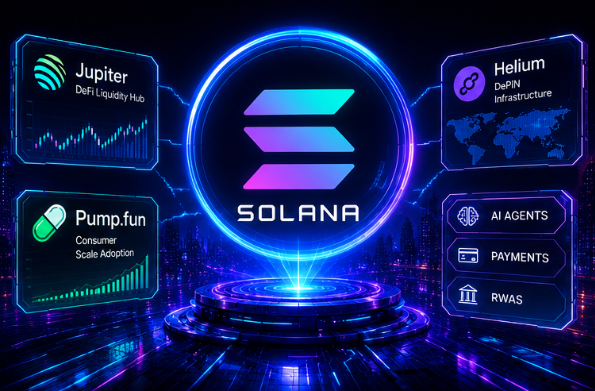
Instead of simply listing star projects, Grayscale chose three representative applications as case studies: Jupiter, Pump.fun, and Helium (extending to discuss DePIN). These three projects correspond to DeFi, consumer-grade applications, and real-world infrastructure in three different sectors, seemingly unconnected, yet together depict the most important growth path for Solana today.
Jupiter: The Core Entry to Financial Liquidity
Many users first encountered Jupiter because it is a DEX aggregator.
However, Grayscale sees Jupiter's real value in that it has become the liquidity hub for the entire Solana DeFi ecosystem.
In traditional financial markets, exchanges, market makers, brokers, and clearing institutions collectively construct a network of capital flows; while in the on-chain world, DEX aggregators serve a similar role, connecting different liquidity pools to seek the best pricing for users and thereby enhancing the market's capital utilization efficiency.
As more DeFi protocols deploy on Solana, Jupiter is no longer merely a trading tool but an important financial infrastructure of the entire ecosystem.
More notably, Jupiter's business boundaries are continually expanding. From aggregating trades to perpetual contracts, Launchpad, cross-chain exchanges, and more, its positioning is increasingly approaching a comprehensive financial platform on-chain, rather than just a DEX product.
This implies that Solana is now capable of supporting complex financial activities, and the maturity of financial infrastructure will further enhance the network effects of the entire ecosystem.
Pump.fun: The Value of Consumer-Level Applications Goes Beyond Meme
Compared to Jupiter, Pump.fun is clearly more controversial.
Over the past year, it has almost become synonymous with the Solana Meme ecosystem and has been viewed by many as a microcosm of the speculative market.
However, Grayscale has not overlooked its Meme attributes and instead considers it a representative application of the ecosystem.
The reason is that Pump.fun has verified something many blockchain projects have failed to achieve—sustained attraction of ordinary users and the establishment of a real business model.
According to data disclosed by Grayscale, Pump.fun boasts about 2 million monthly active users and can generate approximately $1.2 million in revenue daily, making it one of the highest revenue-generating applications on the chain.
For institutions, this data is far more significant than the "Meme" label.
The development experience of internet platforms shows that a product's true value lies in its ability to continually attract users, form network effects, and establish stable revenue sources. From this perspective, Pump.fun is more like an experiment in consumer internet; it proves that Solana can not only support financial applications but also nurture consumer-grade products targeting the general public.
Of course, this does not mean that Meme will become Solana's long-term mainstay.
The broader significance of Pump.fun is that it has helped Solana achieve a rigorous market validation: when millions of users trade, issue, and circulate assets within a short time, the network can still maintain stable operations, providing real-world samples for future high-frequency applications.
Helium and DePIN: A New Growth Pole Connecting the Real World
The third direction that Grayscale focuses on is DePIN (Decentralized Physical Infrastructure).
Compared to DeFi or Meme, the core of DePIN is not on-chain transactions but using blockchain to coordinate real-world resources, including wireless communication, positioning services, computing power networks, sensors, and other infrastructures.
Helium is one of the most representative projects in this sector, constructing a distributed communication network through community-deployed wireless hotspots and gradually collaborating with traditional operators; at the same time, projects like Geodnet focus on high-precision positioning services, providing foundational capabilities for emerging industries such as autonomous driving, drones, and robotics.
Although these projects do not have the massive market hype of Meme, they represent another growth curve that Solana is laying out—extending blockchain from the world of digital assets to the real economy.
In Grayscale's view, the significance of these projects lies in their capacity to continually broaden Solana's application boundaries, progressively expanding from financial networks to real-world infrastructure, laying the foundation for future AI, IoT, and more tangible economic scenarios.
From Jupiter to Pump.fun to Helium, Grayscale is essentially outlining a clear development path: financial liquidity brings capital, consumer-level applications attract users, and real-world infrastructure offers long-term growth space. When all three come together, Solana's value sources will shift from a single performance advantage to a more sustainable network economy.
Chapter Four: From Meme to AI: Solana is Narrating a New Growth Story
If Grayscale's report answers the question, "What is Solana today?" then the signals released by the Solana Foundation in recent months answer another question: Where is Solana preparing to go next?
By observing the ecosystem monthly reports, developer activities, and public speeches released by the Solana Foundation in recent months, it becomes evident that the focus of official external communication has undergone noticeable changes.
In the past, discussions surrounding Solana primarily centered on high performance, public chain expansion, NFTs, and Meme; whereas now, officials repeatedly mention directions like AI Agents, stablecoins, payments, real-world assets (RWA), asset tokenization, and Decentralized Physical Infrastructure (DePIN).
This change is not merely a simple marketing strategy but rather a repositioning of Solana's future growth direction.
In recent years, as regulatory clarity around digital assets in the U.S. has gradually improved, stablecoins and RWA have become key focuses for traditional financial institutions. For Solana, to enter wider institutional markets, relying solely on high TPS is no longer sufficient to establish a long-term competitive advantage; it must instead become an infrastructure that can support real business activities.
In several industry conferences this year, Solana Foundation President Lily Liu presented an important viewpoint: one of the greatest opportunities for blockchain in the future lies not only in serving human users but in serving the value exchange between AI Agents.
As AI Agents become capable of independently calling APIs, leasing computing power, purchasing data, and completing payments, transactions between machines (Machine-to-Machine) will rapidly increase. Traditional payment networks are not suitable for handling large volumes of high-frequency, small-value, real-time settlements, whereas blockchain naturally possesses this capability.
Therefore, Solana hopes to take on not just the role of a public chain but also that of the payment infrastructure for the AI economic era.
Payments are similarly a key direction that Solana is currently focusing on.
In the past few years, public chains primarily competed over DeFi TVL; now, Solana aims to enter a larger market—global digital payments.
More and more stablecoin projects, payment service providers, and fintech companies are beginning to pay attention to Solana's settlement capabilities, as its high throughput, low cost, and fast confirmation characteristics give it a natural advantage in payment scenarios. Meanwhile, the development of real-world assets (RWA) has also brought new growth opportunities for Solana.
From official information released, Solana seems to be attempting to construct a complete development path: attracting enterprises through payments, retaining capital through stablecoins, connecting traditional finance through RWA, and leveraging AI and DePIN to open up new application scenarios for the future.
Compared to the previous cycle's reliance on traffic driven by Meme and NFTs, this round of Solana is more focused on establishing long-term, sustainable growth models.
Chapter Five: Why Are Institutions Re-focusing on Solana?
Grayscale is not the only institution re-examining Solana.
Over the past year, several overseas institutions, including asset management firms, investment banks, and research organizations, have begun re-evaluating Solana's development potential in payments, asset tokenization, and application ecosystems.
This change is attributed to three important reasons.
First, the commercial models at the application level are gradually maturing.
Whether it’s Jupiter's advantage in DeFi liquidity, Pump.fun's demonstrated user growth capability, or Helium and other DePIN projects connecting the real world, these all indicate that Solana no longer relies on a single hot spot but has formed a more diverse application ecosystem.
For institutions, sustained trading volume, fee income, and developer activity are more reflective of a public chain's long-term value than short-term price fluctuations.
Second, stablecoin and payment ecosystems are continuously improving.
Stablecoins have become a crucial bridge connecting traditional finance and digital asset markets, and payments represent an important application scenario for the ongoing expansion of stablecoin scale. As more enterprises explore on-chain payments, cross-border settlements, and digital asset issuance, Solana's advantages in high-frequency trading and low-cost settlements are receiving increasing attention.
Third, the developer ecosystem remains active.
Any public chain ultimately requires developers to continue building applications to create genuine network effects. In the past few years, Solana has experienced market cycle fluctuations, but the developer community has maintained a high level of activity, with new projects continually joining the ecosystem from infrastructure, wallets, and DeFi to AI and DePIN.
Of course, this does not mean that Solana is without challenges.
First, value capture remains a persistent issue across the entire Layer1 sector. How much of the substantial income generated at the application layer ultimately feedbacks into SOL itself needs to be consistently validated through mechanisms such as network fees, staking demand, and ecosystem prosperity.
Second, the sustainability of the ecosystem still needs observation. Over the past few years, Solana has experienced multiple hot cycles with NFTs, Memes, etc., but what will truly determine its long-term value going forward is whether new businesses like payments, RWA, and AI can generate stable demand independent of relying on a single hot sector.
Additionally, public chains like Ethereum, BNB Chain, Base, and Sui are continuously refining their positions.
Ethereum still boasts the most mature developer ecosystem and institutional recognition; Base is rapidly developing in the consumer application domain, leveraging Coinbase's channel advantages; BNB Chain still holds widespread influence in the global retail user market; and emerging public chains continue to explore high performance and new development frameworks.
Future competition among public chains will likely not yield just one winner but will see different networks serving different types of users and application scenarios based on their own advantages.
Chapter Six: Conclusion
From Grayscale's current report, it is clear that a noticeable change is occurring: when the market discusses Solana, there are fewer and fewer mentions of TPS, and more discussions of applications, revenue, payments, RWAs, and institutional adoption.
For a public chain, this indicates that competition has entered a new stage.
In the future, what determines the long-term value of SOL will no longer be just how fast the network can run, but whether this chain can consistently attract developers, retain real users, and nurture more applications like Jupiter, Pump.fun, and Helium that possess network effects and commercial value.
If in the last bull market Solana relied on performance advantages; then in this round, it truly hopes to prove that it can become the most prosperous "financial bazaar" in the crypto world.
免责声明:本文章仅代表作者个人观点,不代表本平台的立场和观点。本文章仅供信息分享,不构成对任何人的任何投资建议。用户与作者之间的任何争议,与本平台无关。如网页中刊载的文章或图片涉及侵权,请提供相关的权利证明和身份证明发送邮件到support@aicoin.com,本平台相关工作人员将会进行核查。


