Author: Claude, Deep Tide TechFlow
Deep Tide Introduction: Bitcoin ETFs are experiencing the worst bloodletting since their inception. CryptoQuant data shows that over 100,000 BTC have exited ETFs within 2026, totaling more than 160,000 since the peak in October last year, marking the deepest retracement since the ETF's creation. The net outflow in June alone reached about 4 billion dollars, setting a record since its launch, with BlackRock's IBIT accounting for nearly 80%. The narrative of "institutional stable buying" has failed to hold up for two consecutive years. BTC has fallen below 60,000 dollars, with a yearly low of 58,190 dollars.
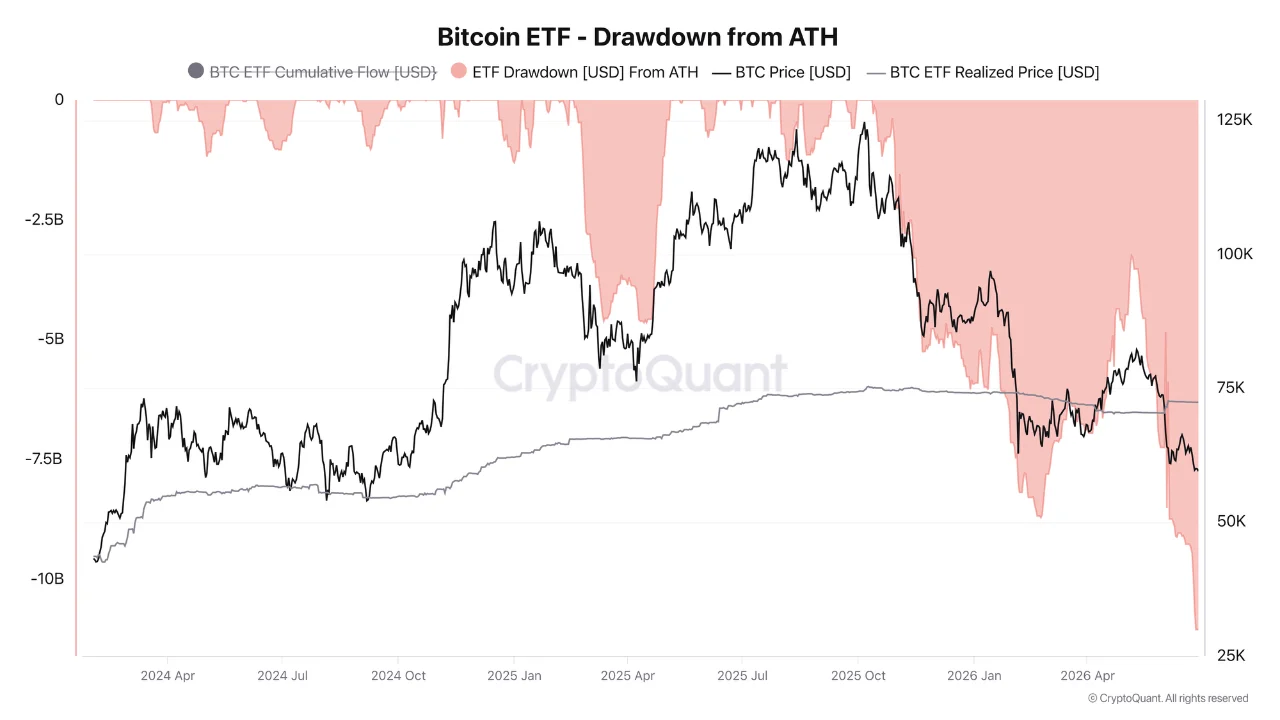
Spot Bitcoin ETFs were once seen as a stable entry for institutional funds, but now this entry is being reversed.
According to on-chain analysis platform CryptoQuant, analyst Darkfost mentioned on June 30th on the X platform that more than 100,000 Bitcoins have been withdrawn from ETF issuers in 2026, marking the first occurrence since the ETF came into existence. If calculated from the historical high of ETF holdings in October 2025, the cumulative outflow has exceeded 160,000 BTC. Darkfost called this the deepest retracement of Bitcoin ETFs to date, with the value lost in holdings connected to it exceeding 11 billion dollars.
His judgment is: "The bear market does not spare anyone, not even large players like ETFs and BlackRock." In a follow-up comment, he added that the market originally expected ETFs to be a source of "continuous buying," but they "have failed to hold for two years."
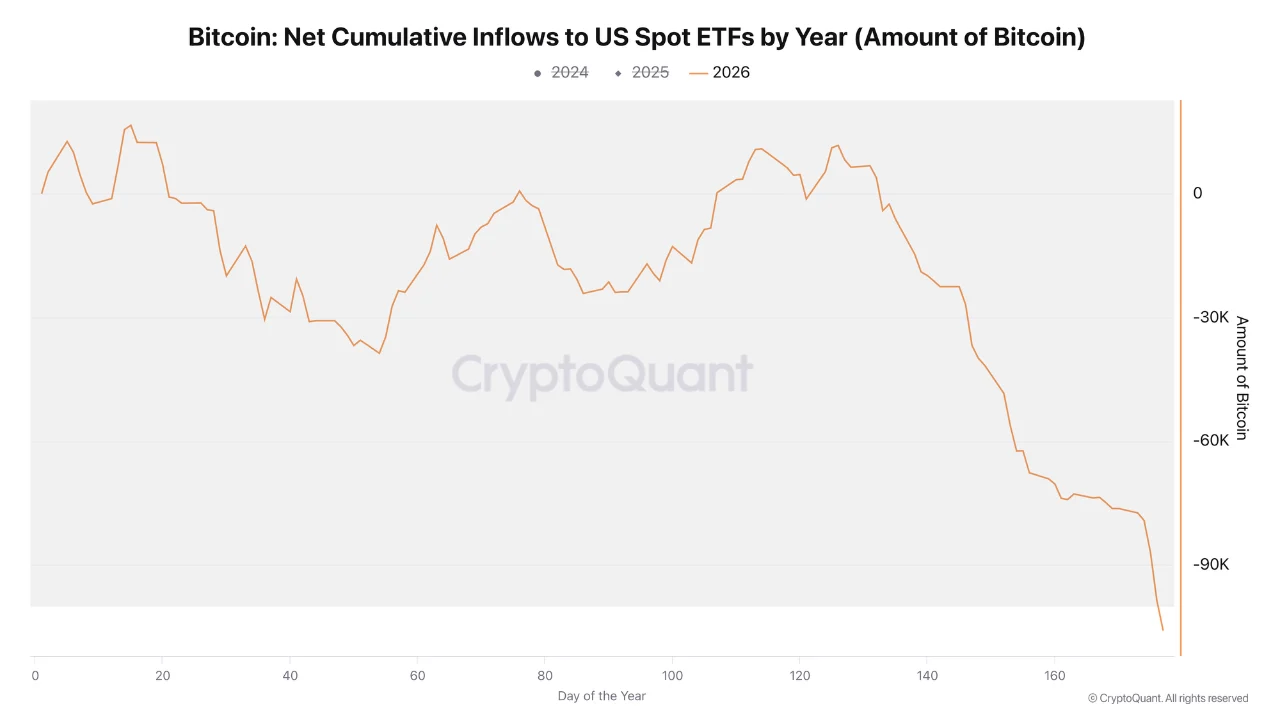
Net outflow exceeds 100,000 BTC, setting a record since ETF launch
The number 100,000 is striking because it is the first time since the ETF's existence of nearly two and a half years.
The spot Bitcoin ETF was listed in the U.S. in January 2024. In the first two years (2024, 2025), despite monthly fluctuations, the cumulative net inflow remained positive. The turning point occurred in 2026—according to CryptoQuant charts, the cumulative capital flow throughout the year has shown almost uninterrupted decline, ultimately falling below the net outflow threshold of 100,000 BTC.
Outside of the outflow scale measured in BTC, the dollar-based data is equally alarming. According to SoSoValue data, the U.S. spot Bitcoin ETF recorded approximately 4.06 billion dollars in net outflow in June, the worst monthly performance since its listing in January 2024, surpassing the previous record of 3.56 billion dollars set in February 2025. When including the net redemptions from May, the two months combined saw an outflow of around 6.5 billion dollars.
The bloodletting is comprehensive. June saw a series of 7 days of net redemptions, with a single-day peak reaching 696.3 million dollars. By the end of June, the total management scale of all U.S. spot Bitcoin ETFs had dropped from a yearly high of about 104 billion dollars to approximately 72.8 billion dollars—this decrease came from both the outflow of capital itself and the decline in the price of the remaining Bitcoin holdings.
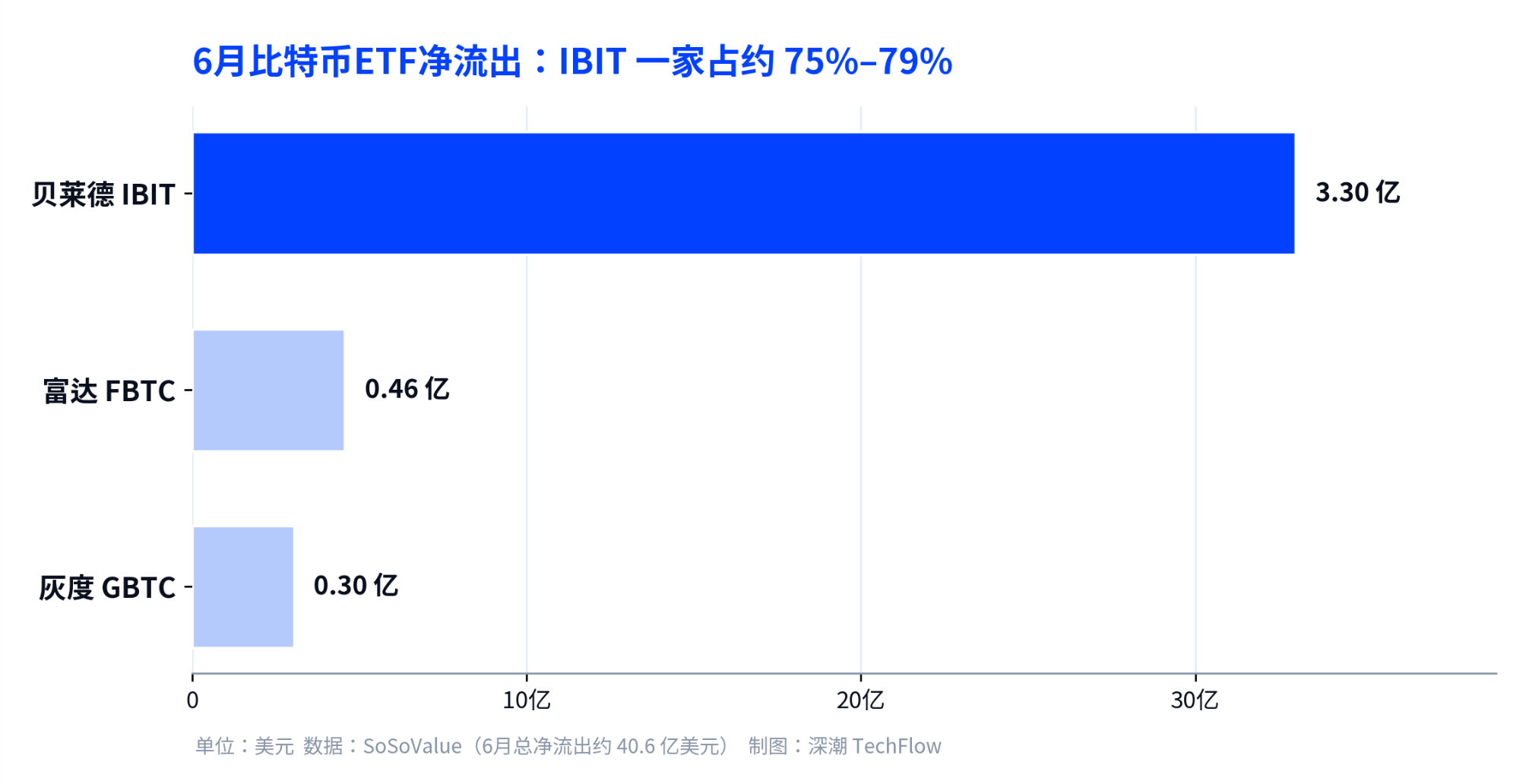
BlackRock's IBIT accounts for nearly 80%, even the "safety card" is being sold
If there is a protagonist in this round of outflow, it is BlackRock's IBIT.
As the largest spot Bitcoin ETF, IBIT has always been a barometer of institutional demand. According to SoSoValue data, IBIT contributed about 3.3 billion dollars in redemptions in June, accounting for approximately 75% to 79% of the total outflows for the month (different sources have slightly varying statistics). In the second quarter alone, IBIT lost about 2.01 billion dollars. During the same period, Fidelity's FBTC saw an outflow of about 456 million dollars, while Grayscale's GBTC had an outflow of about 303 million dollars.
The scale of IBIT makes its redemptions particularly eye-catching. When IBIT is attracting funds, its size reinforces the narrative of institutional demand; when it is bleeding out, the same scale makes the entire market unable to ignore it. According to data cited by KuCoin, IBIT once experienced a net outflow of about 860 million dollars within a week, and as of June 26th, the fund had a net asset value of approximately 44.87 billion dollars.
It is worth comparing with history. In the round of selling in February 2025, the ETF saw a continuous net outflow for 8 days, which was a record at the time. In this round, the consecutive redemption days from mid-June to the end of the month more than doubled. Analysts generally interpret this "selling as it falls" as a signal that ETF holders' price sensitivity near Bitcoin's support levels is increasing.
Behind the sell-off: interest rates, risk appetite, and Strategy's cash pressure
The outflow of ETFs is not an isolated event; it is embedded in a macro environment that is "deeply unfavorable" for Bitcoin.
According to CryptoQuant, as selling pressure increased, U.S. macro data weakened expectations for easing: the PCE price index rose 4.1% year-on-year, above the expected 4.0%; core PCE inflation was 3.4%, also exceeding expectations. GDP growth of 2.1% was also better than estimated. High-interest rates and rising U.S. Treasury yields directly suppressed the willingness to allocate risk assets, including Bitcoin ETFs.
There are multiple signals indicating a slowdown in institutional demand. Darkfost previously pointed out that the Coinbase premium index has been negative for 40 consecutive days since May 15th—this indicator compares the Bitcoin price gap between Coinbase Advanced and Binance, where Coinbase continues to trade at a discount, often indicating that professional investors are under heavier selling pressure than retail investors.
Selling pressure has also spread to "coin-hoarding companies." According to Bitwise estimates, Strategy (formerly MicroStrategy) has cumulatively bought 174,300 BTC in 2026, with about 96,000 BTC (55%) financed through STRC preferred stock, and another 77,500 BTC supported by MSTR common stock issuance. Meanwhile, according to CryptoQuant, STRC dropped to 82.5 dollars last week, creating a record discount of 17.5% compared to its 100 dollars face value, sliding further to about 73 dollars before Friday's market open. Strategy's cash reserves have shrunk by 38% since the beginning of 2026. The funding chain of the coin-hoarding machine is being repriced by the market.
A reverse signal: ETF holdings priced in BTC are still close to peak levels
The numbers are frightening, but there is a detail worth balancing on the other end of the scale for readers.
According to CryptoBriefing reports, despite the record outflow in dollar terms, ETF holdings priced in BTC are still close to historical peak levels.
In other words, a considerable part of the "shrinkage" comes from the drop in coin prices, rather than holders really liquidating their positions. Meanwhile, corporate treasury buyers continued to buy during the decline in June, and this compensatory demand is not reflected in ETF flow data.
For ordinary investors, this round of data does not provide a "bottoming" signal. Public analysis gives an actionable observation point:
If IBIT's outflow slows, and Bitcoin stabilizes in the high range of 50,000 dollars, returning to the range of 59,000 to 62,000 dollars, this week's sell-off could be seen as a potential starting point for a "surrender-style" liquidation or a flow reset. Conversely, if it falls below the support range of 58,000 to 59,300 dollars, the next target may point to 57,000 dollars, and further down to about 54,000 dollars, which would represent a two-year low.
The realized price slightly above 53,000 dollars is another critical observation point during deep declines.
免责声明:本文章仅代表作者个人观点,不代表本平台的立场和观点。本文章仅供信息分享,不构成对任何人的任何投资建议。用户与作者之间的任何争议,与本平台无关。如网页中刊载的文章或图片涉及侵权,请提供相关的权利证明和身份证明发送邮件到support@aicoin.com,本平台相关工作人员将会进行核查。


