Author: David, Trend Research
Electronic-grade hydrofluoric acid has recently become a bit sought after.
On July 1, Taiwan's "Economic Daily" reported that TSMC, Samsung, and SK Hynix are all scrambling to purchase this material, and suppliers have raised prices by 20% to 30%.
In simple terms, when manufacturing chips, a layer of silicon oxide film forms on the surface of the wafer, and it must be precisely dissolved with chemicals to proceed further. Electronic-grade hydrofluoric acid does this:
It dissolves silicon oxide without damaging the circuits underneath and is one of the most consumed chemicals in the wafer cleaning and etching stages, known in the industry as the "chemical key."
The production of hydrofluoric acid requires fluorite and sulfuric acid. Disruptions in shipping through the Strait of Hormuz have pushed up sulfur prices, followed by increases in sulfuric acid, raising production costs; South Korean local suppliers have been forced to start buying raw materials in bulk from mainland China at a premium of about 40% over the beginning of the year.
Following this logic, the fluorochemical sector of A-shares began to rally in mid-May and has seen significant gains since, with a group of related stocks trading near their 52-week highs.
Out of stock, price increases, domestic substitutions... these stories are mostly known and recognized in the market.
At this position, we should clarify which companies have genuine performance backing this wave of broad increases and which are simply being pushed by sentiment.
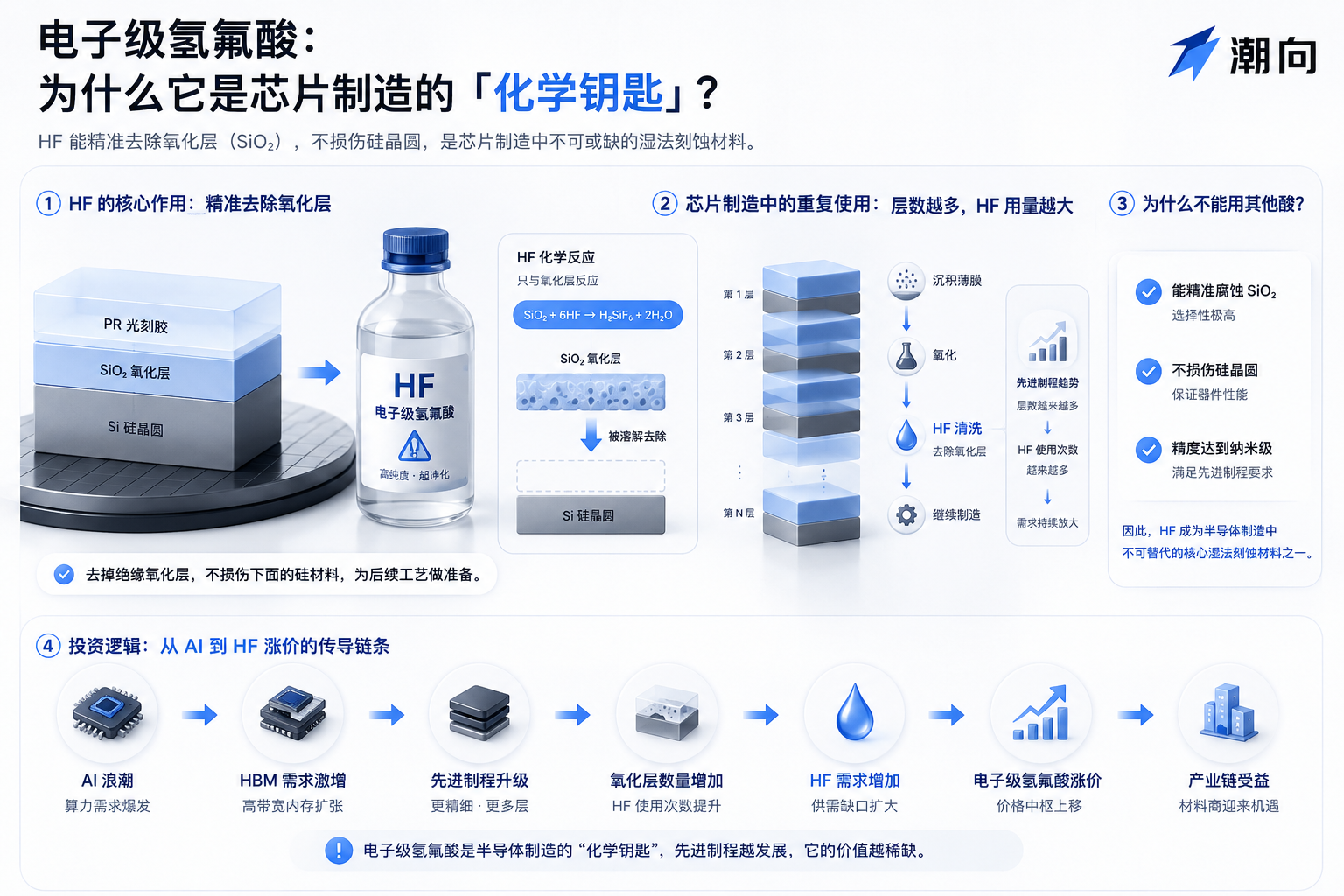
From Fluorite to G5, A Detailed Breakdown of the Industry Chain
The raw material chain for electronic-grade hydrofluoric acid is very short: fluorite (calcium fluoride) and sulfuric acid react at high temperatures to produce anhydrous hydrofluoric acid (AHF), which is then repeatedly purified to obtain electronic-grade products of different purity levels.
The purity levels are divided into five grades from G1 to G5 according to SEMI international standards, with G5 being the highest grade, required to meet advanced processes of 14nm and below, which are being used by TSMC, Samsung, and SMIC, as well as high-bandwidth memory (HBM) products that require extremely high cleaning purity.
In this chain, the distribution of money is extremely uneven.
- Upstream, fluorite and anhydrous hydrofluoric acid are bulk commodities with large quantities but thin margins, with prices following sulfuric acid and non-ferrous metal cycles;
- Midstream, regular electronic-grade hydrofluoric acid (G1 to G4) has many competitors, transparent prices, and average profits.
- Real profits are concentrated in G5: According to industry data cited by Dongfang Wealth, the spot price of G5 products ranges from 180,000 to 200,000 yuan/ton, with leading companies having gross margins of 50% to 60%. The global high-end G5 supply gap is nearly 70%, with a continuous shortage in spot supply.
The reason G5 can earn so much is due to two barriers.
- Technology: Purity must reach 7N to 11N (99.99999% to 99.999999999%), and the refining capability of the production process directly determines whether the product can be used.
- Certification: To enter the supply chains of TSMC, Samsung, and SK Hynix, the certification cycle usually takes two to three years, and bulk supply can only occur after passing certification. This creates two overlapping barriers, and only a small handful of companies globally can meet both.
Japanese companies have long monopolized this position.
Stella Chemifa, Morita Chemical, and Central Glass together account for nearly 40% of the global high-end capacity, with the best global technical indicators; South Korea's Soulbrain and ENF Technology mainly focus on mid-range G3 to G4, with very little domestic G5 capacity, relying 90% on imports of anhydrous hydrofluoric acid from China.
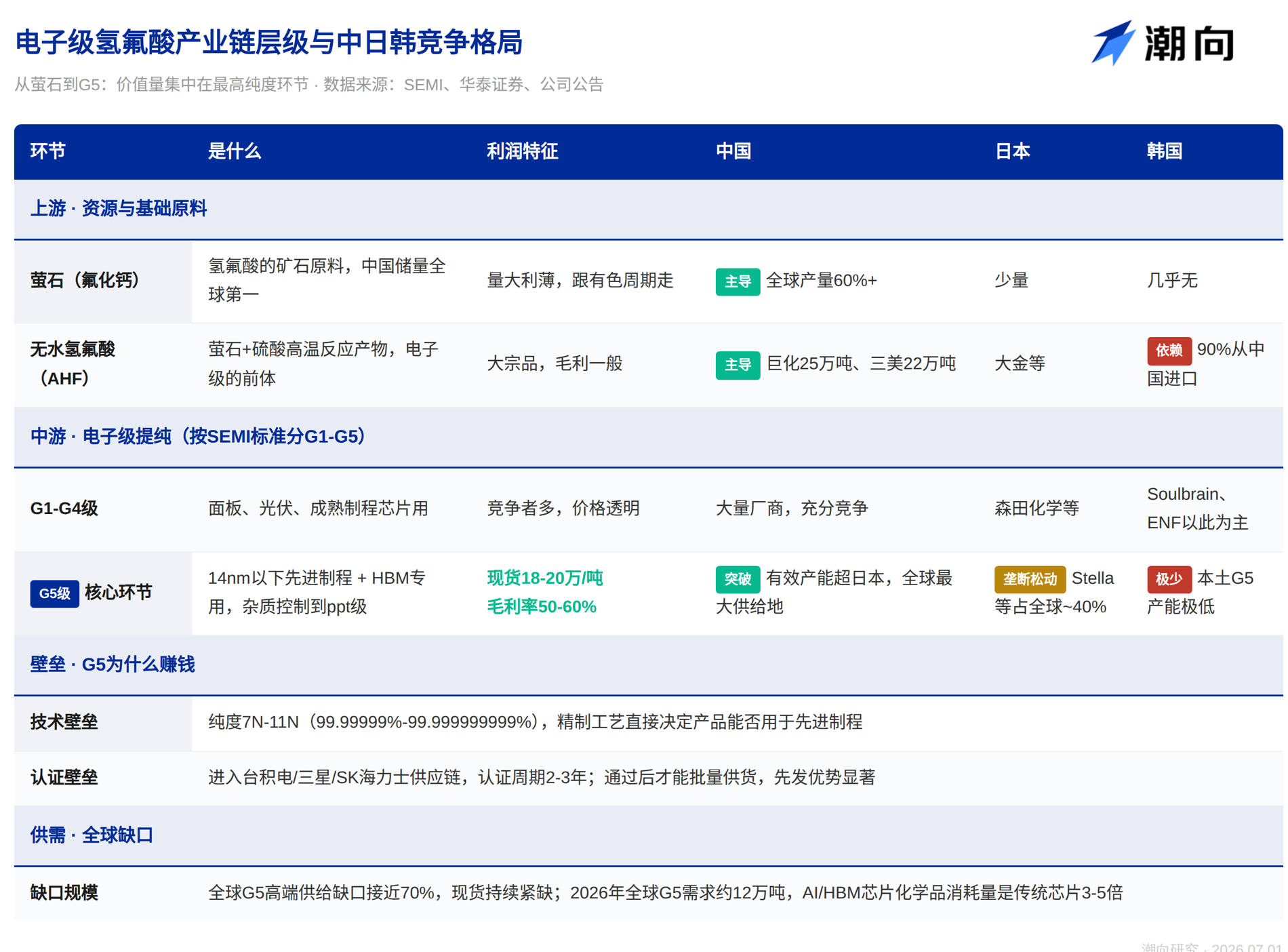
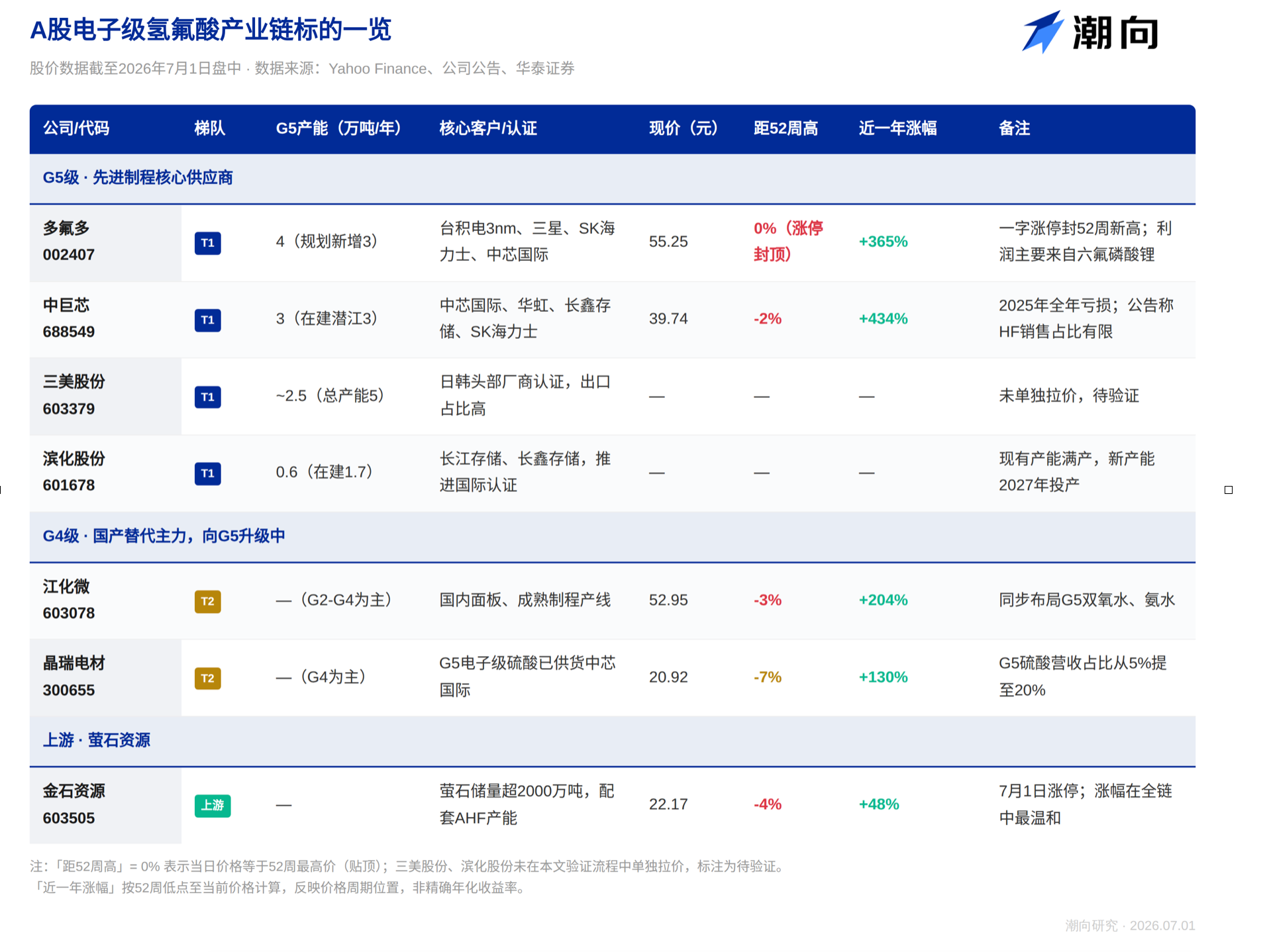
Chinese manufacturers have successively broken through G5 in recent years, and domestic effective capacity has already surpassed Japan, making it the world's largest supplier of high-end products. Based on G5 capacity and customer certification status, A-share related stocks can be roughly divided into three tiers:
First Tier: Large-scale production of G5, certified by international giants
- Multiple Fluorine (002407) — the largest domestic G5 producer, 40,000 tons/year, certified by TSMC, Samsung, SK Hynix, and SMIC, with a global market share of about 25%.
- China Giant Chip (688549) — G5 capacity of 30,000 tons/year (an additional 30,000 tons from the under-construction potential base), with investments from Juhua Group and the National Big Fund, linked to SMIC, Hua Hong, and Changxin Storage, entering the SK Hynix supply chain.
- Sanmei Holdings (603379) — total production capacity of electronic-grade hydrofluoric acid of 50,000 tons/year, with G5 accounting for more than half, certified by leading Japanese and South Korean companies, with a high export ratio.
- Bin Hwa Holdings (601678) — existing G5 capacity of 6,000 tons/year, fully loaded, with an additional 17,000 tons of high-end capacity under construction expected to be completed by 2027, supplying Yangtze Memory, Changxin Storage.
Second Tier: Primarily G4, upgrading to G5
- Jianghua Micro (603078) — an established manufacturer of wet electronic chemicals, covering hydrofluoric acid from G2 to G4, supporting domestic panels and mature process lines, while also positioning for G5.
- Jingrui Electric Materials (300655) — producing 22,000 tons of electronic-grade hydrofluoric acid, primarily G4, with G5 grade electronic-grade sulfuric acid already being supplied in bulk to SMIC (this will be mentioned later).
Upstream Resource: Fluorite
- Jinshi Resources (603505) — the only pure fluorite resource leader in A-shares, with reserves exceeding 20 million tons, supporting 300,000 tons of anhydrous hydrofluoric acid capacity, holding pricing power at the cost end.
In summary, the money-making model along this industrial chain is:
Upstream earns money from resources, midstream earns from scale, and G5 earns from barriers. In the current round of price increases, the G5 segment has the greatest profit elasticity and is also the part being most speculated by the market.
Similar Increases, but Completely Different Logic
The chart below is very intuitive; almost all stocks along the entire industrial chain are trading near their 52-week highs. However, when examined individually, the narratives and themes are quite different.
Multiple Fluorine: The Profit is Real, but Doesn't Come from Hydrofluoric Acid
Public data shows that Multiple Fluorine's net profit attributed to shareholders in Q1 2026 was 376 million yuan (+480%), with a net profit excluding extraordinary items of 380 million yuan (+1724%), exceeding the total for the whole year of 2025 in just one quarter.
China Huan Securities upgraded its rating to buy, expecting net profits of 1.724 billion, 2.335 billion, and 3.260 billion yuan from 2026 to 2028, corresponding to PE ratios of 29, 22, and 16 times, respectively.
Where does the profit come from?
According to Sina Finance, in the first three quarters of 2025, the new energy materials sector (primarily lithium hexafluorophosphate) accounted for 34.97% of revenue, with gross margins skyrocketing from 8.62% to 19.53%, being the largest profit driver. Lithium hexafluorophosphate is a raw material for lithium battery electrolytes, unrelated to semiconductors.
This round of lithium hexafluorophosphate increased from 47,000 yuan/ton in July 2025 to 130,000 yuan/ton in Q1, with Multiple Fluorine being the world's second-largest supplier (shipping about 50,000 tons, with a market share of about 20%), thus reaping all the benefits of the price hike. Some brokerages estimate that this alone could contribute over 2 billion in net profits in 2026.
On the hydrofluoric acid side, Multiple Fluorine mentioned on its investor interaction platform in November 2025: "The market price of semiconductor-grade hydrofluoric acid is stable, with little fluctuation."
The market buys Multiple Fluorine under the label of "hydrofluoric acid price leader," but its profit surge in Q1 relies on the price increase of lithium hexafluorophosphate, which is largely unrelated to semiconductors. Furthermore, the price of lithium hexafluorophosphate is already on the decline.
China Giant Chip: Increased Fourfold, but the Company Denies the Market Label
China Giant Chip rose from a 52-week low of 7.44 yuan to 39.74 yuan, the largest increase along the entire industrial chain. In 2025, it reported a loss of 16.59 million yuan. In Q1 2026, it just turned profitable with a net profit of 6.37 million yuan.
On the day of the limit-up on May 15, the company issued an announcement of abnormal fluctuations, stating, "The sales proportion of electronic-grade hydrofluoric acid business is limited"; "There is no direct trade relationship with Samsung Electronics for electronic-grade hydrofluoric acid products"; "There has been no substantive price increase order agreement with related customers for the above products"...
The main business of China Giant Chip is the overall supply of electronic wet chemicals, and hydrofluoric acid is just one category.
Before capacity is put into production and true profits emerge, the current price of 39.74 yuan corresponds to a company that earned 6.37 million in one quarter. The gap in between is entirely filled with expectations.
Jianghua Micro and Jingrui Electric Materials: Business Alignment, but One Must Distinguish Who Has Orders and Who Is Still Waiting
Jianghua Micro has increased over 200% in a year, with its main business being wet electronic chemicals, positioning towards G5 grade hydrogen peroxide and ammonium hydroxide.
Its advantage is a wide product line and broad customer coverage, with both domestic panels and mature process lines using its materials. Positioning for G5 means it is moving from low-end to high-end, but the G5 products are still in the customer certification stage, and there is currently no public information to confirm whether it can secure orders for advanced processes.
Jingrui Electric Materials has increased by 130%, with only 7% to peak. Among this group, it is relatively less extreme. It possesses a resource many of its peers do not:
G5 electronic-grade sulfuric acid has already been supplied in bulk to SMIC, with revenue share rising from 5% to 20%. This represents confirmed orders. In a context where most of the whole chain is priced based on expectations, a company with real shipments will have relatively stronger resilience during pullbacks.
The rest, such as Jinshi Resources, has increased by around 50%, being the mildest in the whole chain. It is a fluorite miner, earning from the rise in resource prices, with an indirect relationship to semiconductors. As fluorite prices rise, the cost of anhydrous hydrofluoric acid increases, transmitting to the prices of electronic-grade products; it acts more like a "cost driver" for the entire chain rather than a direct beneficiary of end demand.
Data Worth Noting
The short-term pricing of thematic stocks in A-shares often differs significantly from fundamentals. For the hydrofluoric acid sector, which has collectively reached peaks, expectations for short-term and mid-term follow-ups differ.
Short-term focus on funds and sentiment, not fundamentals
Recent data from the trading volume statistics of Multiple Fluorine's limit-ups can shed some light.
On June 11, limit-up (closing at 38.19 yuan), turnover reached 7.92 billion, with a turnover rate of 20.13%. The statistics show that institutional specialized seats net sold 179 million yuan, while speculative funds from "Chengdu" net bought 226 million yuan, and "quantitative trading" seats net bought 77.14 million yuan;
On June 22, it hit limit-up again, with a turnover of 7.906 billion, institutional net selling 147 million yuan, and brokerage seats net buying 490 million yuan. (The above data comes from public information from the Shenzhen Stock Exchange, all data after trading on the corresponding dates)
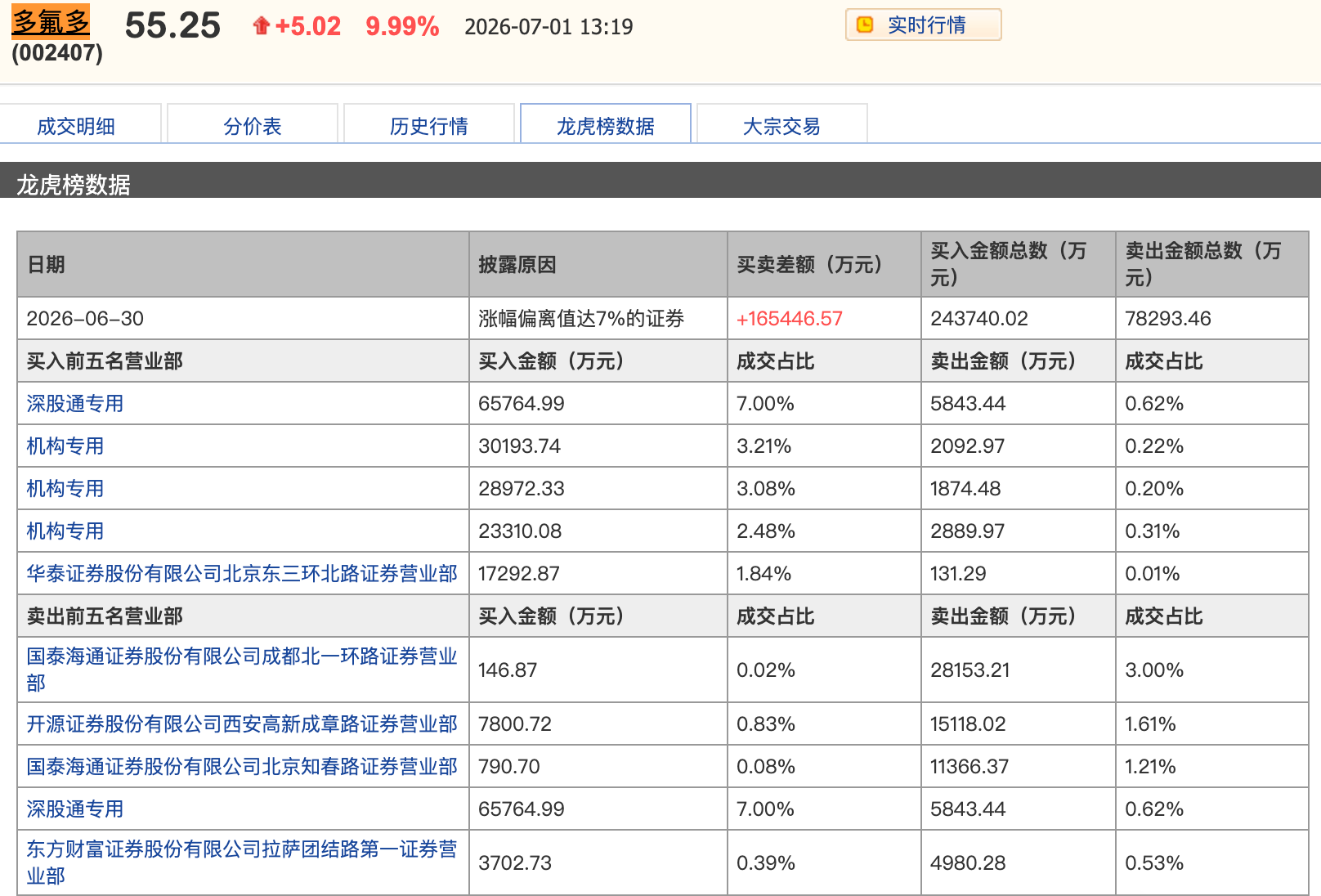
Both limit-ups presented the same structure: institutions are selling, while speculative funds are buying.
On June 29, Multiple Fluorine topped the Hot Stocks list on Tonghuashun. Today, July 1, it hit limit-up, reaching a new 52-week high.
From experience, when a thematic stock meets conditions such as "ranking first on the hot stocks list," "continuous limit-ups with huge turnover," and "institutions continuously net selling," it often indicates that sentiment has reached a very high temperature.
Potential upcoming catalytic events include:
Further price increases from South Korean manufacturers in June to July (as expected by Korean media), interim reports from Multiple Fluorine and China Giant Chip (around mid-August), and the IPO listing of Changxin Technology (market expected from mid-July to early August).
If these events can continue to generate topics, short-term sentiment can be sustained; otherwise, the profit-taking pressure after massive turnover will quickly become apparent.
Trend Judgement
The supply and demand logic of this industrial chain is solid. AI expansion pulls demand, Japanese companies are not expanding production, and South Korea relies on imports, with prices indeed rising.
However, the stock prices across the whole sector are already at high levels, with leaders increasing three to five times. The trading lists show institutions selling while speculative funds are buying, and various heat indicators (hot stocks ranking first, massive turnover, ETF premiums) are all maxed out.
At this point, the importance of industrial logic is less than that of odds; even correct logic can be priced out of space.
If one must find relative positions within this chain, Jingrui Electric Materials is still 7% away from its peak and is the least extreme across the entire industrial chain, with confirmed G5 sulfuric acid orders; Jinshi Resources has seen the mildest increase (about 50%), but it earns from rising fluorite prices, related to semiconductors only indirectly.
The mid-August interim reporting season may be a crucial checkpoint for this hydrofluoric acid sector; those whose performance cannot catch up with stock prices will be the first to decline when sentiment recedes.
Disclaimer: This article is for analysis reference only and does not constitute any investment advice. The stock market carries risks, and investments should be made cautiously. All data are sourced from public information, and the author does not assume any responsibility for the accuracy and completeness of the data.
免责声明:本文章仅代表作者个人观点,不代表本平台的立场和观点。本文章仅供信息分享,不构成对任何人的任何投资建议。用户与作者之间的任何争议,与本平台无关。如网页中刊载的文章或图片涉及侵权,请提供相关的权利证明和身份证明发送邮件到support@aicoin.com,本平台相关工作人员将会进行核查。


