
Original Author: Shao Jiadian
When many people hear Token, their first reaction is Web3, issuing tokens, exchanges, secondary markets. However, AI Token going abroad is not about this.
In Southeast Asia, a child is playing with a chatty AI toy, asking it to tell stories, practice English, and answer a hundred thousand questions. The toy looks like just a hardware terminal, but the real cost is not the plastic shell, but the ongoing model reasoning happening behind the scenes: every wake-up, every follow-up question, every segment of voice interaction consumes Tokens. These requests are initiated from overseas terminals, enter the domestic computing center through a pilot channel in Shantou for processing, and then return the results to overseas users. In other words, what is being sold is not a toy, but a set of AI capabilities charged per use and billed based on amount consumed. What they consume is a new form of hard currency in the AI era—Token. A kilowatt-hour of electricity comes in at about 0.5 Yuan and, when converted to Token, is sold for about 11 Yuan, valuing it at over twenty times more.
This business has never been about "how to sell a Token," but rather a positive matter: selling domestic AI capabilities to overseas clients through a compliant Token measurement method.
Why is it worth doing now? Domestic model capabilities are improving, API prices are decreasing, and overseas demand is real; leading manufacturers are already making significant revenue from overseas markets. But regulation is tightening: AI transit stations are under criminal investigation, and data security risks have been repeatedly highlighted. In a word—AI Token can go abroad, but cannot walk randomly. If the direction is reversed, going abroad will become going inland; if the wrong model is chosen, the business will turn into a risk.
First Definition: AI Token is not Web3 Token
Before discussing the model, we need to firmly establish the concept. The difference between AI Token and Web3 Token does not lie in the name, but in functionality.
Web3 Token is usually issued on the blockchain, can be transferred on-chain, enter secondary markets, and is subject to price fluctuations, carrying payment, value storage, and even speculation attributes. AI Token is completely different: it does not have a blockchain underlay, cannot be transferred between users, has no secondary market, and no price volatility; it is simply an internal unit used for measuring consumption after the user purchases AI services.
A straightforward example: when a user tops up 100 USD, they get a calling quota of 1 million Tokens. This quota cannot be sold, cannot be transferred to others, cannot be listed on exchanges, and can only be consumed on the platform to invoke the model. This is the prerequisite for AI Token to go abroad compliantly.
The judgment is actually quite simple: Tokens can only be used for service consumption; they are measurement tools; once they can circulate, transfer, or speculate, they may slip into virtual asset regulation. Thus, the first boundary for going abroad is—do not turn AI service quotas into financial products.
Why Now: Three Numbers
Bringing the timeline closer to the last year or two, three numbers can explain why this business has suddenly heated up.
The first is usage. In the week around the Spring Festival this year, on the world's largest model API aggregation platform OpenRouter, the top ten models consumed about 8.7 trillion Tokens in total, with domestic models accounting for about 5.3 trillion, a share of 61%. By the first week of April, 6 of the top ten models were domestic, with Chinese models processing 12.96 trillion Tokens that week, while American models only managed 3.03 trillion. Overseas developers are genuinely paying to use domestic models.
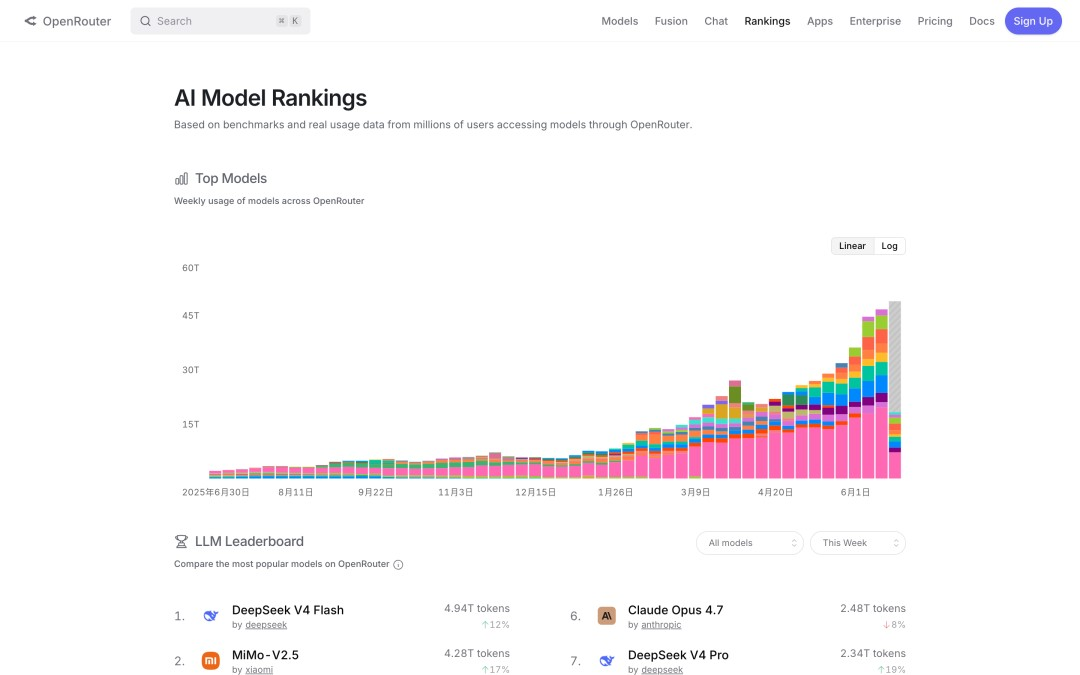
Figure: OpenRouter official Rankings page shows the real usage ranking of models
The second is price. The API pricing for domestic models is often only a fraction of that of leading American models—input price differences are around ten to twenty times, and output price differences are even larger. In the past, people primarily used AI for chatting, with low usage, so this price difference was insignificant; however, entering the Agent (intelligent agent) era, a single task can consume hundreds of thousands or even millions of Tokens, greatly amplifying the cost difference, causing developers to vote with their feet.
The third is revenue. Taking MiniMax as an example, its overseas revenue ratio reached 73% in 2025, while this figure was only 19% in 2023. This indicates that Chinese AI companies are not just "being called", but can genuinely receive money in the global market.
Expansion, price cuts, and impressive overseas performance are part of the equation; the other part is equally important—compliance is becoming the key variable determining how far companies can go. The three paths ahead are differentiated by this.
Model One: Official Direct Connection
The most orthodox, clearest, and highest compliance certainty path is for model manufacturers to go abroad themselves.
The approach is for manufacturers to build their own nodes overseas, or rely on international clouds such as AWS or Azure, to provide official APIs, with data crossing borders, model authorizations, and local operations all following international cloud rules and the laws of the target market. The authorization chain is complete, the service subject is clear, and responsibilities are taken on, with clients also knowing whose model they are invoking, avoiding issues like unclear intermediate transfer authorization, ambiguous interface source, model swapping, and account pool arbitrage.
DeepSeek, Zhipu, and Moonshadow have all launched official APIs; Zhipu, MiniMax, and others have also placed models in overseas clouds such as AWS, allowing local physical servers to perform reasoning, ensuring that data never leaves the region—this precisely addresses the most concerning issue for overseas enterprises: will my data be sent back to China?
The logic of this path is: whoever has the model goes abroad, and whoever provides the service takes responsibility. It is suitable for leading manufacturers with overseas subjects and resources, has a high threshold but brings the least hassle if successful. Conversely, if you are not a model manufacturer, don’t package yourself as “official.”
Model Two: Compliant Aggregation / Tools
For small and medium-sized teams that do not have the capability to lay out global nodes, it is more realistic to focus on aggregation and tools, which is currently the path with the most participants.
The method is to aggregate models from multiple licensed sources, providing a unified gateway, a unified API, plus a set of developer tools, allowing overseas clients to call multiple models with one interface. The previously mentioned OpenRouter is a global benchmark for this model—one API connects to hundreds of models. Revenue comes from the difference in buying and selling Tokens, gateway and technical service fees, tool subscriptions, as well as added value services like routing, monitoring, billing, and risk control.
This is a path with more complex compliance requirements; it is not that it cannot be done, but that it must be done under certain conditions. The two core issues are—source of the models and data responsibility. Where do the aggregated models come from, are there resale rights, do upstream authorizations cover overseas markets, can they be white-labeled and repackaged, who ultimately routes customer data, will it be retained or used for training? If these cannot be clarified, "compliant aggregation" will turn into "gray transit."
What needs to be upheld are the "four closures":
- Authorization chain closure—written authorizations must exist at every level from the model manufacturer, cloud vendor, official channel providers to the aggregation platform, to the overseas clients; relying solely on upstream saying "it's fine" is not enough.
- Business scope closure—authorization must cover actual actions: API calls, model aggregation, external sales, white-label packages, overseas regions, client types, all must be included in the authorization.
- Data responsibility closure—who customer data is passed to, whether it is retained, whether it will be trained on, whether it is handed to third parties, this must be written into DPA (Data Processing Agreement), privacy policies, and subprocessors list.
- Billing evidence closure—upstream procurement contracts, invoices, payment records, downstream sales orders, usage reports, collection records; all must correspond and be traceable.
If these four points cannot be achieved, what is termed "compliant aggregation" will slip into "gray transit". The core of aggregation is not "whether it technically works," but "do I have the right to sell."
In reality, many teams think they are doing aggregation, yet they use personal API Keys, shared accounts, educational discounts, account pools, reverse interfaces, or even misrepresent low-priced models as high-priced ones—these are not cost advantages, but risk detonators.
Model Three: Special Zone Pilot
There is another path, bolstered by policy benefits, and the most noted example is in Shantou.
The state approved Shantou's Overseas Chinese Experimental Zone to carry out "Inbound Data Processing" pilot in 2025: overseas data can legally enter the country, be processed in designated areas, and output again, operating under a unified policy framework without needing to apply for approvals case by case. Complementing this is a "digital bonded area" style framework—physical separation between the special zone and domestic internet, with overseas requests coming in directly via international submarine cables, inference completed within the zone, with results returned along the same route, achieving a latency of about 32.7 milliseconds to Singapore. Guangdong Mobile has built a data center in Eastern Guangdong, also operating the "Token Transit" platform, uniformly handling computing power scheduling, Token measurement, cross-border matching, and profit sharing, successfully running the first complete closed-loop chain of Token going abroad nationwide. A frequently cited calculation in the area is: a kilowatt of electricity comes in at about 0.5 Yuan, and after being converted into Tokens it goes out at about 11 Yuan, increasing in value by over twenty times.
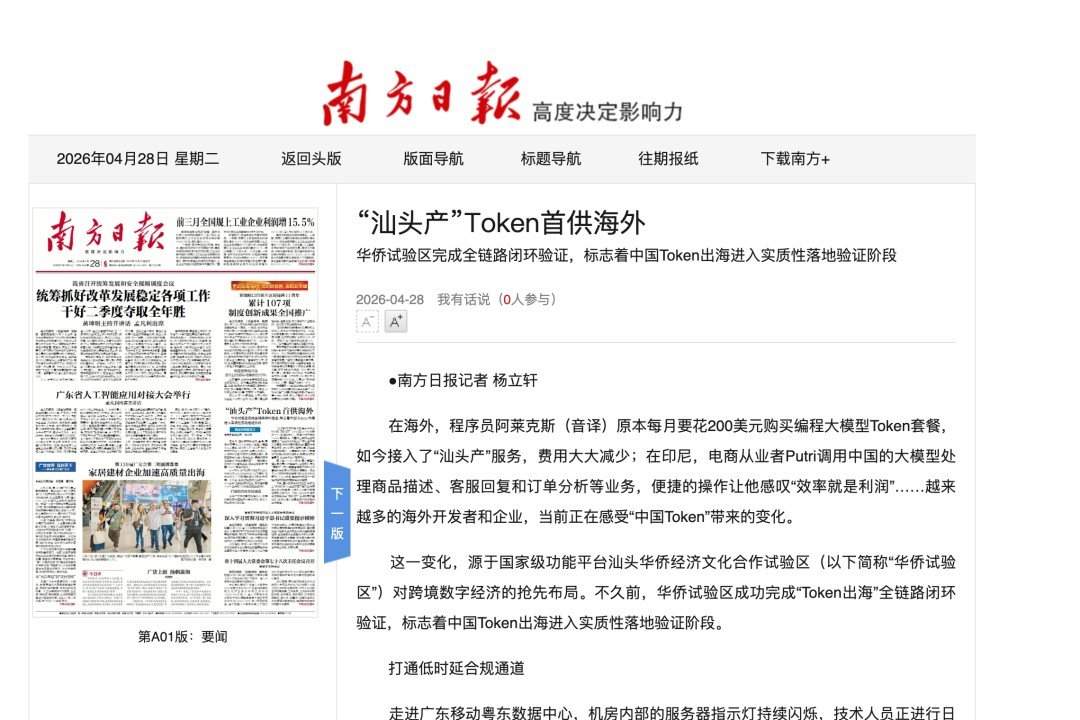
Figure: Southern Daily's digital newspaper publishes "Shantou-produced" Token's first supply overseas report
It solves a crucial question—can overseas data be processed domestically? The rule of thumb is: collect overseas, process domestically, and return overseas; as long as domestic personal information or important data is not mixed during the process, it may avoid the three procedures: security assessment, standard contract, and protection certification.
However, there are clear boundaries for this path. Several conditions must be adhered to: the service target is overseas users, the data source must be overseas, processing in the domestic area should be purely technical, results must return through the original route, no mixing of domestic data, and perform physical or logical separation between domestic and overseas operations, with operational traces being auditable. If a shared system is used between domestic and overseas, or if the processed results flow back for domestic business use, the exemption logic will become ineffective.
More importantly: the pilot is not a nationwide universal exemption. It relies on specific regions, specific policies, and specific facilities, and cannot be simply replicated into "I can freely find a machine room in the domestic area to process overseas data"; also due to regulatory constraints in various places, it is currently primarily aimed at Southeast Asia, while Europe, the US, and Japan, due to strict data localization and export controls, often require relevant services to be deployed locally. It is more like a trial field of genuine dividends that cannot be copied.
III. A Must-Avoid Reverse Example: Token Going Inland
After discussing three legitimate paths, it is necessary to highlight a common misconception often mistaken as "the fourth way": gray transit, which is Token going inland. This is the exact opposite of going abroad—going abroad is selling domestic AI capabilities to overseas clients, while going inland is packaging completed overseas model services that do not comply with domestic regulations and selling them back to domestic users.
The typical approach is in three steps: first, using bulk registration, shared accounts, or even reverse cracking to access overseas model interfaces; secondly, using reverse proxy to package it into a Chinese webpage or API recharge platform; lastly, selling it to the domestic public through communities, e-commerce, or mini programs on a membership or Token basis.
The problem is not just one of qualification flaws, but the entire chain cannot stand firm: the source may have no authorization, models have not completed domestic compliance, charging the domestic public, user data being transferred overseas, the platform lacking ICP/EDI qualifications, and if the interface comes from cracking or stealing it will further enter criminal discussions. In a word, Token going inland is not the fourth export model, but a reverse teaching material that the export business should avoid.
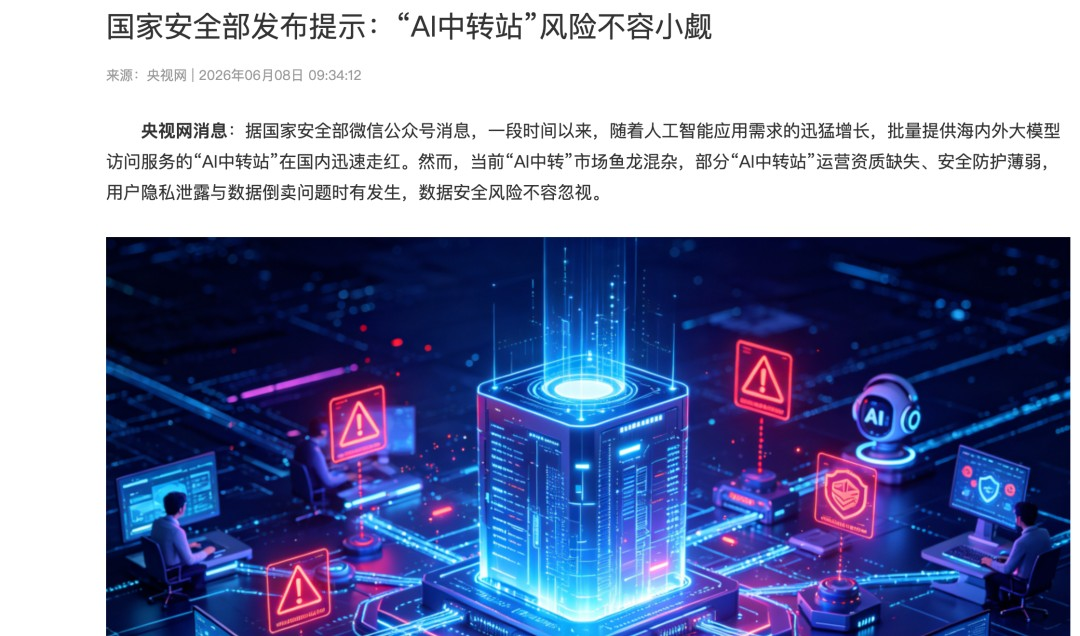
Figure: CCTV News releases the Ministry of National Security’s risk alert regarding "AI Transit Stations"
In Conclusion: Choosing the Right Model Makes Compliance Meaningful
The three paths have no hierarchies, only adaptations. If you have your own models, computing power, brand, and overseas infrastructure, prioritize official direct connections; if you have technical integration and customer channels but do not have self-developed large models, the most realistic approach is compliant aggregation/tools; if you want to process overseas data with domestic computing power and can access policy areas and isolation facilities, consider researching special zone pilots. However, if you package overseas interfaces and sell them to domestic users, regardless of whether it's called transit, mirroring, or gateway, it is not going abroad, it is going inland.
But regardless of which path is taken, one cannot avoid four lifelines—model sources, data outbound, target market, and funds return:
If the model sources cannot be clearly stated, Tokens are not assets, but risks; if the data flow cannot be clearly stated, the platform is not a tool but a black box; if the target market cannot be clearly stated, going overseas is not growth but infringing upon others' regulations; if the funding path cannot be clearly stated, revenues are not profits but costs to be explained sooner or later.
The successful implementation of AI Token going abroad is never about low prices, packaging, or talking points, but a business linkage that can withstand questioning. Tokens are merely a measurement unit; what goes abroad is always AI capabilities—where they come from, who they are sold to, how data flows, how money returns, and who is responsible in case of issues. If these questions are clarified, Tokens will be tools for going abroad; if unanswered, they will turn into another gray entry point.
This article provides industry compliance observations, compiled based on public rules and practical experiences, and does not constitute legal advice for any specific projects.
免责声明:本文章仅代表作者个人观点,不代表本平台的立场和观点。本文章仅供信息分享,不构成对任何人的任何投资建议。用户与作者之间的任何争议,与本平台无关。如网页中刊载的文章或图片涉及侵权,请提供相关的权利证明和身份证明发送邮件到support@aicoin.com,本平台相关工作人员将会进行核查。


