Key Takeaways:
- Senate Banking Chair Tim Scott and Majority Leader John Thune are pushing for a CLARITY Act vote in July 2026.
- The bill needs 60 votes; Republicans hold 53 seats, requiring at least seven Democrats to cross over.
- Galaxy Research cut the odds of passage this year to 50%, citing a tight pre-recess calendar.
Senate Banking Committee Chairman Tim Scott (R-SC) and Senate Majority Leader John Thune (R-SD) are pressing for the chamber to take up the CLARITY Act in July, according to reporting confirmed this week. The market-structure bill would split oversight of digital assets between the Securities and Exchange Commission (SEC) and the Commodity Futures Trading Commission (CFTC), a division the industry has sought for years.
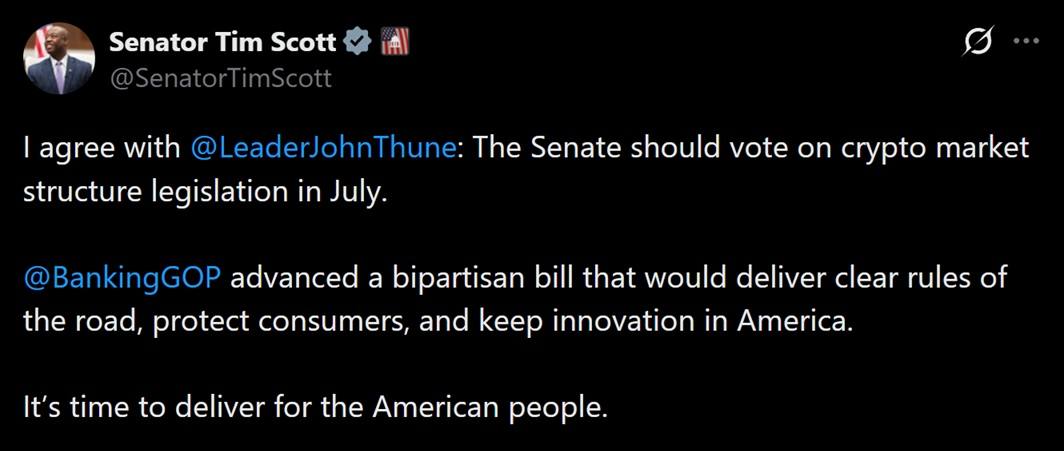
Image source: X
Lawmakers and analysts broadly agree that the Senate must act before the August recess for the legislation to have a realistic shot in 2026. Supporters have flagged a four-week window from July 13 to Aug. 7 as decisive. Lummis, a Wyoming Republican who has championed digital-asset legislation, postured the bill as consumer-first, adding:
“When the Clarity Act becomes law, for the first time, there will be a consumer-friendly disclosure framework for digital assets. Not retrofitted from 1933. Built for 2026 and beyond.”
The bill needs at least 60 votes to overcome a filibuster, yet Republicans hold just 53 seats, meaning at least seven Democrats would have to join. Full Republican backing is not guaranteed either, given that Senators Josh Hawley and Rand Paul opposed the earlier GENIUS Act stablecoin law.
Scheduling adds another hurdle as Thune recently signaled he wants the week of July 13 for the National Defense Authorization Act (NDAA), the must-pass defense bill, which could push CLARITY floor consideration to late July or early August. Galaxy Research, the analytics arm of Galaxy Digital, cut its estimate of the bill becoming law this year to 50%, citing those procedural and political challenges.
Lummis has also pressed the developer-protection case, arguing that coders should not need an army of lawyers to know whether their code is legal and that the CLARITY Act ends that uncertainty.
The bill has drawn heavy lobbying as more than 1,200 tech companies have urged the Senate to pass the CLARITY Act quickly, warning that U.S. firms face mounting uncertainty as other jurisdictions move ahead. The White House has also invited law enforcement groups to discuss concerns about the bill, part of an effort to clear obstacles before a floor vote.
That said, opponents remain vocal, with Senator Elizabeth Warren (D-MA) warning the 309-page bill would be devastating for the economy, and the Senate Banking Committee advanced the measure on a 15-9 vote in May over her objections.
The next step is floor scheduling because if Thune carves out time after the defense bill, the Senate could vote in late July, sending the measure toward reconciliation with the House version before any presidential signature. Miss the August recess deadline, and the industry’s best shot at federal market-structure rules could slip into 2027.
免责声明:本文章仅代表作者个人观点,不代表本平台的立场和观点。本文章仅供信息分享,不构成对任何人的任何投资建议。用户与作者之间的任何争议,与本平台无关。如网页中刊载的文章或图片涉及侵权,请提供相关的权利证明和身份证明发送邮件到support@aicoin.com,本平台相关工作人员将会进行核查。


