Author: Claude, Deep Tide TechFlow
Deep Tide Introduction: The EU's crypto regulatory framework MiCA will take effect on July 1st, with only about 210 out of over 1200 licensed institutions across Europe obtaining the CASP passport, a pass rate of about 17%. The world's largest exchange, Binance, will suspend most of its EU services starting July 1st, withdrawing its application for a Greek license and shifting its focus to France; Bybit has simultaneously restricted EEA users, redirecting them to the already licensed Bybit EU. Coinbase, Kraken, OKX, Crypto.com, and others hold the passport, reshaping the European crypto landscape.
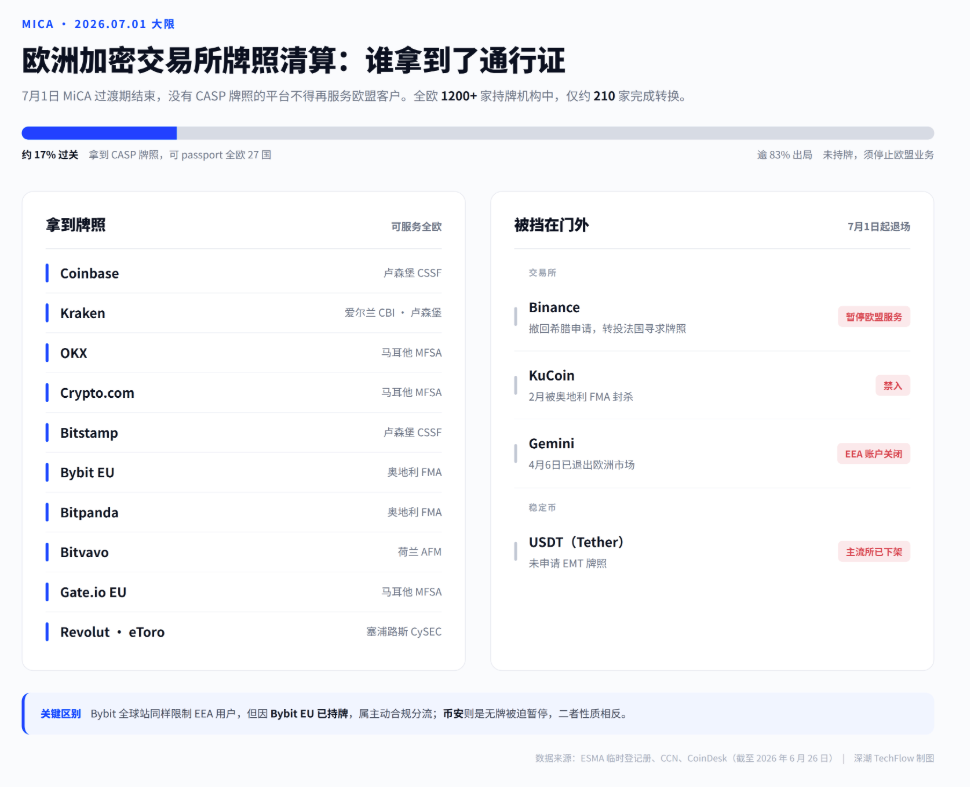
July 1st is the day the EU's Market in Crypto Assets Regulation (MiCA) transition period ends. After this date, any crypto platform wishing to serve EU customers must hold at least one CASP (Crypto Asset Service Provider) license issued by a regulatory authority of a member state, or it will be illegal and must cease operations. The ESMA (European Securities and Markets Authority) has made it clear multiple times: there is no grace period, no extension, no interim status.
Either hold a license or be illegal.
Only 17% pass rate, the world's largest exchange fails to qualify
The true impact of MiCA is reflected in one number.
According to CCN citing data from the ESMA's temporary registry, there were over 1200 institutions across Europe holding VASP (Virtual Asset Service Provider) registrations before MiCA, but by May 2026, only about 210 had completed the transition to a CASP license, with a pass rate of about 17%. The remaining over 80% of institutions either missed the window, or their processes were incomplete and they no longer had legal status, or they quietly withdrew from the market.
Binance fell on the side of non-compliance. It had previously bet on Greece as its entry point into the EU, submitting a MiCA application through its Greek subsidiary in January 2026, and co-CEO Richard Teng had publicly stated in February that Greece's talent pool and security environment made it superior to larger financial centers. However, on June 16th, Reuters reported that the Greek financial regulator (HCMC) was preparing to reject the application. According to the Financial Times, the obstacles centered on anti-money laundering compliance and MiCA's "fit and proper" standards for shareholders and managers, with the core issue being co-founder Zhao Changpeng's past legal record and the company's governance structure. The regulatory authorities of Greece, Ireland, and Latvia had jointly tracked this application.
On June 24th, Binance proactively withdrew its Greek application before it could be formally rejected, emphasizing that "it has not received an official denial"—this wording was intentional, leaving room for a subsequent reapplication. Binance's head of Europe, Gillian Lynch, told Reuters that "Binance is not leaving Europe," and that the company plans to seek a license in France, stating that they expect to obtain it "within the next few months."
For EU users, this means that starting on July 1st, Binance will stop accepting new users in France, Italy, Poland, Spain, and other markets, restricting certain services. Binance has promised asset security and normal withdrawals, but new trading and deposit channels will be cut off. Whether they can obtain a license in France within a few months is crucial for Binance’s return—especially since the French regulatory authority itself has an unresolved investigation into Binance, and if France approves something that Greece was poised to reject, it would expose differences in how various member states implement MiCA.
For EU readers holding Binance accounts, the immediate action is to pay attention to account notifications directly sent from Binance, following the guidelines to manage positions before the deadline, or to transfer assets to self-custody wallets and other licensed platforms.
Bybit also restricts EEA users, but the nature is opposite to Binance
At the same time that Binance announced the suspension of services, Bybit also issued a restriction notice to users in the European Economic Area (EEA), covering 29 EEA countries including Germany, France, Italy, and Spain. On the surface, it seems like the same matter, but in reality, the direction is completely opposite.
Bybit obtained a MiCA license through the Austrian Financial Market Authority (FMA) as early as May 2025 and operates an independent compliant entity, Bybit EU (bybit.eu, headquartered in Vienna), which was launched in July 2025. It is now restricting access to the global site bybit.com for EEA users, redirecting them to the already licensed Bybit EU. In other words, Bybit is "actively complying and redirecting after obtaining a license," while Binance is "forced to suspend due to not obtaining a license." Malta is excluded from Bybit's restriction list because the Bybit EU license has not yet been passported to Malta.
The differences in user experience between the two are also quite practical. Bybit EU currently focuses on spot trading, spot leverage, Earn financial services, and Bybit cards, but lacks the perpetual contracts and options that are the flagship of the global site—these derivatives require an additional MiFID II license, which Bybit has applied for, but until approved, EEA users cannot use them. Bybit CEO Ben Zhou candidly stated in an interview with CoinDesk in April that "just having a MiCA license doesn't make money in Europe," adding, "we are not making money under the existing MiCA license, but as a large institution, we can afford this; it's a long-term investment."
For EU readers, Bybit users and Binance users are in different situations: Bybit users are migrating to a licensed platform within the same group (which requires completing KYC again), ensuring account continuity; Binance users, however, face a platform without a license and service interruption, needing to proactively find alternative solutions.
Winners that obtained the passport: Coinbase, Kraken, OKX lead the way
On the other side of the license clearance, a group of compliance pioneers have obtained passports sweeping across 27 countries.
According to the ESMA registry and cross-confirmation from several media outlets, the mainstream exchanges confirmed to hold licenses include: Coinbase (Luxembourg CSSF), Kraken (Ireland CBI and Luxembourg), OKX (Malta MFSA), Crypto.com (Malta MFSA), Bitstamp (Luxembourg CSSF), Bitpanda (Austria FMA), Bitvavo (Netherlands AFM), Gate.io EU (Malta MFSA), as well as Revolut, eToro, and others. The passport mechanism of MiCA is the core attraction: obtaining a license in any member state allows service across all 27 EU countries plus the entire EEA market of Norway, Iceland, and Liechtenstein, covering nearly 500 million people.
The geographical distribution of licensed institutions has formed several clear clusters. Luxembourg has attracted global brands seeking rapid coverage across Europe (Coinbase, Bitstamp); Malta has become an exchange hub due to many years of experience in crypto regulation (OKX, Crypto.com, Gate); Germany leads in quantity with 53 licensed institutions, mainly banks and brokerage firms.
Not all major platforms have passed smoothly. KuCoin was banned by the Austrian FMA in February this year, prohibiting entry into the EU; Gemini exited Europe on April 6th, shutting down EEA accounts. These cases, along with Binance, illustrate that MiCA treats institutions of all sizes equally, distinguishing only between licensed and unlicensed.
For EU readers, the practical significance of choosing licensed platforms lies in fund protection: licensed institutions are subject to ongoing supervision by designated regulatory authorities, must isolate customer assets, and meet capital requirements, allowing users to seek legal remedy through European courts and member state regulatory authorities. The CASP status of any platform can be verified in a minute via the ESMA's publicly available registry.
USDT shut out, European users must exchange before the deadline
The license clearance has affected more than just exchanges; it also impacts stablecoins.
The world's largest stablecoin USDT (Tether) did not apply for MiCA's EMT (Electronic Money Token) license, so it cannot circulate legally on licensed platforms in the EU. The USDC and EURC from Circle are the only ones among the top ten stablecoins that have obtained MiCA authorization. If licensed exchanges continue to offer unauthorized stablecoins to EU customers, it will jeopardize their own licenses, leading mainstream platforms to progressively delist USDT: Coinbase will delist it for EEA users by December 2024, Crypto.com will stop by January 2025, Binance implemented geographical restrictions on EEA spot markets for USDT in March 2025, and Kraken simultaneously suspended USDT spot trading for EEA.
Tether CEO Paolo Ardoino defended this, stating that MiCA requires placing 60% of token reserves in European bank deposits, which is incompatible with Tether's reserve model, and could trigger both banking and stablecoin crises.
For EU readers holding USDT, the actions before the deadline are quite specific: exchange USDT for compliant assets (such as USDC, EURC, or euros) on licensed platforms, or transfer to self-custody wallets—USDT can still be legally held and exchanged in decentralized scenarios, as this portion is not bound by MiCA service provider rules.
免责声明:本文章仅代表作者个人观点,不代表本平台的立场和观点。本文章仅供信息分享,不构成对任何人的任何投资建议。用户与作者之间的任何争议,与本平台无关。如网页中刊载的文章或图片涉及侵权,请提供相关的权利证明和身份证明发送邮件到support@aicoin.com,本平台相关工作人员将会进行核查。


