
Author: Jae, PANews
Old games can no longer be played. The world's largest Bitcoin holding company, MicroStrategy, chooses to bow to reality.
On June 29, MicroStrategy submitted an 8-K announcement to the SEC (U.S. Securities and Exchange Commission), marking a period of conclusion to its years of "mindless coin hoarding" persona, replaced instead by a defense structure called the "Digital Credit Capital Framework."
Upon the announcement, MicroStrategy's common stock MSTR and perpetual preferred stock STRC both surged over 12%. The market has cast a vote of confidence in MicroStrategy's self-reform during this crisis, but the believers have fallen silent.
Flywheel Stalled + Credit Crisis: MicroStrategy Cornered by $14 Billion in Floating Losses
In the past, MicroStrategy's business model was a typical "Wall Street perpetual motion machine": Issuing shares to buy coins → pushing up NAV (net asset value) per share → increasing stock premium → continuing to issue more shares.
However, the counteracting force of the cryptocurrency price cycle has rendered this perpetual motion machine inoperative.
As of now, MicroStrategy holds a total of 847,363 Bitcoins, with an average purchase cost of about $75,651 per Bitcoin. As the market price of Bitcoin has plunged to below $60,000, its unrealized losses exceed $13 billion.
The fuel for the flywheel is: mNAV (market value of stock / net asset value of Bitcoin) must be greater than 1. Once Bitcoin plummets and the mNAV of MSTR falls below the critical threshold of 1, the market valuation given to MicroStrategy dips even below the liquidation value of its Bitcoin holdings, causing the flywheel to cease operation.
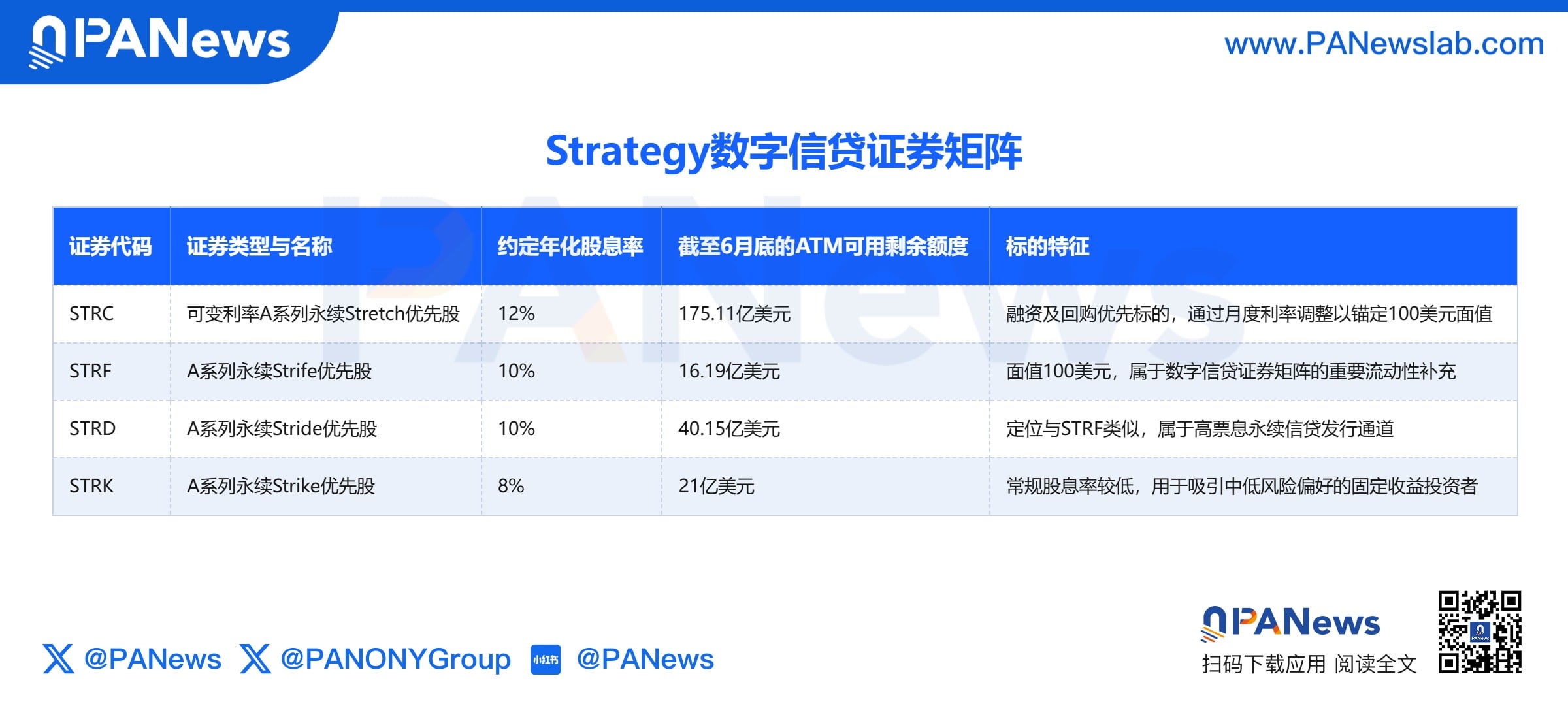
The pressure on the credit side is equally heavy. As the most liquid and actively traded primary financing tool, the price of STRC has collapsed, once falling to a historical low of $71.25, a discount of over 28% from its $100 par value. This indicates that the ATM (at-the-market issuance) channel has been declared ineffective. Issuing more shares under a discounted state not only results in substantial losses of capital but also further dilutes the rights of existing shareholders.
Industry sentiment and even legal actions have followed. Rosen Law Firm has initiated a compliance investigation into MicroStrategy's disclosures, and Ripple CEO Brad Garlinghouse has criticized it as "unsustainable financial engineering," while economist Peter Schiff bluntly stated that Michael Saylor has "destroyed shareholder value."
On the edge of a cliff surrounded by challenges, MicroStrategy must once again prove its survival capability to the market.
Five Pillars to Reconstruct Capital Structure: $2 Billion Securities Buyback + $1.25 Billion BTC Liquidation
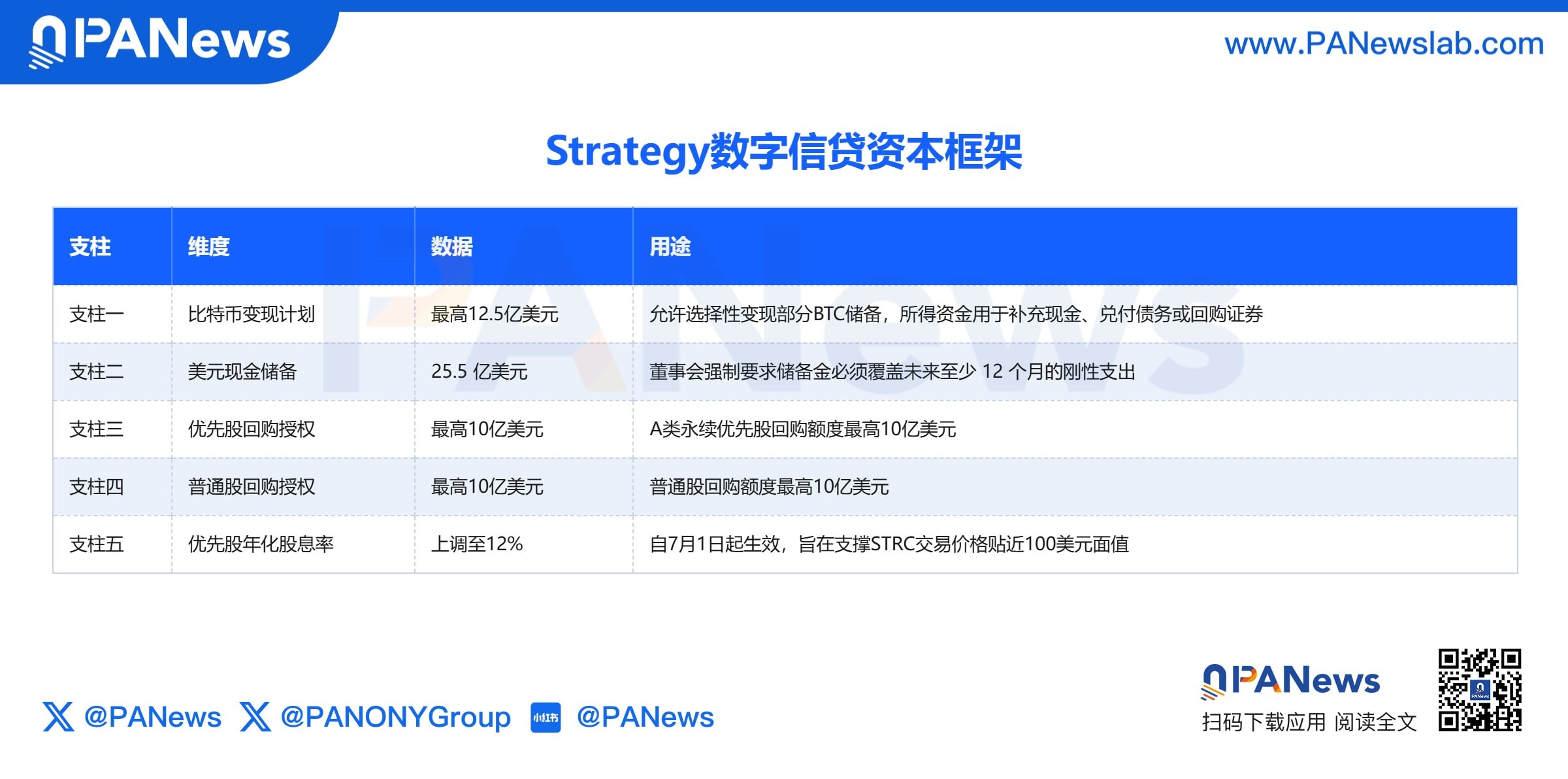
In order to repair credit anchors and restart financing chains, MicroStrategy CEO Phong Le proposed: the company must shift from one-way capital issuance to proactive capital management. MicroStrategy then introduced the "Digital Credit Capital Framework," attempting to support its shaky valuation and liquidity with five pillars.
Pillar One: $2.55 Billion "Reserve Cushion." As of the end of June, MicroStrategy holds approximately $2.55 billion in cash reserves. Under new regulations, this money can only be used to pay preferred stock dividends and interest on existing debt. Any other uses require special authorization from the board.
Based on the current annual rigid expenditure of about $1.76 billion, this reserve can cover approximately 17.4 months, far exceeding the board's minimum warning line of 12 months.
DeFi researcher Chen Mo pointed out that MicroStrategy putting cash reserves first likely aligns with market expectations. Protecting STRC means preserving credit; if confidence is restored, then subsequent financing remains possible.
Pillar Two: Increase STRC interest to 12%. Starting July 1, the annual dividend yield of STRC will be raised from 11.5% to 12%, and the distribution frequency will change from monthly to bi-monthly. MicroStrategy aims to use high interest to attract STRC back to the $99-$100 par value range. Once it returns to par, the ATM financing channel can reopen.
Pillar Three: A buyback of up to $1 billion in preferred shares. The board has authorized the buyback of all issued perpetual preferred shares, and when irrational declines occur in the secondary market, MicroStrategy will prioritize stabilizing STRC.
Pillar Four: A buyback of up to $1 billion in common stock. When management believes MSTR prices are significantly below its intrinsic value, buybacks are the most effective "tourniquet," helping to increase the Bitcoin content per share and enhance long-term shareholder rights.
Pillar Five: A Bitcoin liquidation plan of up to $1.25 billion. The board has authorized the company to orderly and gradually sell some Bitcoin. The funds obtained will be used to replenish reserves, buy back securities, or pay interest. In the past, MicroStrategy's BTC was a "dead asset," with almost nothing coming in or out. Now, it has transformed into a flexible credit endorsement and liquidity buffer.
This is the most unexpected pillar in the entire framework. The belief of "only buying, not selling" has formally given way to the reality of "dynamic management." It is worth mentioning that MicroStrategy previously sold a small amount of coins to "test" market sentiment, but when the selling occurred, the market response seemed calm, with Bitcoin prices remaining stable around $60,000.
CryptoQuant analyst Axel Adler stated that as MicroStrategy continues to finance and manage capital through Bitcoin-related assets, the role of Bitcoin is evolving from a mere value storage tool to a key liquidity infrastructure within the company's capital operation system.
With this series of measures, MicroStrategy has pushed total available liquidity to $3.8 billion ($2.55 billion in cash + $1.25 billion bitcoin liquidation capacity), and the rigid expenditure coverage period has extended to 25.9 months. According to Bitmine's calculations, since 2009, based on a rolling cycle of 36 months, the probability of negative Bitcoin returns is less than 0.8%, and a reserve size of 26 months is sufficient to allow MicroStrategy to ride out the fluctuations of a bear market phase. In other words, even in a bear market, MicroStrategy can survive for at least two years.
The essence of the new framework is: to guide secondary market prices through a buyback of up to $2 billion in securities, restore mNAV to above 1, and then reopen financing channels using the funds raised to buy coins.
From "expansion through issuance" to "support through buybacks," MicroStrategy's strategic focus has shifted from pursuing Bitcoin holding size to maintaining the health of its capital structure and ensuring smooth financing channels.
Crypto analyst Blue Fox noted: "MicroStrategy's 'only buy, not sell' pure HODL model has a vulnerability under a structure of high fixed costs. It is now beginning to establish defensive tools while retaining offensive capabilities. Based on this framework, MicroStrategy can use limited BTC to gain time and credit stability under stress testing scenarios, similar to establishing a last-resort mechanism for 'digital credit' products, but the last-resort fund is its own BTC reserves. This is long-term favorable for BTC, breaking previous market expectations. MicroStrategy has achieved sustainability and is no longer a ticking time bomb."
The Heavy Cost Behind Redemption: The Rupture of Faith
MicroStrategy's capital management transformation, while supporting liquidity protections, has quietly buried a double-edged sword in the Bitcoin market.
Firstly, the annual rigid expenditure of $1.76 billion is the source of "blood loss." Even if MicroStrategy no longer buys Bitcoin, it still needs to shell out this huge amount every year. The decline in traditional business's profit-generating capability and Bitcoin not generating interest means that this model effectively bets on Bitcoin outpacing double-digit capital costs. If Bitcoin stagnates for an extended period, its cash reserves will eventually be consumed by interest payments.
Secondly, the correlation coefficient between STRC and BTC has reached 0.7. The defensive property of STRC is being weakened, which was originally intended to be similar to low-volatility fixed income products. Now, it resonates in sync with the highly volatile Bitcoin. If Bitcoin again plunges, the 12% coupon may struggle to compensate for the secondary market's discount, leading to accelerated capital withdrawals, which in turn may shake the pricing foundation of the digital credit capital framework.
The most far-reaching impact is that the $1.25 billion Bitcoin liquidation plan may lead to a rupture of faith. The reason MicroStrategy enjoyed valuation premiums in the past was that the market regarded it as a "never-sell" pure alternative asset. Now, with the board publicly approving the selling of coins, although financially it is a rational defense, it undoubtedly tears a hole in the faith of Bitcoin bulls: it has shifted from a major buyer of Bitcoin to a potential source of sell-offs.
This reversal of expectation could easily cause the Bitcoin market to experience continued redemption selling pressure similar to the GBTC turning into an ETF. If MicroStrategy's future 8-K announcement reveals substantial selling records or is forced to trigger large-scale sell-offs due to interest consumption, it could trigger a follow-on stampede across the market.
In the future, investors need to closely monitor two signals:
The execution progress of the $2 billion buyback: Whether the STRC price returns near the $100 par value will determine the speed at which mNAV is restored, thereby determining if the capital engine can be reignited.
The first shot of Bitcoin liquidation: MicroStrategy's first substantial selling operation and the market's response.
From the faith persona of going all in on buying coins to meticulous capital operations, MicroStrategy's transformation marks a significant turning point in the history of DAT capital management. It no longer acts as a coin-holding machine that can only increase its positions, but instead begins to manage its own "base currency (BTC)" and "credit derivation (preferred/common shares)" like the Federal Reserve to achieve dynamic asset-liability management.
This is both a self-rescue and an evolution.
Whether the "Digital Credit Balancing Technique" can succeed will not only determine MicroStrategy's own ceiling but also provide a reference model for capital allocation strategies in global DAT.
免责声明:本文章仅代表作者个人观点,不代表本平台的立场和观点。本文章仅供信息分享,不构成对任何人的任何投资建议。用户与作者之间的任何争议,与本平台无关。如网页中刊载的文章或图片涉及侵权,请提供相关的权利证明和身份证明发送邮件到support@aicoin.com,本平台相关工作人员将会进行核查。


