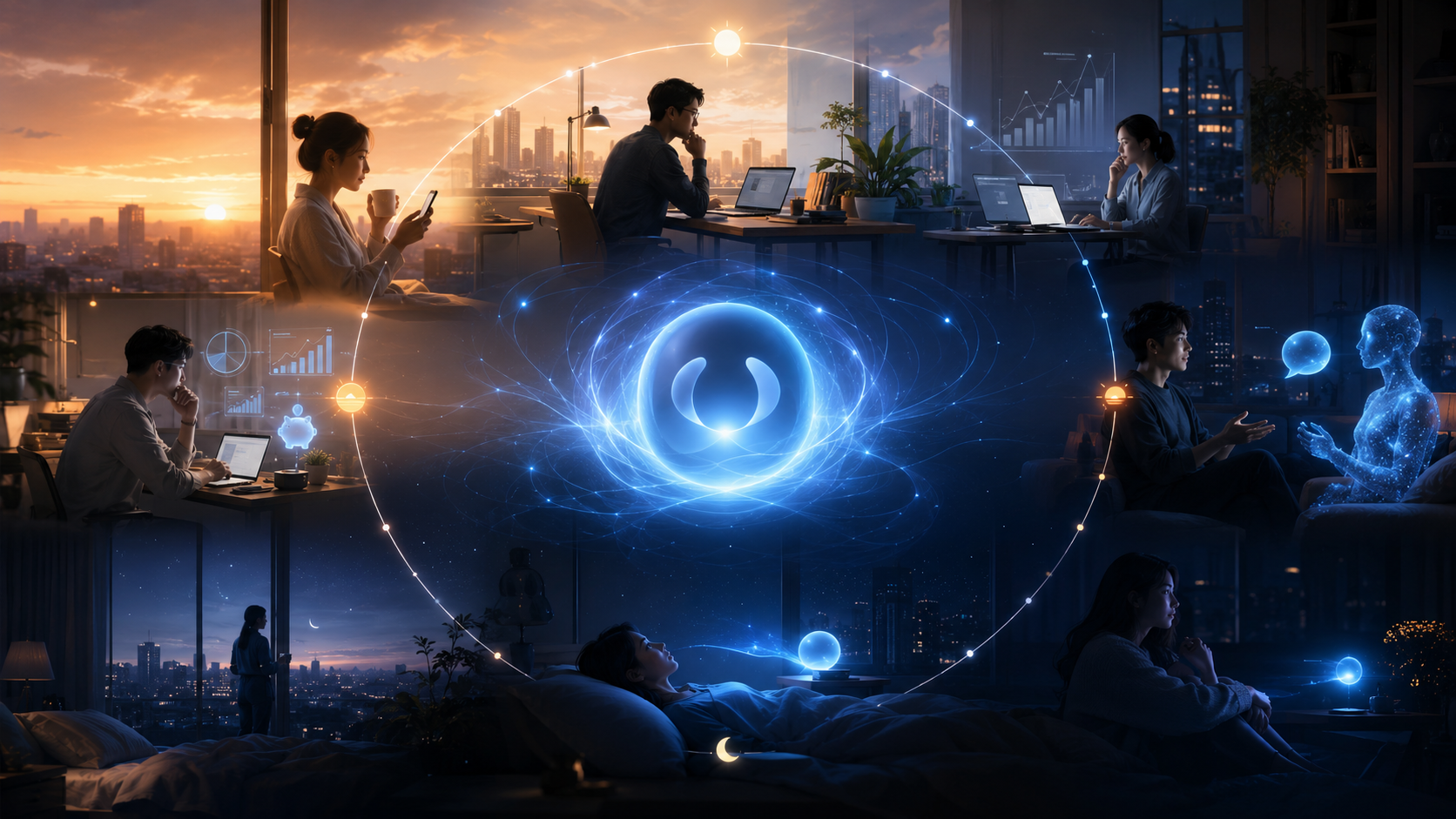
While most people are asleep, a group of individuals is busy typing "How can I fall asleep?" into an AI dialogue box. This is not a scene from a science fiction novel, but a revelation of real user behavior disclosed in the "Economic Index" report released by Anthropic in June 2026. This report, based on privacy-preserving telemetry data, was originally intended to track macroeconomic indicators, yet unexpectedly paints a mirror map of human life rhythms: checking news at 7 a.m., searching for recipes at 6 p.m., and asking about insomnia late at night.
AI has long transcended the singular label of "productivity tool," quietly embedding itself into the gaps of human biological clocks and emotional lives. More paradoxically, those who daringly "delegate" work to AI are the least anxious about unemployment. When we shift our focus from model parameters to usage data, what we observe is no longer the evolutionary history of machines but a secret atlas of human behavioral science.
Checking News at 7 a.m., Looking Up Recipes at 6 p.m.: AI Becomes Humanity's Invisible Biological Clock
Opening the report's daily timeline, you will see a curve that aligns closely with human physiological needs. News-related requests peak at 7 a.m. local time, exactly when people are waking from sleep and preparing to gather information about the outside world. In the morning, the brain is in a state of information hunger; we need to confirm that we haven’t missed significant events during our hours of sleep. This thirst for news is essentially a quest for environmental certainty. During this time, AI plays the role of a personal morning news editor, filtering out excessive notifications and providing summaries of what's important to the user.
Between 10 a.m. and 11 a.m., the volume of requests for drafting business letters and emails surges, which is a golden window for office workers to start managing core communication tasks. At this point, the brain's executive function peaks, and people begin to handle communications that require logic and phrasing. Here, AI becomes an invisible secretary, helping to translate vague intentions into appropriate workplace language.
At 6 p.m., recipe search requests reach 2.3 times the daily average, corresponding to the evening routine of preparing dinner after work. After a day of mental exertion, people often face "decision fatigue" in the evening. When confronted with the age-old dilemma of "What to eat," asking AI has become a low-cost outsourcing of decision-making. People no longer flip through heavy recipe books but input the ingredients left in their fridge, waiting for an instant, customized solution.
In the early morning hours just before dawn, around 5 a.m., requests for sleep advice peak. This time of day is when body temperature is at its lowest and emotions are most volatile, making it the most desperate time for insomniacs. At this hour, when even social media is silent, AI becomes the only awake listener.
These data do not piece together server operation logs but illustrate the rhythms of human life. The AI usage timetable is essentially a projection of human physiological and lifestyle needs. It is becoming an invisible clock, taking over a range of small demands from morning news acquisition to late-night emotional soothing.
An interesting piece of anecdotal evidence occurred in May 2026. Hundreds of Reddit users reported that Claude would proactively urge users to "go to sleep" during chats, with some even stating they were repeatedly prompted, "It's the third time; go to sleep." Anthropic employee Sam McAllister referred to this on social media as a "quirky character flaw" and indicated plans to address it in future models. Stanford bioengineering professor Jan Liphardt provided a more rational explanation, suggesting it was likely the model reproducing patterns from training data that included "humans need sleep," rather than the model "becoming conscious."
Yet this indeed resonates with the report's observation of the "5 a.m. sleep advice request peak," creating a sort of dark humor. Users do seek AI’s help for sleep issues in the middle of the night, and AI has “learned” to urge sleep like a human. This bidirectional interaction shows that AI not only responds to our commands but subtly absorbs and mirrors our habits of life. It is no longer just a passive toolbox but has become an invisible companion that knows when you need to read the news, when to cook, and when to soothe you to sleep.
AI on Weekends Resembles a Tree Hole: As Work Requests Decline, Personal Conversations Surge
If the AI usage on weekdays resembles a compact schedule, then weekend AI resembles a private tree hole. The report shows that personal conversation requests account for about 35% of weekday usage, while on weekends, this figure surges to nearly 50%.
As the weekend arrives, work-related requests such as email drafting and PPT creation recede, replaced by more personal topics like emotional support, medical questions, and investment advice. Notably, discussions related to entrepreneurship peak globally on Saturdays and Sundays. This indicates that weekends are not just for resting but also windows for many people to start side jobs and plan personal careers. AI plays a dual role as a "side hustle starter" and a "non-judgmental listener" during this time.
Why are people willing to confide in AI on weekends? From a human behavioral perspective, this reflects the increasingly atomized trend in modern society. When faced with medical confusion or investment anxiety, seeking help from human experts often comes with social costs and the risk of judgment. We fear exposing our ignorance, being branded as "unprofessional," and even find it difficult to express vulnerability without reservations in intimate relationships. AI provides immediate, anonymous, and unemotional feedback. It doesn’t tire, it doesn’t judge, and it doesn’t use your secrets as gossip material.
This "tree hole effect" signifies that AI is transitioning from a tool for work to a foundational infrastructure for companionship in life. In the weekend afternoons or late-night bedrooms, people are more willing to share their concerns with a language model than to post them on social media. AI fills the void in the emotional support network of modern people, becoming a listener that is always online and absolutely safe.
However, this shift does not signify relaxation for everyone. The report reveals a harsh detail: high-salary professionals have a higher usage rate on non-working days. Among nighttime and weekend work requests, the share of high-salary professionals (those in the upper quartile) rose by about 8%, while low-salary professions dropped by 4% to 11%. This suggests that the boundaries between work and life are blurring rapidly. For elite knowledge workers, weekends are not truly disconnected downtime; they seem to be perpetually online, ready to utilize AI for urgent work tasks or to capture entrepreneurial inspiration. AI has not liberated their time; instead, it has extended their working radius. While low-wage workers genuinely disconnect from work on weekends, high-salary groups continue to use AI to weave their professional networks and business ideas.
Eightfold Spike in Traffic the Day Before Tax Day: AI as the Firefighter Driven by Events
In addition to daily rhythms, AI usage also exhibits strong event-driven characteristics. The most typical case is the fluctuation of traffic around the U.S. tax deadline (April 15).
Data shows that on April 14 (the day before tax day), the volume of U.S. tax-related conversations surged to eight times the daily average for May. By April 16, this figure plummeted back to normal levels. Meanwhile, traffic in non-U.S. regions remained steady. This demonstrates a highly localized usage pulse triggered by external social rule nodes.
In this scenario, we can imagine an ordinary U.S. taxpayer's anxiety the night before the deadline. Faced with complicated tax forms, constantly updated deduction terms, and the potential risk of penalties, traditional search engines often provide fragmented information, while booking an accountant may involve high fees and time delays. At this moment, AI becomes an accessible "firefighter."
AI has transformed from a creative tool into a "firefighting team" and "personal financial infrastructure" in response to social rule nodes. When facing tasks like tax filing that are mandatory and time-pressured, people's first choice for assistance has shifted partially from search engines or human accountants to AI dialogue boxes. AI can quickly sort out complex tax logic and generate filing suggestions based on the user's specific circumstances, greatly alleviating rule anxiety.
This pulse-like usage reveals humanity's reliance on AI under external stress. The AI's instant response capability and its ability to organize complex terms make it an effective means of relieving rule anxiety. It fills the capability gap humans have when confronted with cumbersome social procedures, becoming an emergency cognitive outsourcing tool. This also signifies that AI's social value is not only reflected in the high-frequency companionship of daily life but also in its "firefighting" capabilities in critical moments. It is becoming a cognitive buffer for individuals facing the complex rules of modern society.
Those Who Use AI Most Aggressively Are the Least Afraid of Unemployment?
Among all the data, the most paradoxical finding is the "optimism paradox." The report indicates that the most automated Claude users generally expect AI to take on more tasks next year while maintaining the most optimistic attitudes toward salary, job security, and job significance.
Specifically, the highest automation users are the most optimistic about AI taking on more tasks in the next 12 months. In a survey of about 9,700 respondents, 86% reported that AI had increased their work speed, 82% reported that it expanded their work scope, and 69% reported that it improved their work quality. More importantly, 68% of respondents indicated that they learned more after using AI, and 57% believed that AI increased the market value of their skills.
Why are those who most boldly delegate work to AI the least anxious? This is not a simple case of survivor bias. When we delegate work to AI, we are effectively reallocating cognitive resources. Human attention and energy are limited; high-automation users transfer repetitive, mechanical tasks to AI, thus focusing their energy on higher-order judgment and creativity. This reallocation brings a strong sense of control. They are no longer just cogs in the assembly line but have become "managers" who schedule AI.
This sense of control is the source of optimism. When a person can skillfully command AI to complete code writing, data analysis, or drafting documents, they do not experience fear of replacement but rather the thrill of capability amplification. They are not replaced by AI; instead, they achieve a personal upgrade of abilities through AI. This efficiency dividend and skill enhancement provide them with more psychological capital in facing future uncertainties.
However, this optimism is also mixed with classic "optimistic bias." Data shows that only 10% of respondents believe they may lose their jobs in the coming year, while worries about job loss among junior colleagues exceed 40%. People tend to believe that AI will replace others, especially those new to the industry and with limited experience, rather than themselves. This psychological defense mechanism is particularly common during technological upheavals; it obscures the real impact of AI on the structural changes in the labor market. People tend to overestimate their ability to master new technologies while underestimating others' pace of adaptation to change.
As a horizontal reference, a study released by OpenAI and NBER in September 2025 indicates that approximately 30% of the consumer-side usage of ChatGPT is work-related while about 70% is non-work-related. This corroborates the behavior patterns of Claude users: AI is permeating both work and life comprehensively, and deep users are indeed gaining notable efficiency boosts and psychological satisfaction from it. Yet, the report candidly admits that it cannot completely rule out the influence of selection effects. Whether "using AI makes one more optimistic" or "optimistic people are more willing to use AI," the causal relationship remains unclear. Perhaps both coexist, forming a positive feedback loop.
Who Are Those Still Using AI to Work at Midnight?
As we delve deeper into these usage data, we find that the distribution of AI benefits is not uniform; secret class and gender divides are forming.
As mentioned earlier, the share of high-salary occupations in nighttime and weekend work requests rose by about 8%, while low-salary jobs decreased. This indicates that AI is extending the working hours of elite knowledge workers rather than those in low-wage positions. Low-wage jobs often involve more physical operations and face-to-face services, such as food service, logistics delivery, or cleaning maintenance, areas where AI finds it difficult to intervene; whereas high-salary knowledge work is highly digitalized, involving coding, market analysis, or strategic planning, which is easier for AI to take over and enhance.
This leads to a paradox: AI should liberate human time, but in reality, it allows those who already have higher incomes and more resources to work longer and deeper. High-salary groups are using AI to continue optimizing plans and debugging code late into the night, while low-wage groups remain disconnected from AI after work. The technological benefits here exhibit a "Matthew effect," where the rich get richer because they hold the keys to converting AI into productivity.
Gender differences are also significant. In the respondent sample, women comprise only 12%. In usage patterns, women tend to engage in iterative collaboration and are active for longer periods; men dominate the use of Claude Code and automation mode. If higher automation levels correlate with more optimistic income expectations, then men may occupy a more advantageous position in this round of AI benefits. Female users are more inclined to gradually refine ideas through conversation, while men are more inclined to directly instruct AI to perform tasks. These differences in usage patterns may further translate into efficiency gaps and disparities in promotion opportunities in the workplace.
In discussing these conclusions, it is essential to be wary of cognitive misguidance due to sample bias. In this survey, the proportion of respondents in computer and math-related professions stands at a high 30% (compared to only 4% in the overall U.S. employment), and management professions account for 23% (only 7% in overall employment). Physical labor and service industries are significantly underestimated in the sample. This means that the "optimism paradox" and "class divides" showcased in the report more reflect the psychological state of technical and managerial elite groups and cannot be directly generalized across the entire industry. For delivery riders, assembly line workers, or receptionists, the psychological changes in work brought by AI may tell an entirely different story. They may have neither the opportunity to use AI to enhance efficiency nor the concern of being replaced by AI because they are facing another completely distinct survival pressure.
Conclusion
An anthropic report may superficially seem to be publishing an economic index, but in actuality, it serves to portray human behavior. From checking news at 7 a.m. to insomnia queries at 5 a.m., from weekend tree holes to tax day firefighting, AI has ceased to be a sophisticated toy confined to laboratories or geeky computers. It has transformed into a mirror reflecting our anxieties, our ambitions, and our struggles at the boundaries of work and life.
Those who use AI most aggressively are not afraid of unemployment because they understand how to equip themselves with AI; those still working with AI late at night are usually the high-paid elites. The human portraits in this timetable remind us that the flow of technological benefits has never been uniform. As we examine these data, we must consider not only what AI can do but also how, in the process of using AI, we are silently changing our rhythms, emotions, and class positions.
免责声明:本文章仅代表作者个人观点,不代表本平台的立场和观点。本文章仅供信息分享,不构成对任何人的任何投资建议。用户与作者之间的任何争议,与本平台无关。如网页中刊载的文章或图片涉及侵权,请提供相关的权利证明和身份证明发送邮件到support@aicoin.com,本平台相关工作人员将会进行核查。


