Author: Rita
Trend Guide
Goldman's Asian equity strategy team presented a seemingly contradictory viewpoint in their second half handbook released at the end of June: continue to hold onto winners, and don't approach those lagging behind.
Data from the report shows that the MXAPJ index rose 21% in the first half of the year, but almost entirely supported by technology stocks from South Korea and Taiwan. Excluding these two markets, other regions in Asia actually dropped 9%. Goldman's logic is straightforward: profit growth is the hard reality that determines stock prices, and North Asia's leading advantage in this area will not change in the short term. Therefore, the key in the second half of the year is to see whether these hardware and chip companies that have already risen can continue to deliver profits.
Concentration of Winners in the First Half
Looking at the data, the MXAPJ index rose 21% in the first half of the year, but 96% of this increase came from 8 stocks. If you exclude South Korea and Taiwan, other regions in Asia are negative, dropping 9%. Japan has a similar structure, with the tech-heavy Nikkei 225 rising 38%, while the broader Topix index only increased by 16%.
This extreme concentration is backed by a huge gap in profit growth rates. Goldman estimates that the MXAPJ earnings per share will grow by 60% by 2026, with South Korea contributing 320% and Taiwan contributing 48%. ASEAN and Australia only see mid-single-digit growth. This is why South Korea rose 119% this year, and Taiwan rose 56%. Goldman conducted a historical backtest and found that in the past 30 years, only 5 years simultaneously met the conditions of over 10% growth in the first half and upward revision of profit expectations. The average return in the second half of these 5 years was 13%, while at other times it was only 2%. Now the Asian market just happens to fall within this "good signal" range.
Profit Growth Determines Everything
The core logic of Goldman strategists can be summarized in one sentence: 80% of returns in the Asian market rely on profit growth or upward revisions of profit expectations. Earnings growth in Asia is expected to drop to 22% in 2027, but it is still higher than in other regions globally. South Korea and Taiwan are at the core of the chip industry, and their earnings growth hinges on one thing: the supply-demand gap in memory chips.
Goldman's semiconductor analysts estimate that global computing demand will increase 24 times by 2030, mainly driven by AI. However, the supply of memory chips is lagging. By 2025, there is already a record supply gap in DRAM and NAND, which is expected to widen by 2027, and may not ease until 2028 or even 2029-2030. The supply-demand imbalance has pushed chip prices up, coupled with high leverage in the memory industry, profits have been rising even faster than prices. This is the direct source of South Korea and Taiwan's high profit growth.
Macroeconomic Environment Shifts to Re-Inflation
The macro backdrop for the second half is also improving. The war risks in Iran have eased, and oil prices have dropped significantly. Goldman's commodities team has revised its forecast for the Brent oil price in the fourth quarter of 2026 from $90 to $80. For energy-importing countries, falling oil prices improve growth prospects and reduce inflationary pressures. Goldman expects global GDP growth in the second half to return to an annualized rate of 2.6%, with China reaching 4.7%.
In terms of monetary policy, the Federal Reserve has signaled a hawkish stance, and the market is expecting a potential rate hike in the second half. The dollar may strengthen somewhat in the short term, but looking ahead to 12 months, most Asian currencies are currently undervalued with room for appreciation.
Six Overweight Themes
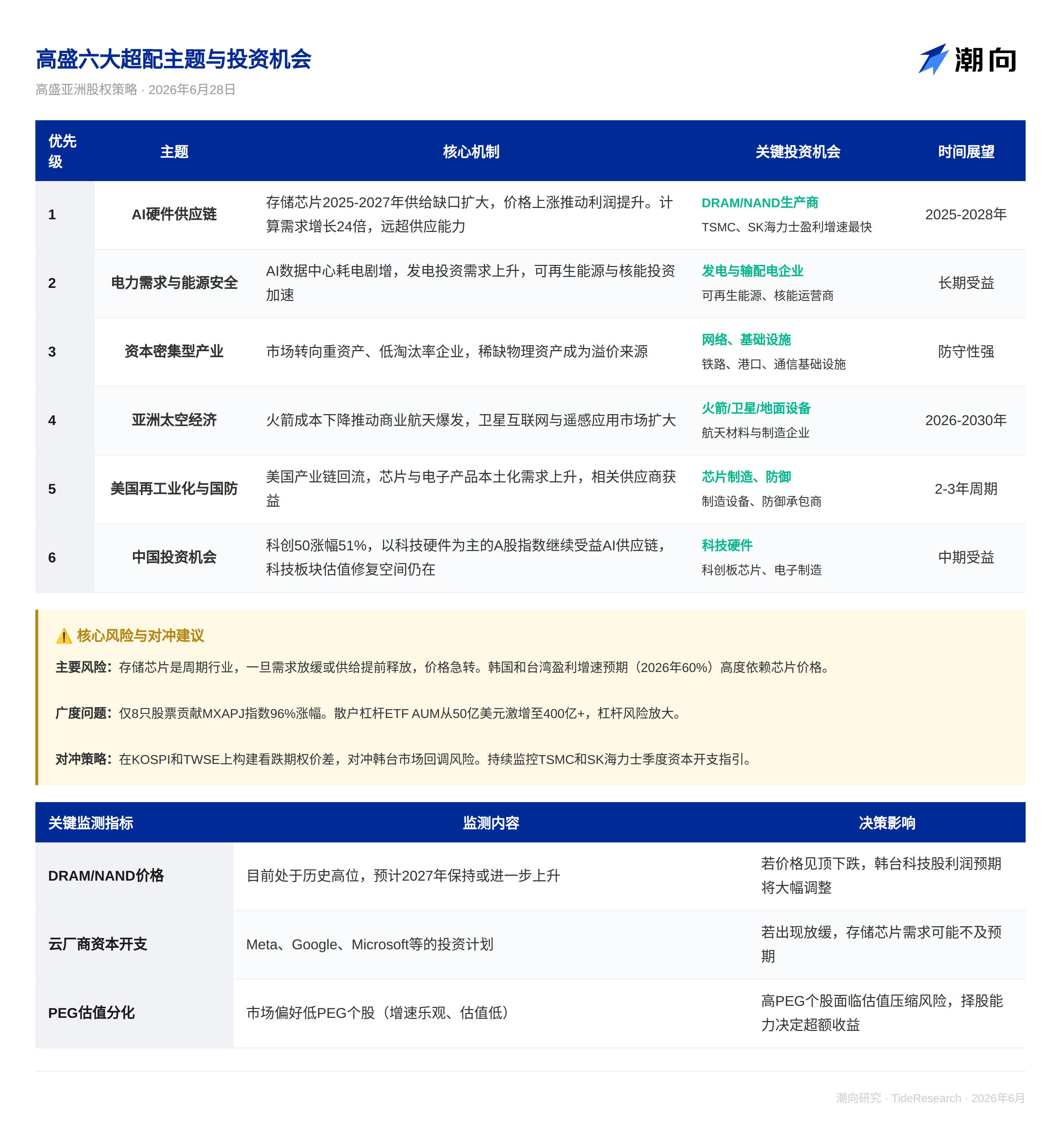
Goldman continues to favor six directions in the second half.
The top priority remains the AI infrastructure supply chain. By 2030, global computing demand will rise 24 times, and the supply of memory chips cannot keep up, with a record gap already appearing in 2025, and expected to widen by 2027. Chip prices are rising, and producers' profits are increasing accordingly.
Other themes include: electricity demand and energy security, capital-intensive industries, U.S. reindustrialization and defense, investment opportunities in China, and a newly added space economy. As AI computing power rises, investment in power generation must keep pace. The space economy encompasses rockets, satellites, ground equipment, and aerospace materials, supported by policies with demand is also rising. In the A-share market, the STAR 50 has risen 51% this year, and technology hardware-focused indices will continue to follow the AI supply chain.
Specific Market Allocation
Goldman's weight adjustments are as follows: South Korea and Taiwan remain overweight, with 12-month targets of 12,000 points for KOSPI (corresponding to 46% U.S. dollar return) and 51,000 points for TWSE (18% return). China A-shares are overweight, with a target of 5,500 points for CSI 300 (18% return). Japan is overweight, with a target of 4,400 points for Topix (17% return). China's offshore, Hong Kong, and Singapore are benchmark, while Australia, Thailand, and the Philippines are underweight. The 12-month target for MXAPJ is 1,080 points, corresponding to a total return of 25%. In terms of sectors, overweight is placed on technology hardware, capital goods, and banks.
Four Major Risks
The report also outlined four key issues to watch.
First, market breadth is too narrow. Eight stocks contributed 96% of MXAPJ's increase this year. Once these stocks start to adjust, the entire Asian index will likely drop as well.
Second, retail investors are leveraging. The size of leveraged ETFs in South Korea has surged from $5 billion at the beginning of the year to over $40 billion, amplifying index volatility.
Third, there is the issue of valuation. Goldman assessed 11 sub-sectors within the technology hardware supply chain, concluding that valuations and growth are generally aligned, but there is significant variance between individual stocks. Recently, the market has favored stocks with low PEG ratios, which also have more optimistic revenue growth expectations (26% vs. 21%).
Fourth, new stock issuances are increasing. However, relative to market capitalization, they only account for about 1% to 1.5%, which is reasonable.
Trend Perspective
The core hypothesis of Goldman's report is "profit growth can support stock prices," but the most fragile link here is the 60% and 22% profit growth rates in 2026-2027, which largely depend on memory chip prices maintaining their levels. Memory is a strongly cyclical industry, and as soon as demand slows down a bit (for instance, if cloud providers stop spending money), or if supply comes in earlier, prices can flip quickly.
The report mentions issues of retail speculation and concentration in its risk section, but does not sufficiently discuss the tail risk of reaching the peak of the memory cycle. Goldman's overweight advice on South Korean and Taiwanese tech stocks naturally carries a bullish bias typical of sell-side research reports.
For investors, the narrative around AI is shifting from "storytelling" to "performance evaluation." However, once the turning point in the hardware cycle arrives, its impact could be more severe than in software due to inventory, capacity, and capital expenditure discipline. This is a critical variable to monitor through quarterly capital expenditure guidance from TSMC and SK Hynix.

Disclaimer
This article is a compilation and interpretation of third-party brokerage research reports by Trend Research. The ratings, target prices, profit forecasts, and related judgments quoted in the article are the opinions of the respective brokerage's analysts and only represent their institution's stance, not that of Trend Research, nor do they constitute any investment advice.
The market carries risks, and decisions should be made independently. This article should not serve as the basis for buying or selling any securities.
Data Source: Goldman Sachs Asia Equity Strategy Report (Timothy Moe Team, June 28, 2026)
免责声明:本文章仅代表作者个人观点,不代表本平台的立场和观点。本文章仅供信息分享,不构成对任何人的任何投资建议。用户与作者之间的任何争议,与本平台无关。如网页中刊载的文章或图片涉及侵权,请提供相关的权利证明和身份证明发送邮件到support@aicoin.com,本平台相关工作人员将会进行核查。


