Author: Dave.𝟎𝐱U
Half of 2026 has passed. Mid-year is a good time for reflection, and this year we have experienced several waves of magnificent market movements across various assets. Recently, with rare free time, I decided to restructure my trading system.
1. Market Cognition
The market is not a price curve; the market is a diverse high-dimensional system. In other words, it has many influencing factors and many explanations. According to Floris Takens' embedding theorem: as long as we continuously record a low-dimensional information for long enough, we can infer the high-dimensional structure. Because time is a hidden dimension, continuous local low-dimensional data can help us reconstruct the high-dimensional structure.
What inspires our understanding of the market from this theorem?
The market is diverse, with many interpretations; no single trading perspective is completely right or wrong. Therefore, methodologically, do not pursue a single trading bible, as all methods have their rationale. Even relying entirely on insider information or even metaphysics can have a self-consistent logic. The premise is to maintain coherence because the theorem states that we need to continuously record low-dimensional information.
So from now on, do not look down on anyone else's trading logic, and do not underestimate your own trading abilities. The most important thing is to find a trading method that fits within your comfort zone.
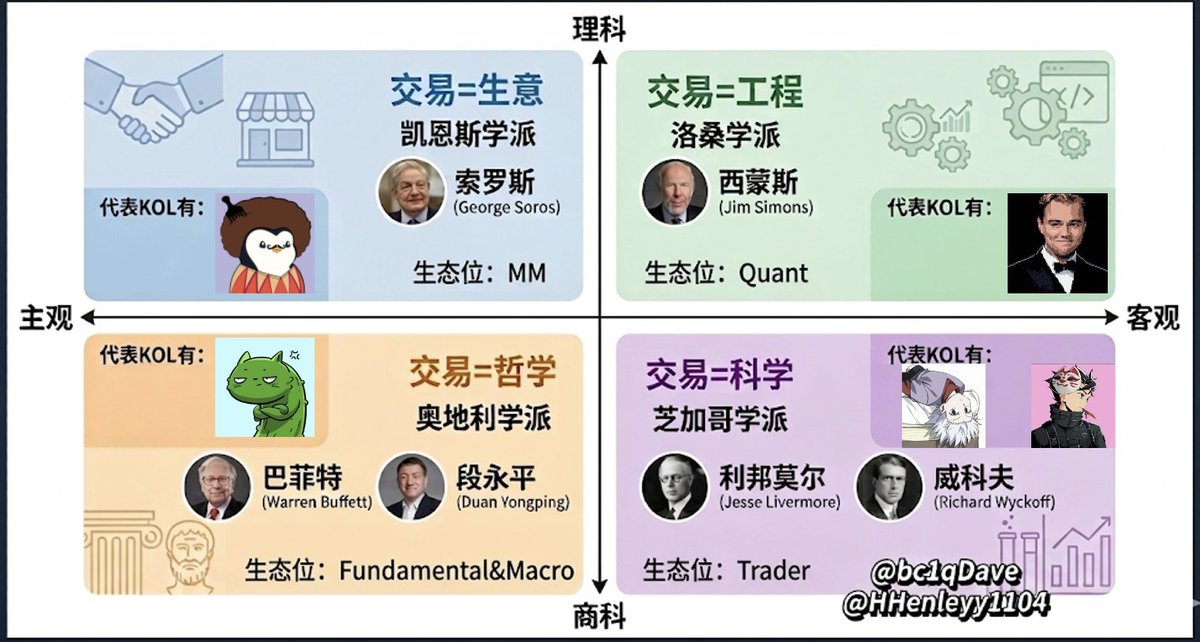
I previously posted a tweet that includes a diagram, which is a systematic presentation of this cognitive framework.
2. Main Line of Trading Logic
Capital is the ruler in my eyes. All price increases of assets come from capital. Please do not misunderstand; this capital does not refer to a specific "big player"; it is a manifestation of market forces. Capital can come from so-called major players or traders, and it can also come from retail investors.
Capital is a primary variable. Similar to a high-dimensional environment, many physical properties may seem basic, but they actually derive from a more fundamental variable. Grasping this fundamental variable allows you to capture the main line of the physical world.
For example, time is an extension property of space, tightly coupled through Lorentz transformation. When space is absolutely still, this space also has no concept of time. In general relativity, both time and space are products of gravity, which can warp spacetime. Thus, by grasping the line of gravity, we can analyze the transformation of spacetime. In the market, capital is this gravity.
Where there is capital, there is the concept of finance, the concept of the market, and the concept of trading. Therefore, when trading, you must choose places with ample capital, which we sometimes call "liquidity". Trading must also follow the habits of capital, focusing on:
Discrepancies in capital
Consensus in capital
Pricing cycles of capital
Local structures of capital
Participating groups in capital
And so on
To reiterate, capital is a broad concept, not merely referring to following big players or simply following the main force. This perspective of following capital can span all trading markets:
1. In the crypto space, "big coins": calculate the cost and profit of major funds, calculate external capital resistance
2. Global consensus assets like gold: analyze which funds dominate pricing in each wave, analyze pricing laws across major asset classes
3. Even in the art market: which artists are currently attracting capital, possessing liquidity and capital preservation consensus
The capital mentioned above is not an abstract liberal arts concept but a method that can be directly applied to trading. Here is a glimpse of a fundamental pricing rule: no major asset class will experience a V-shaped reversal
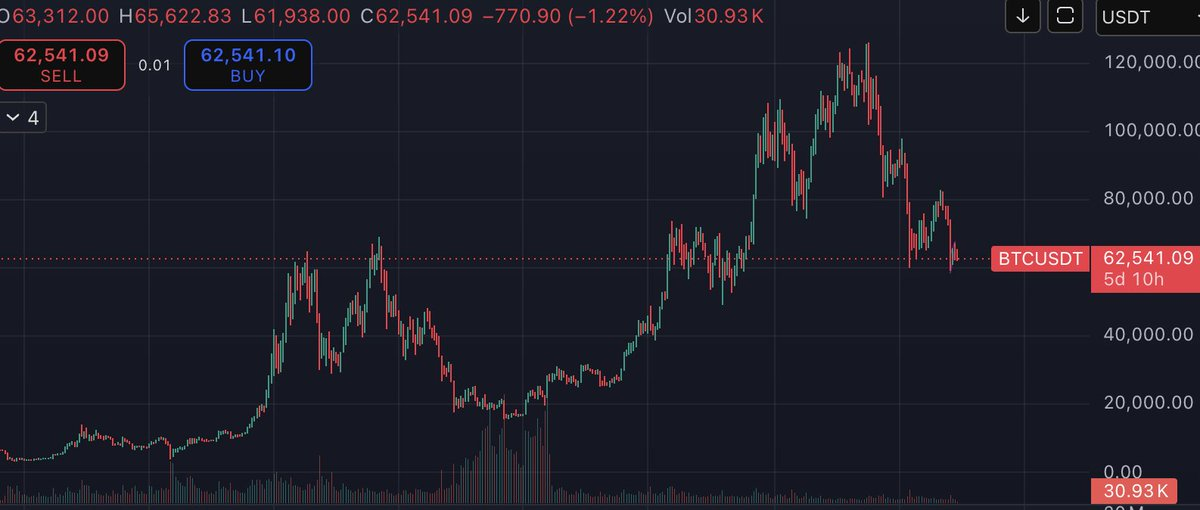
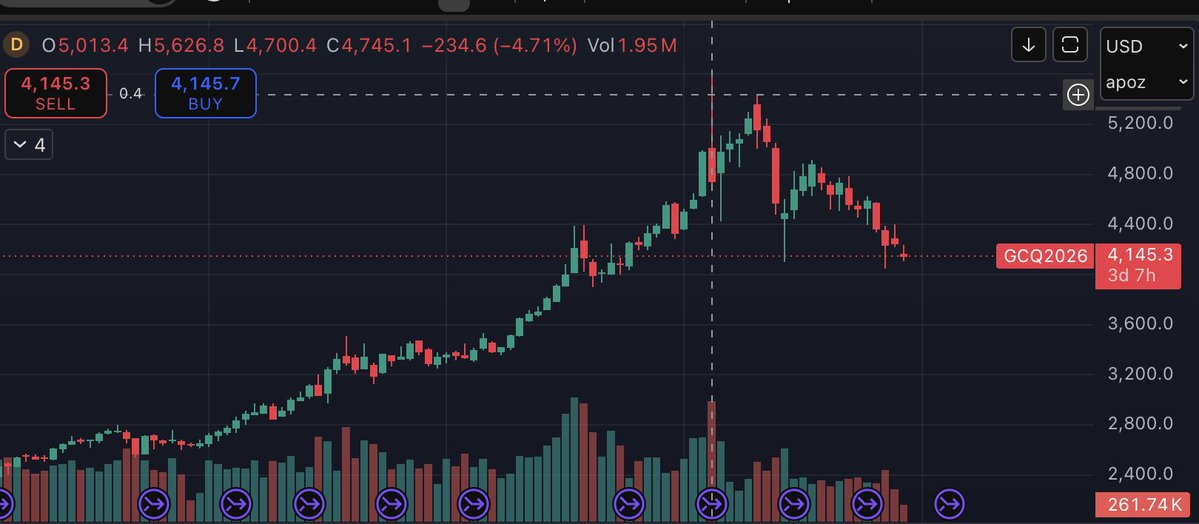
We have seen that Bitcoin in each wave does not flip directly at the peak; all gave time for turnover. From the first round of funding discrepancies appearing in the weekly chart in 2020 with a double peak structure to the second round of repricing. It was not as good as the recent rebound after the gold flash crash back to the previous highs; the underlying logic of this pattern is: major asset pricing involves multiple capital participants, and the psychological expectations of these participants cannot simultaneously reverse. If all capital expectations synchronize, during a significant rise, no one should chase high; everyone should start buying at low; during a decline, no one should buy at the bottom; everyone should sell at high, which is obviously unreasonable.
Thus, after the first wave of decline, there will certainly be capital that continues to follow the original logical inertia for the second wave. The second wave might reach a new high; they might succeed in triggering a new market phase, or they might find insufficient buying volume and be pushed down, ending the phase.
Capital is the main line of my trading logic. Looking back at other logics, for example, technical analysis — the lines are drawn by capital; fundamental analysis — the fundamentals guide the capital. If capital sees good fundamentals, it may come in to buy, thus driving the price. However, good fundamentals do not necessarily mean that capital will definitely come in. For instance, Ethereum has strong fundamentals in the crypto space but performs at a weaker level. Similarly, quant trading relies on a thriving capital market. Because there are more low-cognition capital participants here, quant trading gets more opportunities for arbitrage, market-making, and trend development. If you don't believe this, you can ask how the return rates of quant firms in the crypto space are doing now.
3. Participating Assets
Based on capital participation groups, there are four types of assets I will participate in:
1. Major assets as macro liquidity vehicles: such as Bitcoin, gold, and even some commodities
2. Specific targets with strong manipulation: including manipulation in U.S. stocks and major coins in the crypto space
3. High-quality assets reflecting productive progress: like the Nasdaq index, this type of asset is heavily invested by major human capital
4. High-odds alternative assets: specifically referring to on-chain meme coins. I'm truly not skilled in betting on sports or opening jade stones.
4. Position Management
Position management is a dynamic process; it involves not only the size of on-platform funds but also a complex integrated system. Different entry ages into the market, varying market levels, and different career developments should correspond to different position management philosophies, which relate both to external market conditions and to personal development and even family circumstances. A one-size-fits-all approach does not work.
For example, to correct a misunderstood cognition regarding position management, does every trade need to have a stop-loss?
99% of people believe that a systematic trading strategy must include a stop-loss for every trade, but this is actually not correct. Taleb wrote a paper titled "trading with stop", which clearly points out the qualitative difference in return distributions between trades with stop-losses and those without.
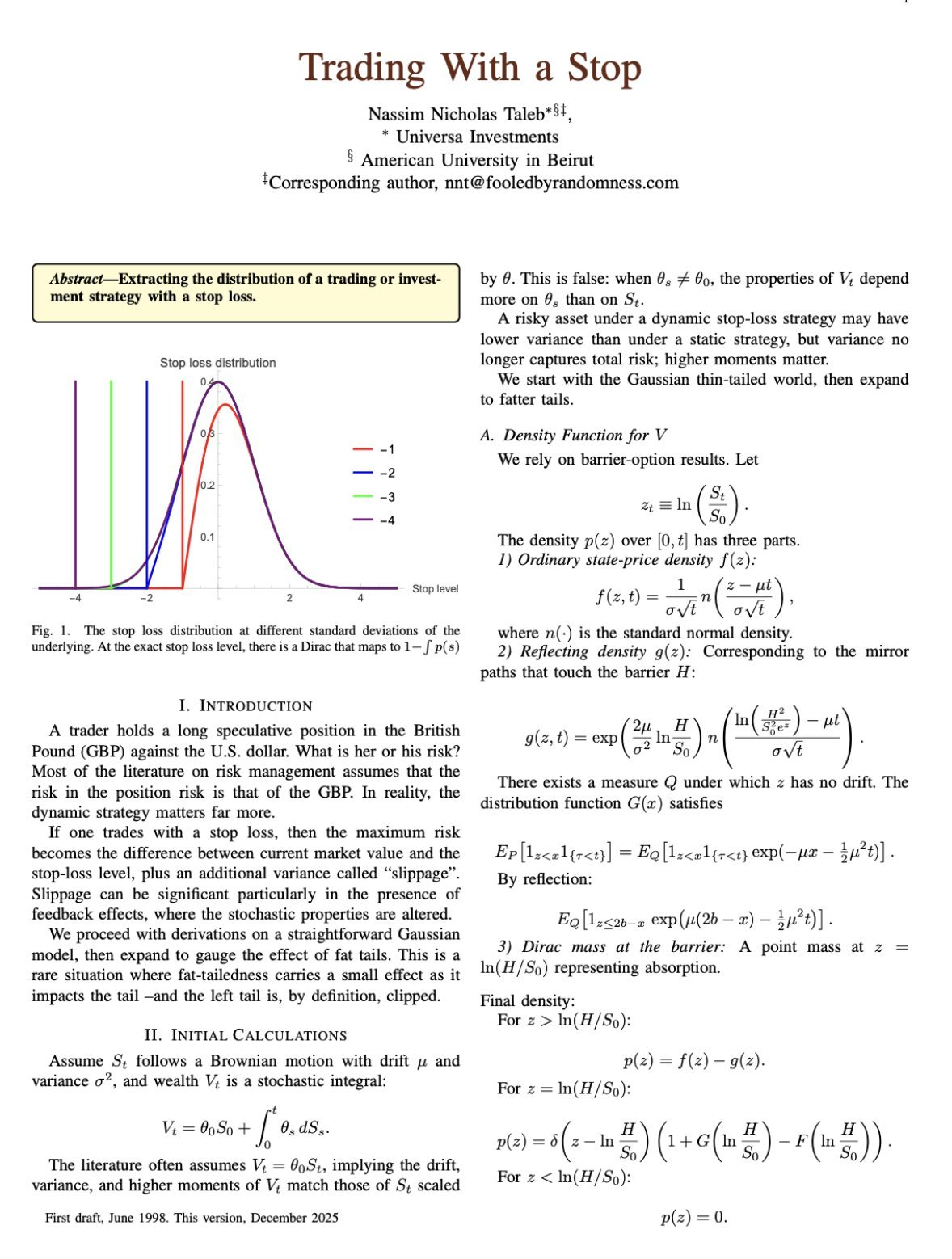
In simple terms: trades without a stop-loss have a continuous return curve, which is the original asset price. Once a stop-loss is applied, your returns are cut off by a hard threshold. Furthermore, the logic of re-entering or adding positions needs to be entirely reconstructed. The main point he wishes to convey is that while applying stop-losses, we pay a huge potential profit cost. Therefore, do not blindly apply stop-losses; set them wisely. The original text is worth reading; it is quite brilliant.
Thus, within my trading system, position management is a highly dynamic process. It is not about managing positions but rather about managing one’s life. Of course, others' trading systems may employ clearer position management standards; for example, some traders may set a hard stop-loss line of 2% for each trade. Others may refrain from trading if losses reach 8% within a week. Meanwhile, hedge funds typically establish maximum position limits.
These little tricks are acceptable. My attitude is that there is no fixed method, but regular reviews are necessary.
5. Sources of Trading Profit
I need to answer why my trading system can make me money:
1. Choosing the right market, a complete trading system should make money.
In the fiercely competitive Asian society, many have a mistaken mindset that one must be better than others to succeed. However, success does not necessarily come from competition; everyone can succeed together.
In an upward-developing economic society and financial market, as long as there is a complete trading system and coherent trading logic, following Floris-Takens' embedding theorem, one can roughly judge the market direction, and it should lead to profit.
Many Chinese friends are suffering in A-shares and the crypto space, feeling that making money in trading is a high-level skill. Yet friends who invest regularly in the Nasdaq, those who invested in the Korean composite index, and even those who began investing in gold a few years ago do not see it that way.
2. My professional advantages allow me to make money
Peter Lynch delivered a brief talk, where he expressed his confusion over why doctors and auto workers jumped on popular oil stocks, despite the fact that auto companies and pharmaceutical firms at that time also had very strong quality assets, and these professionals could discern underlying logic others hadn't discovered yet based on their industry knowledge. Yet, they wouldn't study their industry; instead, they follow trends and buy popular stocks.
I work in half of the financial industry and have significant reflections and experience in trading, and I will continue to optimize my trading system. Given these prior advantages and Bayesian updates, I should have better trading profitability than retail investors on platforms like Xiaohongshu.
This is not my privilege. Anyone can review their trading system and leverage their existing abilities and resources, becoming an expert in a particular sector.
3. Special Market Knowledge
Many markets have cyclical characteristics, such as: 1. Semiconductors, 2. Oil, 3. Real estate, etc. Due to time accumulation, I have special knowledge about the cycles in the crypto space, and even against financial professionals in institutions, I believe that my understanding of the four-year crypto cycles surpasses theirs. In cyclical markets, mastering the intrinsic characteristics of the industry often becomes the biggest advantage.
In every wave, there are always those who refuse to acknowledge the power of the industry's own cycles, telling various unique stories about interest rates, geopolitical issues, institutional directions, and using various logics to compensate; however, the largest driving logic for capital still remains the industry's inherent cycles.
Strictly speaking, I currently only have this unique advantage over the crypto space. In the future, I need to learn and develop in 2 to 3 more markets, allowing for trading rotations among these three markets, which can keep me perpetually in a liquidity-rich environment.
6. Trading Tools
Trading tools are often a point overlooked by traders, but I emphasize that a trading system is not just about guessing price directions; it is a complete system. I opened an IBKR account two years ago, and recently have deeply felt the benefits it brings me.
At this current stage, my trading tools are mainly broker-based trading platforms, while also needing to address tax status issues. In the future, as my investment amounts grow, I will need to consider involving private banking, institutional accounts, trusts, and other tools, all aimed at saving costs while reducing friction in my system.
For virtual currency investment, I already have a series of channels, including yellow and black software, which I won’t elaborate on.
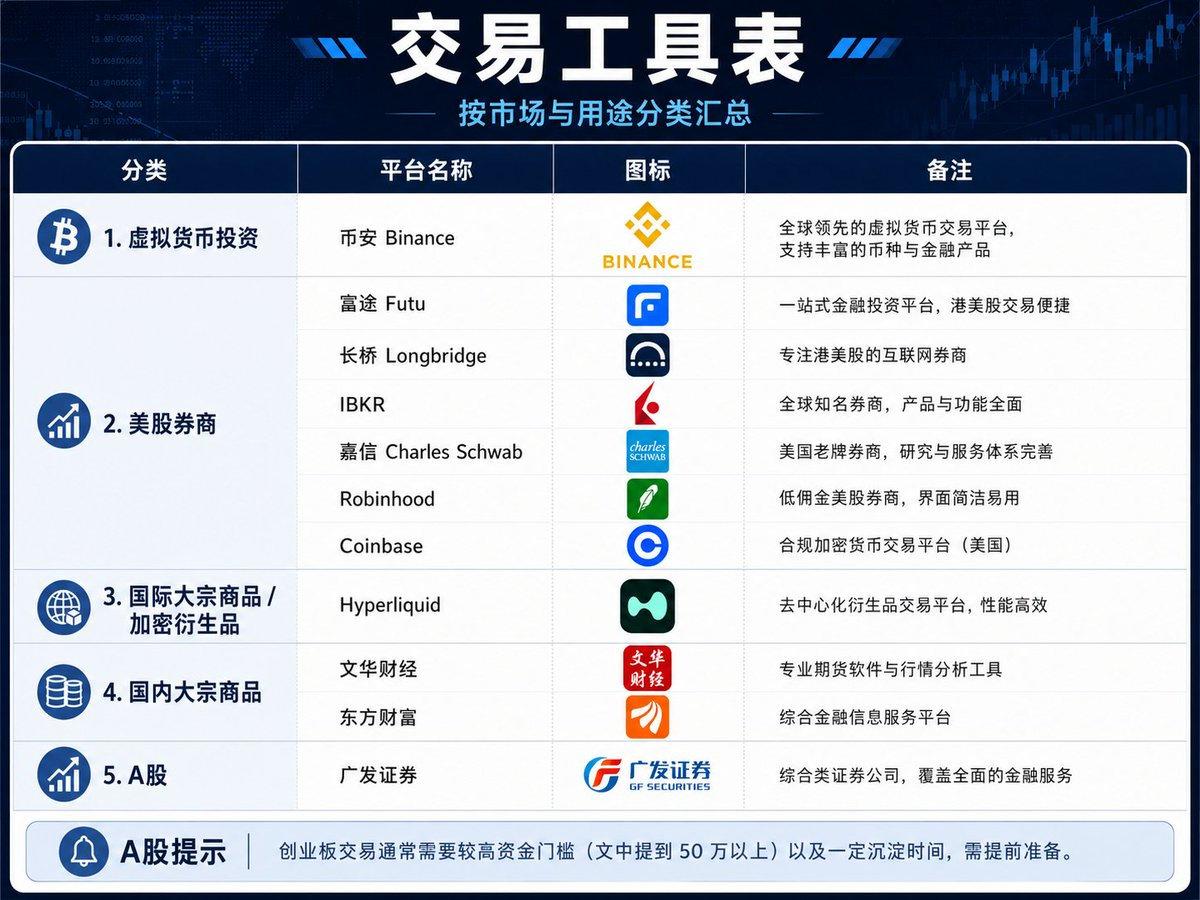
For U.S. stocks, I can open accounts with Futu, Long Bridge, IBKR, etc. Next, I need to expand to other U.S. brokers I can open accounts with, including Charles Schwab, and then try Robinhood, Coinbase, etc.
For commodities, platforms like Hyperliquid provide me with very convenient access. For domestic commodities, I still need to open accounts with Wenhua Financial and Dongfang Fortune.
For A-shares, readers should note: buying stocks on the Growth Enterprise Market has requirements. Funds need to be over 500,000, and there needs to be a certain amount of time before they can be solid. Everyone should prepare as soon as possible. I have participated less in A-shares recently, and I am currently using GF Securities. Suggestions for good A-share platforms are also welcome.
This article is a reflection on my own trading system.
I initially only intended to write it in my notebook, but then thought it could also be shared as an article with my Twitter friends. After all, my positioning is that of a knowledge-sharing blogger, and I hope everyone can gain some help. The trading system focuses on execution.
Any information that does not contribute to profit can only be considered marginal news; any reflection that does not aid in making a profit can only be regarded as literary creation.
Therefore, the most important thing is still to review trading operations and fully apply the trading system to trading actions. This article does not constitute investment advice.
免责声明:本文章仅代表作者个人观点,不代表本平台的立场和观点。本文章仅供信息分享,不构成对任何人的任何投资建议。用户与作者之间的任何争议,与本平台无关。如网页中刊载的文章或图片涉及侵权,请提供相关的权利证明和身份证明发送邮件到support@aicoin.com,本平台相关工作人员将会进行核查。


