

Every Monday, Wednesday, and Friday, we analyze the market with data, seize opportunities with trends, covering macroeconomics, US stocks, precious metals, crude oil, and crypto assets, gaining insights into key global market changes, produced by PANews.
Macroeconomic Market
The US May PCE price index rose year-on-year to 4.1%, with core PCE reaching a three-year high of 3.4%, and core month-on-month recorded at 0.3%; coupled with the first-quarter GDP revised up to 2.1%, personal income and spending both accelerated to 0.7%, but the savings rate has dropped to its lowest since 2022 at 3.0%. The resilience of consumption under high prices hides concerns. New York Fed President John Williams stated that inflation is "undoubtedly at a high level," significantly delaying the realization of the 2% target to 2028, and expecting inflation to still be at 3.5% by the end of 2026, with the unemployment rate only dropping to 4% in 2028.
Crude oil fell back to pre-war levels, with WTI crude oil breaking below $70. Iran plans to impose tolls on the Strait of Hormuz, expecting annual revenue to reach $40 billion. However, the safety of navigation in the strait faces severe challenges. Despite a previously signed 60-day temporary navigation agreement between the US and Iran, a drone attack on a ship flying the Singapore flag on Thursday heightened tensions again, causing the International Maritime Organization (IMO) to suspend evacuation operations for merchant ships in the Persian Gulf. The Iranian Revolutionary Guard is currently strongly pushing its designated route control, with the geopolitical situation in the waterway once again falling into a state of high uncertainty.
Safe-haven assets have also not gained favor, with spot gold touching below $4000 for three consecutive days, currently still fluctuating around $4000. Silver has also been below $60 for three days, having retreated more than 50% from its yearly high.OCBC Bank and trader Guy Adami both warned of short-term downside risks in a high-interest-rate environment, but Invesco believes that gold has largely digested the tightening risks of the Federal Reserve.
US Stock Dynamics
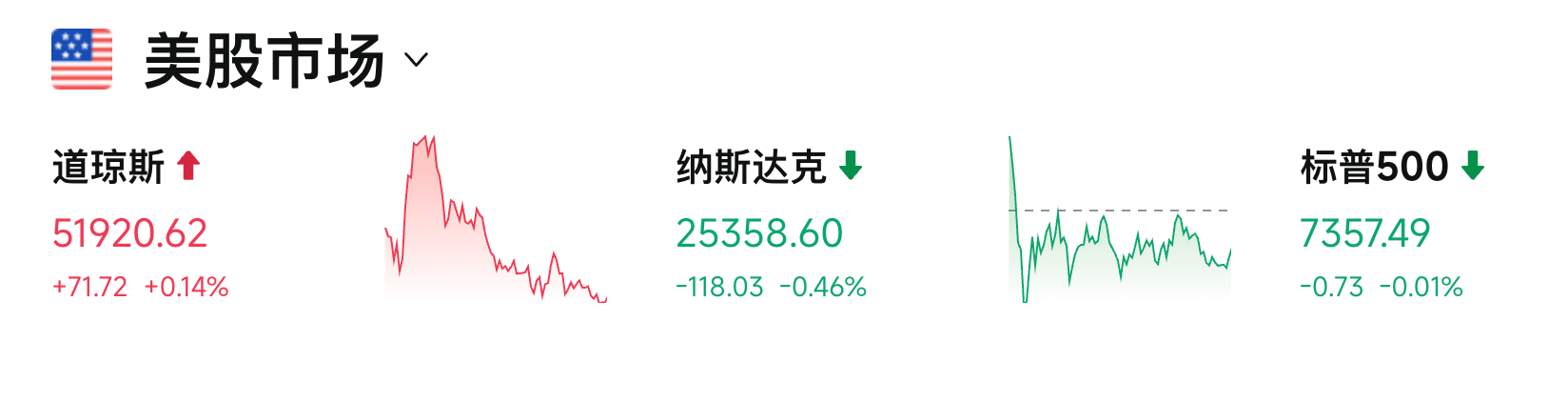
The Nasdaq fell for four consecutive days, down 0.46%, while the S&P 500 index closed flat, and the Dow Jones rose slightly by 0.14%. Meanwhile, the SOX semiconductor index surged by 3.6%, with Goldman Sachs trading desk pointing out that the market currently displays typical “cash reallocating trading” characteristics, with funds flowing from large tech stocks into semiconductor and storage chip companies. Market focus has shifted from the explosive growth of AI demand to "who can really make money."
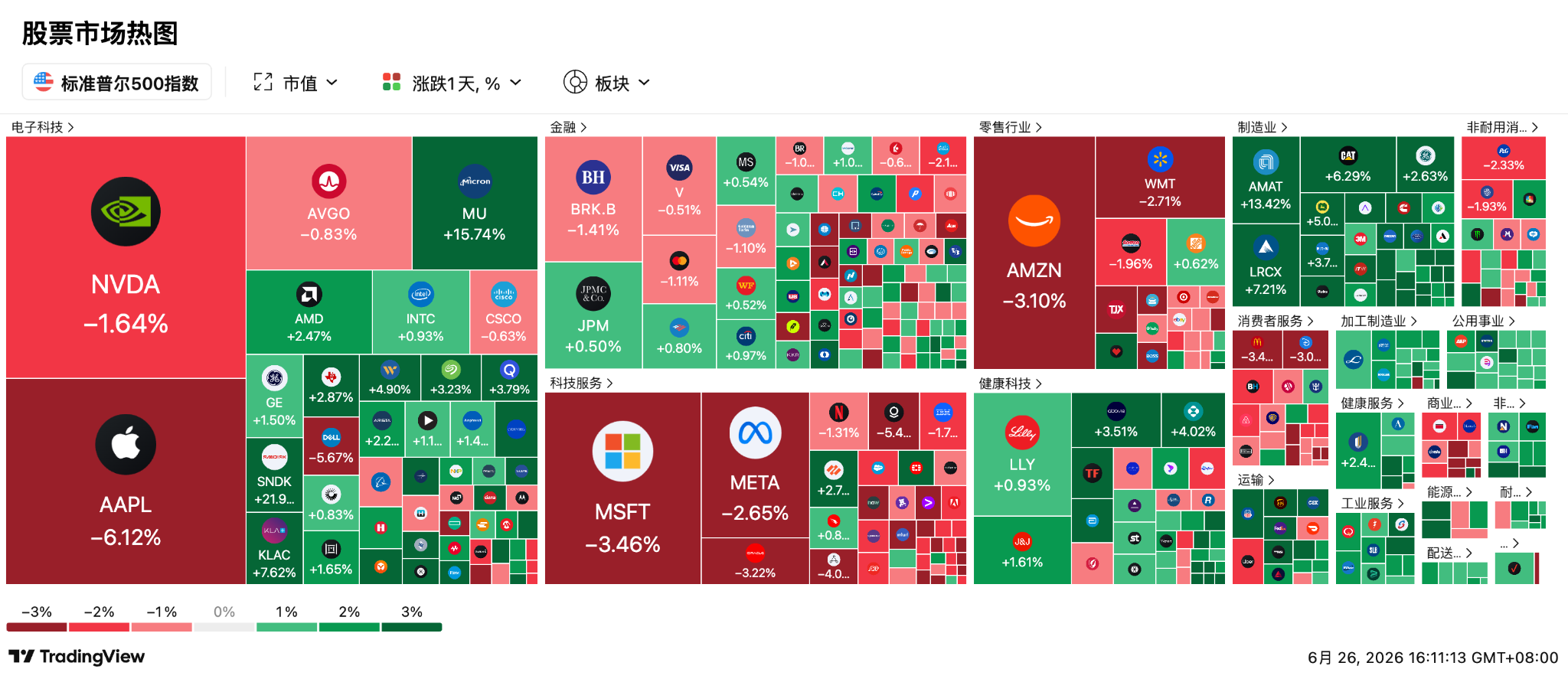
The biggest winner is Micron Technology, which surged by 19% during trading on the back of robust results, briefly surpassing Meta in market capitalization. Related storage concepts surged: SanDisk jumped by 21%, Applied Materials rose over 13%, and Western Digital climbed by 4.9%. The market is starting to realize that profits in the AI supply chain are concentrated upstream in storage, HBM, and optical communication, while cloud vendors face erosion risks in profit margins.
On another front, Apple announced a historic chip strategy adjustment, directly skipping the high-end M6 Pro/Max route and shifting to AI-centric designed M7 architecture. The basic version of the M6’s memory bandwidth has increased to 200GB/s, and the number of GPU cores has increased to 12. The company announced price increases across Mac, iPad, and Vision Pro lines, with some products increasing by up to $300, Apple CEO Cook shifted the blame for the price increases to rising upstream storage prices, and "Macflation" has officially become a new term on Wall Street. Apple's stock price plunged 6.1%, leading the decline among the "seven giants," with Microsoft and Amazon also dropping over 3%, dragging down the Nasdaq. At the same time, Microsoft also announced a price increase for the Xbox Series S due to component shortages, with prices rising by $100 to $150 starting August 1, and the Series X starting at $750.
After its IPO, SpaceX's stock price retraced from $209 to $153; OpenAI, due to market turbulence and US government demands for a phased release of GPT 5.6, plans to postpone its IPO to 2027 to maintain a valuation of $1 trillion, while aerospace stocks like SPCE, RDW, LUNR, MNTS have fallen more than 50% since June, with RKLB down 44%, and ETFs UFO and SPCI plummeting by 30% and 47%, respectively. Fabien Yip stated that both Apple's inability to absorb rising costs and OpenAI's postponement of its listing point to the same issue: the market is starting to doubt whether AI investments really have unlimited returns.
Cryptocurrency
Bitcoin has transitioned from "testing $60,000" to "recovering $60,000." Bitcoin's price briefly dipped below $59,000 in the early morning, hitting a low of $58,188, and is currently fluctuating around $60,000, continuing to create recent new lows. Market sentiment has turned extremely cautious, and capital withdrawal has become the biggest source of pressure. US spot ETF has seen a net outflow for six consecutive weeks during this round of adjustments, with a total outflow reaching $6 billion.
The market is facing the largest options expiration event of the quarter (with a notional value of about $10.6 billion). Analyst Murphy pointed out that the market has entered the Short Gamma range, and if prices further dip to $55,000-$58,000, market makers' hedging mechanisms will shift from "suppressing volatility" to "amplifying volatility." Standard Chartered reiterated the $100,000 target and considers $59,000 as the cyclical bottom, with several analysts believing support is at $55,000-$56,000 and resistance at $62,000-$65,000.
It is worth noting that some traders are wary of a weekend pump to $62,000 followed by a sell-off on Monday, while other traders predict a drop towards $50,000 after a spike to $62,500: historical data shows that Bitcoin often experiences technical rebounds over the weekend, but it is easily affected by macro data and institutional repositioning to fall back on Monday; this rhythm has been repeatedly verified in this round of the market, and traders need to be cautious of Monday's selling pressure following a weekend low-pump.
Today's Highlights:
Adam Back's BSTR's SPAC merger listing plan scheduled for shareholder voting on June 26
Binance contracts will launch U-based and coin-based Q2 1225 contracts on June 26
Binance will provide support for scheduled upgrades for stock trading on June 27
Plasma (XPL) will unlock approximately 88.89 million tokens on June 26, valued at about $10.4 million
Humanity (H) will unlock approximately 266 million tokens on June 26, valued at about $68.56 million
Sahara AI (SAHARA) will unlock 1.025 billion tokens on June 27, valued at about $35.58 million
Upbit 24-hour trading volume rankings: BTC, XRP, SLX, ETH, WLD
Bitcoin spot ETF: -$696 million, six-day net outflow
Ethereum spot ETF: -$81.8651 million, six-day net outflow
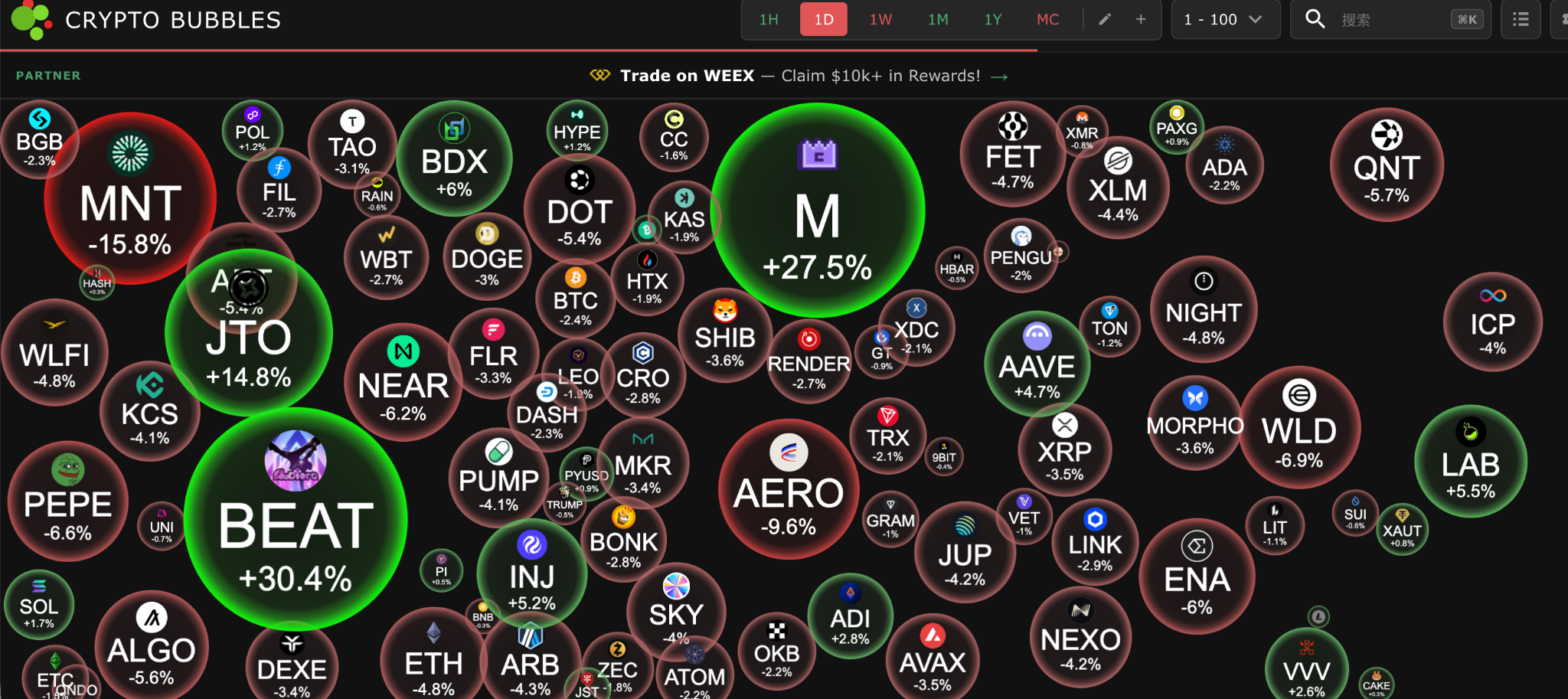
Today's top gainers among the top 100 cryptocurrencies: BEAT up 30.4%, M up 27.5%, JTO up 14.8%, BDX up 6%, LAB up 5.5%.
Asia-Pacific Market
The Asia-Pacific stock markets fell sharply on Friday, with South Korea and Japan leading the decline. Influenced by the global tech stock retreat and domestic tightening expectations, the Nikkei 225 index fell 4.15% in a single day. Tokyo's June core CPI rebounded to 1.6% for the first time in eight months, with the core measure excluding fresh energy rising to 1.9%. Bank of Japan Governor Ueda and hawkish committee member Naoki Tamura stated, "raising rates every few months," Bloomberg's Taro Kimura confirmed that inflation logic has shifted to be driven by domestic demand. In terms of individual stocks, SoftBank Group plummeted over 13% due to rumors of OpenAI delaying its IPO, becoming the biggest drag on the Nikkei index. Meanwhile, TDK (-8.52%), Murata Manufacturing (-9%), and other core "fruit chain" stocks suffered cliff-like sell-offs due to demand concerns triggered by Apple's price hikes.
At the same time, the South Korean stock market exhibited extreme capital tearing, with foreign capital fleeing and retail leverage causing a stampede. The KOSPI index fell over 5.8% on Friday. Foreigners sold 27 trillion won (approximately $1.7 billion) in the morning session, with Samsung Electronics down 5.3% and SK Hynix down 8.36%. Retail investors have net bought $80 billion this year to counter foreign selling, and Samsung has launched a 100 trillion won (approximately $65 billion) ten-year advanced industry investment blueprint. J.P. Morgan noted that a leveraged ETF with a scale of $50 billion has made Korean stocks a high-volatility norm, maintaining a bullish target of 15,000 points.
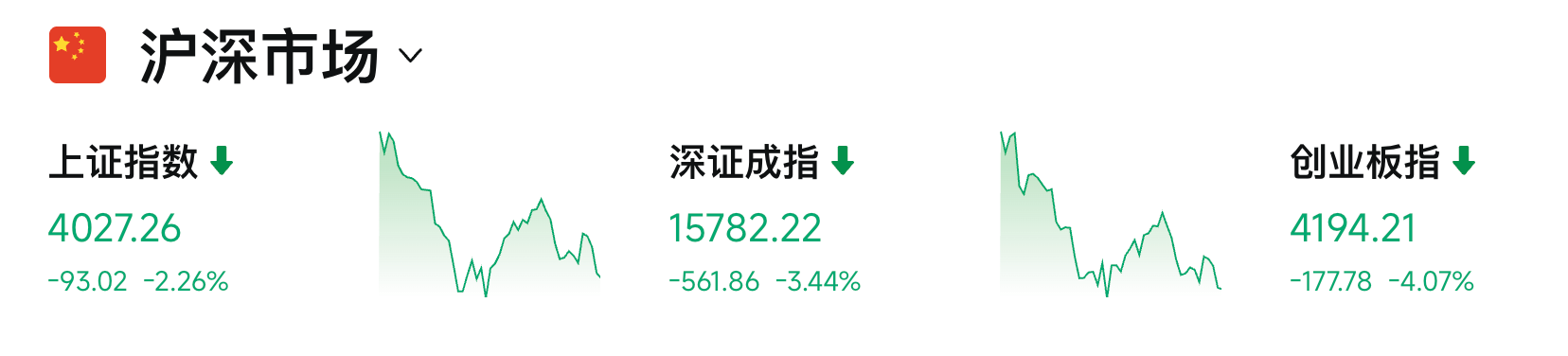
A-shares and Hong Kong shares were unable to stand out in the Asia-Pacific market due to indiscriminate selling caused by month-end position adjustments.
- In A-shares, the ChiNext Index fell more than 4%, the Sci-Tech 50 Index dropped over 4%, the Shenzhen Component Index fell 3.44%, and the Shanghai Composite Index was down 2.26%.
- In Hong Kong stocks, the Hang Seng Index fell over 1.9%, and the Hang Seng Tech Index dropped over 3%. Julia Hermann from New York Life and Bloomberg strategist Mark Cranfield pointed out that concerns regarding capital expenditures of massive cloud providers exacerbated the urgency of month-end position reduction. As a result of Apple's hardware price hikes, GoerTek fell nearly 8%, Luxshare Precision dropped nearly 9%, and Sunny Optical declined over 20% in two days.
免责声明:本文章仅代表作者个人观点,不代表本平台的立场和观点。本文章仅供信息分享,不构成对任何人的任何投资建议。用户与作者之间的任何争议,与本平台无关。如网页中刊载的文章或图片涉及侵权,请提供相关的权利证明和身份证明发送邮件到support@aicoin.com,本平台相关工作人员将会进行核查。


