Animoca Brands has made a significant investment; can AI Pay With Crypto seize the initiative in AI agency payments?
Written by: Grok
Edited by: Saoirse, Foresight News
On a day in June 2026 packed with news from the crypto market, the AI Pay With Crypto project (referred to as APC) announced it had completed a round of strategic financing of $10 million, led by Animoca Brands, with other investors including Titans Ventures, Castrum Capital, Adaverse, and M2M Capital.
APC is a project focused on AI-native financial infrastructure, established in 2022, aimed at providing underlying payment support for the Agentic Economy. It primarily addresses the needs for AI agents to autonomously transact and settle, with core features including AI Payments (autonomous payments), Agent Coordination, Programmable Settlement, and Global Infrastructure (global merchant network). APC is committed to building a payment layer that allows AI agents to operate independently within the global financial system.
Imagine this scenario: your AI assistant detects that you want a cup of coffee today, directly helps you choose the best-value store nearby, completes the payment instantly with stablecoins, and you don't even need to pull out your phone. Or, on the enterprise side, supply chain AI agents automatically complete price comparisons, compliance checks, and then directly trigger cross-border settlements, with the entire process requiring minimal human intervention. It may sound a bit science fiction, but APC is attempting to build the foundational capabilities that make this possible.
The Payment Gap in the AI Agent Economy
Traditional payments have developed quite maturely. Systems like Alipay, WeChat, and Visa have reduced user friction to a minimum, providing a smooth experience. However, the demands of the AI era have changed significantly. It requires agents to autonomously initiate transactions, needs settlement logic that can be flexibly programmed, automatically routing, splitting, or executing compliance checks based on conditions, and must simultaneously be compatible with both on-chain and off-chain environments. In cross-border scenarios, trust and compliance are especially crucial, or regulatory risks can easily magnify.
The current payment infrastructure is still struggling to fully support AI agents in truly "autonomous action." What APC aims to solve is this gap: integrating these capabilities into a callable infrastructure that allows developers or AI systems to easily access.
From an industry volume perspective, the imbalance of supply and demand in the sector is becoming more pronounced. The current size of traditional mature payment infrastructure is approximately $710 billion, the stablecoin market has reached $201.9 billion, while the potential industrial space for AI agent payments could be as much as $3-5 trillion, indicating a substantial gap. As AI evolves from assisting in decision-making to autonomous execution, the agent economy has an extremely urgent need for dedicated payment infrastructures that can autonomously trigger, are programmable, and adaptable to both on-chain and off-chain environments. The existing payment systems cannot match this new scenario, which gives APC's focus on solving the AI agent payment gap strong track necessity and practical value.
Technical Highlights and Infrastructure Layout
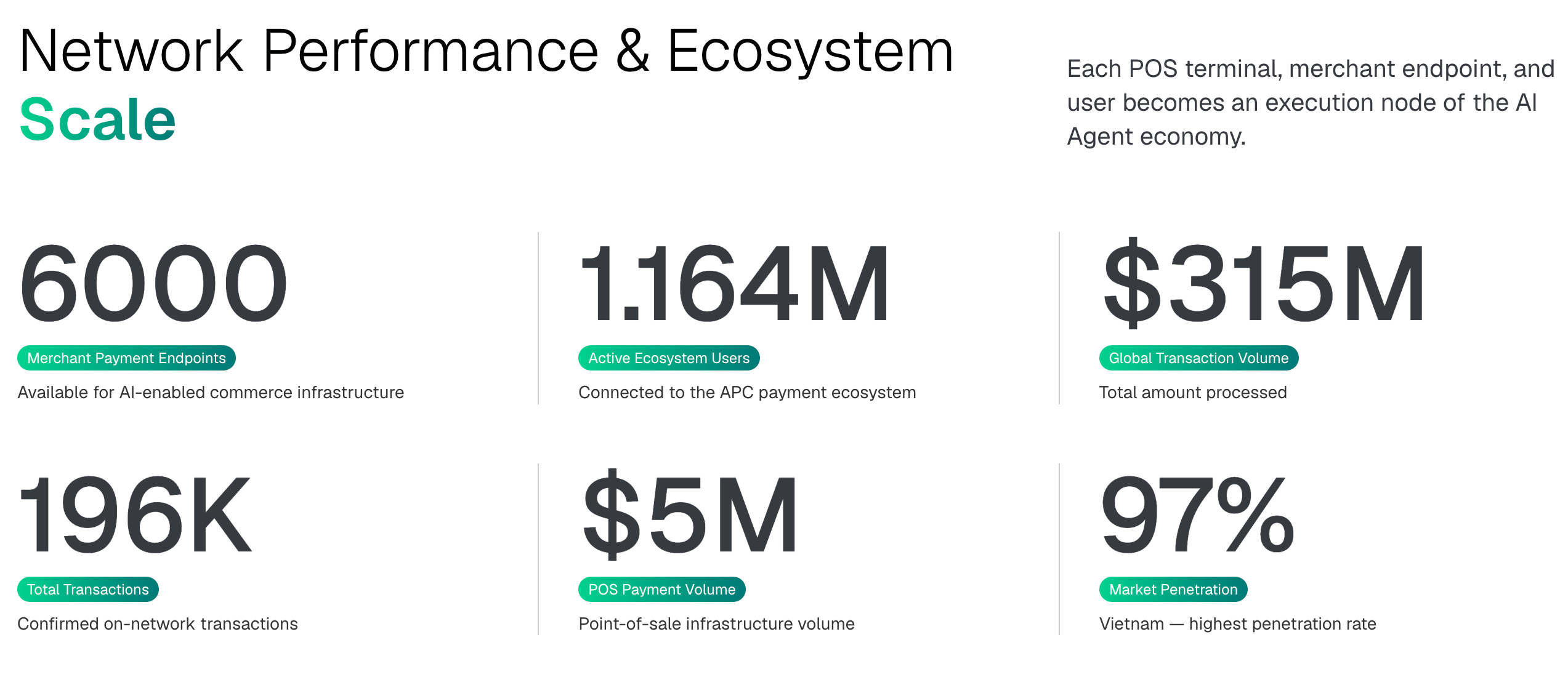
According to official information, APC's core technological highlight lies in achieving real-time settlement of on-chain stablecoins around the clock, supporting smart routing and automated execution, while also connecting real-world QR codes and POS systems. It has already deployed over 6,000 payment endpoints in several emerging markets like Thailand, Vietnam, the Philippines, Indonesia, Nigeria, Brazil, and Georgia, and focuses on local licensing applications, KYC/AML compliance, and fiat deposit and withdrawal channels. These endpoints will become important nodes for AI agents to execute payment actions in the real world.
Project Status and Execution Progress
The APC official website mainly provides product positioning and vision introduction, with limited disclosure of core team backgrounds, specific member resumes, and founding time. This may impact the trust establishment with potential partners, developers, or investors and adds uncertainty to subsequent product launches and merchant expansion.
The project is currently in the early stage of development, having established a foundational industry cooperation network, cooperating with payment service providers, crypto wallets, and offline hardware terminal manufacturers such as KuCoin, WalletConnect, BenPay, SUNMI, PayTheFly, and Roam; its Super App has accumulated a download volume of 1.16 million, completing initial user and industry resource accumulation.
From the official roadmap, the project is currently in Phase 1 (Network Layer Verified), with protocol layer construction (Phase 2) underway, followed by ecological layer expansion (Phase 3). After this round of strategic financing, the project's core focus will be on product function iteration, global merchant resource integration, and scaling up in emerging markets. However, at this stage, information disclosed publicly regarding the depth of customer cooperation and major milestones in core product launches remains relatively limited.
Market Prospects and Competitive Landscape
Optimistically, the entire AI agent payment sector is in a high-growth window. The overall scale of stablecoins continues to expand, the digital payment penetration rate in emerging markets steadily increases, and the "Agentic Economy" concept continues to gain traction and recognition from mainstream institutions. Leveraging its early layout, APC has implemented over 6,000 payment endpoints in multiple emerging markets, and if it can effectively activate offline terminal resources and complete local compliance and merchant ecosystem building, it is expected to form a unique first-mover barrier in the blue ocean track.
However, the competitive landscape is becoming increasingly clear. Companies like MoonPay are advancing AI agent payment functions, while major firms like Google have introduced open protocols such as Agent Payments Protocol (AP2), and other Web3 payment projects are pushing into stablecoin settlements and cross-border scenarios, with traditional payment giants also slowly exploring the crypto space. APC needs to differentiate itself in merchant onboarding speed, programmability flexibility, or localization in emerging markets; otherwise, its advantages could be quickly matched.
From a risk perspective, infrastructure projects generally face issues such as long execution cycles and complex regulations. Additionally, early data gaps and limited public information about the team also increase uncertainty.
From a neutral standpoint, this $10 million represents an important vote of confidence. It provides APC with a development window, but the project is still in its early stages, with considerable uncertainty about its future direction.
Conclusion
The project is still in a very early stage, and there is significant uncertainty about its future development, making it worthwhile for the market to continually observe its product landing and execution status.
Overall, AI Pay With Crypto represents an attempt at the intersection of AI and crypto payments. As the agent economy gradually becomes a reality, those who can build solid foundational payment capabilities may gain an advantage in the next phase of competition. However, the final outcome will still require time and actual execution to verify.
免责声明:本文章仅代表作者个人观点,不代表本平台的立场和观点。本文章仅供信息分享,不构成对任何人的任何投资建议。用户与作者之间的任何争议,与本平台无关。如网页中刊载的文章或图片涉及侵权,请提供相关的权利证明和身份证明发送邮件到support@aicoin.com,本平台相关工作人员将会进行核查。


