This is not an ordinary high-yield bond; it is a pressure test for the MSTR flywheel.
Written by: Rhythm
TL;DR
- After STRC fell below its $100 face value, it seemingly offered a higher yield, but essentially repriced the financing capability of the Strategy.
- It is not a Ponzi scheme in the traditional sense and will not collapse immediately upon falling below face value, but cash dividends, financing windows, and BTC prices will jointly determine the risk.
- Related assets: STRC, MSTR, BTC, other STR series preferred shares.
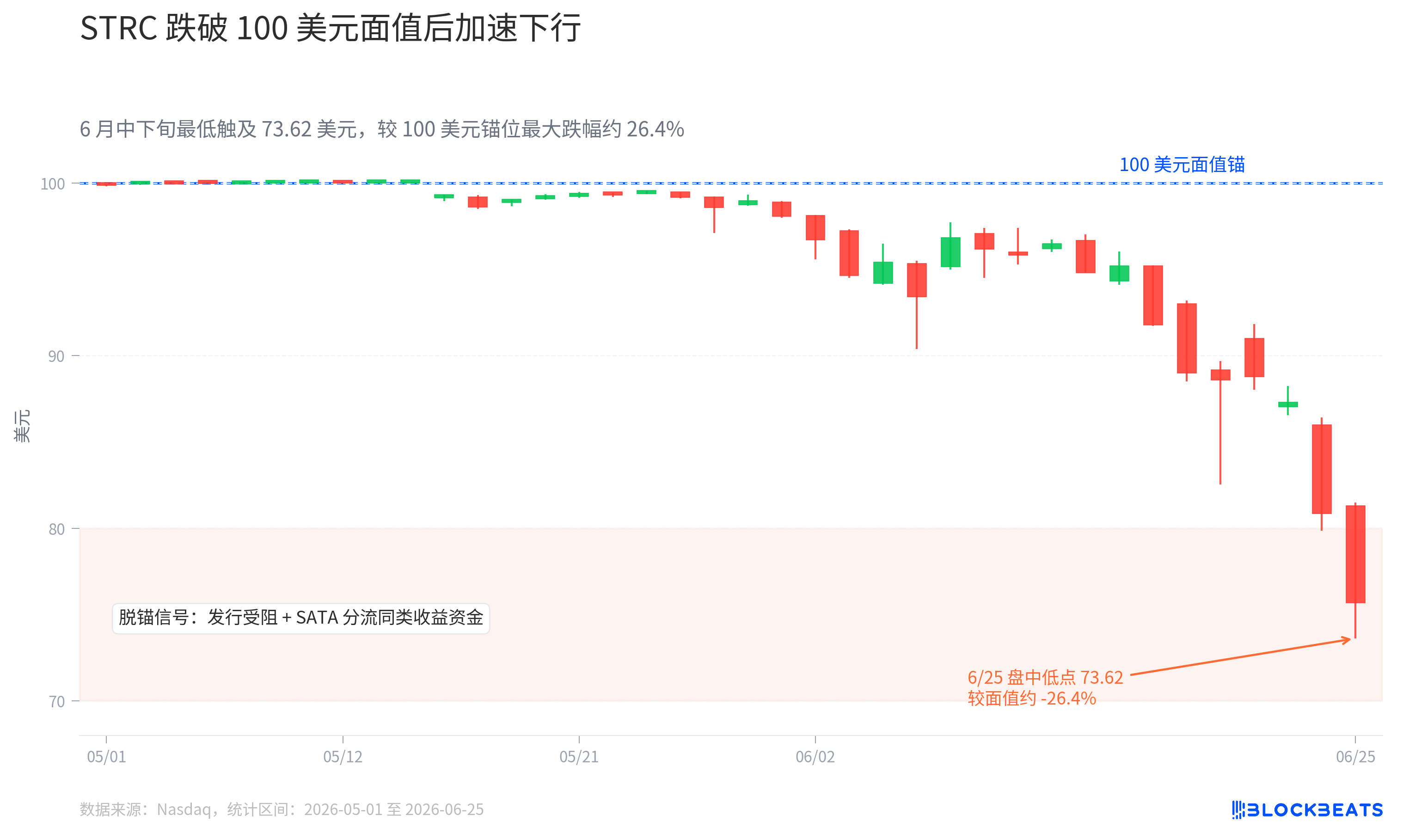
The most appealing aspect of STRC recently is that it looks like a "discounted high-yield ticket." With a face value of $100 and a current annual dividend rate of 11.50%, it dropped to the $75-89 range in mid to late June. Buying at this price would raise the apparent yield to about 13%-15%.
The problem lies here. The market does not arbitrarily discount a preferred share anchored at $100 down to around 80%. This discount is not merely a liquidity discount, but it poses a sharper question to Strategy: Can the flywheel that buys BTC through capital markets still cover the increasingly expensive cost of capital?
In late May, Strategy sold 32 BTC, netting approximately $2.5 million, expected to be used to pay preferred share distributions. The amount is small, but the signal is significant. It turned STRC from a "financing innovation" into a more pragmatic investment question: If one buys now, is it bottom-fishing a high-yield asset or catching the weakest layer within the MSTR structure?
Is STRC a Ponzi?
Let’s start with the conclusion: STRC is not a Ponzi in the traditional sense.
The core of a Ponzi structure is to use the money from later investors to pay returns to earlier investors, without sufficient assets and cash flow to support it. Strategy's situation is different. The company genuinely holds a significant amount of BTC, with publicly disclosed holdings increased to about 847,000 coins. STRC is also not a financial product with a rigid repayment promise but a variable-rate Series A perpetual preferred share, with legal attributes closer to equity rather than having a fixed maturity date for repayment.
This is also the foundational logic that Saylor and the Strategy management team have continually emphasized: The company is not pulling returns out of thin air but is creating a capital market structure out of its BTC reserves. Common stock, convertible bonds, and preferred shares attract different investors, and the funds raised continue to buy BTC. As long as BTC appreciates in the long term, the company's net asset value increases, and the financing tools remain acceptable to the market, this machine can keep turning.
However, "not a Ponzi" does not equate to "no Ponzi risk."
The danger of STRC lies in how it has brought the BTC narrative of MSTR back to cash flow. Common stock can discuss long-term premiums; convertible bonds can talk about conversion upside, but STRC needs cash dividends. The current nominal dividend rate of 11.50% is revenue for investors but a continuous cost for Strategy.
If these dividends cannot be covered in the long term by cash flows from software business, cash reserves, or low-cost refinancing, but rely more on new issuances of securities or selling BTC, the structure will become unattractive. It may not be a Ponzi in the legal sense, but the market will reprice it as "a financial engineering that needs constant lifelines."
Therefore, to assess whether STRC can bottom-fish, the first layer is not to look at how high the yield is but to see where that yield comes from. If the yield comes from short-term panic, it could be an opportunity. If the yield comes from the market believing this structure must finance at a higher cost, the discount is not cheap but a risk compensation.
What are the main reasons for the decoupling?
The anchor for STRC is its $100 face value. Falling below face value indicates that the market is unwilling to hold it at a price close to its face value. There are three main layers of reasons.
The first layer is that both BTC and MSTR premiums are under pressure.
The MSTR flywheel relies on mNAV, which is the premium of the stock price relative to the net value of the coins held. As long as the MSTR stock price is above its BTC net asset value, the company can issue stock or other securities more effectively and use the funds to buy BTC. This cycle runs smoothly in a bull market, as BTC increases, pushing up net value while expanding MSTR's premium and improving financing efficiency.
But if BTC remains flat or declines, MSTR's premium narrows, and financing efficiency decreases. STRC is not an isolated high-yield asset; it is the financing layer in this flywheel. When the market doubts the flywheel's pace, it will first demand a higher yield.
The second layer is that STRC's issuance mechanism is obstructed.
The original design goal for STRC was to keep the price as close to $100 as possible. The company could continually issue small amounts in the market to provide long-term capital for Strategy. However, when the secondary market price drops to the $80s, continuing to issue close to face value becomes challenging. A CoinDesk report in June noted that after STRC fell below face value, the company's related issuance plans had been paused.
This creates a reverse feedback loop. When the price is below face value, new issues become difficult. As issuance becomes more challenging, financing channels become narrower. As financing channels narrow, the market becomes more concerned about cash dividend pressure. As concerns grow, the price continues to stay below face value.
The third layer is that competing products like SATA drew away the same pool of liquidity.
STRC does not target ordinary equity funds but rather funds willing to purchase high-yield, quasi-fixed income securities that can accept the risks of a BTC treasury company. This fund pool is not infinite. When competing products like SATA appear that also target yield-focused funds, STRC is no longer the only choice.
For investors, money will flow toward higher yields, stronger liquidity, or clearer terms. After SATA absorbs liquidity, STRC will need to offer a more attractive price or yield compensation to maintain its $100 face value. Discounts are not solely due to market panic; they may also represent a reallocation of funds among similar products.
The fourth layer is that selling coins to pay interest breaks the "buy only, don't sell" psychological anchor.
Selling 32 BTC at the end of May is not significant. In the context of over 840,000 BTC holdings, it is almost negligible. However, the market is sensitive not to the quantity but to the purpose. File specifications indicate that these funds are expected to be used for preferred share distributions, with media further interpreting this as including STRC dividends.
This leads investors to begin considering a question they were previously reluctant to think about: If financing windows continue to narrow, will selling coins to pay interest change from a one-time action to a regular option?
STRC's decoupling is not fundamentally due to a single $2.5 million coin sale, but because it has revealed the flip side of the MSTR flywheel to the market. In a bull market, financing to buy coins amplifies increases. In a pressured environment, paying dividends and refinancing also magnify doubts.
Under what circumstances will there be a crisis?
STRC does not resemble a leveraged position that could be liquidated overnight. It has no fixed maturity date, and its dividends are not like the mandatory fixed-interest debt. Most of Strategy's debt is not secured by BTC, and the traditional margin call risk is not high.
The real crisis is more likely a continuous collapse of confidence and financing capability.
The first pressure comes from BTC itself. If BTC enters a deep bear market, MSTR's mNAV could be compressed to near 1 or even fall below 1, causing Strategy’s most effective financing means to fail. The thinner the premium of common stock, the more difficult it becomes to justify issuing new shares to buy coins as "enriching each BTC per share," and investors will see it more like dilution.
The second pressure comes from STRC's price. If it stays in the $70-80 range for a long time and cannot return to the $100 area, the market will not be relaying a temporary mispricing but rather a reassessment of capital costs. For a preferred stock designed to stabilize around its face value, the deeper the discount, the more compensation the issuer will need to offer to continue financing with it.
The third pressure is cash dividends. STRC's nominal cash dividend rate of 11.50% presents a high coupon for buyers but represents high cash costs for Strategy. According to rough estimates from the original text, the cash dividend pressure related to the preferred shares is already in the billion-dollar range, which is not a figure that a conventional software business can easily absorb.
The final pressure is that the act of selling coins shifts from an occasional action to a regular pattern. Selling 32 BTC can still be interpreted as balance sheet management, but if more future dividends rely on selling BTC to cover them, the market will redefine this flywheel. What was once a financing strategy to buy BTC now turns into selling BTC to pay for financing costs, reversing the narrative direction.
If any of these four events occur individually, they may not constitute a crisis. The real danger lies in their simultaneous occurrence. BTC declines, MSTR's premium shrinks, STRC is deeply discounted, and cash dividends need to be supplemented by selling coins. At that point, the question shifts from whether STRC has a 15% yield to whether that 15% is sufficient to compensate for the continued discount on principal and the risks of dividend deferral.
In other words, the crisis point for STRC is not a specific price but a fracture in the financing narrative. As long as the market still believes that Strategy can raise money, hold BTC, and maintain preferred shares at acceptable costs, STRC still has room for recovery. Once the market no longer believes, preferred shares will show trust depreciation faster than common stock.
Does each bear market need to "remove one"?
Every bear market in the crypto market follows a familiar script: the financial structures that were most successful in the bull market become the most pressured during the downturn.
In the previous round, exchanges, lending platforms, and high-yield financial products were "removed." Their problems are not entirely the same, but the commonality is that they treated rising prices, liquidity, and confidence as the norm during the bull market. When prices fall, redemptions increase, and financing becomes more expensive, the segments most dependent on continuous inflows will be exposed.
MSTR and STRC are not the same thing. Strategy has real BTC reserves, public company disclosures are more transparent, and preferred shares are not on-chain high-yield funds. It is not accurate to equate it directly with the previous round of crisis projects.
However, the market is not asking "is it the next FTX," but "will this round of bear market remove a BTC treasury company's financing model."
STRC is right in the middle of this question. For optimists, the drop to around $80 means a discounted purchase of a high-yield preferred share backed by a significant BTC reserve. As long as BTC rebounds, MSTR's premium repairs, and STRC returns to the area near its face value, investors can earn both coupon yield and capital gains.
For pessimists, STRC's discount is not a mispricing but rather the market's early downgrade of MSTR's financing model. It indicates that yield-sensitive funds are unwilling to take it on at $100, that high-yield financing is no longer cheap, and that the "digital credit layer" of BTC treasury companies will also be tested by the bear market.
Thus, whether STRC can bottom-fish depends on what buyers are actually betting on.
If the bet is on short-term price recovery, the core observation is whether STRC can get back close to $100, whether MSTR's mNAV stops falling, and whether BTC can reopen upward momentum. If the bet is on long-term yield, one must accept the risk of potential dividend deferrals, prolonged price discounts, and rising yields.
More directly, STRC is not "risk-free high-yield" intended for everyone. It is more like a high-yield ticket regarding whether Saylor's flywheel can weather the bear market. Buying it is not about purchasing a regular bond but betting on whether the market wants to continue believing in MSTR's BTC treasury narrative.
As for whether this round will indeed "remove one," it cannot be concluded just yet. However, STRC has already given early signals: when BTC treasury companies start using preferred shares to stack high yields, the bear market tests not only the coin price but also who can still access funding at a sufficiently low cost.
免责声明:本文章仅代表作者个人观点,不代表本平台的立场和观点。本文章仅供信息分享,不构成对任何人的任何投资建议。用户与作者之间的任何争议,与本平台无关。如网页中刊载的文章或图片涉及侵权,请提供相关的权利证明和身份证明发送邮件到support@aicoin.com,本平台相关工作人员将会进行核查。


