Leveraging human laziness to invest in Bitcoin, this product hides three major deadly risks.
Written by: Thejaswini M A
Translated by: Saoirse, Foresight News
The simplest way to control other people's funds is to wait for them to let their guard down and become inattentive. A large portion of the profits for financial institutions is purely built on people's procrastination and laziness.
Years ago, two economists, Richard Thaler and Shlomo Benartzi, reached a conclusion: persuading others with words is a futile endeavor. Instead of exhausting oneself trying to argue to win, it’s better to design rules that leverage the behavioral inertia created when people do nothing to change their choices. Clearly, most people are too lazy to actively uncheck the "opt-out" option.
If participation in a retirement savings plan requires manually filling out forms, ultimately less than half of people will participate; however, once enrollment is set as the default, those who want to opt out must take manual action, causing participation rates to leap above 90%. The same logic applies to various auto-renewing subscriptions; more than half of paying users would not even utilize the subscription service. Just last week, I subscribed to watch the FIFA World Cup, knowing full well I would completely forget about this service after the event ends.
This mechanism has a key prerequisite: the fund holders and the product configuration creators must be two different parties. The optional fund pool for a 401(k) retirement plan selected by employers only allows employees to passively enter this configuration system.
On June 18, Franklin Templeton submitted an application to issue two ETFs, planning to embed this "default configuration" logic into Bitcoin investment.
Viewed within the macro funding landscape, the financial moat that this product can bring is actually minimal.
Deciding to purchase Bitcoin is in itself a significant barrier to the industry's mainstream adoption. Even if Trump attends a Bitcoin industry conference, temporarily easing public concerns, this barrier still objectively exists.
Financial advisors need to actively allocate Bitcoin and explain this decision to clients and compliance departments; once the price of Bitcoin halves, all loss risks will fall upon the advisor. Due to career risk considerations, the vast majority of advisors will deliberately avoid and never recommend Bitcoin to clients.
Financial advisors will build standardized portfolio models, selectively choose underlying funds, and clients will only passively hold the allocated assets. When clients check their holdings, they will only see vague labels like "40% of large-cap U.S. stocks," without delving into what specific assets are actually held. If an advisor chooses a dividend reinvestment version of a fund, clients will unknowingly hold Bitcoin.
This product is not designed to trap ordinary retail investors—institutions know that retail investors will actively check their holdings. This underlying structure is actually tailored for financial advisors.
This is the core trick of Wall Street; the target date funds that once peaked at $4 trillion grew using this logic: the default configuration itself is the product, and as long as users choose inaction, they will automatically hold that asset. Investors who manually input codes to independently select stocks are excluded from this logic, and Franklin does not expect to rely on such retail investors. The funds truly target capital, which is controlled downstream by other professionals.
Dividend reinvestment plans (DRIP) are the most worry-free "lay flat tools" in investing: when dividends are distributed, the funds do not go into your account but instead automatically purchase more of the same stock. You continuously increase your holdings without having to manage them, which is the essence of DRIP.
Franklin took this mechanism and reversed it: its two funds—the Franklin U.S. Stock Bitcoin Dividend Reinvestment Index ETF and the Franklin U.S. Stock Innovation Sector Bitcoin Dividend Reinvestment Index ETF—will not reinvest dividends into stocks but will directly buy Bitcoin.
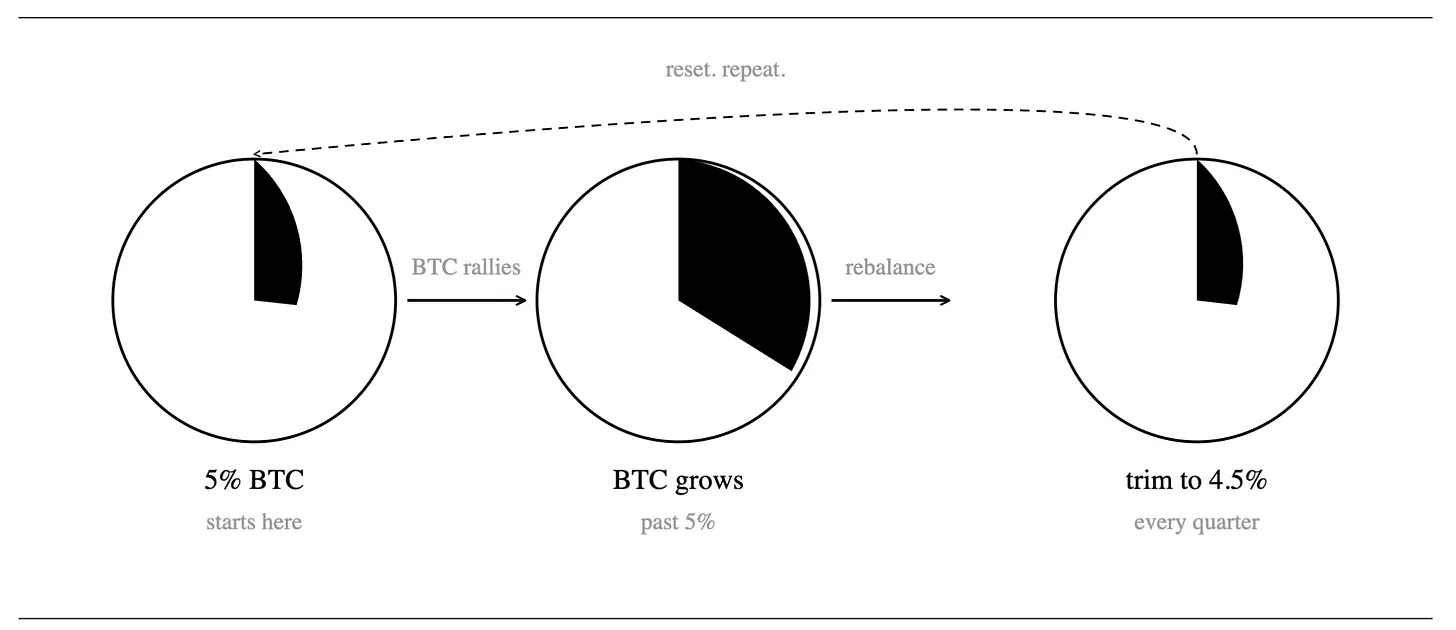
For the Bitcoin holding portion, the funds plan to allocate spot Bitcoin ETFs, Bitcoin futures, and options. The product includes built-in quarterly rebalancing asymmetric rules: if Bitcoin rises sharply, breaking the 5% target weight, it will be reduced to 4.5% in the next quarter’s rebalancing; a hard cap is also set, where Bitcoin holdings cannot exceed 20% of total fund assets.
The initial allocation of the product is 95% stocks and 5% Bitcoin, and all quarterly dividends will be used to increase Bitcoin holdings. If Bitcoin prices rise and the holding percentage expands, part of the Bitcoin will be sold during quarterly rebalancing to bring its proportion back to 4.5%, recycling funds back into stock assets.
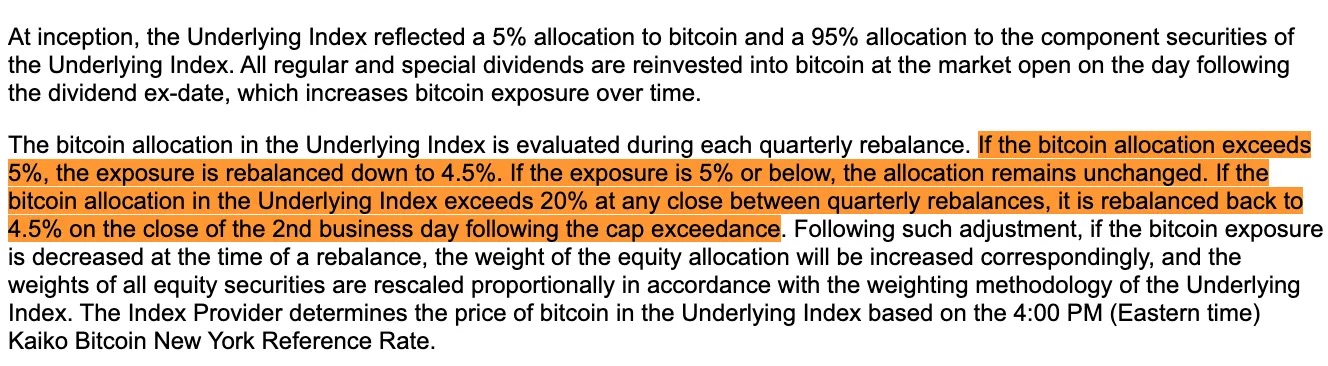
Even if the price of Bitcoin skyrockets between two rebalancing periods, its proportion in the fund will never cross the red line of 20%.
To evade numerous regulatory processes, the Bitcoin held by the fund is uniformly stored in a wholly-owned subsidiary in the Cayman Islands, which configures it with spot cryptocurrencies, futures, and options.
Both funds track the custom index designed by VettaFi and Franklin plans to officially issue them on September 1; the fee section in the filing documents is blank, and the current management fee standard has not yet been disclosed.
Setting Aside Nice Expectations, Facing Reality
It seems to connect with the Wall Street system and add stable Bitcoin buyers, painting a rosy picture, but once the real figures are calculated, the so-called incremental buying power is merely a trickle.
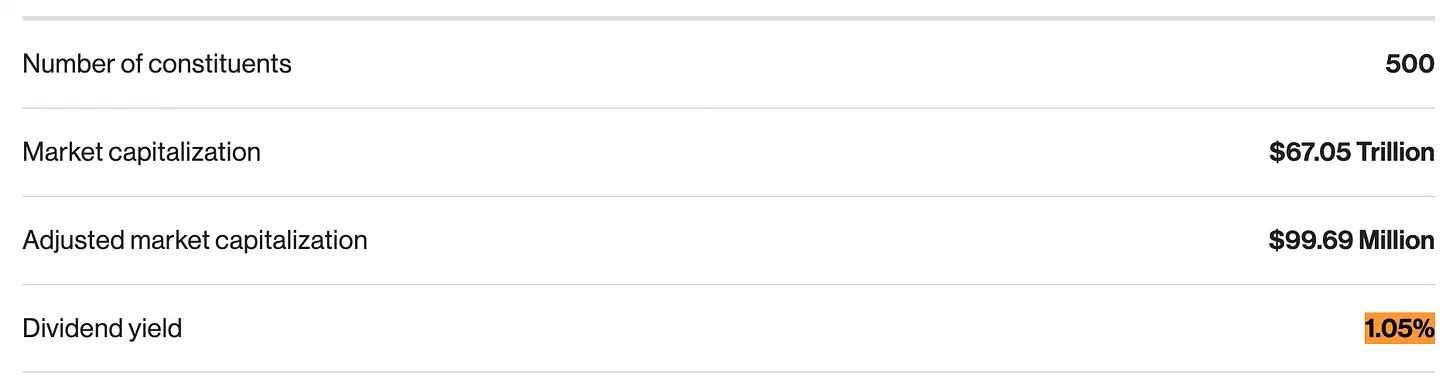
The annualized dividend yield of wide-market U.S. stock indices is 1.05%, while the annualized dividend yield of innovation sector indices is only 0.52%. The initial allocation for both funds is 95% stocks + 5% Bitcoin, and only the dividends generated from stocks will be used to purchase Bitcoin. Calculating this way, the broad market fund can only allocate about 1% of its total assets for Bitcoin purchases each year, while the innovation fund has only 0.5%.
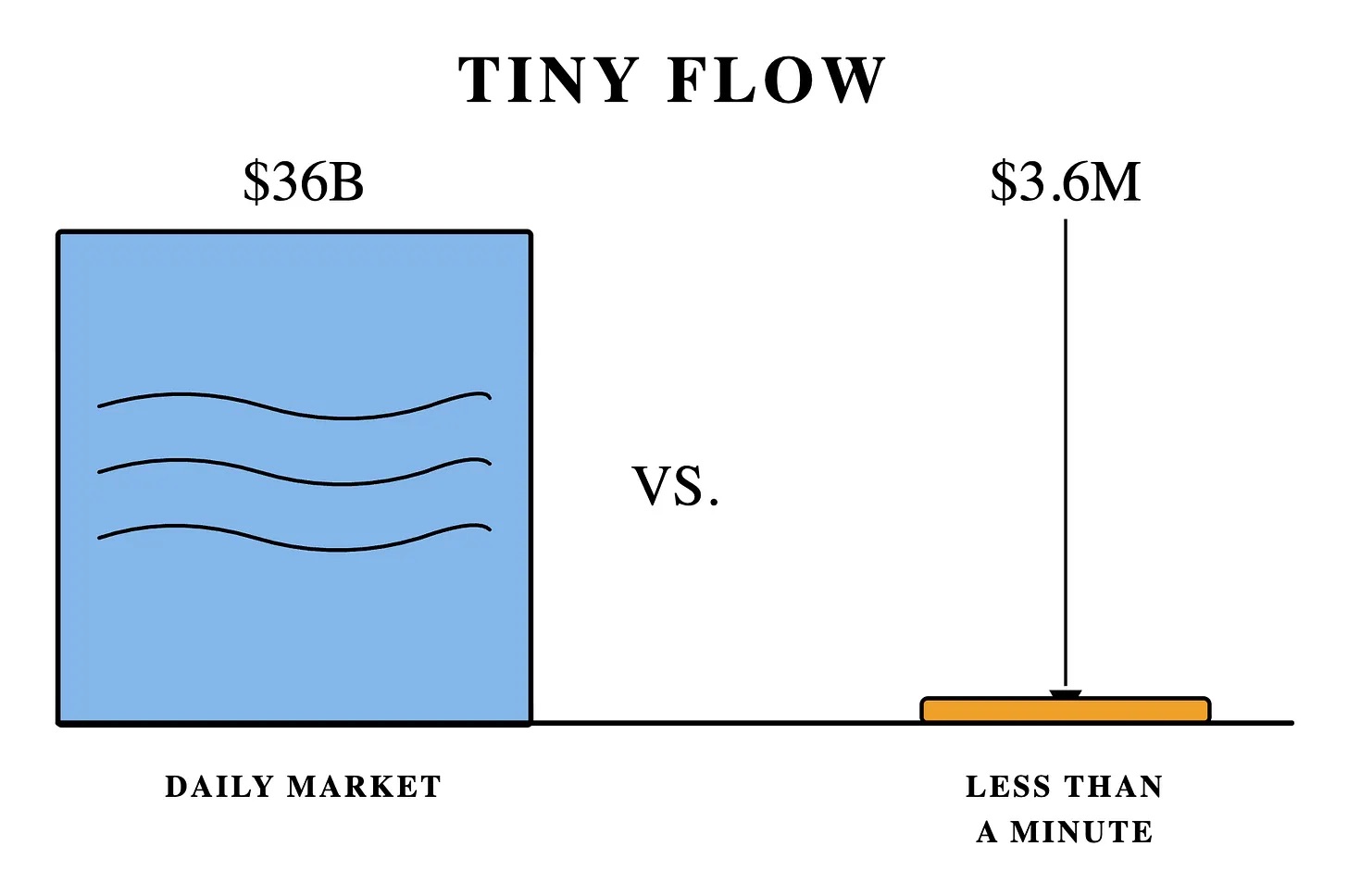
Based on Franklin's existing Bitcoin ETF (with a size of $359 million), the corresponding annual incremental purchasing power for Bitcoin is only $3.6 million. The average daily trading volume of Bitcoin is about $36 billion, the total buying volume of this fund in a whole year could be absorbed by the market in less than a minute.
The design of the innovation sector fund hides deeper flaws: it heavily invests in Nvidia, Apple, and Microsoft, which have extremely low dividends or do not pay dividends at all. The fund's purchase of Bitcoin entirely relies on stock dividends, which is equivalent to lacking the cash flow needed for continued accumulation. Coupled with the reverse mechanism of quarterly rebalancing, once the Bitcoin proportion exceeds 5%, it must be reduced to 4.5%. The higher Bitcoin rises, the more the fund sells. In a bullish market, the pressure from continual selling will easily offset the buying increments from the meager dividends. This product, from its foundational design, is destined to struggle to hold appreciating assets in the long term.
In prosperous days for Bitcoin markets, this fund may become a passive seller.
Why is that? Index funds are forced into passive trading by the market, with traders familiar with the fixed buying and selling times and targets of the indices, positioning themselves in advance for arbitrage profit. Meanwhile, these two Franklin funds create a reverse situation: they are programmatic, passive continuous selling tools. The fund consistently buys Bitcoin on the day after dividends are received, and during quarterly rebalancing, sells uniformly, allowing short-term traders to precisely predict the operational nodes, harvesting from both ends of the buying and selling.
The selling pressure from a single fund of this scale is minimal, akin to a mosquito bite; however, once a full category of similar products forms, the accumulated selling pressure could create a significant impact. If a large amount of similar funds floods into the market, every Bitcoin price increase will encounter continuous selling, creating a price ceiling that is hard to break through.
In addition to this core trick of the default configuration, the filing documents also hide three clever designs:
- Compliance evasion methods. Many financial institutions internally prohibit allocations in cryptocurrencies, but this fund is publicly labeled only as “U.S. stock equity products,” allowing financial advisors to allocate it to clients in compliance, indirectly achieving Bitcoin holdings.
- Offshore structural compliance scheme. Bitcoin is uniformly stored in a wholly-owned subsidiary in the Cayman Islands, which is a common compliance method for public funds holding commodity assets. It does not disrupt the fund's original tax status and is both legal and widely used in the industry.
- Tax legacy issues. Dividends are automatically converted into Bitcoin before they hit your hands, yet this dividend still needs to be taxed. Funds are already locked up in crypto assets, and you can only take out additional cash to pay taxes on dividends you never received in your own account.
For this model to truly take shape, these kinds of funds must become the default configuration for pensions or closely adjacent to the default asset pool. The Pension Protection Act of 2006 allowed employers to gain legal support to automatically enroll employees in pension plans, with default configurations corresponding to certain funds.
Back then, only 5% of 401(k) plans launched target date funds; now, the coverage rate has reached 96%, and the industry's total scale has surged from $100 billion to $4 trillion.
In August 2025, Trump signed an executive order officially lifting restrictions, allowing 401(k) pensions to allocate cryptocurrencies. In March 2026, the U.S. Department of Labor released a draft regulation stating that if fiduciaries include alternative assets like cryptocurrencies in the optional pension list, they would enjoy liability protection.
The public comment period for the draft closed on June 1. If new regulations are to be formalized by the end of this year, related processes must be completed beforehand. Compared to adding optional crypto products for investors, setting crypto assets as the default configuration for pensions is more challenging. Therefore, regardless of how the final text of the new regulations ends up, corporate legal departments generally judge that most employers will choose to wait and see, acting only after court rulings confirm the safety of the liability exemption clause.
The core of this entire system is never about convincing anyone to actively buy coins. Human attention is the most scarce resource in the world, and any model that can save thought and operate automatically relying on inertia will ultimately prevail.
The entire system only needs to exploit people's laziness.
免责声明:本文章仅代表作者个人观点,不代表本平台的立场和观点。本文章仅供信息分享,不构成对任何人的任何投资建议。用户与作者之间的任何争议,与本平台无关。如网页中刊载的文章或图片涉及侵权,请提供相关的权利证明和身份证明发送邮件到support@aicoin.com,本平台相关工作人员将会进行核查。


