The debut of Fed's Warsh as a strong hawk shatters the "devaluation trade"! Under the storm of a strong dollar, gold, silver, and Bitcoin are fiercely washed out, losing key price levels.
Written by: Xu Chao
The "devaluation trade" that has dominated Wall Street's trend this year is rapidly collapsing. The hawkish stance of Federal Reserve Chair Kevin Warsh has strengthened market expectations for interest rate increases, combined with a significant strengthening of the dollar, forming a dual suppression; gold, silver, and Bitcoin have successively lost key price levels. Meanwhile, a large amount of capital is flowing out of precious metals and into the semiconductor sector, and the sustainability of this chip frenzy has increasingly raised market doubts.
This Wednesday, gold fell below $4000 per ounce for the first time in about eight months, down approximately 29% from this year's historical high of about $5600 in January; silver fell below $60 per ounce, more than 50% down from the peak of $121; Bitcoin also fell below $60,000, hitting a new low since the end of 2024. The dollar index (DXY) has risen 2.8% this month, closing at its highest level in over 14 months, likely recording the largest monthly gain in nearly a year.
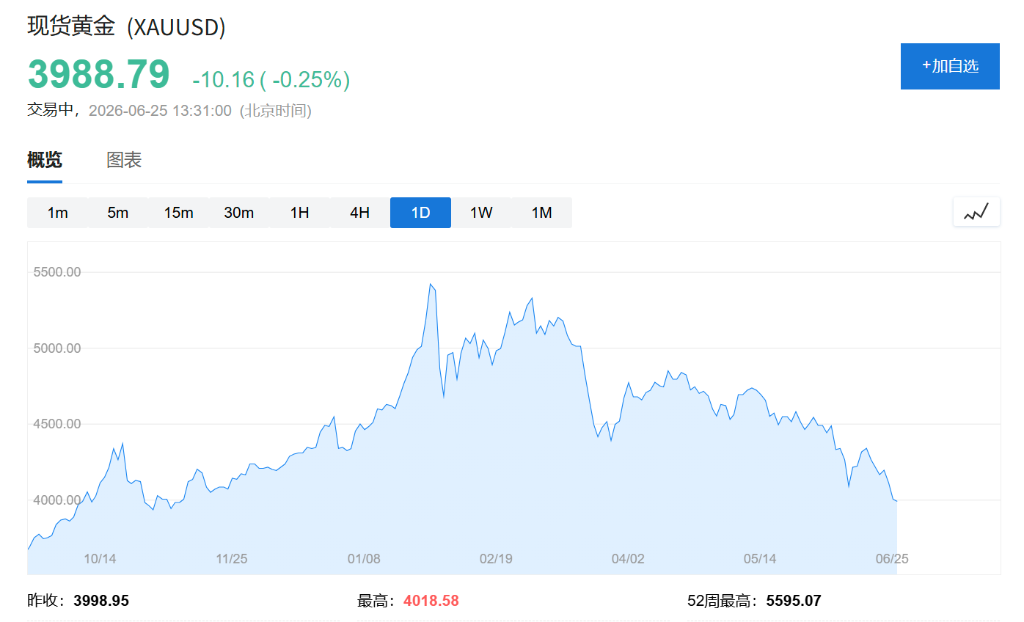
The key turning point that drove the situation to shift rapidly was Warsh prioritizing price stability above all else during the Fed's press conference, further assuring the market that he would adopt a more aggressive stance against inflation. A strong dollar makes dollar-denominated precious metals appear more expensive to overseas buyers, while rising interest rate expectations directly increase the opportunity cost of holding non-yielding assets.
Micron Technology's after-hours earnings report exceeded expectations, temporarily curbing the selling sentiment in the chip sector, with Korean chip stocks like SK Hynix also rebounding. However, several market participants warned that this chip rally with extreme volatility has shown several characteristics of a historical top.
Warsh's hawkish debut: interest rate expectations restructured, devaluation logic shattered
The logic of the "devaluation trade" is based on concerns about fiscal extravagance and central banks enabling inflation, which has continuously driven gold, silver, and Bitcoin upwards in recent years. After Warsh was nominated as Federal Reserve Chair in January, gold plummeted over 13% that day, marking the largest single-day drop in over 40 years, followed by Bitcoin's crash, while the dollar rebounded from a long-term decline—this market response indicates that Warsh's hawkish credibility is taken seriously from the very beginning.
Robin Brooks of the Brookings Institution believes the root of the devaluation trade lies in improper fiscal policy, with monetary policy merely acting as an "accomplice": when policymakers try to dilute unsustainable debt with inflation, they must turn on the printing press. This framework explains why the market is so sensitive to the Fed's candidates and why Warsh's emphasis on price stability during his first press conference was enough to trigger such a violent asset repricing.
Stephen Innes, executive partner at SPI Asset Management, stated that Warsh's public debut has led the market to believe that he is adopting a tougher anti-inflation path. The S&P 500 index priced in gold—the classic indicator that measures whether economic growth stems from substantive expansion or monetary devaluation—significantly reversed upwards three months ago, showing the market's confidence in the devaluation narrative has already collapsed. Notably, the conclusion of the ceasefire agreement in the Middle East has also provided extra momentum for the dollar.
Gold and silver deep correction, key support levels and buying windows emerge
This round of precious metal declines marks a dramatic reversal from the historic trend earlier this year. Earlier this year, gold once soared to a record high of about $5600 per ounce, and silver broke through $121, with both rising even more than the "Tech Seven," becoming Wall Street's most crowded momentum trade. Now, this splendor has become a thing of the past.
Nate Miller, vice president of product development at Amplify ETFs, pointed out that rising yields and a strong dollar have increased the opportunity cost of holding metals; while silver, due to its dual attribute as both a precious metal and an industrial raw material, usually experiences a sharper decline than gold during macro tightening periods—that is the reason why silver's rapid drop is so pronounced this time.
Ben McMillan, chief investment officer at IDX Advisors, believes that rising interest rate expectations and liquidity unloading are the "main culprits" behind gold's sharp decline, but he also views the current correction as a "generational buying opportunity." Peter Grant, vice president and senior precious metals strategist at Zaner Metals, expects the next key support level for gold to be at $3800 per ounce, with a potential rebound to $4500 within the year; however, to rebuild market confidence in gold refreshing historical highs, it needs to return above $4800.
Strong dollar and Bitcoin under pressure: negative correlation dominates crypto trends
Bitcoin's drop below $60,000, along with the dollar index reaching a new high in over 14 months, once again confirms the long-term negative correlation logic between the two.
Standard Chartered Bank strategist Steven Englander noted that the difference between real and nominal interest rates has become the main driver of the dollar's strength since early May, expecting the Fed to maintain interest rates unchanged while the European Central Bank still has room for one rate cut in the first half of next year. This ongoing interest rate differential between the US and Europe will continue to support the dollar, placing Bitcoin under persistent headwinds.
Vincent Deluard of StoneX Financial warned that while the ceasefire in the Middle East eased oil price shocks, inflation will not smoothly return to the 2% target but will long consolidate at a high level between 3.5% and 4%.
Apollo Global's chief economist, Torsten Slok, raised a counterintuitive scenario: the drop in oil prices could amount to a tax cut, further stimulating already overheated total demand and thereby pushing up inflation, providing a basis for Fed rate hikes—if this pathway materializes, it would further pressure the devaluation trade.
Funds shift to semiconductors, chip stocks become new momentum favorites
Mark Hackett, chief market strategist at Nationwide Investment Management Group, pointed out that a large and highly coordinated amount of funds is collectively shifting substantial positions from cryptocurrencies, meme stocks, and precious metals to semiconductor stocks, with Samsung Electronics and SK Hynix becoming the main destinations for this round of reallocation.
He told MarketWatch that the strong dollar triggered the sell-off in precious metals, while the change in Fed policy expectations is the fundamental reason for the dollar's strength. "But this is almost used as an excuse for investors to collectively unload precious metals," he said.
Micron Technology's after-hours earnings report eased the short-term selling pressure in the chip sector: the company's revenue guidance exceeded expectations, and profits were also significantly better than expected, with its 12-month rolling profits quadrupling in two quarters, and after-hours market cap returning to about $1.4 trillion. Prior to this, SK Hynix had experienced a sell-off after announcing a focus on producing low-margin DRAM memory chips, but subsequently received a boost—even though the company disclosed a stock issuance plan of up to $29 billion on the same day.
Chip rally topping signals emerge, defensive layouts gradually gain consensus
However, extreme volatility itself is a warning signal. Larry McDonald from Bear Traps Report pointed out that it is extremely rare for semiconductor stocks to have market capitalization fluctuations of over $100 billion within hours, usually occurring only near major market tops or bottoms in history.
BCA Research suggested ending the bullish strategy that has more than doubled this year—namely, going long on emerging market semiconductors while shorting the "Tech Seven" mega-cap cloud computing companies that pay for it. BCA noted that the implied volatility of the Korean Composite Stock Price Index (Kospi) over a month has surpassed historical peaks, and this level historically often appears at "the bottom of a bear market rather than a historical high," indicating that the current situation is characterized as being driven by "highly speculative forces amplifying" a top.
McDonald also warned that the end of the month, end of the quarter, combined with the upcoming US long holiday weekend, historically, such time points are often accompanied by large-scale fund redemptions and summer market sluggishness; the dense issuance of new stocks will consume the market's ability to absorb liquidity, while large insider sell-offs often herald an impending top. For investors still holding bullish positions in chips, Micron Technology's strength after hours may provide a relatively good exit opportunity at high levels.
免责声明:本文章仅代表作者个人观点,不代表本平台的立场和观点。本文章仅供信息分享,不构成对任何人的任何投资建议。用户与作者之间的任何争议,与本平台无关。如网页中刊载的文章或图片涉及侵权,请提供相关的权利证明和身份证明发送邮件到support@aicoin.com,本平台相关工作人员将会进行核查。


