Author: Kuri, Trend Research
Trend Guidance: The 2x leveraged ETF "RAM," tracking the storage chip theme, was listed on June 24, the same day Micron reported a record Q3 revenue of $41.5 billion and a gross margin of 84.9%, rising over 12% in after-hours trading.
The underlying DRAM ETF attracted over $20 billion in less than three months since its launch, but has retraced about 16% from its recent high. RAM can amplify rebound gains but can also magnify withdrawal losses. This article breaks down RAM's product mechanism, core risks, and the current profit and loss logic for investment.
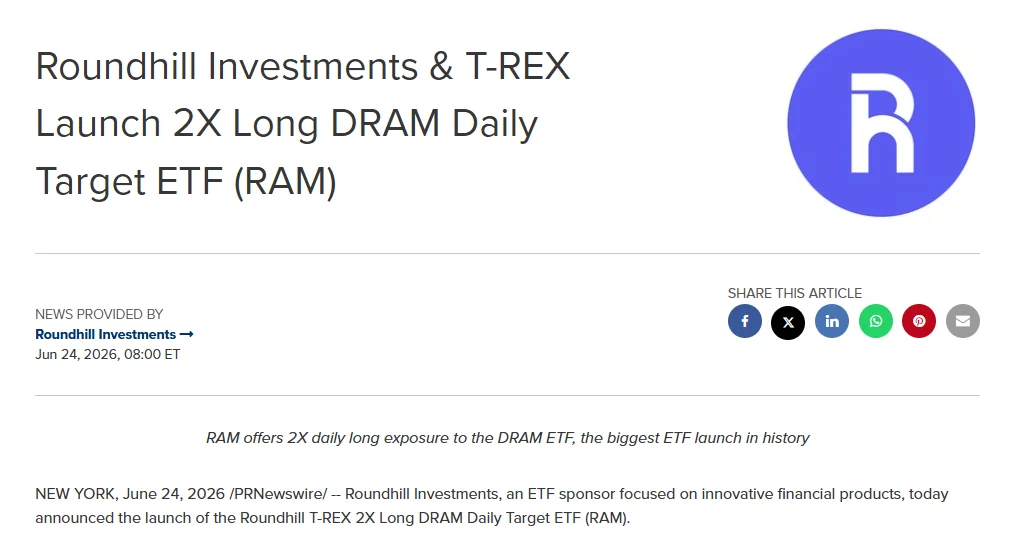
The storage chip sector is in a delicate position: fundamentals have never been stronger, yet prices have declined from their highs.
The launch of the 2x leveraged ETF "RAM" on June 24 has placed this question squarely in front of every investor focused on the storage sector—should investors leverage during a retracement, is it a tool for bottom fishing or an amplifier for accelerating losses?
Before answering this question, let’s take a look at what happened that day.
Micron Reports $41.5 Billion Revenue in a Single Quarter, Validating the Storage Super Cycle
On the day of RAM’s listing, Micron Technology released its fiscal year 2026 third-quarter results.
According to Micron's 8-K filing with the SEC, the quarterly revenue reached $41.46 billion, a year-over-year increase of 346%, significantly exceeding Wall Street's consensus expectation of approximately $34.7 billion. The non-GAAP earnings per share were $25.11, with the consensus expecting around $20. The gross margin was 84.9%, setting a company record, compared to only 39% in the same period last year. Revenue from DRAM products reached $31.3 billion (accounting for 76%), and the data center business grew more than seven-fold to $11.5 billion year-on-year.
More critically, the forward guidance for Q4 indicates revenue of $50 billion (±$1 billion) and a gross margin of about 86%. CEO Sanjay Mehrotra also announced the signing of 16 strategic client agreements, locking in multi-year supply commitments. According to CNBC, Micron’s stock rose approximately 12.6% in after-hours trading.
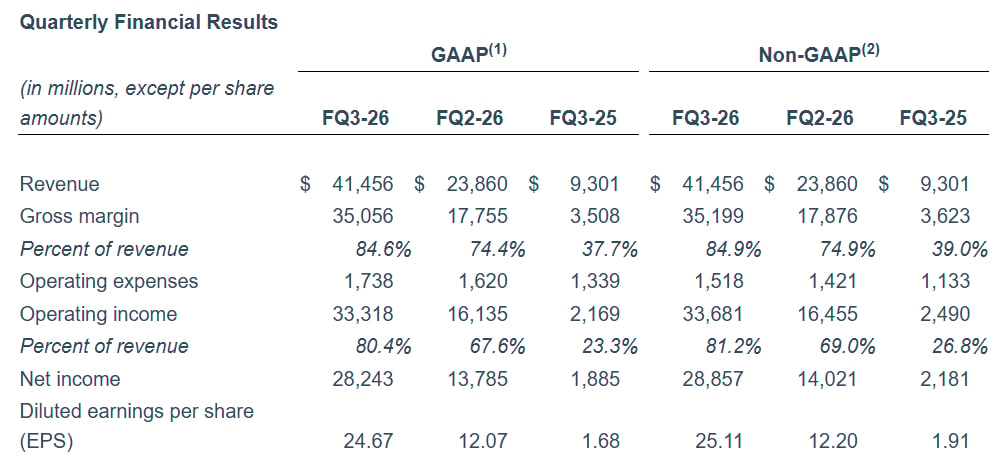
The significance of this financial report is that it validates the core logic of the storage super cycle. Supply constraints, continuous price increases, and expanding profit margins. Goldman Sachs previously estimated a DRAM supply-demand gap of 4.9% for 2026, the most severe in nearly 15 years. Micron disclosed that it can only meet 50% to two-thirds of customer demand in the interim, with the entire year's HBM capacity already contracted. For investors considering leveraging with RAM, this is the most important fundamental background.
What is RAM: 2x Daily Leveraged, Tracking the Fastest Growing ETF in History
RAM stands for Roundhill T-REX 2X Long DRAM Daily Target ETF, co-issued by Roundhill Investments and T-REX (a joint venture between REX Shares and Tuttle Capital Management), listed on June 24 on the Cboe BZX exchange.
Its target is the Roundhill Memory ETF (ticker DRAM), a pure storage chip-focused ETF that includes only companies where more than 50% of revenue comes from storage businesses. DRAM was launched on April 2, reaching $1 billion in assets under management in just ten trading days, and by June 24, its AUM exceeded $20 billion, with a total return of 179.84%, making it the fastest-growing product in ETF history.
The mechanism of RAM: it rebalances every trading day, aiming for 200% of the DRAM daily return. If DRAM rises by 3%, RAM aims to rise by 6%; if DRAM falls by 3%, RAM aims to fall by 6%. The net expense ratio is 1.25% (waived until September 2027). The custodian is Citibank. Options trading is not currently supported.
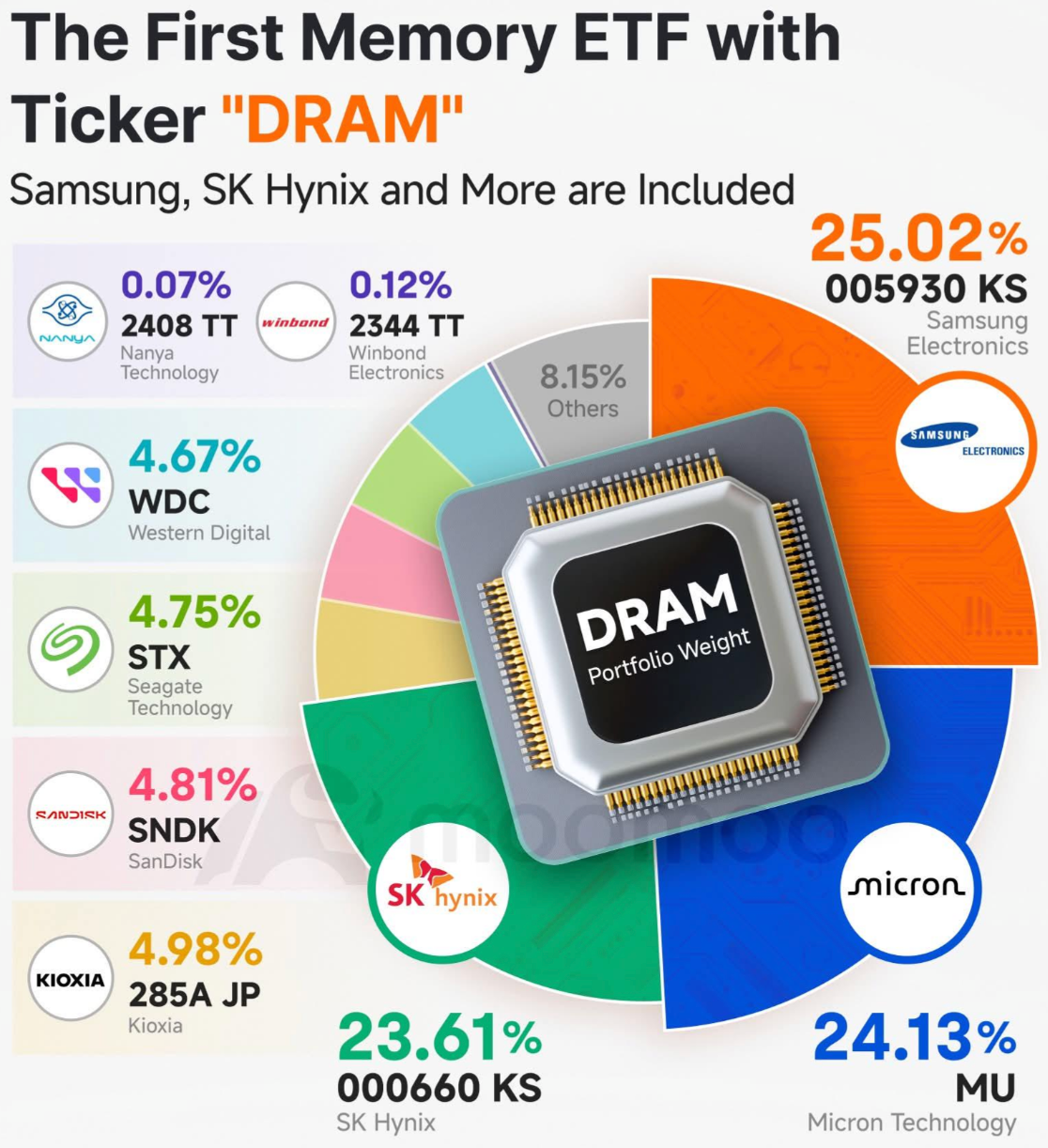
The holdings of the DRAM ETF are highly concentrated:
SK Hynix approximately 29%, Micron approximately 27%, Samsung approximately 21%, with these three stocks accounting for about 77% of the fund's net assets. Other holdings include Kioxia, SanDisk, Western Digital, Seagate, etc., with weights in low single digits. These three companies are also the only three HBM suppliers in the world.
Three Core Risks of RAM: What Happens if You Hold Still
The risk of RAM lies not in directional judgement but in the method of holding. Roundhill clearly warns in its recruitment documents: the fund "is not suitable for all investors" and is intended only for those who understand leveraged risks and are willing to frequently monitor their holdings.
Risk One: Diminished Volatility. Leveraged ETFs rebalance daily, and even if the underlying asset ultimately stays flat in a volatile market, the leveraged ETF will incur losses. A simple example: if DRAM rises 10% on the first day and falls 10% on the second day, after two days DRAM's net value becomes 99% of the original (losing 1%), but RAM's net value becomes 96% of the original (losing 4%). The more extreme the volatility and the longer the holding period, the more pronounced the decay. This means RAM is suitable for short-term directional trading, not long-term holding.
Risk Two: Concentrated Holdings with Added Leverage. The DRAM ETF has 77% of its position concentrated in three stocks, and RAM adds 2x leverage on top of that. On June 23, the KOSPI in South Korea plummeted by 10%, with both Samsung and SK Hynix falling over 12%, and the DRAM ETF fell about 14% that day. If RAM had been listed then, the theoretical single-day decline would have approached 28%. Although the KOSPI rebounded by 3.3% the next day, such extreme volatility combined with 2x leverage poses a severe test on position management capabilities.
Risk Three: Time Zone Mismatch. About 49% of the underlying assets of the DRAM ETF (Samsung, SK Hynix) trade on the Seoul exchange, and their prices cannot be reflected in real-time during U.S. trading hours. Overnight fluctuations in the Korean stocks will be concentrated and released at the opening of U.S. markets, causing a price gap. RAM amplifies this gap by 2x.
Current Position: Leveraging after a 16% Retracement?
As of the close on June 24, the DRAM ETF was priced at $68.35, having retraced about 16% from the 52-week high of $81.34 on June 19. Micron closed at $1057.59, rising approximately 12.6% in after-hours trading to around $1190 following its earnings report.
If using a simplified model to project: assuming Micron's earnings report catalyzes an 8% rebound in the DRAM ETF on June 25 (considering a simultaneous rebound in Korean stocks), RAM's target return could be approximately 16%. Conversely, if the market perceives that the positive news from Micron's earnings report has fully materialized and the DRAM ETF declines another 5%, RAM would incur a loss of around 10%.
It's important to note that the DRAM ETF has seen a significant increase from its launch price in April to the current $68 (total return of 179.84%). Even with a 16% retracement from its peak, the current price forms an unrealized loss for investors who entered positions at higher levels.
Entering RAM at this position bets on the Micron earnings report triggering a new rebound cycle, rather than continuing the retracement.
The supporting data for this judgment: Micron's Q4 guidance of $50 billion far exceeds market expectations, indicating a further sequential revenue growth of 20%. According to Everstream Analytics, about 70% of high-end DRAM capacity will flow to AI data centers by 2026. SK Hynix is expected to achieve an operating margin of 72% in Q1 2026. Multiple institutions anticipate that storage shortages will continue until 2028 or even longer.
However, there are also contrary signals.
Out of 27 analysts covering Micron, 25 have given buy ratings, but the average target price is only about 3% higher than the closing price on June 22, indicating tight upside potential. Within just three months of the DRAM ETF’s launch, there have been two instances of volatility triggering circuit breakers in the Korean market, indicating that this sector has a very high beta. Using RAM with leverage essentially amounts to applying 2x leverage on an already highly volatile asset. If the direction is correct, the returns can be substantial; if the direction is wrong, the exit window may be much narrower than expected.
Who Should Use RAM, and Who Should Not
Investors suitable for RAM:
- Those who have day trading or short-term trading habits (within several days),
- Those with a clear directional judgment on the storage chip sector, who can tolerate daily fluctuations of over 20% and understand that leveraged ETFs do not equate to "two times the return."
Investors unsuitable for RAM:
- Those planning to hold for more than a week,
- Those who treat RAM as a "superior version" of the DRAM ETF for long-term allocation. Diminished volatility will continuously erode returns during mid to long-term holdings; even if the directional judgment is correct, the final returns may still significantly fall short of expectations.
For investors bullish on the storage super cycle but lacking day trading abilities, the DRAM ETF itself (0.65% fee, no leverage) may be a more stable choice. With the current price at $68, which has retraced 16% from the peak, if the fundamental logic verified by Micron’s earnings is accepted, the DRAM ETF allows investors more room for correction after errors; RAM does not provide this leeway.
Disclaimer
This article is a compilation and interpretation of public information. The predictions and related judgments quoted in the text are all based on publicly available information and do not constitute any investment advice.
免责声明:本文章仅代表作者个人观点,不代表本平台的立场和观点。本文章仅供信息分享,不构成对任何人的任何投资建议。用户与作者之间的任何争议,与本平台无关。如网页中刊载的文章或图片涉及侵权,请提供相关的权利证明和身份证明发送邮件到support@aicoin.com,本平台相关工作人员将会进行核查。


