Holding 3.5 billion in traffic, but the trust crisis and regulation remain the biggest obstacles.
Written by: Gino Matos
Translated by: Luffy, Foresight News
TL;DR:
- According to The New York Times, Meta has formed a small team to develop a points-based prediction application codenamed Arena, where users can bet on the outcomes of politics, sports, and global events.
- The prediction market has shown real demand, and with 3.56 billion daily active users, Meta is poised to bring this niche track to the mainstream market.
- However, Meta's trust crisis, along with elections and misinformation scrutiny, may make Arena a target for regulation before it scales up.
On June 23, The New York Times reported that Mark Zuckerberg is leading a specialized team to develop the prediction market application Arena. Users will bet on the results of political elections, sports events, and international affairs using points on the platform.
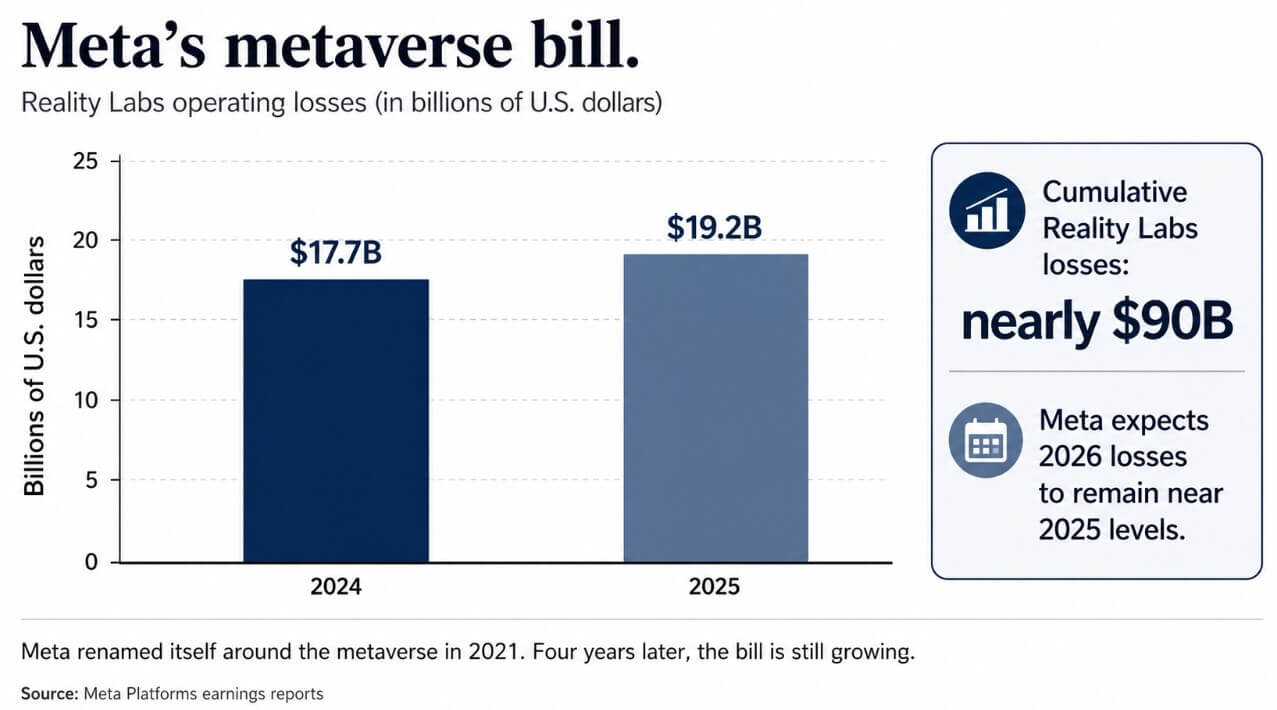
This company, which has rebranded to focus on the metaverse and has accumulated nearly $90 billion in losses at its Reality Labs division, is now shifting its focus to the prediction market. This track has strong real demand and an established user base, but the regulatory rules are complex. This transformation might be Meta's wisest strategic adjustment or could repeat past costly failures.
The Huge Bills Left by the Metaverse
In October 2021, Facebook officially changed its name to Meta, with Zuckerberg stating that the company's core goal is to "build the metaverse," predicting that it will reach one billion users within a decade.
The division supporting this vision, Reality Labs, has seen loss expansion: an operational loss of $17.7 billion in 2024, $19.2 billion in 2025, with cumulative losses nearing $90 billion. Meta told investors that losses in this segment could equal 2025's figures in 2026.
The flagship social VR platform Horizon Worlds fell below 200,000 monthly active users in 2022, far below the initial target of 500,000; later, Meta adjusted its expectations again and plans to gradually shut down the operations of the VR version by 2026.
Why the Prediction Market is a Completely Different Track
In 2026, Kalshi and Polymarket, two leading platforms, will have a combined monthly trading volume of about $24 billion, with industry institutions predicting the total annual trading volume of the prediction market will exceed $130 billion.
Robinhood will launch a prediction market section in 2025, and Interactive Brokers will integrate event contracts into its trading platform; even the Golden Globe Awards will introduce interactive elements involving prediction markets. Bernstein's April research report estimates that the annual trading volume of this track could hit $1 trillion by 2030.
Meta has always excelled at replicating popular products, relying on vast traffic to gain an advantage: after Snapchat launched Stories, Instagram introduced Stories; Twitter dominated the social image and text arena for a decade, and then Meta launched Threads; after TikTok became popular for short videos, Meta introduced Reels. As of April, Meta's entire product suite had a total of 3.56 billion daily active users, outpacing all existing prediction market platforms.
Arena employs a point system, continuing Meta's consistent strategy of tapping into existing user behavior needs, embedding itself in its traffic ecosystem, and compensating for lack of product originality through massive distribution.
Building a prediction market requires only software, information streams, account systems, content review, and compliance systems, with some scenarios allowing access to licensed partner institutions; however, the metaverse requires custom hardware, immersive content, virtual avatars, exclusive operating environments, and years of user habit cultivation. The enormous losses of Reality Labs prove that creating an entirely new track from scratch is extremely costly.
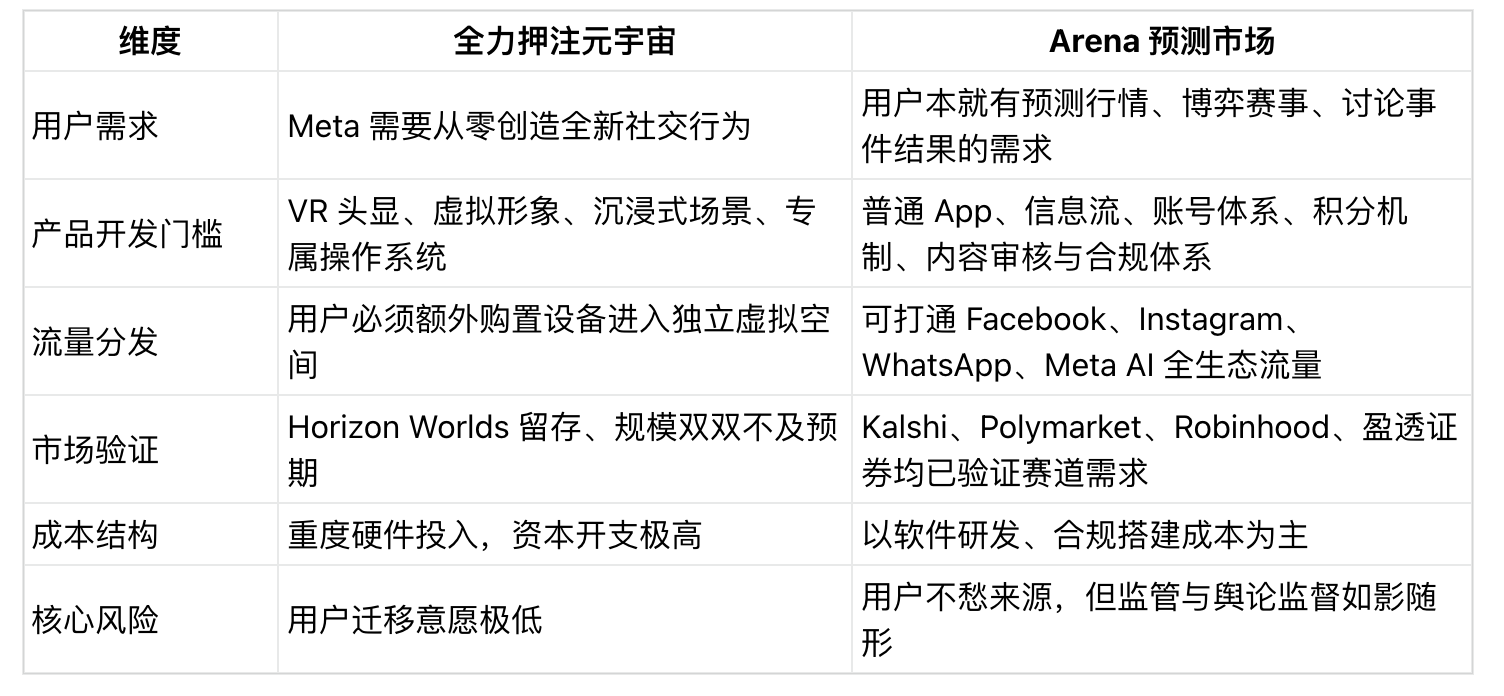
Core Dimension Comparison Between the Metaverse and Prediction Market Arena
Arena Is Not Meta's First Foray into Prediction Markets; The Previous Product Has Already Been Shut Down
As early as the beginning of the COVID-19 pandemic in 2020, Meta launched a points-based prediction application called Forecast, focusing on current affairs predictions, but it was shut down in 2022. At that time, Polymarket had not yet gained popularity from the 2024 U.S. presidential election explosion, and Kalshi had not won the federal lawsuit for election contract operation qualifications with the Commodity Futures Trading Commission (CFTC), and the annual trading volume in the industry had not yet exceeded $50 billion.
There have been numerous regulatory penalty cases in the prediction market that Meta is about to enter:
- In 2022, the CFTC found that Polymarket conducted off-exchange event derivatives trading without registration and imposed a $1.4 million fine;
- Kalshi spent years in federal litigation vying for election contract operation qualifications, with a favorable ruling from the district court in September 2024, and the CFTC dropping its appeal in May 2025, allowing more compliance space for election event contracts, but issues of political trading and market fairness are still not resolved;
- In April 2026, the CFTC initiated the first-ever insider trading lawsuit in the prediction market, accusing an active-duty U.S. military officer of profiting from trading on Polymarket using confidential intelligence from Venezuelan operations.
Meta's past forays into financial products have already made regulators highly alert to its financial ambitions. The digital stablecoin project Diem (formerly Libra), led by Facebook, was ultimately sold to Silvergate Bank at a low price in 2022 after regulators determined that Meta's control over a payment network serving billions of users could lead to excessive concentration of financial and social power. During that year's Libra hearing, Meta was met with fierce regulatory opposition due to its combination of social identity, political content, financial incentives, and market data.
It is precisely because the points-based prediction game can circumvent early stringent financial regulation that Meta has chosen this as the starting point for Arena.
What Advantages Can Massive Traffic Bring
The most feasible form of Arena's initial product is to build a public prediction function based on social scale: Instagram creators publish prediction markets for award events, Facebook groups discuss sports odds, WhatsApp communities share collective prediction opinions, and Meta AI aggregates mainstream expectations from across the web.
This version does not involve cash event contracts that have previously attracted regulatory penalties, relying solely on the operation of the social graph with 3.56 billion daily active users.
However, the core logic of the prediction market is to rely on real money games to constrain prediction behavior and form fair prices; once replaced with point-based interaction incentives, the product will prioritize dissemination and user engagement over prediction accuracy.
Meta's poor track record in handling political content and combating misinformation means that regulators and the media will naturally scrutinize every controversy arising from Arena.
The traffic advantage of Meta is sufficient to support the scale of the market. The successful logic of Stories and Reels is consistent: capturing existing user preferences and amplifying dissemination through a platform with hundreds of millions of users. If Arena establishes a lightweight social prediction function, controlling the financial barriers, allowing ordinary Facebook users to easily access the prediction market while platforms like Kalshi maintain a professional trading position, Meta may grow the industry pie and benefit existing leading platforms.
Users who are native to cryptocurrencies and possess financial knowledge have supported billions in the prediction market domain, while Meta's 3.56 billion daily active users are a vast pool of ordinary users that the industry has never reached. This is also the greatest opportunity for this entry.
However, just two months prior to the news of Meta's entry, the CFTC initiated the first insider trading lawsuit in the history of prediction markets, with regulatory scrutiny continuing to tighten. The platforms under Meta cover predictions related to elections, sports events, and public figures, which can easily trigger regulatory intervention; combined with the company's past negative records in handling sensitive political content, Meta enters the market with inherent credibility issues, and the massive traffic may amplify various negative controversies.
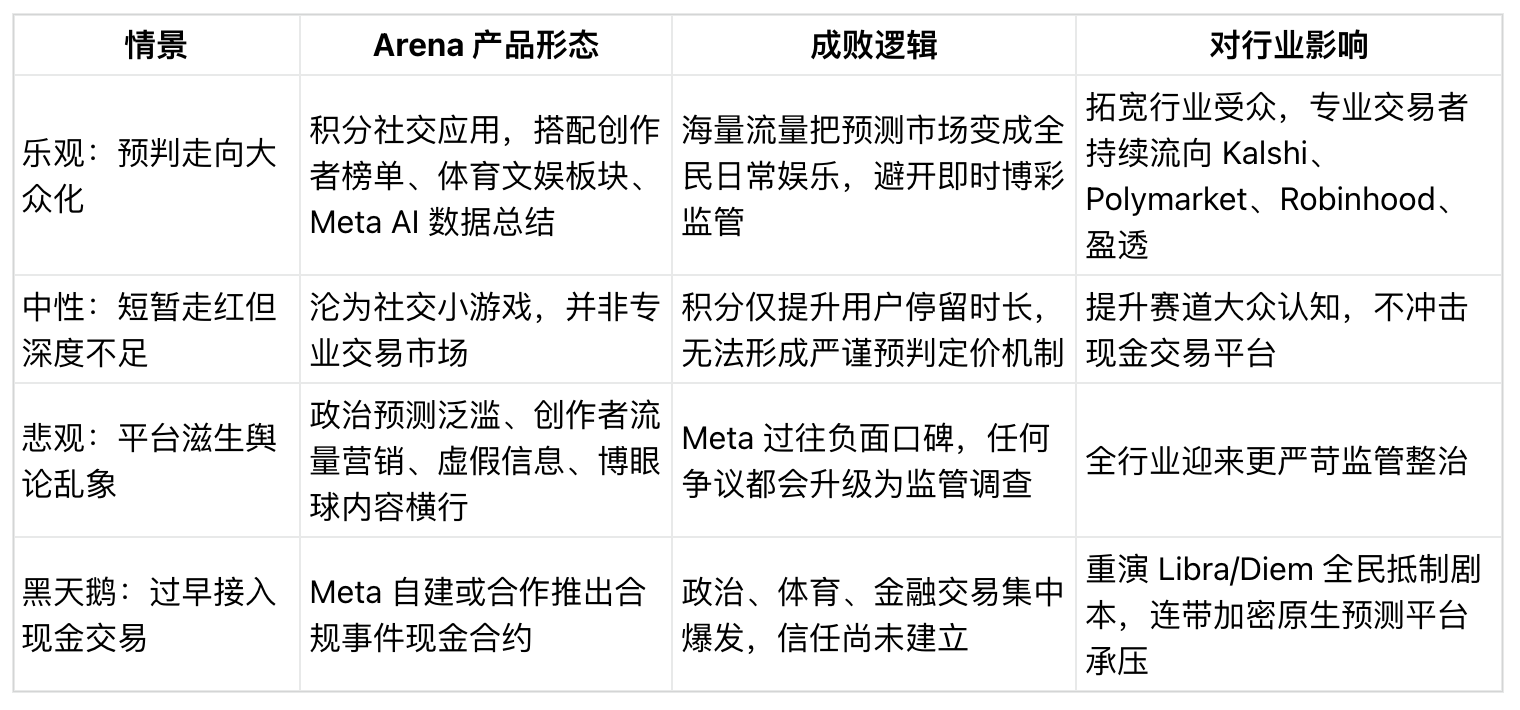
Four Development Scenarios for Arena
Several of Meta's previous financial products have completely failed due to the inability to resolve trust issues as determined by regulators.
Arena has inherent advantages, with the prediction market track already established, and a real existing user base. However, the operating platform Meta carries the same negative reputation as when Libra failed. Once election and financial transactions are involved, trust becomes a core asset that Meta must earn through long-term operations; simply having a large traffic scale cannot compensate for the lack of credibility.
免责声明:本文章仅代表作者个人观点,不代表本平台的立场和观点。本文章仅供信息分享,不构成对任何人的任何投资建议。用户与作者之间的任何争议,与本平台无关。如网页中刊载的文章或图片涉及侵权,请提供相关的权利证明和身份证明发送邮件到support@aicoin.com,本平台相关工作人员将会进行核查。


