
Author: Nancy, PANews
Meta rose early again but was late to the party.
After six years, tech giant Meta is once again entering the battlefield of prediction markets. Back in 2020, Meta quietly launched the experimental prediction application Forecast, trying to explore the commercial potential of collective intelligence, but the product did not create much of an impact and quietly ended.
Today, the prediction market has grown into a hot new sector, with players like Polymarket and Kalshi pushing this field to a size of hundreds of billions of dollars. Meta has chosen to make another move, with Zuckerberg personally pushing for the internal development of the prediction market application Arena, attempting to leverage its massive user ecosystem and traffic advantage to take a share of this feast.
Zuckerberg personally leading the team, 3.5 billion daily active users become Meta's biggest bargaining chip
According to The New York Times, Zuckerberg has recently assigned a small internal team at Meta to develop a smartphone application similar to Polymarket and Kalshi, codenamed “Arena.”
Insiders say that Arena allows users to predict future events and will operate independently from Meta's existing social product ecosystem, including Facebook, Instagram, WhatsApp, and Messenger.
Unlike existing prediction market platforms, the initial version of Arena will not involve real money betting mechanisms and is more likely to adopt a game-like points system.
This design stems from multiple practical considerations.
Firstly, real money prediction markets in the US and globally face complex gambling regulations, compliance reviews, and potential litigation risks. The use of a points system helps position Arena as a social entertainment prediction tool, thereby reducing legal and compliance pressure and alleviating concerns about addiction, market manipulation, and money laundering risks, leaving space for global promotion.
Secondly, as a product still in the early validation stage, a low-barrier points system can help Meta quickly test prediction mechanisms and social interaction models with lower legal and operational costs, continuing its usual rapid trial-and-error strategy.
Additionally, the design without a monetary barrier also helps lower the participation threshold, expand user coverage, and accelerate the formation of scaled participation and community interaction.
Although the project is still in the experimental stage, Zuckerberg is personally promoting it and has listed it as one of the internal priority projects.
Compared to most newcomers, Meta plans to leverage its huge social network user base to drive traffic and growth for Arena. According to Meta's Q1 2026 earnings call, its social platform's daily active users (DAP) reached 3.56 billion this quarter, which is seen as a significant confidence boost for its swift entry into the prediction market.
However, insiders at Meta also revealed that Arena is still in the early development stage, and whether it will be officially released is yet to be determined.
Failed testing six years ago, Meta re-enters the prediction market
In fact, this is not Meta's first foray into the prediction market arena.
As early as 2020, Meta's new product experimental team NPE launched the crowdsourced prediction application Forecast. Users could make predictions and discussions about future events through a points mechanism. At that time, NPE was positioned as Meta's innovation incubator, focusing on quickly testing various new forms of social products. Forecast was one of the applications tested by NPE.
The birth of Forecast, to some extent, stemmed from the multiple pressures Facebook faced at the time. The quality of social discussions on Facebook was declining, the spread of fake news and conspiracy theories was increasing, and the polarization of comment sections was worsening. To address this, Meta hoped to guide users to express views based on evidence rather than emotional outbursts through Forecast.
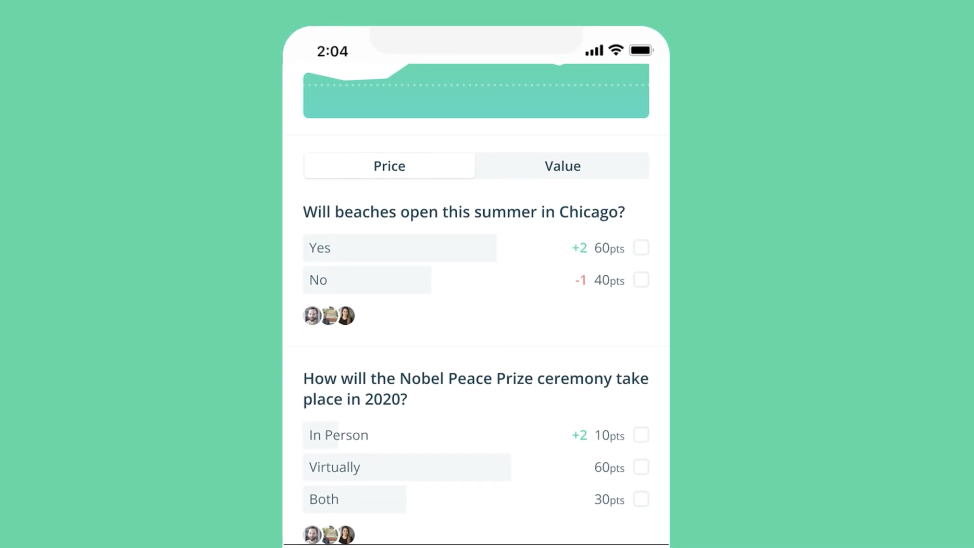
At the same time, Meta was also trying to verify whether collective public predictions could surpass expert judgments in specific areas (such as the pandemic, economy, and public events). The early topics of Forecast focused on pandemic-related predictions to test whether collective intelligence could evolve into a new source of information.
NPE product head Rebecca Kossnick stated: “We believe that communities built around predictions can not only gather crowdsourced wisdom but also promote healthier online conversations.”
However, due to unclear product positioning, lack of user incentives, limited mechanism designs, gradual resource shrinkage of the team, and the contentious nature of pandemic-related topics, it was difficult for Forecast to achieve stable growth, leading to its closure two years later.
Similar stories of missing opportunities are not rare in Meta's product history. For example, with stablecoins, in June 2019, Meta announced the launch of the stablecoin project Libra, but soon faced global regulatory pressures, political resistance, and multiple partner withdrawals, forcing the project to be renamed Diem and continuously shrink in scale, eventually being sold to Silvergate Bank in 2022.
But this year, when Meta cautiously returned to the stablecoin arena, the market had already "changed," with Tether and Circle firmly occupying the dominant share, while more traditional financial giants entered the arena, solidifying the competitive landscape. Meta had to give up the issuance of its own stablecoin and instead integrate third-party stablecoin payment systems, focusing on its advantages in user experience, distribution capabilities, and platform scenarios.
The prediction market enters an oligopoly, making it harder for newcomers to get a slice
Six years later, Meta's return to the prediction market table is not an easy task. Once a niche experiment, it has now evolved into a hot battlefield of fierce competition among giants and emerging players.
According to Dune data, as of June 24, there have been over 3.77 million unique addresses participating in the prediction market, with a cumulative nominal trading volume exceeding $259.3 billion. In terms of monthly performance, the nominal trading volume for June alone reached $33.6 billion, growing about 15.6 times compared to the same period last year; active participating addresses exceeded 740,000, nearly 2.9 times compared to the same period last year; monthly fee income surpassed $220 million, growing approximately 27.5 times year-on-year.
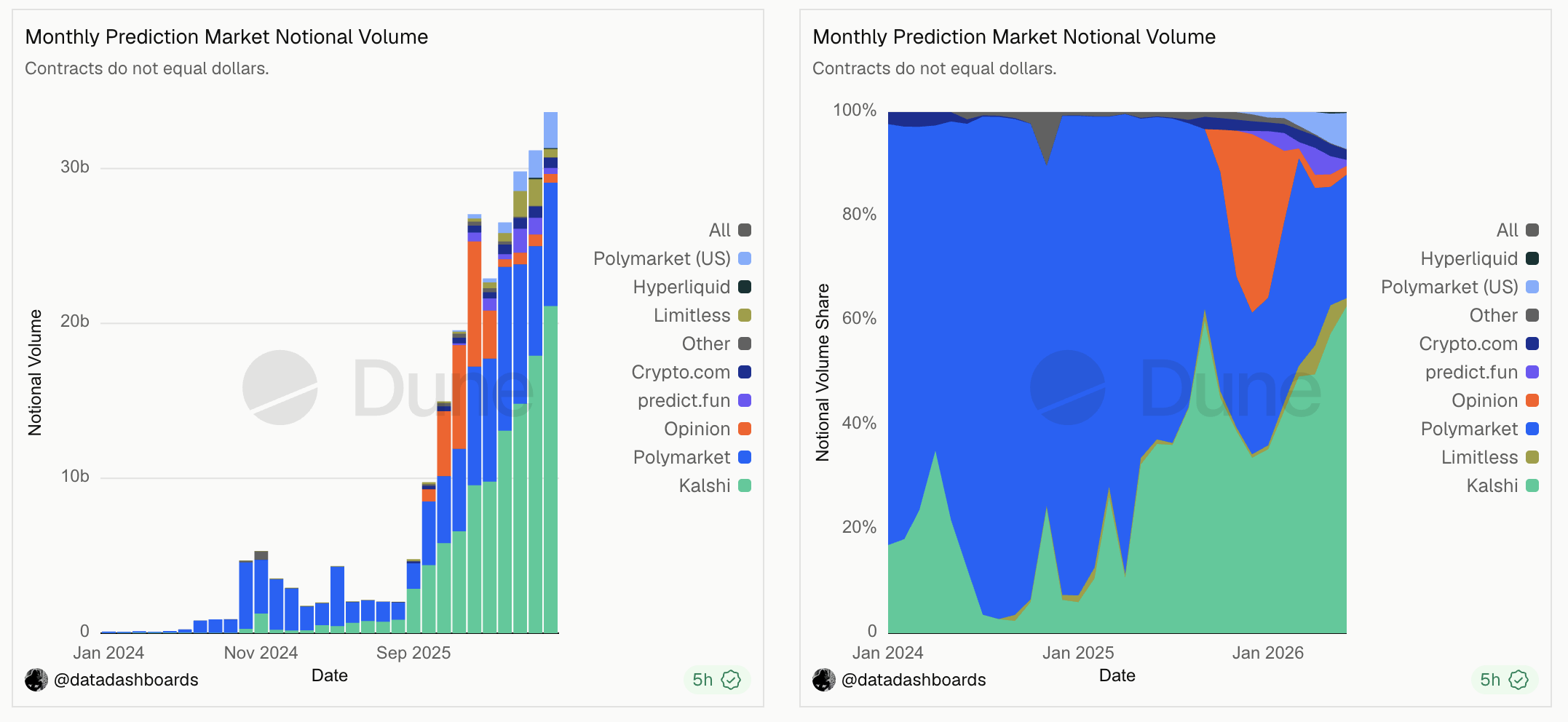
Despite the rapid expansion of the market, the shares have been divided among a few leading players, with Kalshi and Polymarket dominating.
Dune data shows that as of June 24, in terms of nominal trading volume, Kalshi accounted for 62.8%, and Polymarket accounted for 23.7%; regarding fee capture, Kalshi accounted for 77.1%, while Polymarket was about 21.1%. Meanwhile, the valuations of both have quickly risen to approximately $22 billion and $15 billion, respectively.
Not only that, the prediction market is welcoming more entrants, including Charles Schwab, DraftKings, Robinhood, Coinbase, and Webull, all of which have announced or launched related business layouts.
In addition to competitive pressure, the prediction market is also facing increasingly severe regulatory and legal challenges. Many countries have implemented varying degrees of restrictions or prohibitions on prediction markets, and recently, US regulatory agencies have released the first draft of regulatory rules for prediction markets, raising concerns among regulators about market manipulation, insider information, insufficient consumer protection, and the potential for participants to profit by influencing events.
For Meta, the real challenge lies not in re-entering the arena but in how to leverage its extensive user base and social ecosystem to create a differentiated experience rather than simply replicating existing platform models.
Looking at it another way, if Meta, with its vast traffic, can successfully increase the size of the pie, it not only stands to gain considerable traffic and revenue growth but also has the potential to break through the ceiling of the prediction market.
免责声明:本文章仅代表作者个人观点,不代表本平台的立场和观点。本文章仅供信息分享,不构成对任何人的任何投资建议。用户与作者之间的任何争议,与本平台无关。如网页中刊载的文章或图片涉及侵权,请提供相关的权利证明和身份证明发送邮件到support@aicoin.com,本平台相关工作人员将会进行核查。


