Author: Martin talk
In June, discussions regarding "US stocks" in the crypto market have once again intensified. After major platforms like Binance and Coinbase recently underwent intensive adjustments or launched US stock-related products, Bitget has also made consecutive moves this month: first, launching US stock tokens (rToken) issued by Reality at the beginning of June, and then rolling out Bitget's direct service for US stocks this week.
Launching two radically different US stock solutions in just one month, Bitget's "dual track" layout has drawn attention from the industry. Is this truly a stopgap measure in response to regulatory pressure, or is it a deep exploration of the integration path between traditional finance and the crypto world?
Direct US Stocks: Finding Balance Between Traditional and Crypto
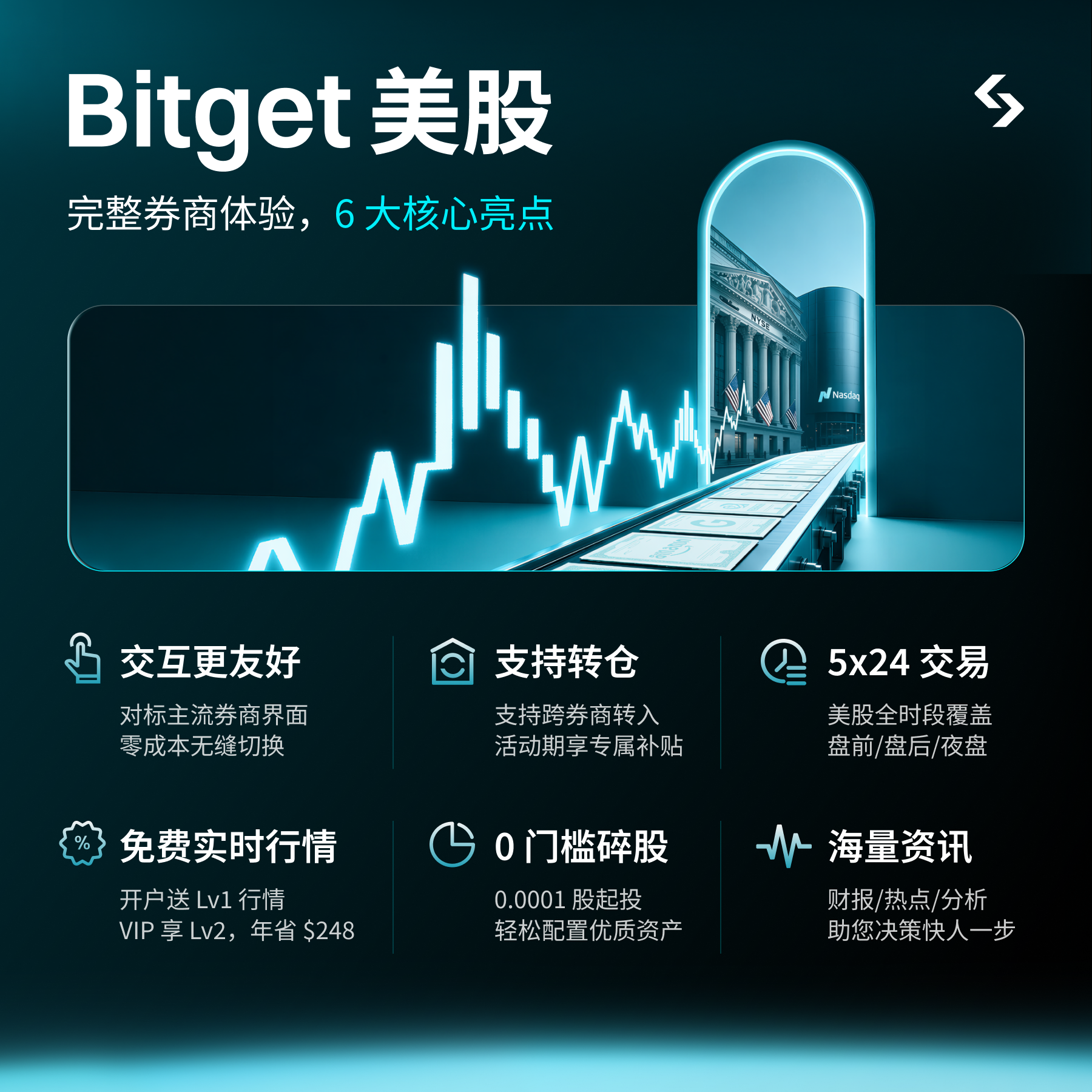
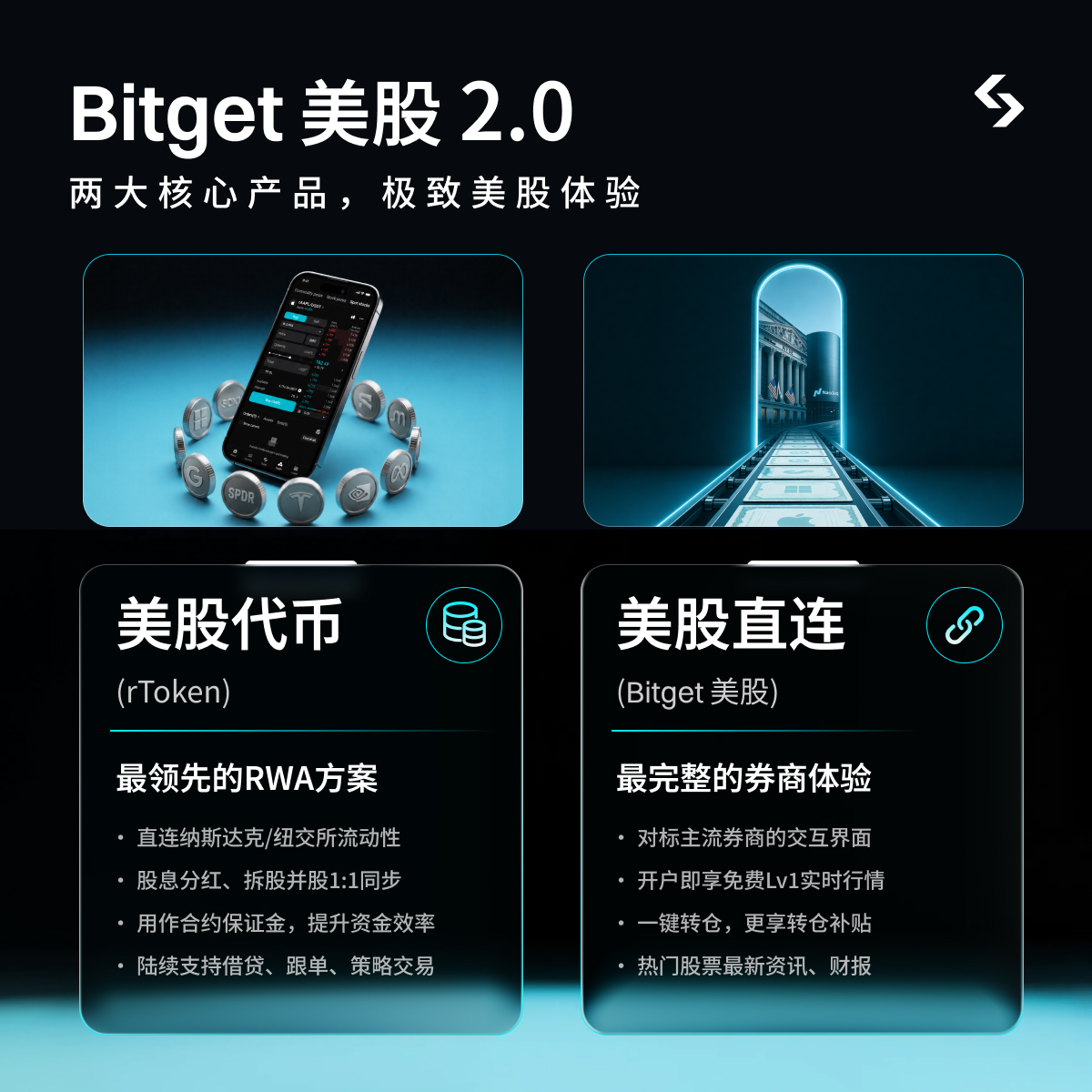
This week, Bitget launched its direct service for US stocks—Bitget US Stocks, which aims to provide a "broker-like" experience. By cooperating with US licensed brokers like RQD Clearing and Atomic Vaults Securities (AVS), the platform offers trading access to over 10,000 US stocks and ETFs, supporting fractional trading starting from 0.0001 shares. Notably, this service allows free transfers from traditional brokers such as Futu, Tiger, and Changqiao, and offers a 5×24 hour trading period.
In crypto exchanges, "direct connection" is no longer a novel concept; many claim to connect directly to Nasdaq and the New York Stock Exchange, the two most active capital markets globally. The primary problems that "direct connection" can solve are liquidity, the authenticity of assets, and the synchronization of corporate actions like dividends and stock splits. If platforms like Binance, Bitget, and Gate all achieve direct connections to US stocks, then direct connection is no longer a differential advantage.
Compared to Binance's previously launched US stock offerings, Bitget's direct service retains traditional trading habits intact: users enjoy real stock holding, dividend rights, and voting rights, support for transfer from other brokers, and an interface closer to the standards of traditional brokers in terms of interaction, real-time market data, and information. However, this model also faces challenges similar to those of traditional brokers, such as being constrained by the strictness of KYC audits and the risks of centralized asset custody. For users accustomed to licensed traditional brokers, whether the experience of buying stocks on a crypto exchange is sufficiently attractive remains to be seen in the market.
US Stock Tokens: A Boundary Experiment in RWA Solutions
Compared to the "conservative" direct connection service, Bitget's Reality US stock tokens (rToken), launched at the beginning of June, have a more crypto-native flavor. As part of the RWA (Real World Assets) track, rToken attempts to achieve a chain representation of US stock assets through blockchain technology, promising to restore the liquidity of US stock tokens through collaboration with US broker Alpaca, with users even testing that when ordering rToken on Bitget, that order appears in the order books of brokers like Robinhood, demonstrating that the liquidity issues that previously plagued RWA issuers like Ondo and xStocks have been effectively resolved through mapping and linking.
As former leaders in the US stock token market, Ondo and xStocks' US stock tokens have been criticized for insufficiently obvious dividends, and for slow responses to actions like stock splits, which have caused some assets’ prices to deviate significantly from real stocks for extended periods, further intensifying user concerns about decoupling. Meanwhile, Reality's US stock tokens maintain a 1:1 synchronization with underlying assets in terms of dividends, stock splits, and other rights.
If liquidity and dividend schemes were to be compared, the "US Stock Tokens" might only achieve a tie with "Direct US Stocks." The true core advantage of rToken, developed by this mainstream exchange, lies in its deep integration with the exchange ecosystem, as it can be directly used as margin for contracts, thus enhancing capital efficiency. Additionally, rToken will gradually support more extensive functions like lending, regular investments, and copy trading. Compared to early RWA projects like Ondo and xStocks, Reality genuinely seeks to address the pain points of liquidity fragmentation. However, it is undeniable that the RWA track still faces multiple challenges, including regulatory uncertainties, oracle dependencies, and cross-chain security risks. Currently deeply bound to Bitget, whether rToken can independently expand more off-chain and on-chain scenarios without the backing of exchanges will be key to testing its long-term value.
Dual Track Parallel: A Pragmatic Choice in the Transition Period
Why did Bitget choose to promote two routes simultaneously by launching two US stock products within a month? Bitget CEO Gracy Chen provided an intuitive explanation in a recent tweet: there are significant behavioral differences between traditional investors and crypto users, and forcing a unification often leads to a negative experience for both parties.
From an objective perspective, Bitget's "dual track" reflects the current market's split perception of US stock tokenization. On one hand, traditional investors remain skeptical about private key management and smart contract risks, preferring regulated centralized custody; on the other hand, crypto users pursue 24/7 trading, high capital efficiency, and a decentralized spirit. In the transition period where these two groups have not fully merged, a single product struggles to meet the needs of both ends.
Bitget's strategy appears to be a compromise but is, in fact, a pragmatic market position. By attracting traditional funds through direct services and exploring Web3 native scenarios through rToken, Bitget seeks to find the greatest common divisor between compliance and innovation. However, this model also raises higher demands on the platform’s operational capabilities: how to ensure the independence of the two systems at the compliance level? How to avoid internal resource competition?
In the long run, US stock tokenization may be an inevitable trend, but the pace of this process may be slower than anticipated. Bitget's "dual track" attempt may provide the industry with a sample for observing how traditional finance and the crypto world coexist. However, until regulatory clarity emerges, this experiment regarding US stocks on-chain will continue to progress amid controversy and exploration.
免责声明:本文章仅代表作者个人观点,不代表本平台的立场和观点。本文章仅供信息分享,不构成对任何人的任何投资建议。用户与作者之间的任何争议,与本平台无关。如网页中刊载的文章或图片涉及侵权,请提供相关的权利证明和身份证明发送邮件到support@aicoin.com,本平台相关工作人员将会进行核查。


