Source:Shanghai Securities Journal
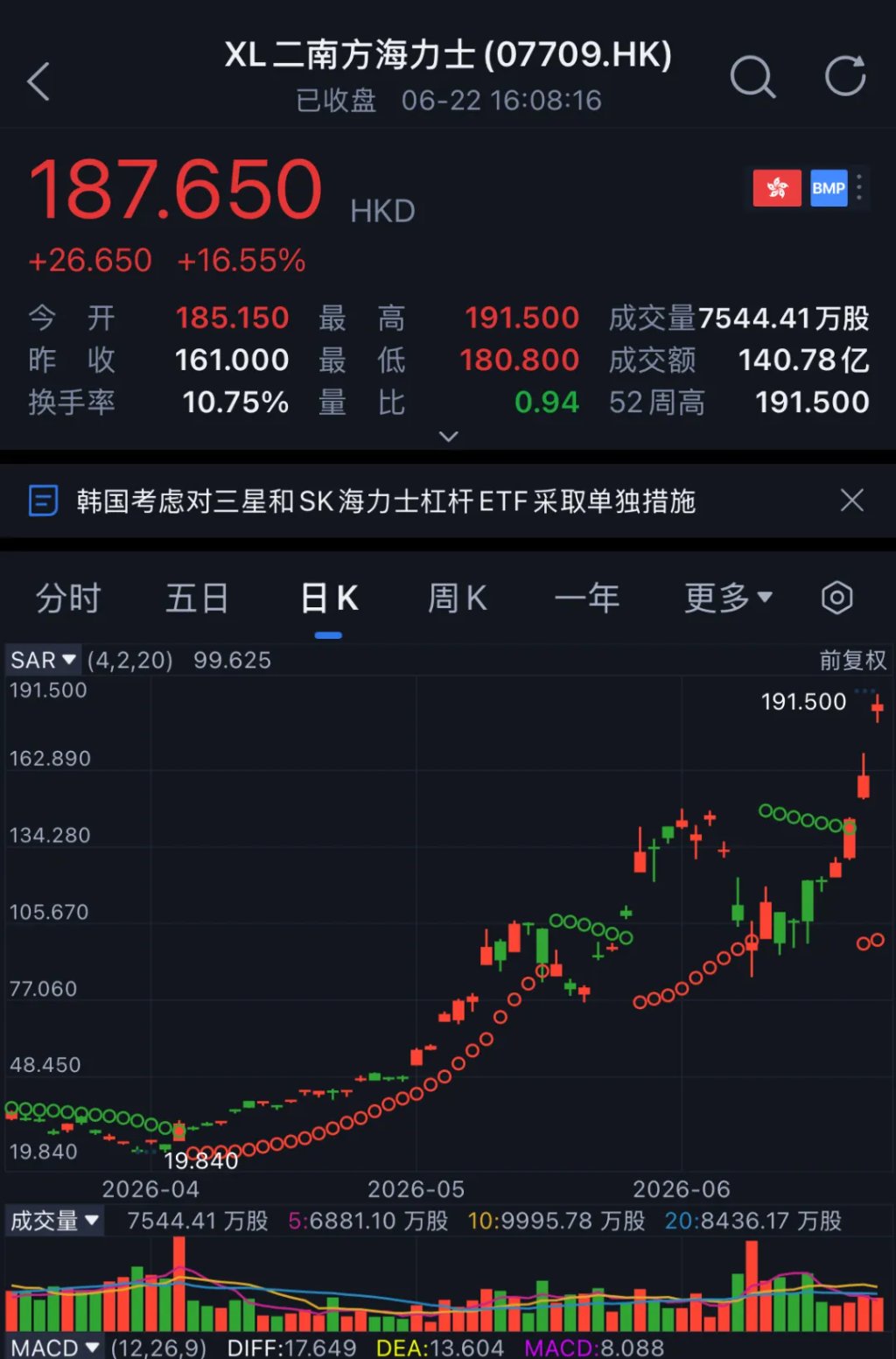
With market funds eagerly chasing storage chips, as of June 22, the Southern Double Long SK Hynix ETF has seen its increase this year surpassing tenfold. Meanwhile, the asset scale of this ETF has also skyrocketed over twenty times compared to the end of last year.
However, industry insiders remind that against the backdrop of semiconductor sector valuations being at historical highs and increasing divergence between bulls and bears, the risk of leveraged products amplifying losses in both directions is accelerating exposure, and individual investors need to maintain sufficient caution regarding such tools.
Southern Double Long SK Hynix Rises Over Tenfold This Year
Since 2026, the global semiconductor market has been continuously surging. In the A-share market, core storage stocks such as GigaDevice, Zhongwei and Jiangbo Long have been rising; the overseas market remains hot, with the South Korean storage giant SK Hynix's stock price continuously climbing. On June 22, SK Hynix's market value briefly surpassed Samsung Electronics, reaching the top of the South Korean stock market valuation list, closing up 5.61% on that day.
Previously, SK Hynix announced the delivery of 12-layer HBM4E samples to core clients, which is a new generation of high-performance DRAM aimed at AI scenarios.
According to industry insiders, compared to HBM4, HBM4E achieves dual upgrades in performance and energy efficiency, with a maximum pin speed of 16Gbps and an energy efficiency improvement of over 20%. This product, relying on a new interface and architecture design, can reduce transmission latency and operate stably under high-bandwidth conditions, enhancing the data processing capability for AI training and inference, while also effectively improving the overall computational efficiency of the new generation of AI data centers and large computing systems.
Zhou Jingxiang, fund manager of Nuon Research Optimal Fund, said in an interview with Shanghai Securities Journal that the core driver of this round of storage up-cycle comes from the explosion of SSD storage demand resulting from AI inference computing power, and the industry's prosperity may rise throughout the year.
Leveraged ETFs linked to core chip leaders like Hynix and Samsung Electronics have also ushered in an epic market.
As of June 22, at the Hong Kong stock market, the Southern Double Long SK Hynix ETF surged 16.55% in a single day, with a cumulative increase of 1061.92% this year. This product was officially listed on the Hong Kong Stock Exchange on October 16, 2025, with an initial scale of only about 24 million Hong Kong dollars. However, with the continued fermentation of the storage market, the scale of this product has experienced explosive growth - as of June 18, the ETF's scale stood at 14.418 billion US dollars, skyrocketing 21.7 times compared to 636 million US dollars at the end of last year.
The Southern Double Long Samsung Electronics has also seen a significant influx of funds. Data shows that as of June 18, the Southern Double Long Samsung Electronics ETF's scale reached 4.4 billion US dollars, following a massive increase of 215.96% in May, and again growing over fifty percent since June.
However, analyzing the funding structure reveals that the current leveraged ETF trading market exhibits a distinctly retail investor-dominated characteristic, with institutional funds generally absent.
"The vast majority of institutions will not allocate to leveraged ETFs, with only a few hedge funds using them as tools for short-term trading," a senior foreign fund manager candidly told reporters, emphasizing that funds such as pensions that pursue stable long-term returns are completely mismatched with the high volatility and high risk nature of leveraged products, making individual investors the core purchasing group for such products.
Be Aware of Potential Volatility Risks
Industry insiders view leveraged ETFs as a typical "double-edged sword" of returns and risks, capable of multiplying investment returns during a market uptrend; however, when the market turns downward, losses will also be amplified. Currently, the divergence between bulls and bears in the global semiconductor sector continues to grow, with multiple uncertainties intertwining in geopolitics, industry, and valuation, and the various risks hidden within leveraged ETFs are continuously being exposed, requiring investors to remain highly vigilant.
Recent market fluctuations have vividly demonstrated the damaging power of losses from leveraged products. On June 18, the South Korean Financial Supervisory Service released a monitoring report showing that from May 27 to June 12, Samsung Electronics' underlying stock saw a maximum drawdown of 18.0%, corresponding to a maximum drawdown of 35.9% for the double long leveraged ETF, nearly doubling the losses; SK Hynix's underlying stock drew down 19.1%, and its double leveraged ETF's drawdown further expanded to 38%. Regulatory authorities have repeatedly reminded that the South Korean market's individual stocks are subject to ±30% price fluctuation limits, and the theoretical maximum daily loss for double leveraged products can reach 60%, making principal easily shrink significantly in extreme markets.
In addition to the regular amplified volatility risks, leveraged ETFs have also experienced extreme anomalies where the movements completely disconnect from the underlying stock, resulting in huge losses for retail investors pursuing short-term gains. In early June this year, a double leverage ETF tracking SK Hynix showed two consecutive trading days of divergence: on June 8, when SK Hynix's underlying stock fell nearly 8%, the ETF surged nearly 50%; the next day, when the underlying stock rose over 13%, the ETF plunged as much as 40% during intraday trading.
Regarding this abnormal fluctuation, the product manager, Korea Investment Management Company, explained that the root of the anomaly lies in insufficient market-making liquidity. During the closing auction period, market makers have no obligation to quote, with large market buy orders pushing up the fund price, creating significant premiums, and when market liquidity returns the next day, prices quickly revert to fair value, causing substantial losses for investors who entered at earlier high levels.
A fund analyst from Shanghai explained to reporters the long-term and short-term multiple potential risks of leveraged ETFs: firstly, the product adopts a derivative structure with daily reset leverage, which under high volatility market conditions will generate persistent time decay, meaning that even if the underlying stock price returns to previous highs, the fund's net asset value may still suffer permanent losses; secondly, the leveraged product magnifies both gains and losses, with the overall valuation of the semiconductor sector currently at historical highs—once the sector collectively adjusts, the impact of leveraged product drawdowns will far exceed that of underlying stocks; if the product's scale continues to swell and then encounters concentrated redemptions, it could trigger a liquidity spiral, further exacerbating price declines; thirdly, the trading volume of leveraged products in the Korean market has approached that of leading chip stocks, with large retail investors concentrating their bets creating positive feedback, continuously driving buy orders during the uptrend and causing a rush of stop-loss selling during the downtrend, significantly elevating market fragility.
Uncertainty at the fundamental level of the industry chain will also amplify the volatility risk of leveraged products. Sheng Jin, the investment portfolio director of Wellcome Group, analyzed that the semiconductor industry chain is long and deeply bound by globalized division of labor, making the variables influencing valuations complex. Any single variable such as companies' quarterly performance falling short of expectations or global industry policy adjustments can quickly disrupt the existing valuation pricing logic, triggering violent fluctuations in the sector, with high-leverage products simultaneously amplifying the impact of these fluctuations.
免责声明:本文章仅代表作者个人观点,不代表本平台的立场和观点。本文章仅供信息分享,不构成对任何人的任何投资建议。用户与作者之间的任何争议,与本平台无关。如网页中刊载的文章或图片涉及侵权,请提供相关的权利证明和身份证明发送邮件到support@aicoin.com,本平台相关工作人员将会进行核查。


