Author: George Qiao Unknown · Elaine Sun
This is a condensed version of a long article about on-chain finance.
The core question is very simple:
What will happen when asset issuance, distribution, custody, clearing, settlement, and pricing begin to migrate from account systems to wallet systems and blockchain infrastructure?
My core judgment is:
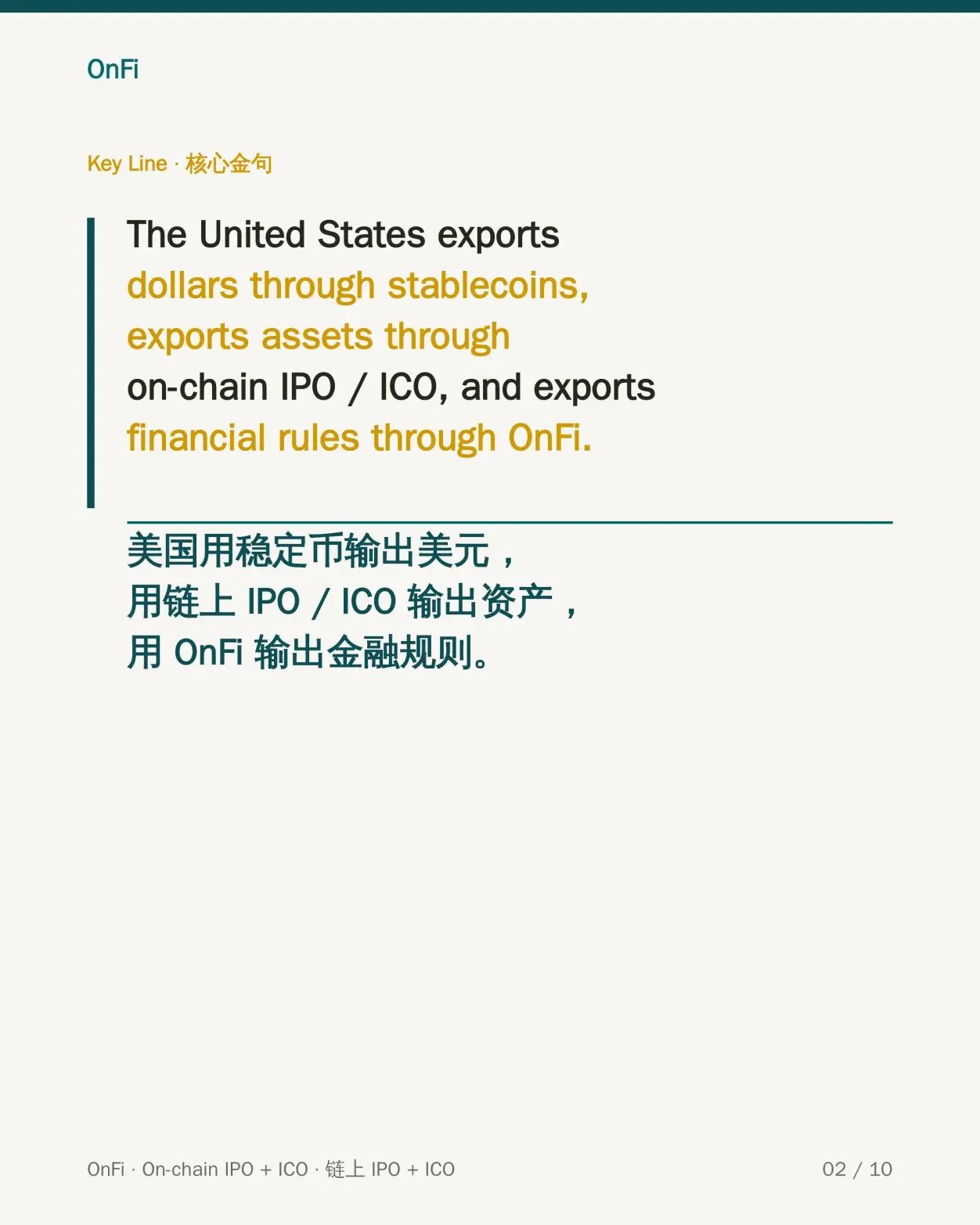
The United States exports dollars through stablecoins, exports assets through on-chain IPO / ICO, and exports financial rules through OnFi.
The second core judgment is:
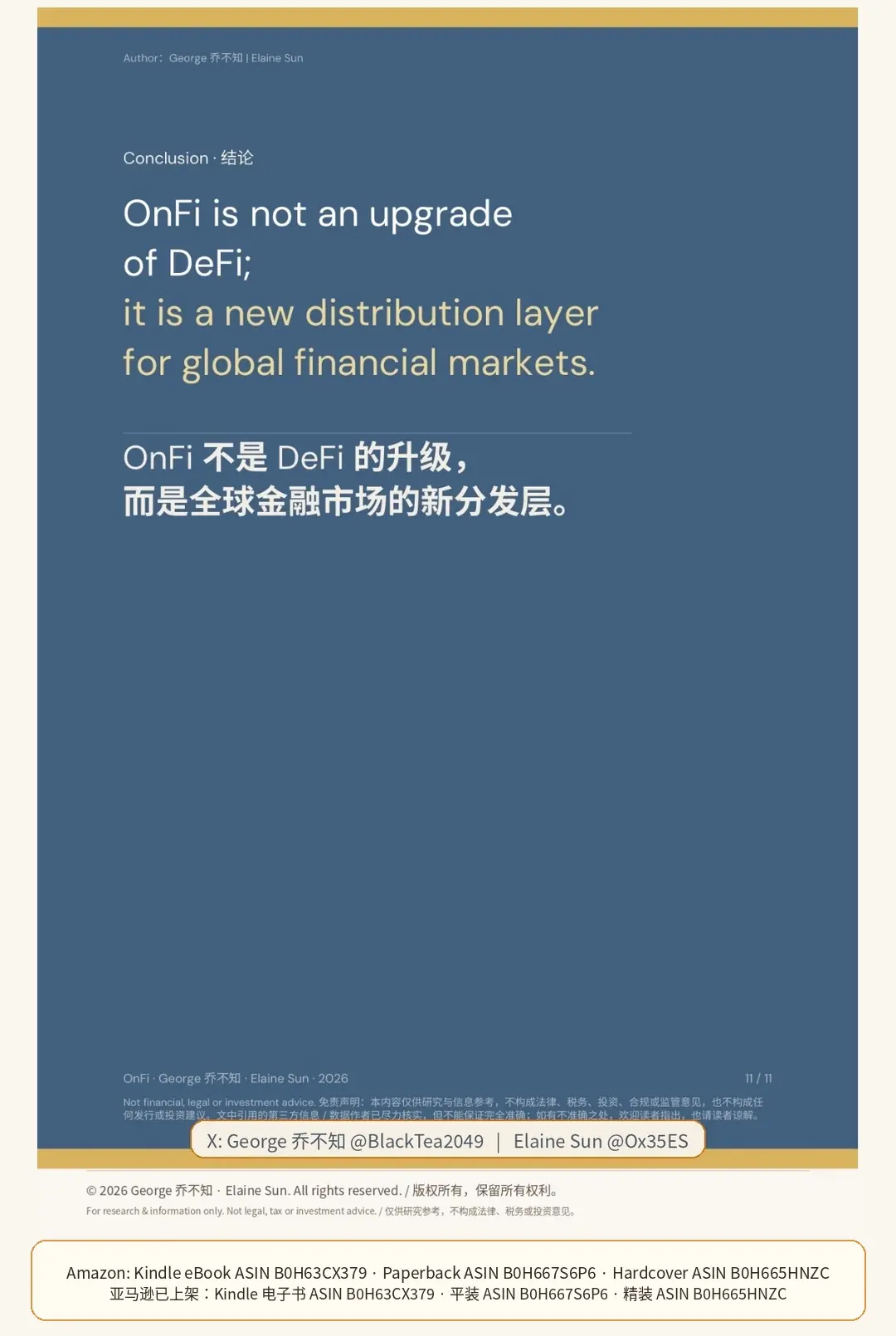
OnFi is not an upgrade of DeFi, but a new distribution layer for the global financial market.
1. Why OnFi is Important
OnFi is not simply "institutional DeFi."
It refers to a new financial system formed after the on-chainization of traditional financial functions:
Issuance, trading, custody, transfer, clearing, settlement, compliance, collateral, financing, and global distribution.
DeFi initially focused primarily on crypto-native assets.
The difference with OnFi is that it focuses on real assets, securities, stablecoins, tokenized stocks, funds, treasury products, network tokens, and digital goods, and how they are issued, distributed, priced, and settled through blockchain trajectories.
This is why OnFi should be understood as a new distribution layer for the global financial market.
2. Three Keywords
To understand the framework of the entire text, one needs to first understand three keywords:
ONFI/On-chain Finance,
Whitelist Market,
Bluelist Market.
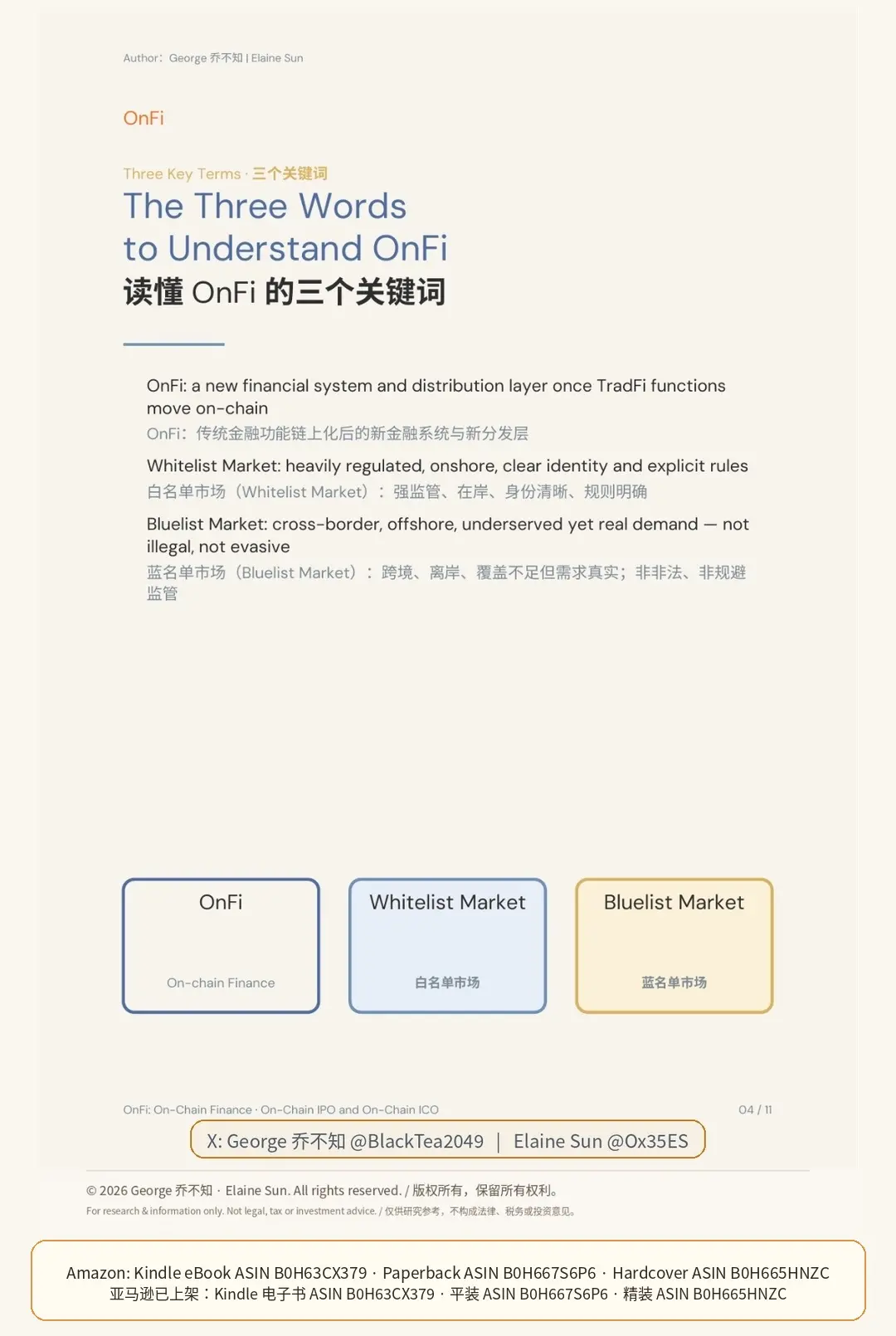
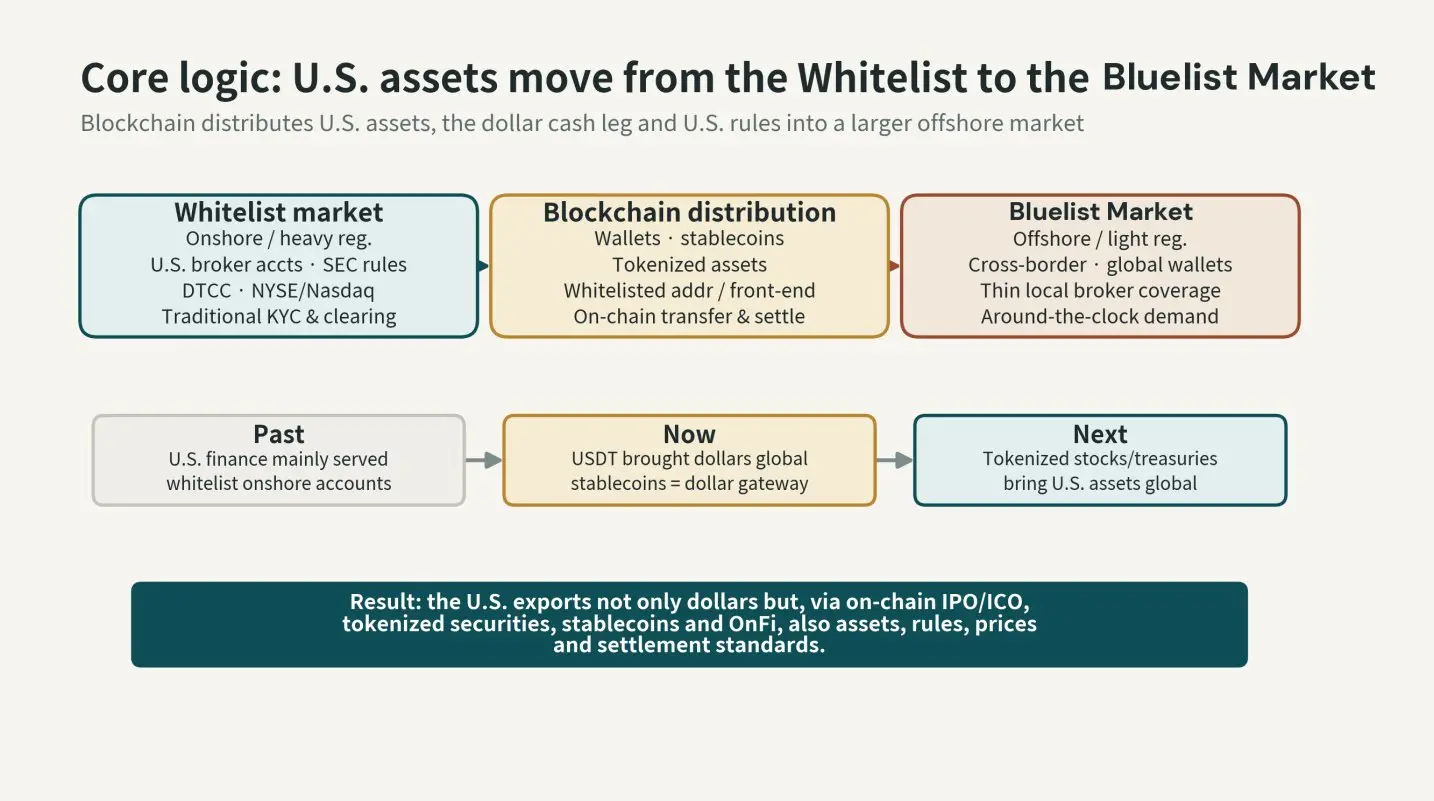
The Whitelist Market is a heavily regulated, onshore, KYC, account-based market, primarily served by traditional brokerages, banks, custodians, and regulated exchanges.
The Bluelist Market is a larger cross-border audience. They have a genuine demand for US assets, but the coverage of traditional brokerages and bank account systems is insufficient for them.
The Bluelist Market is not a lawless market, nor is it synonymous with illegal markets.
It refers to a cross-border market with insufficient traditional financial service coverage, but real demand exists.
Wallet-native distribution, stablecoin settlement, and the reach of tokenized assets can precisely serve this demand.
The core conclusion:
US assets need to serve both the Whitelist Market and the Bluelist Market simultaneously.
On-chain channels have the opportunity to reach both.
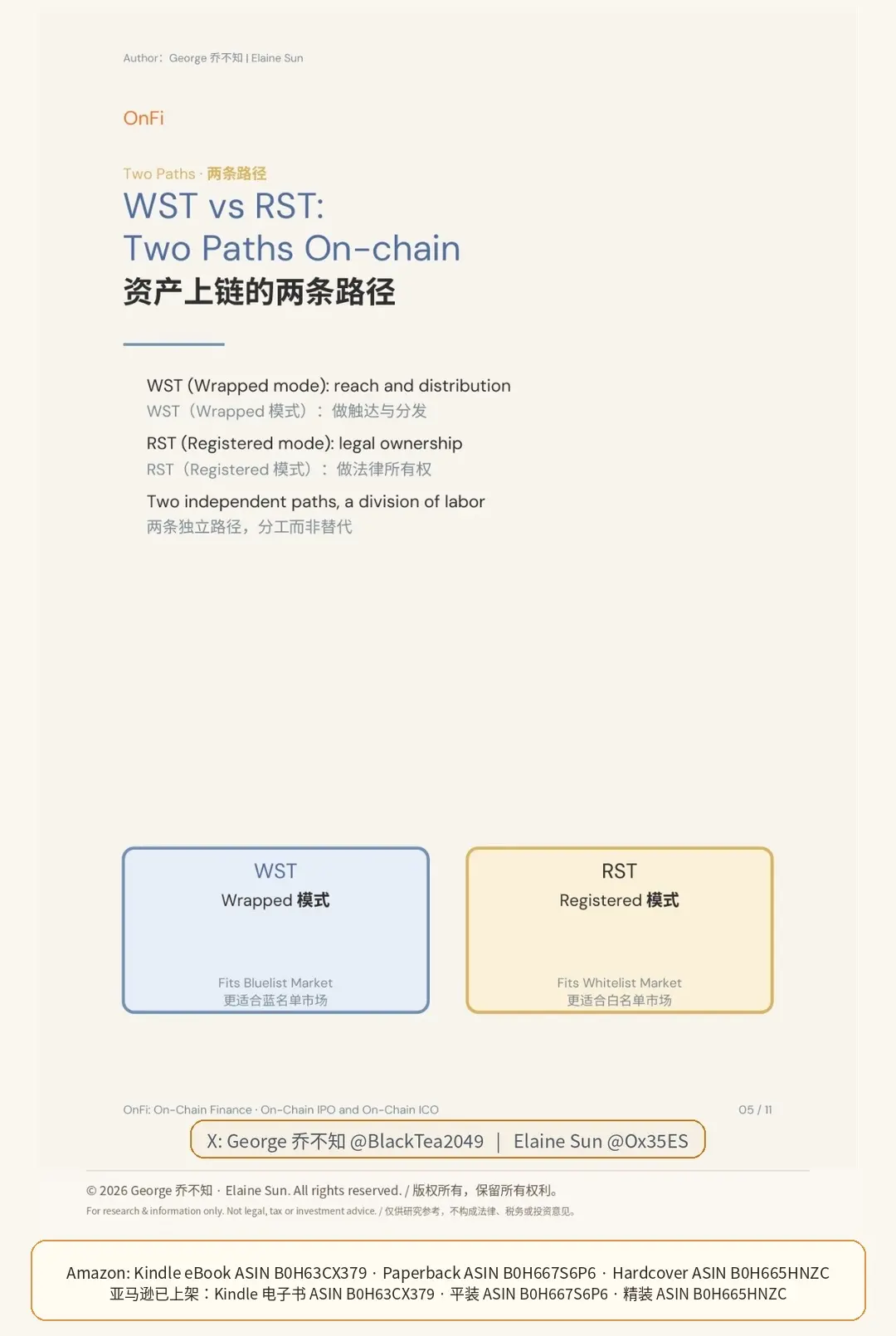
3. WST and RST: Two Paths for Asset On-Chain
There are two main paths for asset on-chain:
WST: Wrapped Stock Token / Wrapped Model
RST: Registered Stock Token / Registered Model
The Wrapped / WST model uses on-chain certificates or tokens corresponding to off-chain holdings.
It goes live faster, has stronger global distribution capabilities, and is easier to combine with DeFi protocols.
However, WST typically provides users with economic exposure, rather than full shareholder registration.
In many cases, users may not have complete voting rights or registered shareholder rights.
The Registered / RST model anchors legal ownership through issuer-side registration.
It aims for a state closer to "token transfer equals ownership transfer."
Simply put:
WST maximizes reach and distribution.
RST anchors ownership and shareholder rights.
The future will not see one model replace another.
The future is more likely to involve coexistence of multiple paths.
The same underlying stock may simultaneously exist in multiple forms in the future:
Traditional street name holdings,
DRS direct registration,
issuer-sponsored tokenized shares,
and third-party Wrapped / WST tokens.
The key is that each form must clearly disclose the true rights it grants to the holder.
4. The Core Spirit of the Clarity Act
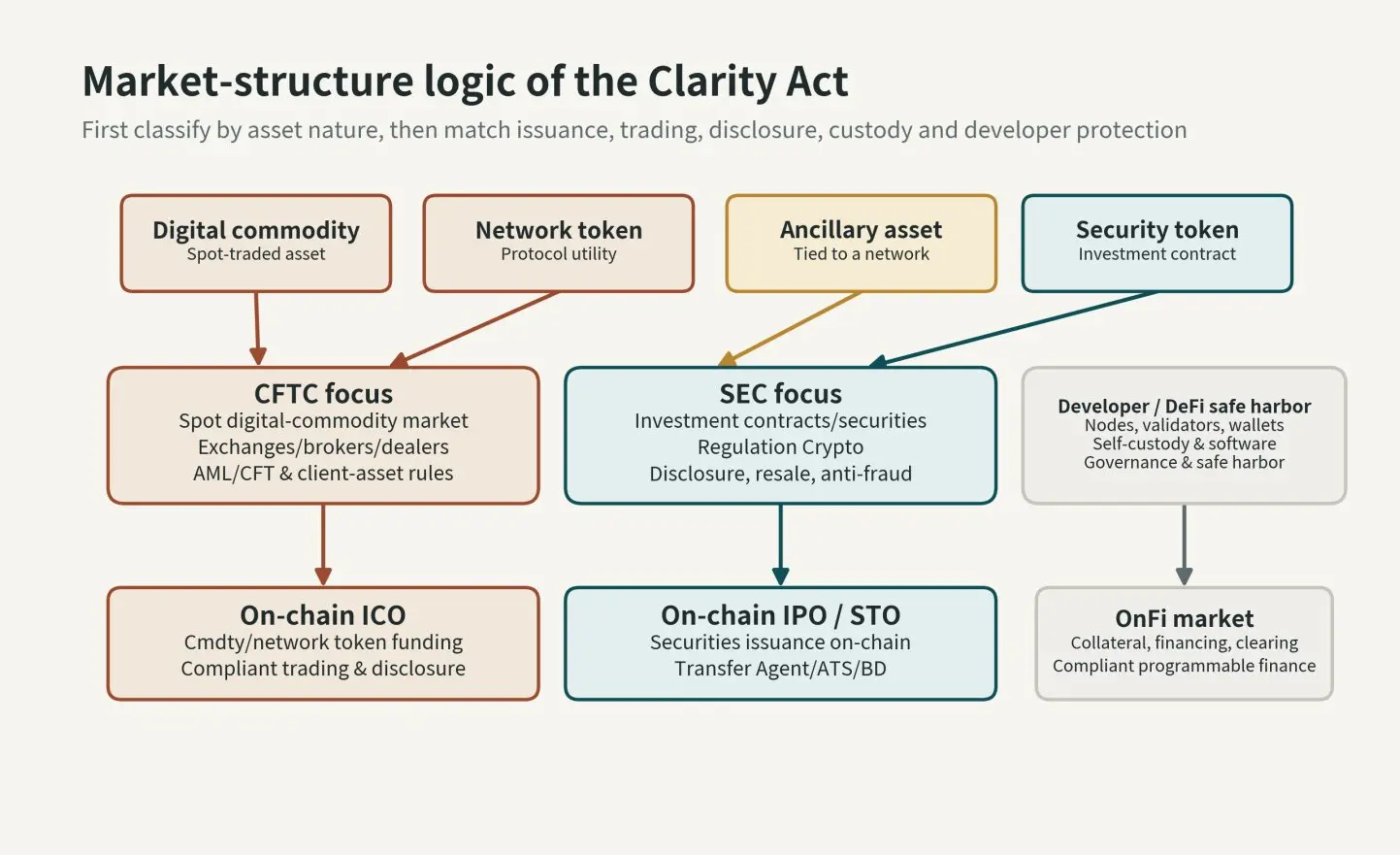
The value of the Clarity Act is not just to further clarify the boundaries of SEC and CFTC style regulation.
Its deeper value lies in potentially providing a lifecycle-style institutional path for projects from early financing to network maturity.
Projects may no longer have to choose between two extreme paths:
Fully registered securities issuance,
or fully offshore issuance.
They may transition through a set of mechanisms better suited for the crypto network:
Information disclosure,
financing limits,
resale restrictions,
exchange certification,
and decentralized testing.
The Clarity Act has threefold significance.
First, compliant market participants gain certainty.
By clearly distinguishing the regulatory boundaries between SEC and CFTC, the bill may reduce uncertainty for exchanges, custodians, brokers, and institutions entering the US market.
Second, true DeFi builders gain protection.
Under specific conditions, non-custodial developers and infrastructure providers should not be simply viewed as money transmission businesses.
Third, the issuance of tokens with blurred boundaries is constrained.
The Clarity Act does not resurrect the old ICO era.
It pushes token issuance towards clearer classifications, stronger information disclosures, and more disciplined market structures.
From this perspective, it is more favorable to serious projects rather than insider-driven or loosely structured issuances.
5. Classification of Digital Assets
Asset classification is fundamental.
If the classification is unclear, subsequent issuance, trading venues, custody, clearing, settlement, information disclosure, and investor protection will all be unstable.
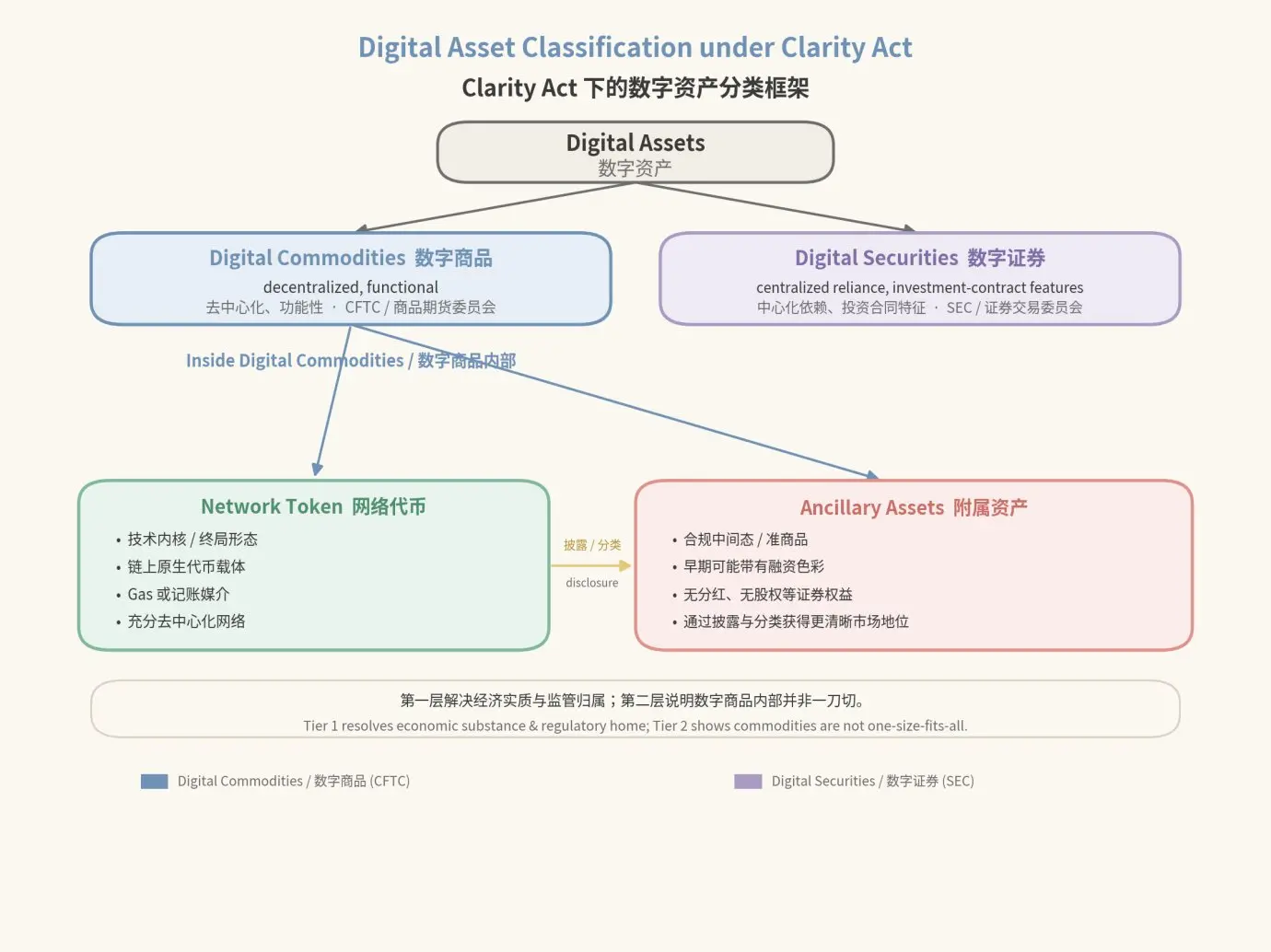
At the highest level, digital assets can be categorized according to their economic substance and regulatory affiliation as:
Digital Commodities,
Digital Securities.
Within digital commodities, the key distinction is:
Network Token,
Ancillary Asset.
Network tokens are closer to the technical core or mature form of the blockchain network.
They may assume the functions of gas fees, accounting medium, or native network assets.
Ancillary assets are closer to compliant transitional forms.
They may still carry early financing characteristics, but do not necessarily grant rights such as dividends or equity.
The clearer the regulatory classification, the easier it will be to standardize the issuance paths, trading venues, custody, clearing, and compliance interfaces of on-chain IPO / ICO.
6. On-chain IPO and On-chain ICO
The future market cannot simply be understood as:
IPO is traditional finance,
ICO is crypto.
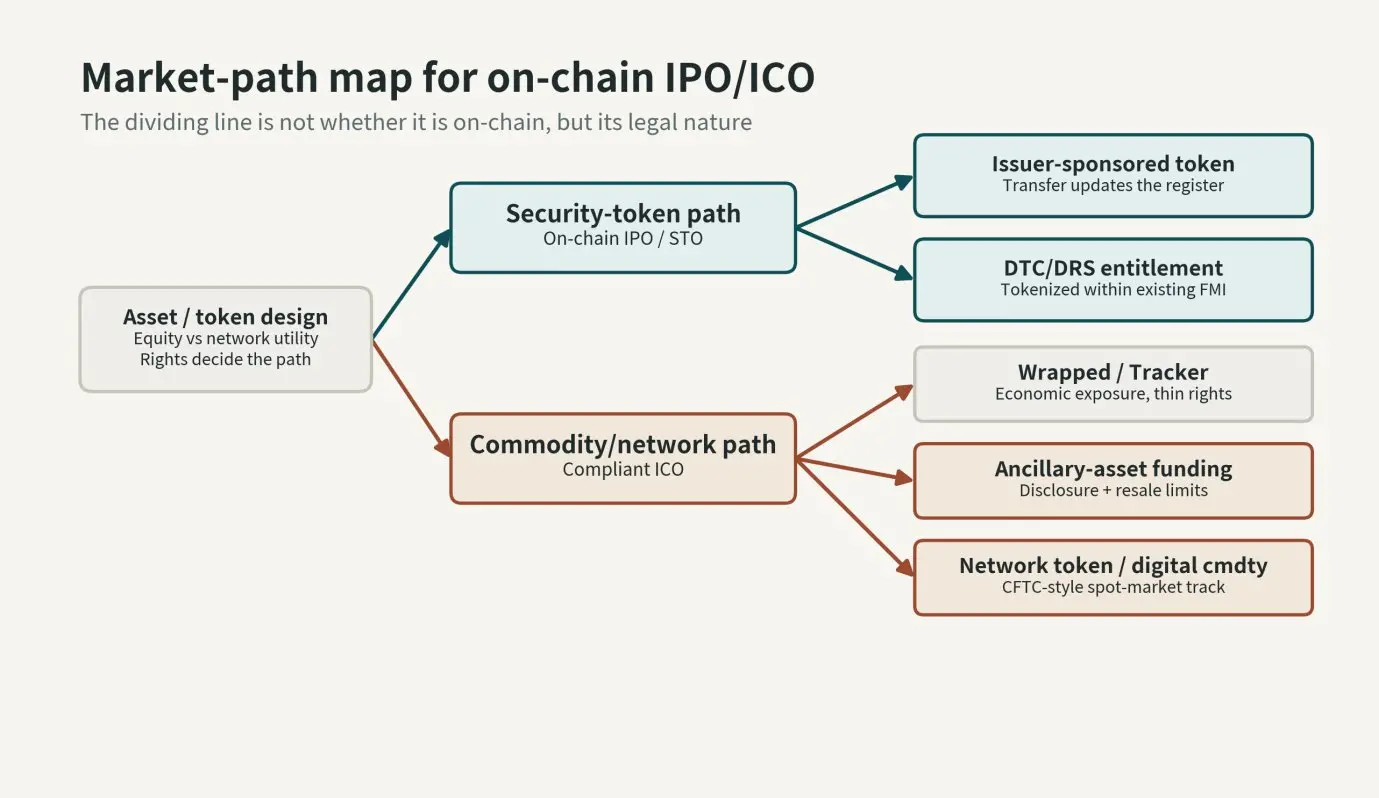
A more accurate division is:
Securities-type rights go through on-chain IPO,
network-type assets go through compliant ICO,
economic exposure-type products follow WST or derivative-style regulation,
stablecoins and payment-type assets go under payment and bank regulation,
funds and yield-type assets follow fund or securities regulation.
The most difficult issue for on-chain IPO is not the price exposure.
The real challenge is:
How does on-chain transfer become a legal transfer of ownership?
This is why transfer agents, issuers, DTC participants, ATS, custodians, brokers, and blockchain infrastructure are all very important.
The true frontier of on-chain IPO is not just tokenized stock price exposure.
It's about making tokenized securities closer to real ownership.
The issues with on-chain ICO are different.
It is primarily governed by asset classification, information disclosure, financing limits, decentralized status, and secondary market trading rules.
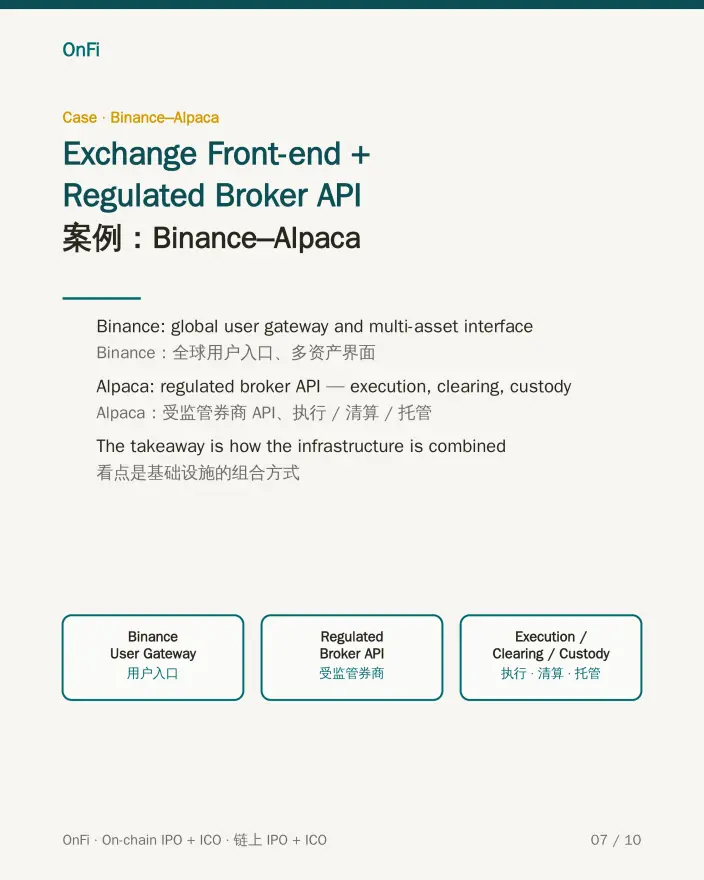
7. Binance-Alpaca: A Case of Infrastructure Collaboration
The Binance-Alpaca collaboration model is worth attention because it showcases how an exchange entry can combine with the API, execution, clearing, settlement, and custody tracks of a regulated brokerage.
In this model:
The exchange provides a user-facing entry and distribution,
the regulated brokerage provides compliant execution and post-trade infrastructure.
This is not just a product collaboration.
It is more like a rehearsal for the future division of financial infrastructure:
Distribution layer,
Broker API layer,
Execution layer,
Custody layer,
Clearing and settlement layer,
Compliance layer.
This analysis focuses only on the collaboration model and business division.
8. Migration of Prime Brokerage to OnFi
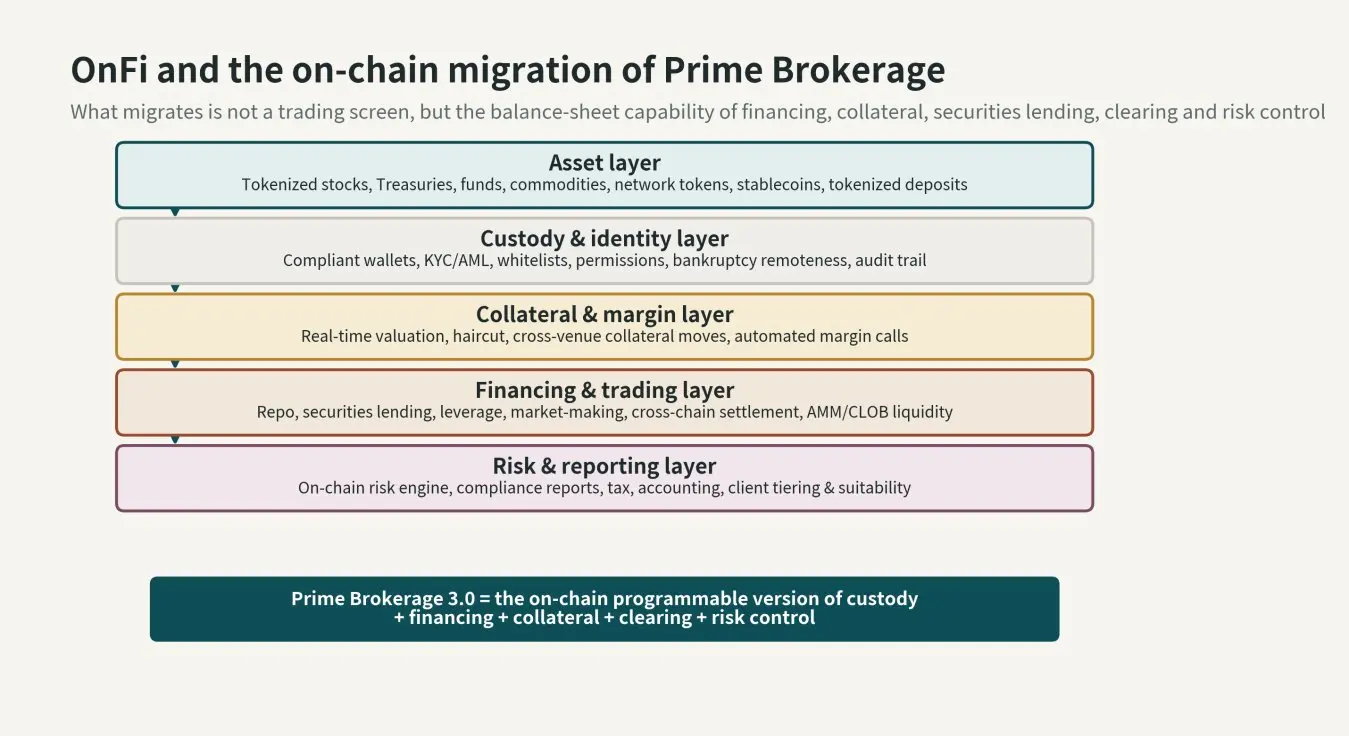
Tokenization is not "another category of trades."
It is a comprehensive upgrade of the systems of accounts, assets, custody, transfer, trading, financing, clearing, and settlement.
The functions of prime brokerage are being recombined between on-chain tracks and traditional tracks:
Financing,
Custody,
Clearing,
Settlement,
Securities lending,
Collateral management,
Risk control,
Cross-venue execution.
Brokers capable of connecting issuers, transfer agents, DTC participants, ATS, custodians, and wallet-native distribution may be more defensible.
The future broker is not just an account provider.
It may become the entry point for OnFi.
This means brokers need to establish a due diligence framework for tokenized assets.
They need to distinguish:
Issuer-sponsored tokenized securities,
And they need to clarify which assets can:
Be showcased,
Be traded,
Be custodied,
Be financed,
Or be used as collateral.
This is where traditional prime brokerage may begin its migration to OnFi.
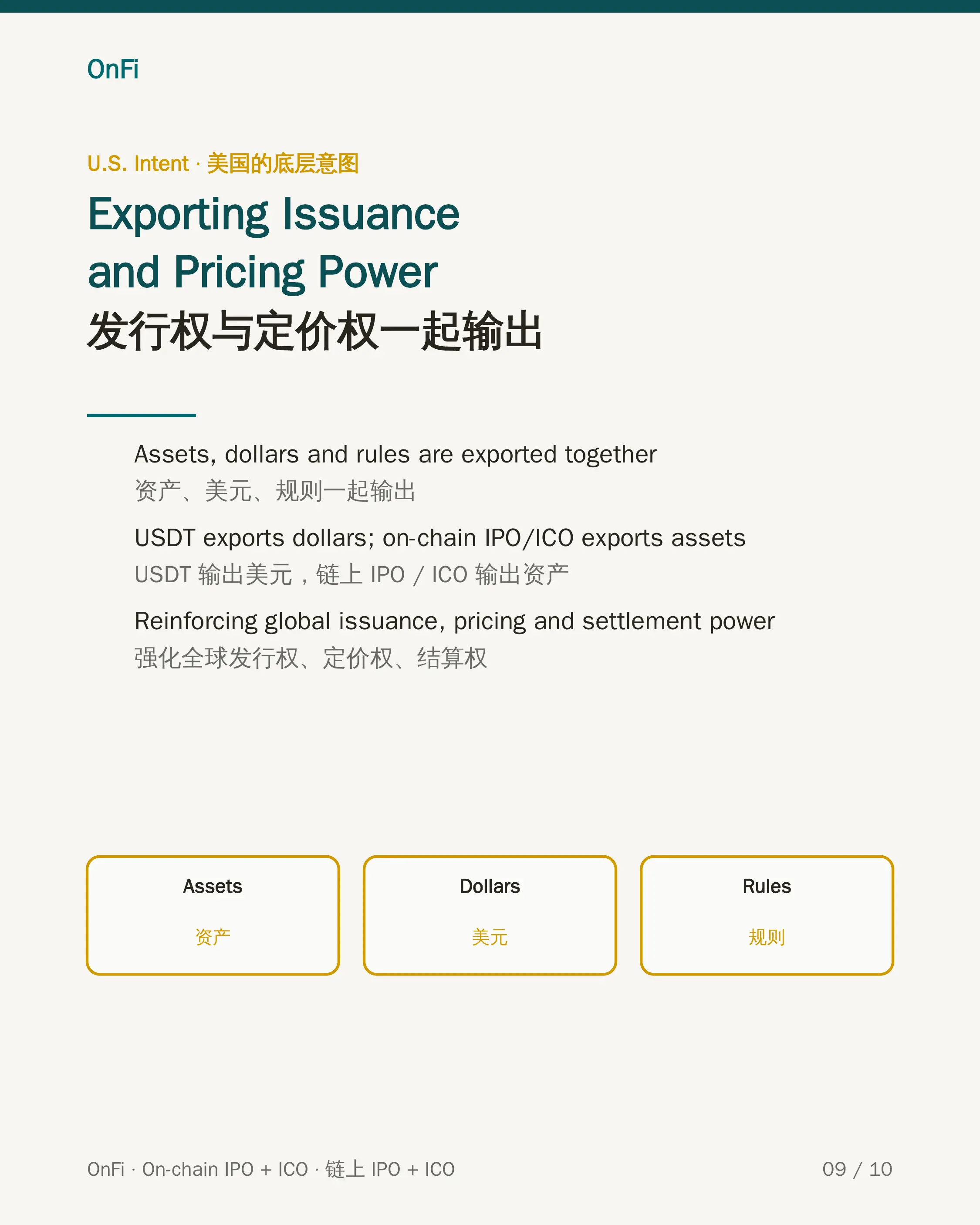
9. How the U.S. Exports Dollars, Assets, and Rules
Stablecoins are already exporting dollars.
They enable US dollar-denominated value to circulate globally through wallets, exchanges, payment flows, and on-chain settlements.
On-chain IPOs and on-chain ICOs may further export assets.
They allow US assets, tokenized securities, network assets, and economic exposures to be distributed through blockchain-native channels.
OnFi exports rules.
What it exports are the standards governing the flow of assets:
Identity,
Custody,
Settlement,
Disclosure,
Compliance,
Transfer limitations,
Market access.
This is the deeper strategic point:
The rights to issue and price go hand in hand.
When US assets are issued, priced, and settled on-chain, in US dollars, under US rules, the distribution of assets simultaneously reinforces the role of the dollar.
This is also why OnFi is not just a technology story.
It is a financial infrastructure story.
10. Conclusion
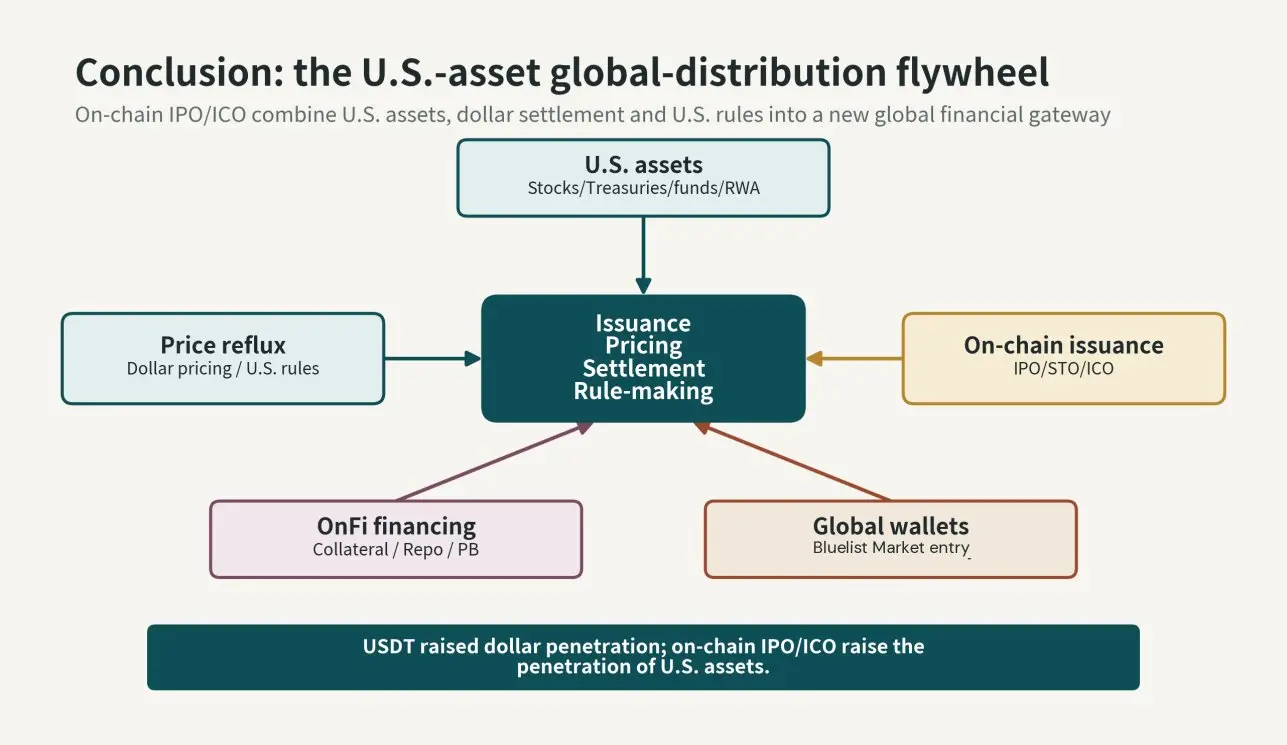
On-chain IPO and ICO are not just faster trading tracks.
They move issuance, pricing, settlement, and distribution to blockchain infrastructure.
WST and RST are not mutually exclusive enemies.
They are two independent and complementary paths.
WST maximizes reach and distribution.
RST anchors ownership and shareholder rights.
The Clarity Act could create a more disciplined lifecycle path for digital assets.
Transfer agents, exchanges, brokers, custodians, and prime brokers may all need to redefine their roles.
The largest market opportunity lies not just in token trading.
But in the reconstruction of the global financial distribution system.
The final sentence:
The US exports dollars through stablecoins, exports assets through on-chain IPO / ICO, and exports financial rules through OnFi.
OnFi is not an upgrade of DeFi.
It is a new distribution layer for the global financial market.
免责声明:本文章仅代表作者个人观点,不代表本平台的立场和观点。本文章仅供信息分享,不构成对任何人的任何投资建议。用户与作者之间的任何争议,与本平台无关。如网页中刊载的文章或图片涉及侵权,请提供相关的权利证明和身份证明发送邮件到support@aicoin.com,本平台相关工作人员将会进行核查。


