Why do Wall Street magnates want to buy shares of cryptocurrency companies, and what returns can cryptocurrency companies gain from this?
Written by: Prathik Desai
Translated by: Block unicorn
On June 9, London-based asset management company Janus Henderson signed a four-part agreement with Ethena (the cryptocurrency company behind the USDe stablecoin). According to the agreement, this asset management company, which manages $480 billion in assets, agreed to invest one of its own funds into a reserve supporting the digital dollar, which has a circulating supply of $5.5 billion. Additionally, the company agreed to package Ethena's products for sale to its clients and to invest its corporate cash in USDe.
Janus is not an isolated case. Over the past four months, the world's two largest asset management firms—BlackRock and Apollo—have also taken similar actions in different areas of cryptocurrency protocols. The total assets managed by these three companies exceed $15 trillion.
In today’s article, I will explain why Wall Street magnates are buying shares of cryptocurrency companies and what returns cryptocurrency companies can gain from it.
Traditional Finance and Cryptocurrency Transactions
Let's first take a look at what Ethena and Janus can gain from this latest transaction. Ethena has included Janus Henderson’s tokenized credit fund in its USDe reserves. This move strengthens Ethena's recent attempts to adjust its collateral portfolio backing its USDe reserves.
In the article "When Revenue Dwindles," I explained how Ethena diversified its collateral to cover both traditional and crypto assets. Previously, Ethena's reserve strategy relied entirely on generating yields from crypto-backed basis trades and treasury bills, but this strategy became ineffective in a market downturn.
Janus's AAA-rated fund is one of the safest components within the corporate loan pool. Such funds have the lowest default risk and enjoy the highest priority regarding interest and principal payments. Ethena's risk committee has approved this fund as part of the qualified collateral portfolio. This will be the first time that USDe is backed by actual corporate credit instruments.
As part of the transaction, Janus also did three things. It acquired Ethena’s governance token ENA through its blockchain company ANTIK. It agreed to jointly develop a regulatory exchange-traded product (ETP/ETF) for USDe with Ethena in the second half of 2026. This will allow ordinary investors to purchase Ethena dollars through regular securities accounts without having to open a crypto wallet. Lastly, Janus indicated that it would hold USDe and its yield-bearing version sUSDe as its own funds.
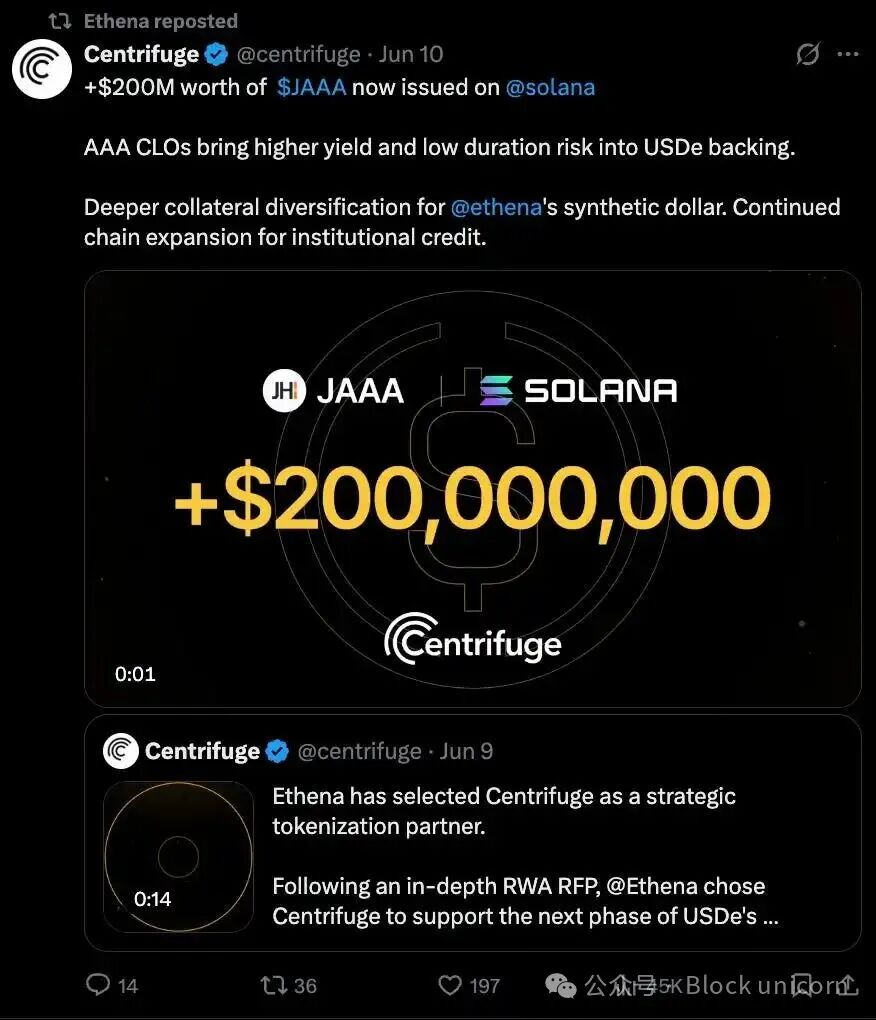
For Janus, the demand from Ethena for its tokenized credit fund is now stable and steady. Since Janus’s credit fund currently serves as the USDe reserve, for every dollar of USDe issued, Ethena must purchase more reserve assets, including JAAA. This influx of excess funds into Janus's credit fund requires no marketing efforts from Janus.
In return, the asset management company becomes a client of the dollar agreed upon in this transaction, gains governance rights through purchasing ENA tokens, and increases its stake to become a distributor of two of its traditional clients' products.
The other two fund managers also reached similar agreements four months ago. BlackRock purchased an undisclosed amount of the Uniswap token UNI while listing its tokenized treasury fund BUIDL on the Uniswap platform. However, access to BUIDL is restricted and open only to large qualified investors and approved market makers. Apollo Global Management signed an agreement to purchase up to 90 million MORPHO tokens, about one-tenth of the total supply, while building a lending market on the Morpho platform and using its own credit fund as collateral.
A small investment by an asset management company in a crypto protocol may be seen as a "test." But we are now discussing the three most well-known asset management companies buying the tokens of this protocol and integrating their products into the blockchain ecosystem.
But why are they governance tokens? There are two reasons.
The traditional financial perspective on cryptocurrency investment has undergone a 180-degree shift. A few years ago, the instinctive reaction was to invest in cryptocurrencies as much as possible but not wanting to touch the underlying infrastructure directly. They chose to hold cryptocurrencies through tokenized funds, custodians, or ETP products.
However, the continuous evolution of crypto infrastructure use cases has significantly redefined its value proposition. The rise of stablecoins and the tokenization of real-world assets have shown traditional financial participants that the operational costs of on-chain financial activities can be greatly reduced. In the past, tasks such as settling transactions, holding assets, and recording ownership were both cumbersome and expensive, requiring someone to charge high fees. Now, the costs of these tasks have significantly decreased, almost equivalent to the cost of running software.
Once the infrastructure becomes commoditized, value transfers to the levels that determine the flow of data, rule-making, and product distribution. Those who control this layer can seize the value flowing through it. Currently, the simplest approach for traditional financial giants is to purchase shares of crypto infrastructure protocols that control this layer. Since Uniswap or Ethena do not have traditional equity available for purchase, their governance tokens offer Wall Street the closest way to hold equity in companies.
The second reason is that holding shares creates stable market demand. When someone needs USDe, they must pledge an equivalent amount of dollars to Ethena as collateral before Ethena will issue this stablecoin. Ethena then needs to deposit the collateral received into reserve assets to support its newly issued dollars. JAAA is now one of the assets that Ethena is authorized to hold, so as the supply of USDe grows, part of the new collateral will flow into Janus's fund. This excess demand is a byproduct of USDe's expansion and requires no market promotion from Janus.
Apollo and BlackRock have also conducted similar operations with Morpho and Uniswap, respectively. In both cases, fund managers own tokens, provide products, and can funnel funds into the protocol. More funds mean greater demand for the newly integrated funds by the fund managers.
For Wall Street, owning a cryptocurrency transportation system allows them to control the reserves, seize allocation rights, and utilize blockchain to fund their products at extremely low costs.
What Benefits for the Protocol?
Two words: scaling distribution.
For Ethena, Janus opens its distribution network to users who would otherwise never set up a crypto wallet or access crypto protocols. The ETP and ETF co-developed by Janus and Ethena will allow advisors to purchase Ethena's products without needing to understand blockchain. Assets under management by Janus amount to as much as $480 billion, almost 100 times the billions managed by Ethena.
A few weeks ago, Ethena reached a similar agreement with Coinbase, further enhancing its distribution channel expansion.
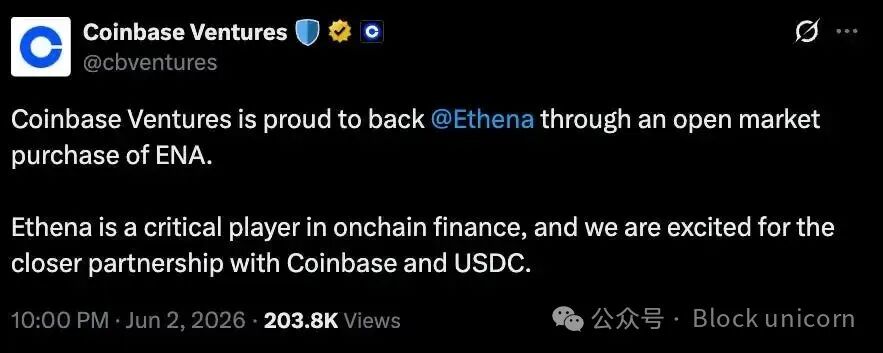
On June 2, Coinbase Ventures acquired ENA and agreed to launch a savings product for Coinbase's over 100 million users.
Approximately $19 billion in assets are already held within Coinbase's USDC ecosystem. If Ethena's yield is even slightly higher than USDC, Coinbase can invest part of its idle USDC balances into Ethena's products, providing users with higher yields, while Ethena gains more ample capital and wider circulation.
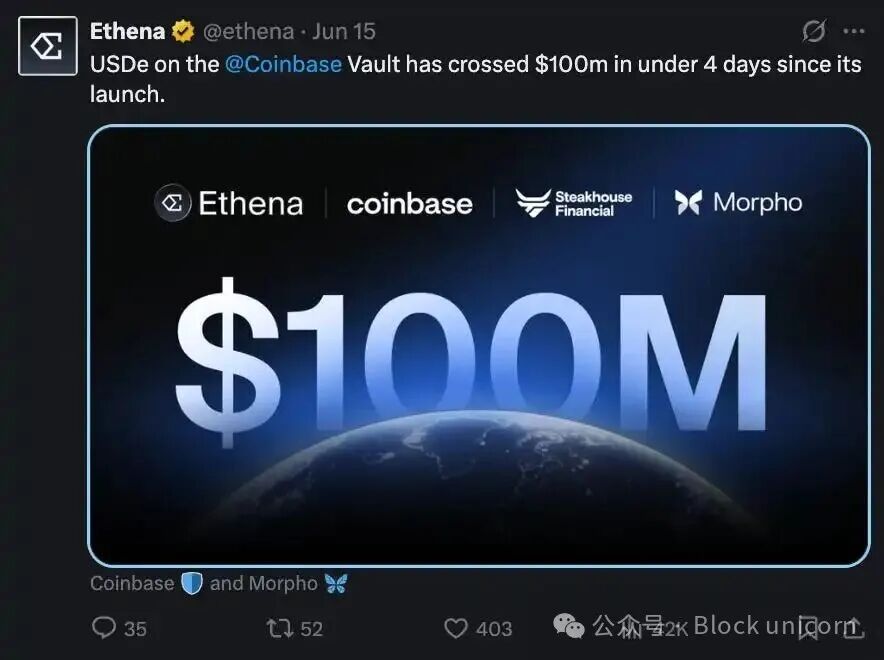
Just four days after its launch, USDe's circulation in Coinbase Vaults surpassed $100 million.
Distribution also helps raise funds to operate its yield mechanism at a lower cost. By tapping into a portion of the $19 billion exchange balances or the $480 billion AUM client base of managers, Ethena can reduce the marginal cost of expanding its circulation. For a protocol currently with a circulating supply of $5.5 billion, even a 1% conversion rate of Janus’s $480 billion in assets under management could nearly double Ethena’s base.
But why do Wall Street companies want to hold stablecoins instead of regular money market funds?
With Janus's AAA-rated loan fund incorporated into Ethena's reserve strategy, the support structure for USDe now resembles a traditional cash investment portfolio. This reserve currently holds short-term, high-quality collateral, along with more stable basis trades around commodities like gold. This makes the reserve quite similar to money market funds that corporate treasurers have managed for decades.
The additional step taken by Janus, which is to hold cash in the form of treasury bonds, shows that this asset management company is confident in Ethena's ability to defend the dollar using its new collateral portfolio. Even BlackRock and Apollo have not taken this approach with Uniswap and Morpho.
However, there are a few points to be cautious about.
First, staking USDe does not guarantee yields. The yield depends on a series of trades and market conditions at the exchange. AAA-rated credit risk is low, but not entirely without risk, as evidenced by the financial crisis of 2008.
Second, the governance tokens purchased by Wall Street companies in crypto protocols have not yet provided any returns to holders. Ethena's fee conversion mechanism, which aims to distribute protocol revenue to ENA holders, is expected to be met by September 2025, but has yet to be implemented.
Therefore, Janus, BlackRock, and Apollo do not have rights to any cash flow. But they are essentially purchasing a claim to future revenues, which they will receive once the protocol decides to pay them. Morpho's fee conversion mechanism is also closed, while Uniswap's fee conversion mechanism is only half complete.
Nonetheless, these companies have achieved two major victories.
First, by partnering with blockchain protocols, they can create stable market demand for their products. Second, they can gain a head start in a field where value is emerging. By investing in blockchain products, these companies are also effectively buying a share of the expected returns from these products after they achieve widespread adoption in the larger financial market.
BlackRock, Apollo, and Janus are not the first institutions to recognize that potential infrastructure can create value.
We've been discussing this model in our previous articles.
Before Merrill Lynch split accounts and paid depositors market rates, banks were merely institutions for absorbing deposits. Afterward, other banks followed suit.
Before vertical integration forced exchanges to transform into price discovery platforms, they were essentially equivalent to trading desks. Today, all exchanges have become (or are becoming) places to offer perpetual contracts, pre-IPO markets, and prediction markets, all centralized on one platform.
Synthetic dollars are the latest bottleneck to be breached. The dollar, its circulation track, and the reserves supporting it are being layered, with control over each layer going to those who manage it best. While Ethena rebuilds its reserves, institutions like BlackRock and Juno are providing distribution channels. Wall Street is witnessing the infrastructure costs plummeting to nearly zero and deciding to control the issuance of digital dollars.
When you strip this phenomenon down to its most basic principles, you realize that these asset management companies are effectively buying shares of a crypto protocol, doing things quite similar to what companies like BlackRock and Apollo have been doing for years. They are purchasing shares of a blockchain-based platform that still holds and transfers assets (in this case, stablecoins) and strives to maximize returns for holders. Isn’t that the classic asset management model?
免责声明:本文章仅代表作者个人观点,不代表本平台的立场和观点。本文章仅供信息分享,不构成对任何人的任何投资建议。用户与作者之间的任何争议,与本平台无关。如网页中刊载的文章或图片涉及侵权,请提供相关的权利证明和身份证明发送邮件到support@aicoin.com,本平台相关工作人员将会进行核查。


