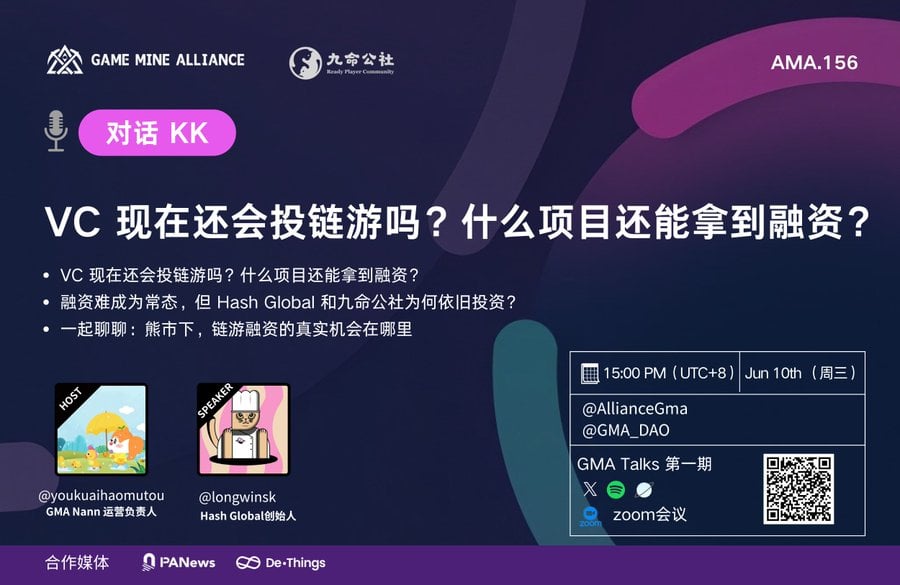
Host: GMA Nann
Guest: KK, Partner at Hash Global
Interview Time: June 10 (Wednesday) 3:00 PM
Partner: Hash Global rpcnftclub
Web3 games have passed through the most bustling bubble stage and have entered a more real and harsher industry second half.
In the past, project teams focused on storytelling, economic models, and token issuance expectations; now, VCs care more about a simple but critical question: is this game actually fun? Are there real users? Can it generate revenue?
GMA Talk Q&A
Q1: After working in traditional finance for a long time, why did you decide to enter Web3?
KK: I have always worked in the traditional finance industry. Our team entered Web3 mainly because we were looking for a track that we could cultivate for a long time and continually accumulate understanding. We also learned about AI, but AI requires a very high level of professional technical judgment. In contrast, Web3 is more financial and relies more on the understanding of economic models, business models, and profit distribution mechanisms.
Q2: What is the biggest difference between traditional investment and Web3 investment?
KK: Early Web3 was indeed very different from traditional investment. Back then, there were only a few core assets, and it was easy to make money. Looking back, it was more of a Beta; making money sometimes felt inexplicable, while losing money was due to one’s own understanding. But after 2024, it’s clear that Web3 investment is quickly aligning with traditional investment logic. Whether in the primary or secondary markets, the judgments of business models, value capture, and resource capabilities that apply in traditional investment are increasingly being used in Web3 investment. In the past, Web3 had many narratives that sounded logical, but many key links were missing for them to function. Now, I focus more on whether the matter itself has value: how much money can actually be made? How much value can be captured? In the future, Web3 will gradually lower the narrative and return to a more real value dimension.
Q3: What do you think about Web3 games? What is the most important criterion for judging a game project?
KK: The game must first be fun. People involved in Web3 games often forget about this and focus on how to issue tokens and design economic systems. But now it seems that everyone should have an increasing consensus: whether the game itself is fun is the most important. Users do not need to understand Web3 from the beginning, nor do they need to understand whether the equipment can transition from the game server to the chain address. The core question remains: is this game actually fun? Are users willing to play? This prioritizes user value.
Q4: Is Play to Earn still a viable direction?
KK: I used to think that Play to Earn might be relatively easy to achieve, but after observing over the past few years, I now feel that Play to Earn may be the hardest thing to accomplish and should be the last step for a Web3 game. If a game is truly to achieve Play to Earn, it must go through a long initial phase: proving that it is fun, proving that it can attract enough game users without relying on Web3. Only after passing this stage should we discuss value distribution, asset issuance, and how players and KOLs engage with the ecosystem, which will be healthier. In other words, the mechanisms of Web3 are not meant to replace the game itself but to improve value distribution and ecological collaboration after the product is established.
Q5: Is Hash Global still investing in games now?
KK: We are still investing. I particularly favor games that are competitive, social, and have low entry barriers. It doesn’t necessarily have to start as a heavy AAA title but should allow users to easily get started and utilize Web3’s technological features, such as asset issuance, value distribution, fan participation, and emotional value. We hope to see a game that doesn’t rely on issuing tokens or expectations of airdrops and can still generate revenue, just like a Web2 game with real income. Elements like ticket sales, advertising, skins, and commercial functions need to be gradually improved. Once these basic commercial elements are in place, we can focus on traffic and larger ecological expansion.
Q6: What specific standards do you look at when choosing to invest in game projects?
KK: First, the people and the team. We particularly assess the quality of the team itself. Ideally, this team should have been very successful and experienced in the original Web2 track, capable of making products well. They are not here just to present a concept; they are really capable of creating new business models in the original track using new technologies like Web3 or AI, increasing revenue and reducing costs. Specifically for games, I look at three points: first, whether users are willing to play without needing to understand Web3. Second, whether the mechanism can improve asset issuance, user contribution, fan participation, and community distribution. Third, whether the team has the capability for ongoing operations, customer service, and iteration. I value whether the team genuinely loves playing games, really wants to make the product good, and isn’t just interested in quickly issuing tokens and making a fast profit. We are more willing to invest time in truly long-term-oriented teams and will put in more resources and efforts post-investment.
Q7: Why does Hash Global focus more on Chinese teams?
KK: This is a clear recognition of our own capacity boundaries. I was educated in the U.S. and have worked in an asset management company there, but we do not feel we have the ability to compete with U.S. VCs for European and American startup projects. We are more familiar with Chinese entrepreneurs. We have accumulated insights regarding language background, cultural environment, resource structure, and judgments about people. Of course, this doesn’t mean that all Chinese teams are the best; we have also made many mistakes and are constantly learning from them. But we made it clear from the start: focus on investing in Chinese teams and work hard to support and help them grow.
Q8: Where do you think Web3 applications will first land on a large scale?
KK: We have been thinking about this question. Previously, we hoped that Web3 applications could develop as quickly as AI, but now we may have to accept a reality: Web3 applications may need AI to propel them. One perspective is to see which fields are most easily propelled by AI productivity improvements and particularly need Web3 technology empowerment. Another perspective is to look at fields that have significant pain points in distribution mechanisms, such as the creator economy. Many creator industries have unfair distributions, but existing platforms are very efficient, making it hard to surpass them with a new product. Therefore, it’s necessary to find sufficiently strong pain points or identify scenarios that AI can drive. I don’t think there’s necessarily one sub-sector of Web3 that will outpace another. The key is whether specific projects can capture the fundamentals of their products, first completing the transition from 0 to 1, and then progressing from 1 to 100.
Q9: What do you think about the rhythm of RWA implementation?
KK: Compared to discussing Web3 applications in general, we have clearer thoughts on the path for RWA promotion. I believe that the assets that will likely emerge must be good assets that, for some reason, are not particularly easy for global investors to invest in within the traditional financial world. Such assets may be prioritized. Additionally, we have defined a direction called "non-financial RWA" or more specifically, "cultural and entertainment RWA." Cultural and entertainment RWA, as it does not involve financial products, is inherently a "commodity" as long as you don’t try to create K-line charts. It faces less resistance and may develop faster.
Q10: How does the Nine Lives Society view NFT membership rights and community governance?
KK: I have always believed in using NFTs for private community management and also see potential in using Web3 and NFT technologies for community operations and fan management. NFTs are superior to traditional membership cards or spreadsheets because they represent a blockchain address, can be airdropped, data can be carried along, and assets can be traded globally. However, during our process of establishing the Nine Lives Society, we encountered many challenges. We are not particularly skilled at product development or community operations, so we are appropriately tempering our short-term expectations and growth speed. We are establishing the Nine Lives Society because we value Web3 entrepreneurs. If figures like Wang Xing, Liu Qiangdong, Jack Ma, and Pony Ma emerge from this community in the future, how could this community lack value? We want to build a platform in a less utilitarian manner, creating connections to gather like-minded entrepreneurs and practitioners.
Q11: What kind of community do you hope the Nine Lives Society will become in the future?
KK: Initially, we thought, can there be cats in the East while there are monkeys in the West? However, we differ from some mature NFT communities; we did not fund this project itself and are not particularly skilled at gaming or product development. We hope that some cultural and entertainment projects in the Hash Global investment ecosystem can gradually grow. When these ecosystems are ready, they can in turn provide the Nine Lives Society with more concrete content and spiritual value. So we can say we are waiting for certain developments; we are not in a hurry. I hope that one day the NFTs from the Nine Lives Society will be valuable, but we are not rushing it. We hope its value arises from the genuine sense of belonging, recognition, and value exchange among community members, rather than short-term speculation.
Q12: What kind of Web3 game projects can still secure funding now?
KK: I believe that good Web3 games can be understood by serious investors. There are a few key points: first, it must genuinely be fun. Second, there should be real points of consumption or external economic input, such as top-ups, advertising, equipment, skins, or other sources of income. Third, Web3 mechanisms should bring about things that Web2 finds difficult to achieve, such as asset issuance, value distribution, and community participation. Fourth, the team must be able to maintain operations and iteration, rather than concluding after just one token issuance. If a project possesses these elements, I think it makes sense and has opportunities to secure funding.
Q13: What advice would you give to new institutional investors entering Web3 in the current bearish market?
KK: If someone is willing to enter and look at Web3 at this moment, I believe that such investors must have conducted very thorough research and understanding. Because it’s not just "a bit bad," but rather already quite bearish. For these investors, I express more respect rather than advice. The fact that they are willing to seriously look at Web3 at this stage indicates they are not drawn in by short-term hype.
Q14: Why does Hash Global have confidence in the BNB ecosystem?
KK: We started researching BNB in April 2019. Since we come from traditional finance, we were very interested when we saw that BNB is both valuable and functional, and we conducted serious research and produced reports. We were also one of the first on-chain nodes in the BNB ecosystem. Over the years, we have observed the BNB ecosystem iterating step by step. Of course, there have been uncertainties due to regulatory and judicial pressures, but overall, especially after some lawsuits in the U.S. have been resolved, we are very confident in the BNB ecosystem. I believe the value of the BNB ecosystem is greatly underestimated. BNB is not just a token; behind it is a very real Web3 financial ecosystem with real users and the capability to connect with global capital. We hope to allow traditional institutional investors to understand and participate in the BNB ecosystem in a more compliant, convenient, and cost-effective way.
Q15: How do you usually handle information input and knowledge accumulation?
KK: Extensive reading is essential. I read quite broadly; as long as it’s high-quality and classic content, I will check it out. Good people recommend good books, and good books often lead to another good book—really, you can never finish all the good books. But it’s crucial to control the sources of information. I deliberately filter, for example, by selecting only a limited number of sources for one information channel. I don’t subscribe to too many sources on platforms like Xiaoyuzhou, YouTube, or media. First, I need to control the sources well, then use AI tools, and then use note-taking software like Obsidian to consolidate what needs to be consolidated. Professor Shen Ming once mentioned a term called "intelligent compound interest," which resonates with me. The more you embrace new knowledge, the more you’ll master new knowledge and new tools. Our team must do well in this matter and also ensure our intelligence can compound.
Q16: What has been your biggest reflection over the years in Web3 investment?
KK: There are so many areas needing reflection. If I had to mention one, I’d say it’s about pace. Being in VC naturally leads to a more optimistic outlook, but the Web3 industry is still in its early stages, so often the more conservative individuals end up lasting longer. The pace cannot be too fast; one must see reality clearly. If the pace is too fast and the setbacks too severe, it may hinder persistence till the end. We have also paid a lot of tuition and learned numerous lessons. However, I believe that starting in the second half of 2024, we have gradually regained pace. Web3 investment needs optimism, but it also requires restraint. Simply surviving longer and staying in the game is a very important capability.
免责声明:本文章仅代表作者个人观点,不代表本平台的立场和观点。本文章仅供信息分享,不构成对任何人的任何投资建议。用户与作者之间的任何争议,与本平台无关。如网页中刊载的文章或图片涉及侵权,请提供相关的权利证明和身份证明发送邮件到support@aicoin.com,本平台相关工作人员将会进行核查。


