The crypto industry bubble has burst, and the potential win rates and odds of "issuing tokens" have dropped to weaker levels than traditional equity financing.
Written by: Long Ye
Summary:
- The crypto industry bubble has burst, and the potential win rates and odds of "issuing tokens" have dropped to weaker levels than traditional equity financing. Traditional crypto players and associated practices will almost be completely cleared. Currently, in Q2 2026, we are still in the early to mid-stages of a bear market.
- The four-year cycle still exists, but due to its high correlation with macro financial markets, the amplitude will significantly decrease, and the boundaries will appear more blurred.
- In the past six months and in the upcoming six to twelve months, the main theme of the crypto circle will focus on how to tokenize traditional financial assets to absorb traditional funds onto the blockchain, thus increasing the "total market capitalization of stablecoins." During this period, perp dex will serve as an important ecological entry, becoming the best track, among which I most recognize Lighter. It will be difficult to see native innovative narratives in the crypto circle in this six to twelve months period.
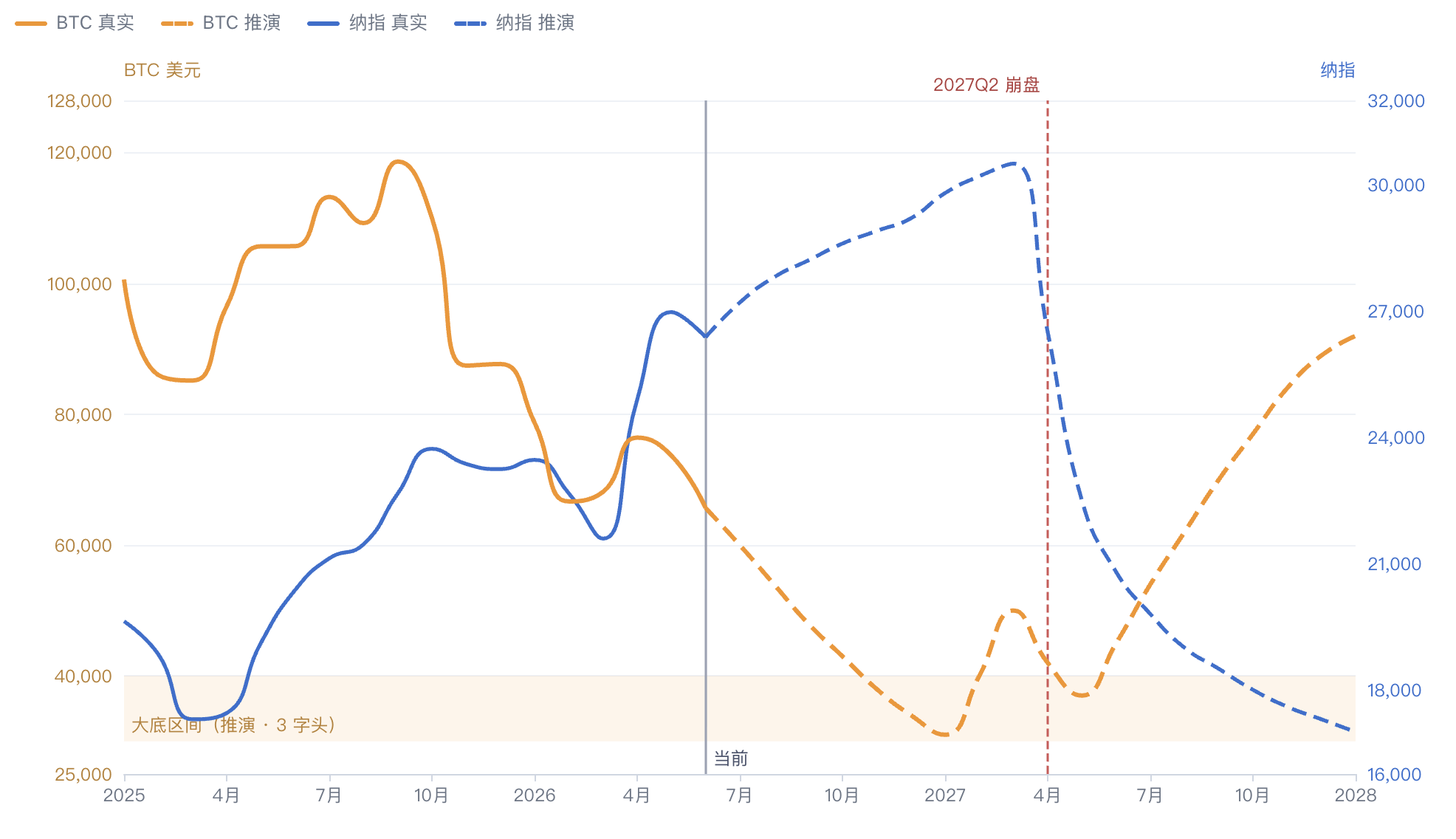
- The bottom of this cycle's bear market for BTC will appear in Q4 2026, with a low point of 30,000-40,000 US dollars. After that, due to a major crash in Nasdaq, a "double bottom" will occur, and the second price low generated is likely not to be lower than the previous low. Then, as Nasdaq falls into a long bear market, BTC will experience a low valley period before slowly rising into a new cycle.
—— "In Norse mythology, the gods fell one by one. Three winters came in a row, and there was no summer in between; the sun could not provide a hint of warmth... The fire giant Surtr raised a sword brighter than the sun and burned the nine realms, the rainbow bridge broke under the army's march… The gods and giants perished together on the final battlefield."
If you have played Warcraft 3: The Frozen Throne, the term "Ragnarok" will be no stranger to you.
In Norse mythology, it is not humanity's death, nor the world's destruction, but the death of the gods, for the old order has completed its mission, and a new era is about to come.
What died today is not just the set of "rules of engagement" of Native Crypto, but the entire financial system of the past thirty years.
The Crypto Circle - In the Midst of a Long Winter
"During the peak of the industry in mid-2025, there were about 300 or more projects submitting binance listing applications each week. Now this number might only be three."
I believe the most optimistic veterans in the industry, regarding the current state of the crypto circle, can only sigh deeply. A year and a half ago, I made a prediction: "And, within my sight, the atmosphere of the entire industry by 2025 determined that I had a pessimistic attitude towards the emergence of milestone 'business concept innovations'." ("2024 & 2025, BTC's Last Mega Cycle - The Value and Price Theory of BTC"). Looking back now, it remains so.
Let's take a look at what has happened in the past two years -
Since meme became a popular token issuance model in 2024, issuing tokens has become a threshold-free affair. In the thriving industry of 2025, there were tens of thousands of tokens issued on various launchpads in a single day. As the entire industry increasingly deviated from fundamentals and the supply side expanded unprecedentedly, industry liquidity was thoroughly diluted, and the primary market for tokens was completely annihilated.
So, unlike traditional finance, where every overheat in the secondary market drives the primary market, the secondary market bubble bursting takes a while to transmit into the primary market's winter. However, the crypto industry in 2025 is the reverse.
Thus, throughout 2025, we all know that the bull market could end at any moment; I also said that the end of 2025 would be the peak of the cycle. But making trading decisions, especially at the moment of trend reversal, determining when the actual peak is, requires precise timing, pricing, and momentum.
Looking back at the core predictions from my article written in December 2024 ("2024 & 2025, BTC's Last Mega Cycle - The Value and Price Theory of BTC"):
(1) Timing: I described the end of 2025, meaning October, November, or even December. Relatively speaking, when I began to arrange the reduction plan for the entire cycle towards the end of Q3 2025, I leaned towards the peak phase of Q4, expecting the highest point to appear in the first week of October, on October 6.
(2) Pricing: For the past decade, I have judged price ranges based on the logic from my paper ("Bitcoin Valuation Model Under Miner Market Equilibrium - Based on Derivative Pricing Theory"), concluding that the BTC cycle peak would be in the range of 160,000 to 220,000. However, entering Q3 2025, I overlooked an important fact: a large number of mining farms have turned into data centers, and the actual computing power participating in mining is far less than what I had always used the statistical caliber to reflect.
(3) Momentum: To this day, I still believe that under the momentum at that time, BTC had just broken its historical high of 127,000 on October 5, and the market should have had a one-month "final bull market" window. However, four events combined destroyed this trend:
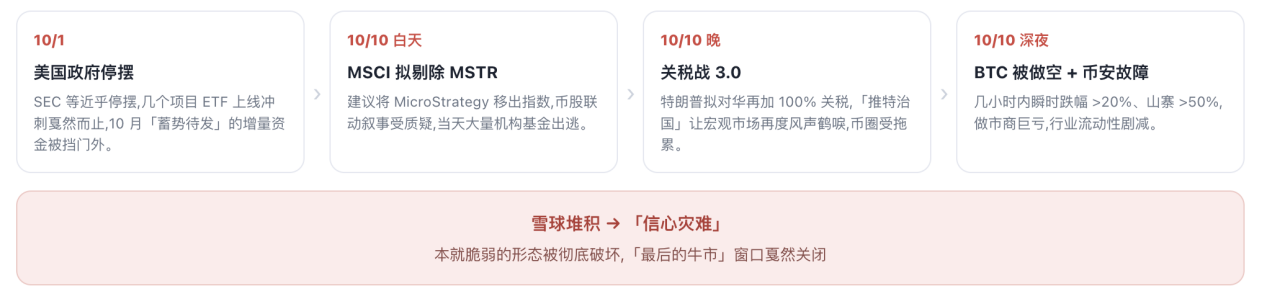
First, the U.S. government shutdown that began on October 1 led to a near-complete halt of the SEC's work, interrupting several well-known crypto projects that were in the final sprint phase for ETF launches; by the time subsequent work resumed, it was close to Christmas, and with 2026's work restart, the overall trend had reversed, thus blocking the incremental funds that the traditional market had already been "poised to strike" in October. Second, on the evening of October 10, Trump's plan to impose an additional 100% tariff on China—"Tariff War 3.0"—caused "Twitter governance" to cause the macro-financial market to tumble again, which also dragged the crypto circle along with it.
Third, on the same day, MSCI announced it would recommend excluding Microstrategy from the index, leading traditional investors to doubt the BTC stock correlation narrative, resulting in mass exit of institutional funds.
Fourth, amidst the repercussions of the first three events, BTC was shorted, experiencing an abnormal plummet within hours that night. Binance exacerbated the situation with technical failures; within hours, BTC witnessed a drop of more than 20%, and other altcoins dropped over 50%, leading to massive losses for many market makers and a drastic reduction in industry liquidity.
These four consecutive "coincidences" accumulated like a series of snowballs, ultimately evolving into a "crisis of confidence," completely destroying an already fragile state.
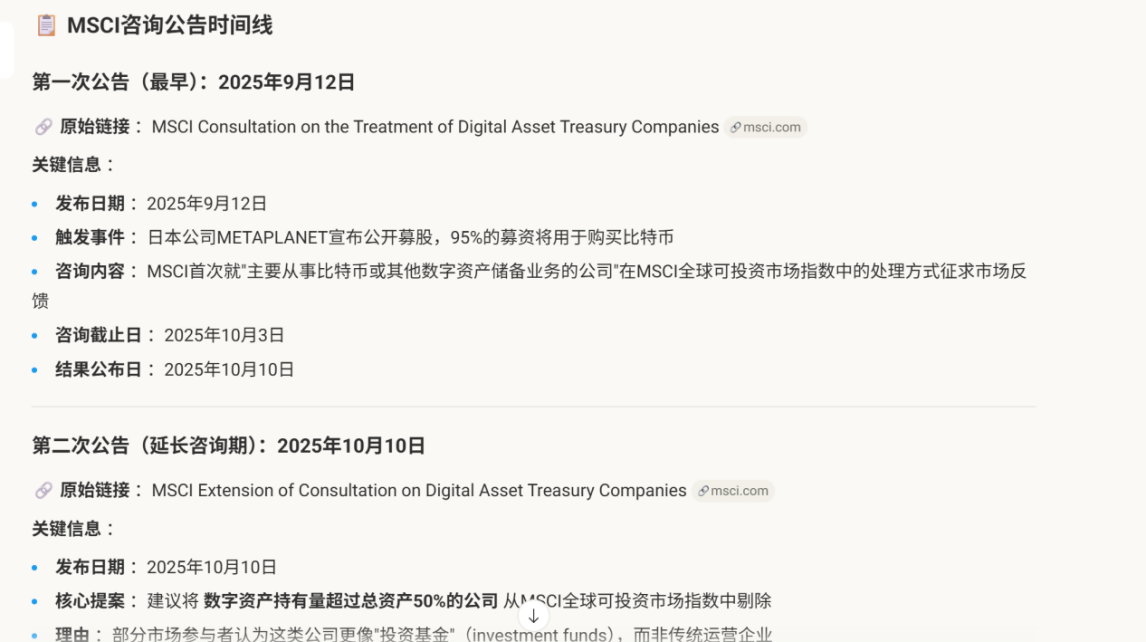
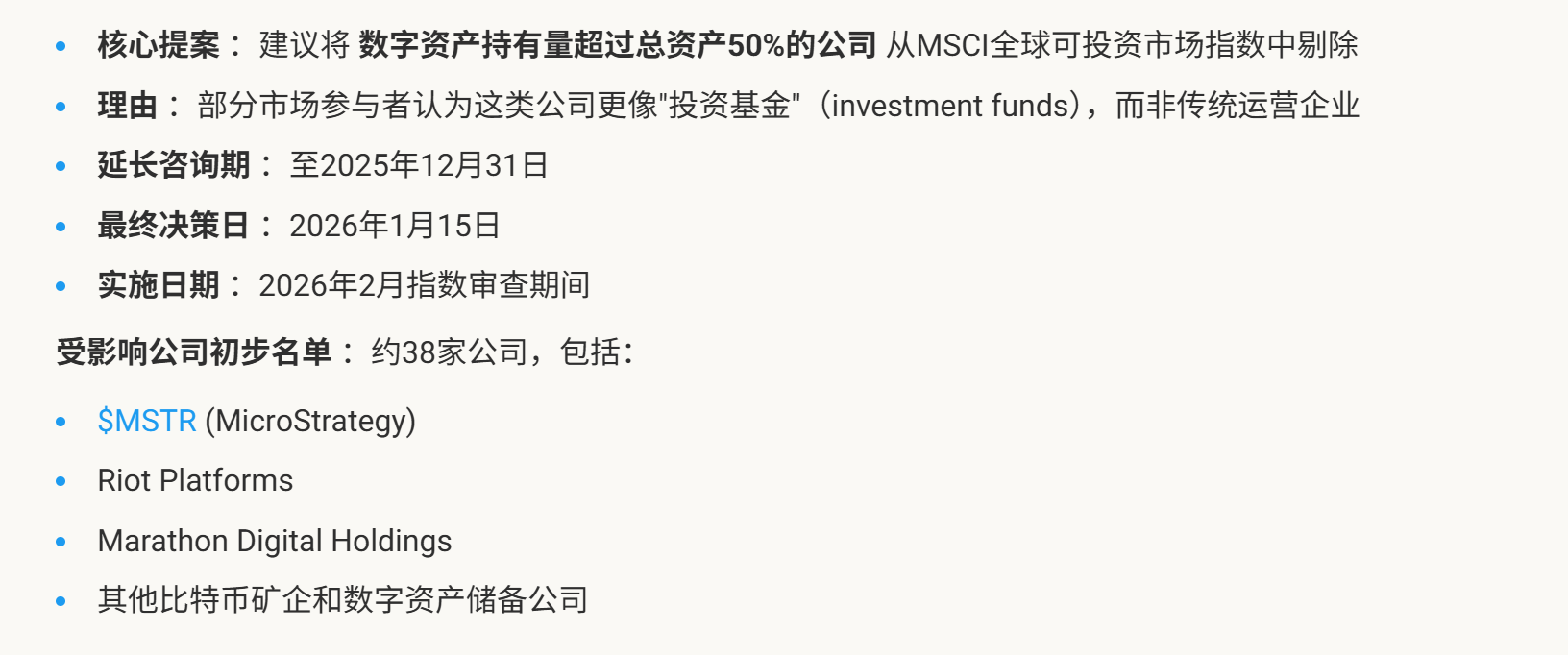
Source: Minara.ai, Date: 2025/10/21
Looking back from today, when it comes to making trading decisions at the pivot point of bull and bear transition, I made several misjudgments in timing, pricing, and momentum, but overall, the larger trend in the crypto circle completely aligns with the projections from my articles at the end of 2024 and early 2025. Additionally, although I did not manage to quickly liquidate after October 11, I still "came to realize" and began preparations for liquidation in late November, completing my selling in the final wave of "technical rebounds" at the end of November and early December when BTC was above 90,000 and ETH above 3,200.
I took this extensive space to review that pivotal point in October 2025, not only for the outcomes but also for my understanding of "trading strategy structure" after the review, which I will focus on discussing in this article's conclusion regarding future AI-era finance.
The current crypto circle has already seen the bubble burst. I believe that the current crypto market resembles the early 2002 internet era: trading volumes have shrunk, overall attention has dropped to a freezing point, and pessimistic sentiment is rampant. Prices have not yet fallen to cycle lows, and looking ahead, the industry will still need at least a year to find its "anchor" and source of innovation. And I predict that the next generation capable of leading a crypto bull market innovation will not be merely native blockchain technology or financial innovations; it will inevitably stem from a technological breakthrough in the mainstream tech circle, flourishing on blockchain, thus bringing entirely new increments in the form of "blockchain +".
However, I still maintain my contention—crypto rights will become the third type of financial medium after debt and equity. Regarding financing and capitalization paths, the choice between rights and crypto rights can be seen in another series of my articles ("The Four-Part Series on 'Crypto Capital Theory': Token Issuance, A New Financing Paradigm""The Four-Part Series on Crypto Capital Theory Part II (Upper): A Battlefield Without Gunpowder - VC or Token Fund?").
The current chaotic listing phenomenon in the crypto circle has no standards, akin to the original establishment of NASDAQ in 1971, more like an "electronic quotation system". Not until 1982 did NASDAQ launch the NASDAQ National Market and establish a clear set of financial and scale requirements, such as minimum net assets, minimum public shareholding, minimum number of shareholders, and minimum share price.
Now, the trend towards stock tokenization in the crypto industry has introduced a brand new form of on-chain assets, attracting traditional funds into the stablecoin market, enhancing the potential capacity for funds on the blockchain, while also educating traders who previously only followed trends in trading coins. When these native traders, mostly retail investors from third world countries, gradually establish a value system for asset trading, it will indirectly drive crypto rights project issuers, exchanges, and others to establish industry standards.
This will take time, and when we see the native crypto practices are dying out, it indicates that day is approaching.
Discussing the Four-Year Cycle
"Throughout the past decade of Crypto history, every major cycle was born from an innovation that significantly changed the industry structure; ultimately, they all perished due to the failure of that innovation itself. As the saying goes: success came from the same source as failure."
When we talk about the "four-year cycle," we are referring to Bitcoin's halving every four years, an unshakeable "industry axiom," as well as the "main theme" of each cycle's rise and fall.
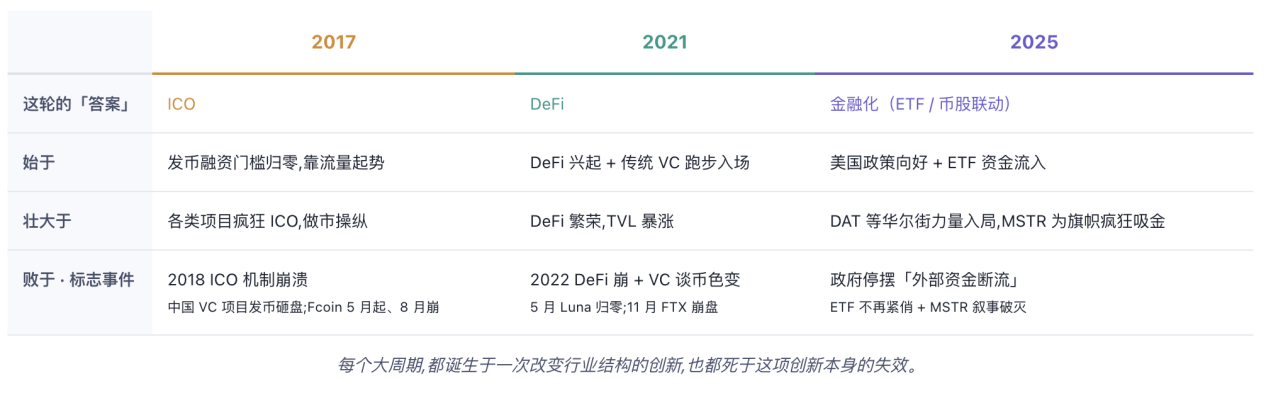
The bubble burst actually has a "common origin." The bull market of 2025, the last cycle, started with favorable U.S. policies and inflows of traditional funds such as ETFs; it was strengthened by the entry of Wall Street forces like DAT; publicly listed companies/funds actively linked with crypto, with Microstrategy at the helm vacuuming funds; naturally, it will collapse due to government shutdown causing an "external funding drain"; it crashed when ETFs were no longer in high demand, and the Microstrategy narrative completely collapsed.
Coincidently, the 2021 bull market began with the rise of DeFi and traditional VCs "running to enter"; it ended with the DeFi crash in 2022 and traditional VCs' fear of "cryptocurrency"—marked by the crash of Luna in May 2022, leading to the zeroing of global flagship DeFi public chains and algorithmic stablecoins; the subsequent crash of FTX in November 2022, including mainstream funds from Silicon Valley and Temasek incurring devastating losses, the "fraud" of assets worth tens of billions collapsing overnight, led to unprecedented skepticism regarding the credibility of crypto circle projects among traditional VCs. During that time, within weeks, all VCs' attitudes dramatically turned 180 degrees, almost completely halting equity investments in crypto circle projects.
Even further back, the 2017 bull market started with ICOs and ended in 2018 with the collapse of the ICO mechanism. The landmark event was in January 2018 when Chinese VCs promoted equity projects that could not achieve exits, quickly smashing down after issuing tokens, coupled with Fcoin surging in May and rapidly collapsing in August. This was more like a funeral of an era, declaring the end of the ICO era of fundraising reliant on traffic and market manipulation.
It is crucial to properly recognize the core innovation of each cycle.
The hard fork disputes in the crypto circle in late 2015 brought more attention, but what really changed the fundamentals was the maturation of ETH's ICO in late 2016.
The 1024 in the crypto circle in 2019 was merely a temporary victory; what truly changed the native fundamentals was the first DeFi wave that began in August 2020.
The beginning of 2023 was a low point, while at the end of 2023 there were BTC technological innovations and milestones, but it was not until the second half of 2024 with crypto ETF applications and stock linkage due to U.S. regulation that the fundamentals genuinely changed.
Some say that BTC's four-year cycle is actually the U.S. interest rate cut cycle, promoting the idea of an "everlasting bull market" during cuts, and if interest rates are not cut in the future, the four-year cycle will cease to exist.
However, will an interest rate cut necessarily ignite a crypto bull market?
What then, from where does a crypto bull market necessarily arise from interest rate cuts?
Returning to the initial question, does the four-year cycle still exist?
Yes, but it will manifest with different levels of interference. Because the correlation between BTC and the stock market is increasingly strong, it will make the four-year cycle still exist albeit in a blurry manner; however, each cycle will not show the previous amplitude so distinctly. Additionally, due to increased external factors "outside the crypto circle," there will be some uncertainties regarding the time boundaries and triggering conditions during the transition of bull and bear markets.
Of course, the most pressing question still remains:
If ICO was the answer for 2017. DeFi was the answer for 2021. Financialization is the answer for 2025.
Then what will be the answer for the next cycle?
The Future of the Crypto Market
"When Wall Street learns to issue tokens, crypto will no longer be just crypto."
Starting from 2024, the industry has already lacked native narrative innovation. In 2025, the only driving force for growth is the increasingly open attitude of the U.S. towards crypto compliance, bridging traditional financial markets with the crypto circle, generating inflows of funds.
The involvement of Wall Street in the crypto market and stock market linkage has the most common methods: first, listed companies purchase a certain well-known crypto asset to boost their stock prices; second, well-known crypto projects buy shells, packaging their assets into the stock market; third, reputable crypto project foundations, having been recognized as "commodities" rather than "securities," raise bond funds to elevate their token price and then offload at highs to repay principal and interest.
By 2026, the entry of funds has completely changed; as the number of tokens purchasable through ETFs has increasingly risen (by June 2026, there are about ten crypto assets available for ETF purchase), traditional funds have lost interest in configuring tokens through ETFs. The entrance of funds has shifted from "traditional funds entering native crypto via ETFs" to "traditional financial assets like stocks and oil being tokenized on chain to attract traditional funds for on-chain trading."
In my earlier article ("History Does Not Repeat Itself, But It Rhymes—Do Not Miss This Time"), I mentioned early that the significance of Hyperliquid is to serve as an entry point and infrastructure for the new generation of crypto funding: "Now we enter another important question: after BTC, if we need to hold an asset, what should we choose? I still stand by my previous viewpoint: if it's a $500K scale investment, I choose Hyperliquid."
Now that compliance is clearer in focus, after Hyper, it should be Lighter. Today, if you still ask me the previous question:
If I could place $5M, I only trust BTC;
If it's $500K, I choose Lighter.
Hyperliquid and Lighter represent new funding entrances. If we consider perp dex as a pipeline—what pours in consists of the on-chain U.S. stocks and various RWAs.

Of course, it is undeniable that the tokenization of U.S. stocks will inevitably experience a major widespread explosion. The remaining new projects in the crypto circle are mostly concentrated in perp dex. The current methods of U.S. stock tokenization primarily involve "synthetic/shadow stocks," and with the emerging liquidity following the global stock market surge, it is unclear whether the tokenized stocks have verifiable 1:1 custody, and whether there is a more scalable way to ensure liquidity aside from a few market makers hanging on. Furthermore, beyond the reliability of assets, almost all trading venues are heavily leveraged, lacking technical audits and legal compliance checks across various new perp dex - any asset untethering or custody failure, compounded with leverage, leads to a series of liquidation events. This is akin to a gray rhino, which will inevitably arrive.
Nevertheless, just like the stablecoin sector, which kicked off with USDT at the end of 2017, encountering multiple "untetherings" during these years, some once notorious stablecoin projects have vanished in the historical river after imploding, while in the end, only the oldest assets like USDT, USDC, and DAI remain. I believe that stock tokenization and perp dex will also undergo such a process; for me, if involved in these projects, the most prudent approach is to seek the next "Circle."
Beyond that, opening the funding entrance does not mean there will be net inflows of capital. The "confidence density" of funds is crucial. Business increasingly requires more "emotional value"; only emotional value can capture attention and be believed by a certain segment of people.
Previously, the funds in the crypto circle were limited because the entrance was narrow and the operation of wallets was relatively complex, allowing only those who genuinely love it, have faith, and are willing to put in time to enter. In 2025, the crypto market almost迎来了他们所梦想的一切,却遭受了最惨淡的“牛市”,因为新来的这一部分资金,离开的也快——你们以为迎接的是上帝,其实是披着上帝外衣的撒旦。那些传统金融机构可能会把你认作“野蛮人”,甚至将原本市场中期待的一群人们一起拉走了。
但这也意味着,行业慢慢要走向正轨了,之前所缺少的法律、会计基础设施,以及从业者的整体素质提高后,重塑行业规则,才能让新进来“并不是原生信仰者”开启一轮新的牛市。
当然,谁说未来世界的主宰,AI agent,或者说数字人们,不会是 crypto 市场真正的“信仰者”呢?
Let’s speculate on the price trends in the coming years
- In six months, by the end of 2026 or early 2027, BTC will reach the bottom of this four-year cycle, which is expected to occur before the end of the Nasdaq bull market, that is, the day of the "big top".
- During these six months, due to the loss of momentum, it will continuously decline, accompanied by sporadic crashes, until it reaches a minimum extreme, which is expected to start with the number 3.
- In early 2027, with the last wave of mania in Nasdaq and together with its cycle in the crypto circle, there will be a short-term rebound due to a resonance effect. However, as Nasdaq peaks and then crashes, BTC will initially drop along or show signs of double-bottoming, approaching the previous low until external wars or other political events trigger a safe-haven effect and siphon off funds.
- In 2027, the world's focus will be on traditional finance, yet with the full compliance of stock tokenization and the maturation of AI trading, on-chain funds, "waiting a long time," alongside the rising reserves of stablecoins will rotate from stocks on-chain to native crypto, which means BTC.
- In 2028, the aftershocks of the AI bubble will slowly fade, with several rebounds in between; however, tech stocks will still remain gloomy overall, while crypto, relatively, will not rise sharply but will continue to increase steadily.
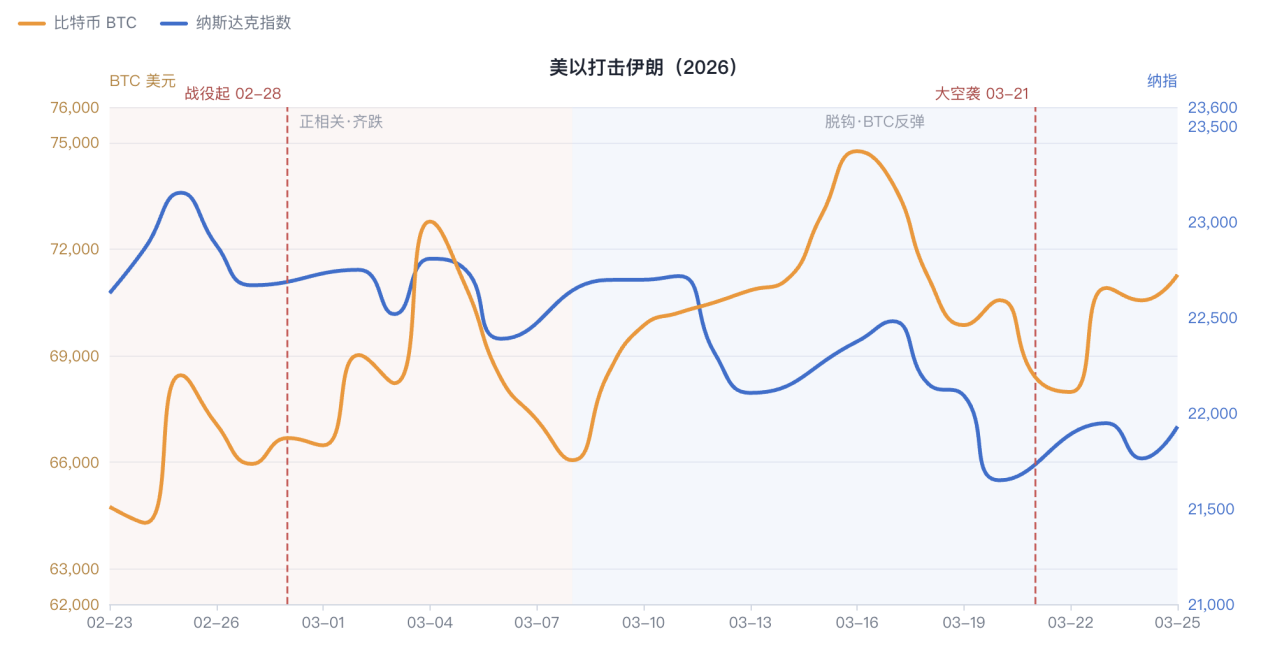
Here I need to clarify a question I'm frequently asked: is Bitcoin positively or negatively correlated with the Nasdaq Index? This question is not a simple yes or no. The answer is that during unexpected events or trend reversals, they initially present a positive correlation before exhibiting a negative correlation.
The most typical example is war; whenever a war breaks out, such as the Russia-Ukraine war at the end of February 2022 or the joint strike by the U.S. and Israel against Iran at the end of February 2026, there are several hours before the war when panic causes the traditional financial markets to decline. Institutions, besides mainstream stocks, often configure Bitcoin, translating this panic into Bitcoin's short-term price drop. However, the following day, when the stock market declines again, Bitcoin shows its safe-haven properties, leading other funds to flow in and pushing its price back up, often exceeding pre-war prices within a week.
This is also why I say if the AI bubble bursts in early 2027, and Nasdaq crashes, Bitcoin too will initially fall alongside it; however, a crash is not achieved overnight. As Nasdaq consolidates, a slight rebound might spark expectations, and before the second wave fully collapses, BTC may dip again, approaching our previously mentioned bottom (but not necessarily breaking through), and then rebound as on-chain funds show safe-haven demand rotating into BTC, thereby breaking free from the bottom range of the four-year cycle.
Wait, what are you saying? The AI bubble bursts?
Yes, the bursting of the AI bubble. Compared to the crypto circle, I am more worried about the global macroeconomic and financial system. Everyone is stepping on their left foot with their right, forcefully covering up all commercial issues with the development of technology, and the development of this technology, AI, will inevitably push the speed of information transmission, reception, and processing to the extreme, thereby triggering large-scale, even irreversible chain reactions.
My prophecy—the Nasdaq will likely crash between early and mid-2027, ending the four-year bull market that commenced in early 2023. Global mainstream stock markets will also be dragged down, headed towards a historical-level collapse.
Next, let us pull back the lens from the crypto circle and turn towards the battlefield I truly worry about—the global macro, and that AI bubble that is bound to burst.
免责声明:本文章仅代表作者个人观点,不代表本平台的立场和观点。本文章仅供信息分享,不构成对任何人的任何投资建议。用户与作者之间的任何争议,与本平台无关。如网页中刊载的文章或图片涉及侵权,请提供相关的权利证明和身份证明发送邮件到support@aicoin.com,本平台相关工作人员将会进行核查。


