OpenRouter has launched an API built around a simple bet: that a panel of cheap AI models, combined the right way, can match a single expensive one. And by “expensive,” they mean Claude Fable 5.
The product is called Fusion. It sends a prompt to multiple models in parallel, then uses a judge model and a synthesizer to merge the results into one grounded answer.
The timing is fortuitous. Shortly after releasing Fable 5 and Mythos 5 last week, a U.S. export control directive forced Anthropic to suspend those models for every foreign national worldwide, citing a disputed jailbreak finding. OpenRouter took the news to X the next day, leaning straight into the gap with a promise of "Fable-level intelligence at half the price."
How to get a cheap Fable
When you send a prompt to Fusion, OpenRouter fires it off to a panel of models in parallel. Each one gets web search and bash tools.
Then, a judge model extracts consensus points, contradictions, and blind spots from every response. After this phase is over, a synthesizer—Claude Opus 4.8 by default—writes the final answer grounded in that analysis.
The whole thing happens server-side. You can swap your model string to "openrouter/fusion" for a default panel, add a fusion tool so your own model calls it selectively, or build a custom panel in the Fusion chatroom with no code.
OpenRouter tested this on DRACO, Perplexity’s benchmark built from real user deep research requests. Fable 5 paired with OpenAI’s GPT-5.5 and synthesized by Opus topped the chart at 69%. Solo Fable scored 65.3%, though seven of its 100 tasks never ran because its own content filters blocked them.
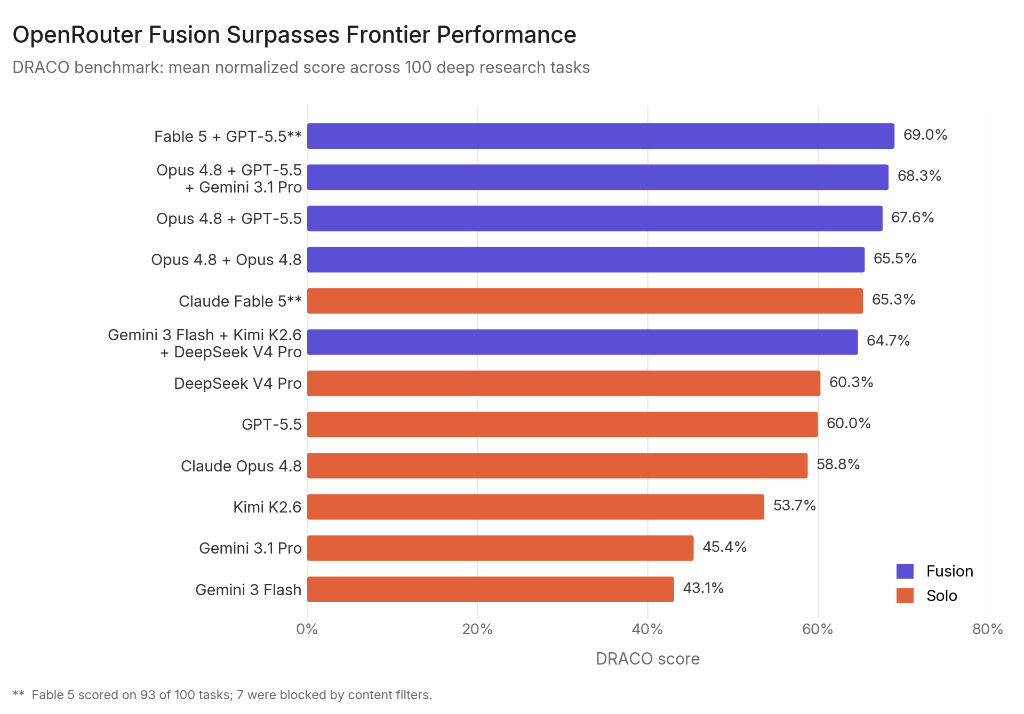
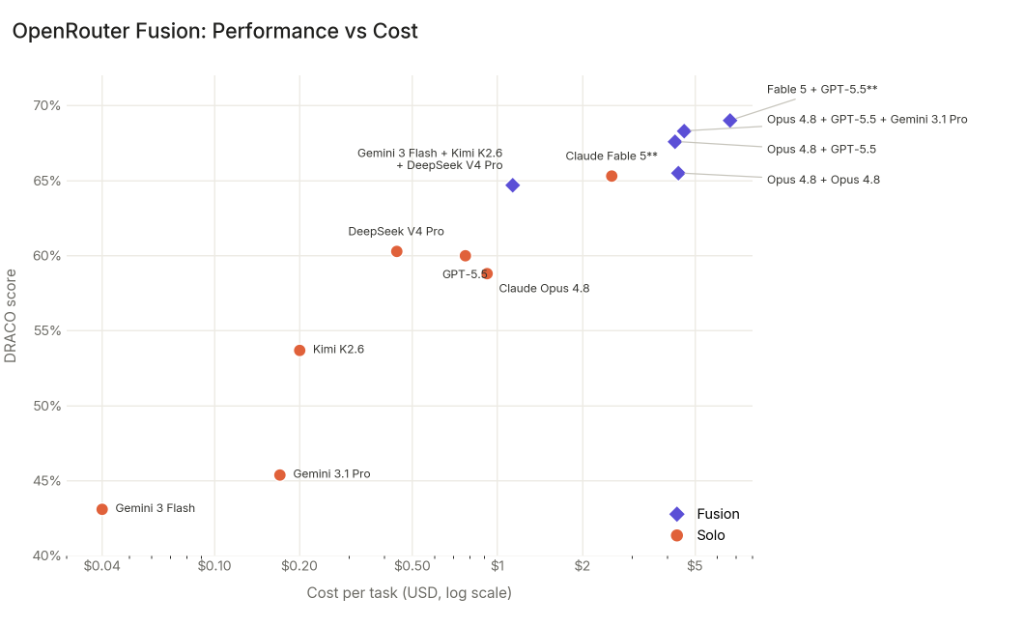
The cheaper combination is the one OpenRouter wants remembered: The cheap Gemini 3 Flash combined with the open-source Chinese models Kimi K2.6 and DeepSeek V4 Pro, fused and synthesized by Opus, hit 64.7%—beating solo GPT-5.5 (60%) and solo Opus 4.8 (58.8%) outright and landing within a point of Fable at roughly half the cost.
Even pairing Opus 4.8 with a separate instance itself scored 65.5%, a 6.7-point jump over solo Opus; OpenRouter says roughly three quarters of that lift comes from the synthesis step itself, the rest from genuine model diversity.
One wrinkle: giving the panel live web access lets models surface DRACO's own grading rubric in search results, a contamination risk that OpenRouter calls coincidental rather than deliberate. The fix took one config line to exclude the benchmark's hosting domains from the search tools, and every published number reflects that cleaned-up run.
Worth a try?
OpenRouter is upfront that Fusion isn't a full Fable replacement. DRACO skips long-horizon work, where Fable reportedly still leads, and for coding, Fusion works as a tool a coding model calls selectively, not a wholesale swap—a caveat that echoes what Decrypt found testing DeepClaude, a cheaper backend swap that keeps Claude Code's agent loop intact but still trails Opus on the hardest reasoning tasks.
The regular model still handles the day-to-day stuff. Fusion is there for the questions where one model might miss something important, and having a few perspectives cross-check each other actually moves the needle.
For deep research, complex planning, or anything where contradictions matter, the room seems to help.
The charts make the basic point clear enough: On this kind of work, the expensive solo model is no longer the only way to get strong synthesis. A group of models that are still easy to get, fused together, can sit right next to it on the results while delivering a much smaller bill.
The launch thread split roughly two-to-one positive in sentiment tracking. AI researcher Andrew Trask called it "a way bigger deal than it seems," arguing frontier labs will never again own the frontier alone. Skeptics pushed back on the framing, however, citing bad coding results, poor tool calling, and a lack of transparency since Fable 5 isn’t available anymore to compare results.
Fusion runs entirely on models routed through OpenRouter's own infrastructure, so it doesn't fix the export-control problem at the source. Anyone locked out of Fable 5 now has options: a Fusion panel, a backend swap like DeepClaude, or open-weight alternatives such as GLM-5.2 that may not be better but are good enough for the price.
免责声明:本文章仅代表作者个人观点,不代表本平台的立场和观点。本文章仅供信息分享,不构成对任何人的任何投资建议。用户与作者之间的任何争议,与本平台无关。如网页中刊载的文章或图片涉及侵权,请提供相关的权利证明和身份证明发送邮件到support@aicoin.com,本平台相关工作人员将会进行核查。


