Written by: Dong Jing
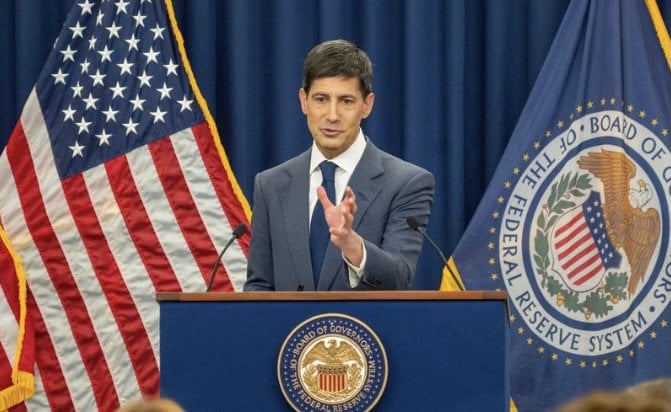
The primary challenge facing Waller upon taking office as Chair of the Federal Reserve is not whether interest rates should rise or fall, but a more fundamental judgment: What type of prosperity is the current AI boom? This judgment will determine the direction of Federal Reserve policy and will define Waller's historical position.
On June 19, journalist Nick Timiraos, known as the "new Federal Reserve press agency," stated that there are two completely opposing interpretations within the economic community regarding the ongoing AI boom:
One view holds that the productivity dividend is about to be realized, supply will catch up with demand, and the Federal Reserve can remain still and wait for inflation to naturally decrease; the other view argues that the benefits of productivity improvement are still far off and that demand shocks have already occurred. If the Federal Reserve waits for data confirmation, it will miss the best intervention window and will ultimately be forced to raise interest rates more significantly.
This week, the Federal Reserve kept interest rates unchanged, but in the latest dot plot, nearly half of the officials expect rate hikes later this year, while the remaining officials hold the opposite view—this internal division reflects the high uncertainty surrounding this core issue.
Waller's own leanings were vaguely visible during the press conference. He emphasized multiple times that "strong, productivity-driven growth is not what we fear, but what we embrace," echoing Greenspan's thinking from 1996.
However, the macro environment he faces—tariff pressures, widening fiscal deficits, globalization dividends fading—is vastly different from the smooth sailing context of Greenspan's time. Making the correct judgment between these two historical scenarios will be Waller's first real test in leading the Federal Reserve.
Two 1990s: Greenspan's Dual Legacy
Timiraos noted that Waller has repeatedly referenced the 1990s as a historical benchmark over the past year, but this decade encompasses two entirely different narratives.
In 1996, Greenspan, facing rapid economic expansion, chose to stay put. He assessed that fast growth would not ignite inflation, and it turned out he was right. The economic expansion continued for several years, earning him the title of "maestro."
By 1999, Greenspan changed his judgment. With the stock market soaring and the labor market continuing to tighten, he began to raise interest rates continuously, culminating in the bursting of the internet bubble. It was in this year that the Federal Reserve established the mechanism of "forward guidance" to signal interest rate hikes in advance—this practice continues to this day and is something Waller has clearly stated he wishes to abolish.
The Trump administration openly favored the 1996 version of the Federal Reserve, and Waller had previously expressed a desire to create a central bank "that is confident enough to do less." However, the current economic situation may be presenting him with another version of the script.
Waller's Judgment Logic: Trusting the Narrative, Not Waiting for Data
Before taking office, Waller publicly stated his position on Fox Business: He is concerned that the Federal Reserve is about to commit its "sixth or seventh major mistake"—tightening monetary policy too early during a productivity boom that should allow for more freedom.
Timiraos describes his core argument as: The productivity increases brought about by AI may not immediately reflect in official statistics and could take years to emerge. If the Federal Reserve insists on waiting for data confirmation, it will misjudge a beneficial boom as an overheated economy, leading to interest rate hikes—which could precisely kill the growth momentum that could otherwise suppress inflation.
The essence of this logic advocates using forward-looking narratives instead of lagging data as the basis for decision-making. Waller also continued this line of thought during the press conference: when asked whether AI is currently boosting demand or expanding supply, he merely stated that "demand is easier to measure than supply," deliberately avoiding a clear stance, while also adhering to the communication principle of "not revealing the next steps in advance."
Timiraos believes that even if Waller ultimately makes the correct judgment, the analogy to the 1990s is still incomplete.
When Greenspan made that famous bet in 1996, there were multiple supportive factors: cheap overseas goods and labor continued to suppress inflation, and the federal budget deficit was also narrowing. These structural factors provided an additional safety margin for the Federal Reserve's "wait and see" approach.
Waller, on the other hand, faces a completely different environment: Tariff policies are driving up import costs, fiscal deficits are expanding rather than contracting, and the globalization dividend has already faded. This means that even if the AI productivity dividend is eventually realized, the inflationary pressures Waller endures while waiting will be far greater than those Greenspan faced.
Counterarguments: The Chicago Fed's "Expectations Overdraft" Model
Timiraos pointed out that the most systematic challenge to Waller's judgment logic comes from Austan Goolsbee, the president of the Chicago Fed.
According to the Wall Street Journal, Goolsbee made a key distinction at a conference at Stanford University last month: Whether a productivity boom allows the central bank to remain still depends on whether that boom is unexpected. A boom that everyone can foresee may have the opposite effect—people will overdraft future wealth and significantly increase spending before the productivity dividend is realized, thus causing the economy to overheat.
"Eventually, you will have to raise rates significantly, much more than you would have needed if you had acted sooner," Goolsbee said.
He believes the current AI boom falls precisely into this "everyone can see" category. Surveys of economists, technology professionals, and the general public indicate that the market widely expects AI to bring about an annual productivity increase of about one percentage point, with most of the benefits still in the future. According to his model, this expectation itself constitutes a reason for interest rate hikes, rather than a basis for cuts.
Goolsbee also cited current "overheating signals": The construction of AI data centers is driving up land, electricity, and chip prices, while raising the costs of electricians and equipment, thereby squeezing resources from other industries. Apple announced this week that it would raise prices due to rising costs, which he views as evidence that this mechanism is in operation.
It is worth noting that Goolsbee's framework is not without challengers. Federal Reserve Governor Christopher Waller pointed out at the same Stanford conference that the "expectations overdraft" mechanism can only work if people can borrow money to consume in advance. But in reality, many households’ spending is strictly constrained by current income and cannot easily convert future wealth into immediate spending.
"If they cannot overdraft that part of spending in advance, the entire mechanism will be cut off," Waller said.
This rebuttal provides theoretical support for Waller's "stay still" position: If borrowing constraints are prevalent enough, the demand-forefront effect will be significantly reduced, making it more likely that the productivity boom will gently push supply expansion instead of triggering inflation.
The Ultimate Paradox: Abolish Forward Guidance, or Be Forced to Use It
Additionally, Timiraos believes that Waller faces a deeper paradox in leading the Federal Reserve, and this paradox arises precisely from the very matter he most wishes to change.
He explicitly expressed a desire to create a Federal Reserve that "does not reveal its hand in advance," reducing forward guidance and leaving the market in speculation. However, the current forward guidance mechanism of the Federal Reserve was established in 1999—when Greenspan began signaling in advance of interest rate hikes to avoid catching the market off guard.
If the economic trajectory is as optimistic as described by the Trump administration, Waller may never need to signal rate hikes in advance. But if the economy heads in a different direction, he will face a dilemma:
Either continue to use the forward guidance practices he wishes to abolish to inform the market of interest rate plans in advance; or remain silent, allowing the market to speculate on the magnitude and pace of rate hikes, bearing the risks of severe volatility in the financial markets that may ensue.
The resolution to this paradox ultimately hinges on the answer to the same question: Is it now 1996, or 1999?
免责声明:本文章仅代表作者个人观点,不代表本平台的立场和观点。本文章仅供信息分享,不构成对任何人的任何投资建议。用户与作者之间的任何争议,与本平台无关。如网页中刊载的文章或图片涉及侵权,请提供相关的权利证明和身份证明发送邮件到support@aicoin.com,本平台相关工作人员将会进行核查。


