
Author: Charlie Perkin, Zach Pandls, Grayscale
Translation: Yuliya, PANews
Editor’s note: With the continuous decline of the cryptocurrency market since the beginning of the year, investors are faced with an important question: which digital assets are worth investing in at current prices? This assessment isn't easy for digital commodities like Bitcoin, but many other crypto assets are more akin to financial rights and can be valued through cash flows. This report uses the on-chain decentralized lending leader Aave as an example, delving into how the reasonable value of crypto assets can be accurately calculated through protocol revenue, token value capture mechanisms, and industry price-to-earnings (P/E) multiples. Below is the complete translated content:
Key Points
- The crypto market has continuously plummeted since the beginning of the year: How should investors judge which digital assets have investment value at current prices? This may be quite challenging for digital commodities like Bitcoin, but many other crypto assets are more like financial debt, which can indeed be valued through cash flows.
- This report focuses on Aave: As a leading blockchain-based lending platform, Aave is a well-established project with transparent financial data, but has recently experienced a rocky period, including the departure of core contributors and the outflow of deposits.
- According to traditional discounted cash flow (DCF) analysis: Grayscale's research department believes that the AAVE token has investment value at current levels. Despite facing headwinds recently, we expect the protocol to earn about $60 million in net income by 2026; referencing typical P/E multiples of about 20 to 25 times for traditional fintech companies, its fair market value should be between $1.2 billion and $1.5 billion, corresponding to a token price of about $80 to $100 (in comparison, the current market price is around $75).
- In the benchmark scenario: If regulatory clarity accelerates the adoption of tokenized assets, we believe that the fair value of the AAVE token is expected to rise to about $175 within a year.
- Aave demonstrates a successful example: It proves that success at the protocol level can be clearly tied to token value capture, thereby supporting the application of traditional valuation frameworks including DCF analysis, price multiples, and comparable company analysis.
- Token value capture mechanisms are crucial in DeFi protocol economics: It enables projects to translate top-level business adoption into increases in token prices, while maintaining a decentralized governance structure.
- Aave is not a traditional company: It is a DAO. Currently, DAOs still face significant regulatory uncertainty. If the CLARITY Act passes smoothly and becomes law in 2026, the AAVE token may be classified as "network assets" under that framework.
*Note: DCF is one of the most widely used pricing models in corporate finance and investment, equivalent to discounting all the cash flows that a company can earn in the future to today and then summing them up.
Digital assets have already established themselves in mainstream technology and finance, but overall, this market is still too young. Just a small comparison shows: the top 30 cryptocurrencies by market capitalization average only about 8 years of age; while traditional blue-chip companies in the U.S. stock market, like those in the Dow Jones Index, have an average lifespan of over 100 years. Because it is a "newborn," there are constant debates over "how to classify, regulate, and value crypto assets." As the market matures, clarifying these issues can not only make cryptocurrency prices more reasonable but also attract more outside capital into the market.
Grayscale's research department believes that as the market evolves, we need a more nuanced method for valuing digital assets, including introducing frameworks derived from traditional financial analysis. Before investing in any coin, the first step is to clarify its "economic fundamentals": What is it used for? How does regulation view it? How intense is the competition? Most importantly, if the project makes money, through what mechanisms can it distribute that to token holders? Understanding these factors is essential for measurement.
For crypto assets, simply checking whether a project has users is not enough; it is also essential to see if its token economics and governance structure can turn "the project's earnings" into "token price increases." Next, we will use the DeFi lending sector and the Aave protocol as examples to analyze how to value the protocol using cash flows and fundamentals.
Classifying Crypto Assets
Just like the common sense in traditional financial markets for hundreds of years, the driving logic for stocks, gold, foreign exchange, and bonds is completely different. You cannot use the same method to value them.
Similarly, not all crypto assets should be valued using the same framework. While the early crypto market often conflated all tokens, today's investors increasingly prefer to distinguish assets with different economic functions, ownership characteristics, and value drivers. Asset classification needs to identify underlying factors that promote token value growth, such as monetary premiums, liquidity premiums, utility premiums, governance premiums, and cash flow-related premiums.
Figure 1: Structural Differences Between Commodities and Financial Debts
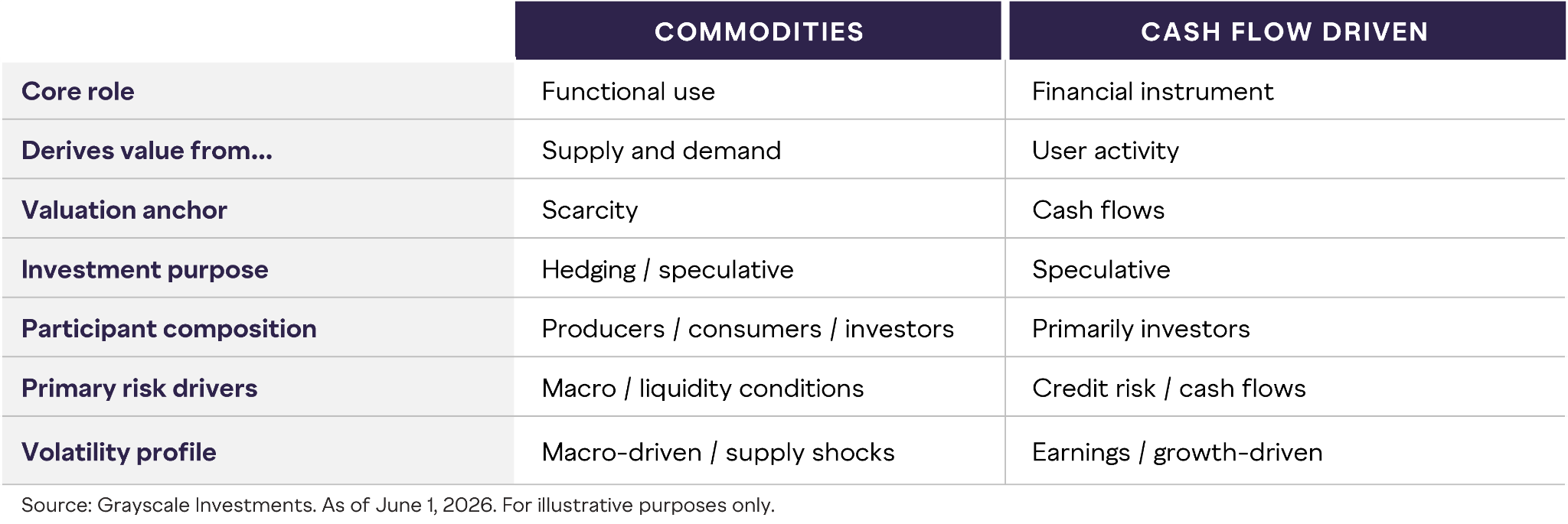
In the classification process, distinguishing between "commodity-like assets" and "cash flow assets" is an important starting point.
- Commodity-like assets (such as Bitcoin): These assets do not pay you a salary or dividends. Their value relies on "scarcity" and the "consensus" of people using it as a medium of exchange, collateral, or store of value.
- Cash flow assets (such as DeFi tokens): These assets are tightly bound to the underlying business activities of the project. Their value depends on how much fee income the project collects, how much operating expense it incurs, how much it holds in its treasury, and most importantly—what mechanisms the project uses to return this money to token holders.
Figure 2: Asset Spectrum from Pure Commodities to Financial Debts
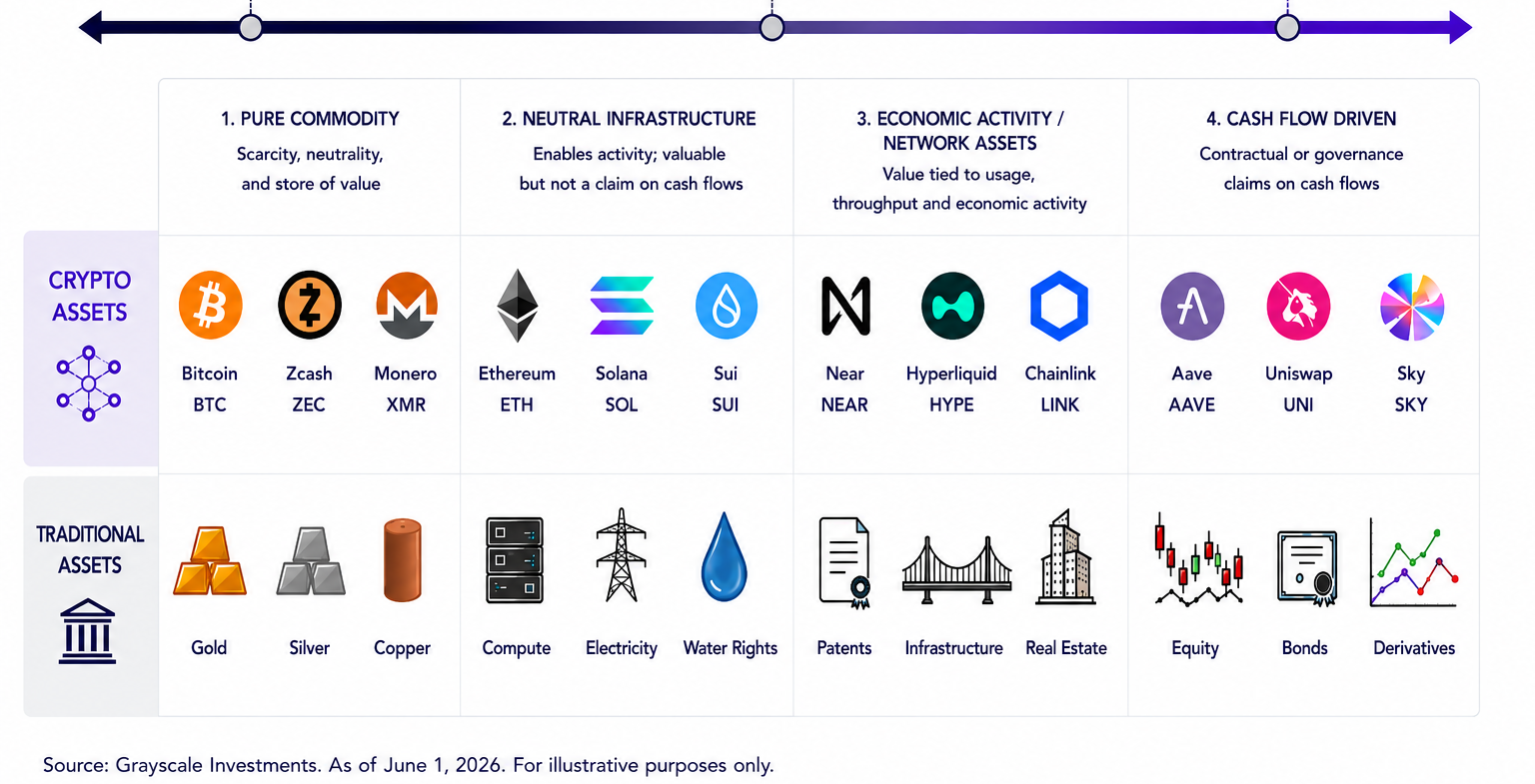
In reality, many tokens actually lie in between the two; a valuation method suitable for a reserve or settlement asset (like BTC) is fundamentally different from that for a protocol token (like AAVE) that has sustainable income, treasury assets, governance rights, and clear value capture mechanisms. Many tokens may even embody multiple characteristics, requiring investors to assess which economic drivers are most critical at specific stages of protocol development.
Therefore, when choosing a valuation model, we must consider the asset's "economic essence," rather than merely looking at whether it is a coin issued on-chain. As projects mature and markets change, their attributes may also evolve.
Within this asset spectrum, DeFi protocols are the most typical representatives of "cash flow-driven" assets. Here, their economics are directly linked to token val...
免责声明:本文章仅代表作者个人观点,不代表本平台的立场和观点。本文章仅供信息分享,不构成对任何人的任何投资建议。用户与作者之间的任何争议,与本平台无关。如网页中刊载的文章或图片涉及侵权,请提供相关的权利证明和身份证明发送邮件到support@aicoin.com,本平台相关工作人员将会进行核查。


