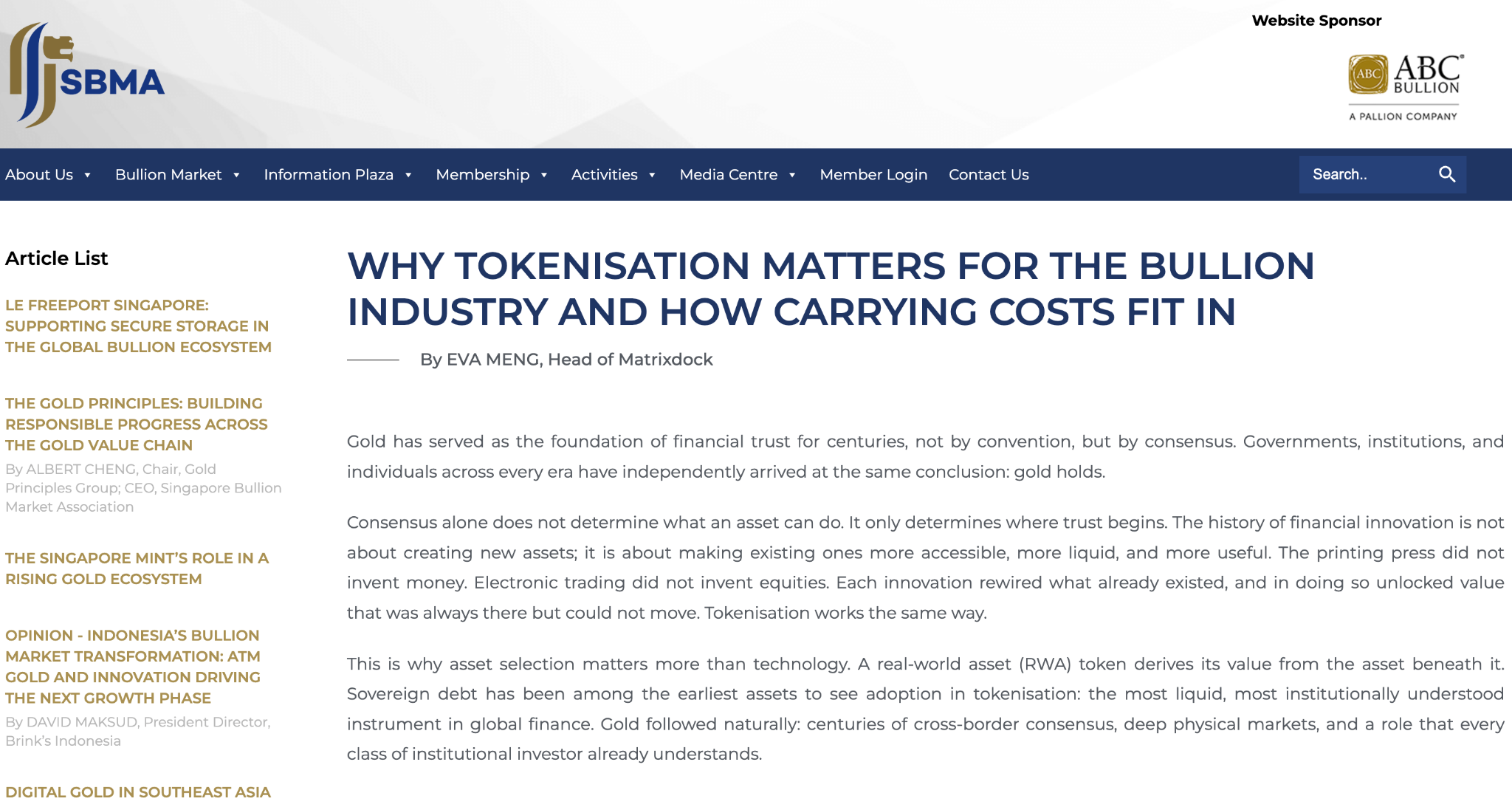
Recently, a research article from Matrixdock, the RWA tokenization platform under BIT (formerly Matrixport), has been published again in the industry publication "Crucible" of the Singapore Bullion Market Association (SBMA). The head of Matrixdock, Eva Meng, published an article titled "Why Tokenisation Matters for the Bullion Industry and How Carrying Costs Fit In", exploring how tokenization enhances the usability and capital efficiency of precious metal assets from the perspectives of market efficiency, holding costs, and the evolution of precious metal market infrastructure.
As an SBMA member, Matrixdock has continuously participated in discussions related to the global precious metal industry since joining the association. Following previous opinions on tokenized gold transparency and asset verification mechanisms, this publication further extends the discussion to market efficiency and financial infrastructure upgrades, reflecting that tokenized precious metals are gradually gaining more attention from the traditional precious metal industry.
ETFs have changed how gold is invested, and tokenization further expands the uses of gold
Gold has long been viewed as an important store of value, with its value consensus transcending nations and markets, continuing throughout hundreds of years of financial evolution. However, the stability of asset value does not imply that the method of using the asset remains unchanged. From paper certificates to electronic trading and then to ETFs, each upgrade of financial infrastructure has continuously improved the liquidity and accessibility of gold.
The article argues that the changes brought about by tokenization are similar. It does not redefine gold; rather, it allows this traditional asset to enter the digital financial system more efficiently while retaining its value attributes.
Over the past two decades, gold ETFs have significantly lowered the investment threshold, making gold more easily accessible in modern portfolios. However, the core goal of ETFs is to provide price exposure rather than to allow gold to directly participate in broader financial activities. With the development of digital finance, new questions have begun to arise in the market: Can gold achieve instant settlement beyond just holding it? Can it be used for digital collateral? Can it circulate in a market that operates around the clock?
In this context, tokenized gold does not attempt to replace ETFs, but rather aims to enhance gold's liquidity and usability further on the foundation that ETFs have already improved gold’s accessibility for investment, gradually equipping gold with broader applications such as settlement, collateral, and payments, rather than being a mere investment allocation tool.
Holding costs will not disappear; transparent mechanisms are key to real-world assets
For physical assets like gold and silver, storage, insurance, and custody costs always exist objectively. This issue is even more pronounced for silver, given its lower unit value and larger volume.
Traditional ETFs generally cover related costs through a total expense ratio, but the true custody costs, management fees, and profit margins are often bundled together, making it difficult for investors to distinguish between different sources of costs clearly.
Regarding this issue, Matrixdock introduced the Fungible Reserve Standard (FRS) framework in the article, hoping to reflect the holding costs of real-world assets more transparently through FRS. The underlying Economic Purity Principle emphasizes that tokens should faithfully reflect the economic characteristics of the underlying assets rather than obscure these characteristics.
Matrixdock believes that the key to tokenizing real-world assets is not just about putting assets on-chain but rather accurately reflecting the true economic properties of the assets in a transparent manner.
From XAUm to XAGm, Matrixdock expands tokenization practices in precious metals
The article also introduces Matrixdock's practices in the field of precious metal tokenization. As the first tokenized asset built on the FRS framework, XAGm transparently incorporates holding costs into the token mechanism; while gold token XAUm represents Matrixdock's core practice in institutional-grade gold tokenization.
From gold to silver, Matrixdock is exploring more transparent and economically aligned expressions of different precious metal assets on-chain.
It is noteworthy that, as the market evolves, industry focal points are also changing. The early market was more focused on proof of reserves and asset authenticity, while as the market matures, the industry begins to pay more attention to asset efficiency and capital utilization issues. According to data cited in the article, the market size for tokenized gold surpassed $6 billion by February 2026, showing significant growth over the past year. The article points out that as the market size continues to expand, tokenized gold is gradually becoming an important component of the digitalization process in the precious metals market.
If ETFs made gold an important part of modern investment portfolios, then tokenization is driving gold further into the digital financial system. The value of gold has not changed, but its methods of use and application scenarios are continually expanding. From a store of value to a digital asset that can support settlement, collateral, and broader financial operations, the development of precious metal tokenization may still be in its early stages.
免责声明:本文章仅代表作者个人观点,不代表本平台的立场和观点。本文章仅供信息分享,不构成对任何人的任何投资建议。用户与作者之间的任何争议,与本平台无关。如网页中刊载的文章或图片涉及侵权,请提供相关的权利证明和身份证明发送邮件到support@aicoin.com,本平台相关工作人员将会进行核查。


