
Author: Jae, PANews
On June 12, the Nasdaq bell tugged at the nerves of global capital.
The business aviation giant SpaceX, valued at $1.77 trillion, officially listed, setting a record for the largest IPO in global capital history. Wall Street institutions flocked out, retail investors overflowed with FOMO sentiment, while the crypto industry struggled through a lack of liquidity and exhausted narratives, as funds cast their votes with their feet.
On one side was the soaring technology stocks, while on the other, the chill in the crypto market was palpable. Natives of the crypto space, tired of being trapped in the stock battles of a single asset class, began to seek a low-threshold gateway to mainstream assets. The Gate TradFi product suite released at the right time just handed them this key.
Notably, amid the unprecedented hype surrounding the SpaceX IPO subscription rush, Gate TradFi successfully completed its allocation of subscription shares, becoming one of the few winners who realized success in this IPO frenzy.
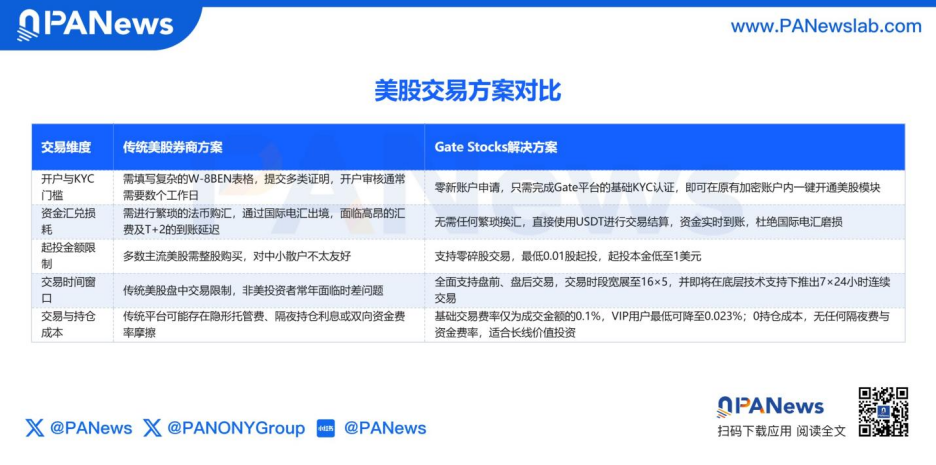
USDT Reconstructing the Settlement Layer, One Account Breaking the "Islands" of TradFi Assets
For a long time, global traditional financial markets resembled islands built from different fiat currency systems, time zone spans, clearing mechanisms, and regulatory frameworks.
For crypto users accustomed to "24/7, instant settlement, high capital efficiency," entering traditional assets for the first time typically hits three high walls.
- Account Fragmentation: Investors participating in markets such as U.S. stocks, foreign exchange, precious metals, or commodities often need to navigate multiple brokers, each trading platform requiring new KYC, new deposits, and relearning, resulting in excessively high operational costs;
- Idle Funds: There exists a physical barrier between crypto accounts and securities accounts, where margins cannot be shared across markets, leading to idle crypto funds on one side and margin gaps in securities accounts on the other, rigidly splitting capital efficiency;
- Inefficient Settlement: Traditional brokers generally adopt T+2 settlement, which can lead to delays in fund arrival and share confirmation, failing to meet crypto users' demands for immediacy.
The popularity of stablecoins provides a natural bridge to break this deadlock. The entry of cryptocurrency exchanges into traditional financial markets at this time is essentially a revolution aimed at reconstructing the traditional asset settlement layer with stablecoins, seizing the gateway to global users' asset allocation.
To solve this chronic ailment, Gate TradFi presented its solution: start from a unified account system, integrate compliant broker infrastructure downward, and cover all categories of primary and secondary assets and derivative tools upward.
Users only need to complete a single crypto KYC account verification to use USDT as margin and settlement assets throughout, greatly enhancing capital utilization and returning the settlement cycle to "crypto speed."
SpaceX's IPO Challenge, Why Could Gate TradFi Successfully Deliver Allocations?
While clearing account and settlement barriers, what drew market attention even more was whether ordinary investors could have the opportunity to share in the growth dividends of quality primary market assets.
It’s important to know that Pre-IPO shares of top unicorns like SpaceX have always been the exclusive game of Wall Street giants, old money in Silicon Valley, and high-net-worth individuals. Ordinary retail investors not only get locked out but often play the role of "premium buyers" in the secondary market.
Take SpaceX as an example; traditional brokers like Fidelity require investors to have account assets of over $500,000 to qualify for subscription, and they must manually confirm within a very short timeframe before the listing, failure to do so renders it void. Overseas retail investors find it even harder to touch the threshold.
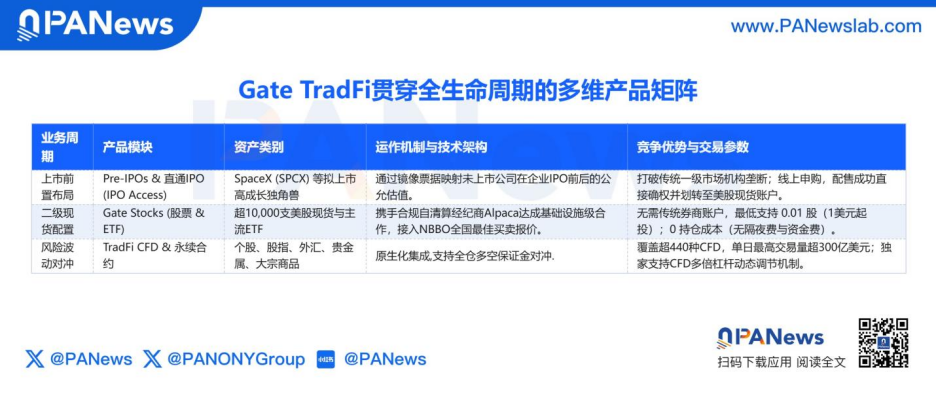
Gate TradFi, on the other hand, has torn down the ticket to the primary market and handed it to ordinary people: using "Pre-IPOs + Direct IPO (IPO Access)" combo to lower the investment dividends of the primary market to a broader user base.
Step 1: Pre-IPOs, locking in valuation dividends before asset listing.
On April 22, SpaceX was launched as the first target for Pre-IPOs subscriptions, raising nearly $395 million. Users subscribed for "mirror notes," mirroring SpaceX's real fair value. At that time, the subscription price was $590 per share, which, after a 1:5 stock split, became $118 per share, corresponding to a $1.43 trillion valuation. As SpaceX's valuation climbed above $1.75 trillion, early investors reaped substantial floating profits.
It’s important to note that Pre-IPOs subscriptions are for asset mapping certificates; users can freely buy and sell through pre-market trading and can also convert to real shares or exit during a six-month lock-up period after the IPO. For retail investors, this is already a feasible way to obtain a unicorn entry ticket at the lowest cost and threshold.
Step 2: Direct IPO, new offerings no longer just for the rich.
On June 9, Gate TradFi launched its SpaceX "Direct IPO" service, directly lowering the subscription threshold to 100 USDT.
On June 12, SpaceX officially listed, and users who successfully subscribed automatically received real new shares, which were directly transferred to their Gate stock accounts. That evening, the Direct IPO smoothly settled SpaceX's new offering allocations, with a single account receiving up to 154 shares, seizing the cognitive first-mover advantage with users.
From locking in valuation before listing to confirming allocation upon listing, Gate TradFi compressed the entire participation process into a single keystroke.
From Primary to Secondary Market, Gate TradFi Reshapes the Trading Market Landscape
If acquiring participation resources in the primary market is just the beginning, the asset security, liquidity, and capital utilization efficiency in the secondary market, along with the trading experience, is the trump card for retaining users over the long term.
Gate TradFi launched the stock spot trading product Gate Stocks, encompassing U.S. and Hong Kong stock markets. Currently, Gate Stocks not only supports over 10,000 U.S. stocks/ETFs but has also launched over 1,500 Hong Kong stocks, covering top market capitalization, liquid quality listed companies in both the Hong Kong main board and the GEM, positioning itself as the industry’s first platform to launch Hong Kong stock spot trading.
In terms of asset breadth, Gate Stocks has far surpassed similar competitive products, achieving high coverage of leading secondary markets to provide users with a wider choice of global asset allocation.
It's worth mentioning that the underlying U.S. stock market of Gate Stocks has integrated with the U.S. licensed self-clearing broker Alpaca, achieving "physical-level access" to the real U.S. stock market.
Alpaca is registered and regulated by the U.S. Securities and Exchange Commission (SEC), and is a member of the Financial Industry Regulatory Authority (FINRA) and Securities Investor Protection Corporation (SIPC), serving millions of securities accounts worldwide. Through deep integration with Alpaca's API, Gate Stocks has encapsulated the capabilities of compliant brokers into its crypto account system:
- Capital Security: Securities held by users are implemented via third-party segregated custody by regulated compliant institutions;
- Native Liquidity and Optimal Execution Price (NBBO): User orders directly access Nasdaq, NYSE, NYSE Arca, NYSE American, and BATS, connecting to the national optimal pricing system, eradicating common issues in tokenized stock trading such as "high slippage, insufficient depth, delayed pricing";
- End-to-End Automatic Settlement: Alpaca handles the execution, clearing, settlement, and custody of all U.S. stock/ETF orders, as well as corporate actions such as dividends and stock distributions, which will also be automatically processed and allocated by Alpaca. For instance, on June 16, Gate completed the dividend distribution for Alphabet's GOOGL (Class A common stock) and GOOG (Class C capital stock). The dividend standard was $0.22 per share, directly distributed in USDT to user accounts.
For crypto users seeking higher capital efficiency, spot trading is merely the first step in asset allocation. A derivatives market characterized by high liquidity and supporting two-way operations is the main arena for releasing capital efficiency. This is the deep logic behind Gate TradFi's construction of its CFD and perpetual contract matrix.
Now, Gate TradFi has laid out over 440 types of CFDs in its derivatives segment, encompassing a variety of categories including forex, stocks, precious metals, indices, and commodities. The rich asset supply has also brought a stronger "liquidity aggregation" effect, with Gate TradFi's CFD daily trading volume exceeding $30 billion at times, while the TradFi perpetual contract monthly trading volume nearly reached $290 billion, placing it among the industry's leading tier.
The most noteworthy innovation is the "Adjustable Multiple Leverage Mechanism." In traditional CFD markets, leverage multiples are strictly fixed by the platform. Gate TradFi breaks this outdated dogma and, while offering leverage of up to 500 times, has introduced multiple tiers of leverage, allowing users to manually adjust settings, providing flexible parameter choices for different risk appetite trading strategies.
Another attractive feature is "Zero Margin Requirement for Long-Short Hedging." When users open equal long and short positions on the same asset, the system will automatically hedge, reducing the margin to zero. This represents a tangible liberation of capital efficiency for market makers and arbitrage strategies.
The ecological barriers between traditional assets and the crypto market are further dissolving at Gate TradFi: the trading volume of TradFi derivatives has officially been incorporated into Gate's VIP tier system. As users engage in equity index arbitrage and gold hedging, they also reduce their marginal transaction fees. In other words, the more they trade, the lower the costs.
Moreover, Gate TradFi has extended a uniquely Web3-responsive value-added toolbox:
RWA Financial Management: Idle stablecoins can be allocated to yield products such as GUSD with an annualized return of about 2.9%, with funds not left idle;
Copy Trading: The mature social copy trading model of the crypto industry is replicated to traditional asset derivatives trading, allowing novices to learn from expert trading strategies;
Quantitative Robots: Strategies like grid and Martingale are directly applied to U.S. stock CFDs and forex trading.
The common thread among these tools is to transfer the habits of crypto users back to traditional finance: lower usage thresholds, higher levels of automation, and a more open social trading ecosystem.
Conclusion: The Gateway to Global Asset Allocation is Undergoing Reconstruction
If in the past, the core question of the crypto industry was how crypto assets would integrate into the mainstream financial system, in the coming years, a more important trend may be how high-quality global assets can reach a broader user base through crypto infrastructure.
From SpaceX igniting the epic IPO on Nasdaq to tech new players like OpenAI and Anthropic secretly submitting IPO applications behind the scenes, quality assets are no longer fragmented by geography, accounts, or currencies, as liquidity continually migrates from the traditional world due to unified accounts, stablecoin settlement, and on-chain financial infrastructure.
As global users’ demand for cross-market asset allocation grows more urgent, the future competitive focus is no longer just the quantity of products, but rather who can build more robust underlying infrastructure, more stable resource acquisition capabilities, and a smoother trading experience.
The SpaceX IPO undoubtedly provided a real stress test for Gate TradFi and allowed the market to re-examine what role crypto platforms can play in the traditional financial ecosystem amidst the broader trend of reconstructing global asset entry points.
免责声明:本文章仅代表作者个人观点,不代表本平台的立场和观点。本文章仅供信息分享,不构成对任何人的任何投资建议。用户与作者之间的任何争议,与本平台无关。如网页中刊载的文章或图片涉及侵权,请提供相关的权利证明和身份证明发送邮件到support@aicoin.com,本平台相关工作人员将会进行核查。


