Polymarket World Cup betting on favorites suffers huge losses, 400,000 in reverse bets wildly earns 9 million.
Written by: Gino Matos
Translated by: Saoirse, Foresight News
In the match between Spain and Cape Verde on June 14, Spain had nearly 75% possession and took 27 shots — such statistics in most games would guarantee victory. But the final score settled at 0-0, with Cape Verde's 40-year-old goalkeeper Vozinha winning the best player of the match. This draw caused significant losses for many bettors on Polymarket, while an unknown wallet made about 9 million dollars in profit in a single day.
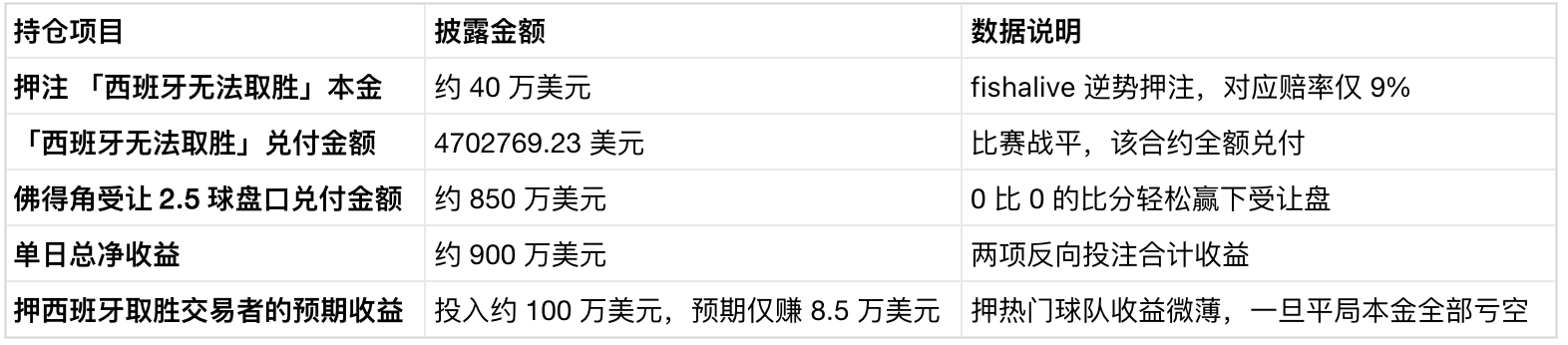
The wallet is registered under the account name fishalive, which registered on Polymarket in June 2026 and has only two prediction bets in the public records. The account bet on the contract "Spain cannot win," which yielded about 4.7 million dollars; it also bet on Cape Verde receiving a 2.5-goal handicap (a rule used in sports betting to balance the odds of strong and weak teams, adding 2.5 goals to Cape Verde's score), securing about 8.5 million dollars in profit. They invested only about 400,000 dollars in principal, ultimately netting nearly 9 million dollars.
Data from Polymarket's sports sector shows that the initial odds for this 400,000 dollar bet were only 9%, with the final payout amounting to 4,702,769.23 dollars. The amount of this bet, the time of betting, plus the fact that the account was just registered, sparked extensive discussion online. Some commentators pointed out that the position valued at 4.5 million dollars was established only 8 minutes before the match started.
This newly registered wallet accurately predicted Cape Verde's chances of winning, while the platform's publicly available on-chain ledger allowed everyone to see in real-time the entire process of this large profit being credited.
Position and profit data overview:
In the single market for World Cup champions, Polymarket's transaction volume reached 2.46 billion dollars. Among the market odds, France leads in championship expectations, accounting for about 17.6%; Spain follows closely with 13.9%; Portugal and England are not far behind, at 10.8% and 10.5%, respectively. The championship contract will settle around July 20. Polymarket stated that there are a total of 362 active trading markets for the 2026 World Cup across all categories, with total transaction volumes surpassing 2.5 billion dollars.
The large trading volume makes each football match an independent financial trading event; just in the match between Spain and Cape Verde, the total trading volume on the platform reached 64 million dollars.
Popular teams suffer consecutive upsets, causing widespread losses for bettors
A trader named betoor619 bet on Spain to win, with an implied odds as high as 92%. He invested nearly 1 million dollars in principal, with potential earnings only 85,000 dollars, and this draw completely wiped out that position.
Days earlier, Polymarket’s sports sector had recorded similar maneuvers: another user invested 1 million dollars betting on Spain to defeat Cape Verde, which would only return 1,085,943.48 dollars if victorious. Cape Verde held strong throughout the match, not conceding a goal even in stoppage time, earning their first World Cup points in history, and both bets on Spain winning became void.
In just 24 hours, a similar scenario played out again. Media Inc. reported that trader FlickRaw incurred approximately 4.2 million dollars in losses: among which 2.7 million on Netherlands beating Japan and 1.5 million on Belgium beating Egypt. Japan equalized twice, and their goal in the 88th minute locked the final score at 2-2; Belgium was scored against by Egypt in the 19th minute, levelled in the 66th minute, but ultimately drew 1-1.

The draw between Belgium and Egypt also erased the largest single bet of this World Cup: trader leeeroyjenkins placed 8.6 million dollars betting on Belgium to win, and had the team won, he could have received about 13.1 million dollars in payout. Polymarket's sports section updated the game odds in real-time, first announcing Egypt leading 1-0 at half-time, and ultimately confirming the draw, resulting in a total loss on this massive bet.
Why betting on favorites leads to widespread losses?
From a theoretical strength perspective, Spain, the Netherlands, and Belgium are significantly stronger, and the trading market agrees with this assessment. However, "only the team wins" contracts pay out only under a single outcome, and draws in football matches are quite common; when the final whistle blows and the scores are tied, even a dominant performance turns the bet into worthless paper.
The odds for "betting on the team to win" are priced as high as 92 cents, with the market assuming victory is nearly a certainty; but once the team fails to score, the value of the shares drops to zero. Fishalive's two bets turned profitable because the contracts for "Spain cannot win" and Cape Verde's handicap can payout under draw conditions, while all traders betting on favorites to win this week fell victim to draws.
The championship expectations leaderboard reflects market sentiment changes; as match results are announced, traders continually reassess the championship probabilities of each national team. Single match contracts have a high degree of dissemination: they can be settled in 90 minutes, and screenshots of large gains or losses easily spread on social platforms, while unreasonable large bets immediately pay the price.
Large traders concentrate on heavily backing popular teams to win, but the large asymmetric gains are always from handicap bets and contracts that preemptively factor in draw risks, such as “the team cannot win.”
Goldman Sachs' pre-match prediction model indicated a championship probability of 26% for Spain, higher than France's 19%. However, after Cape Verde's draw against Spain, Polymarket's market funds repriced, and France's championship expectations overtook Spain directly.
The World Cup inherently has a global audience, with fans able to grasp the logic of match outcomes; the group stage schedule is dense, with new market hot spots emerging every few hours; national team events carry strong emotional attributes, regardless of financial gains or losses; and the transparent settlement mechanism allows every large bet to generate complete transaction records for sharing. All these traits enable prediction markets to break out of the crypto industry's circle and enter the public eye.
Two major trends going forward
As the knockout stage approaches, the trading scale related to the World Cup will continue to expand. The publicly available wallet records on-chain, real-time odds changes, and national team events that carry fan emotions all keep Polymarket as a focus of ongoing coverage in sports media.
The profit story from the match against Cape Verde and the massive loss case against Belgium are just the beginning of this competition, with new significant trading stories emerging every few days. The single match trading market, compared to traditional sports betting, has a faster pace and more direct impacts on gains and losses.
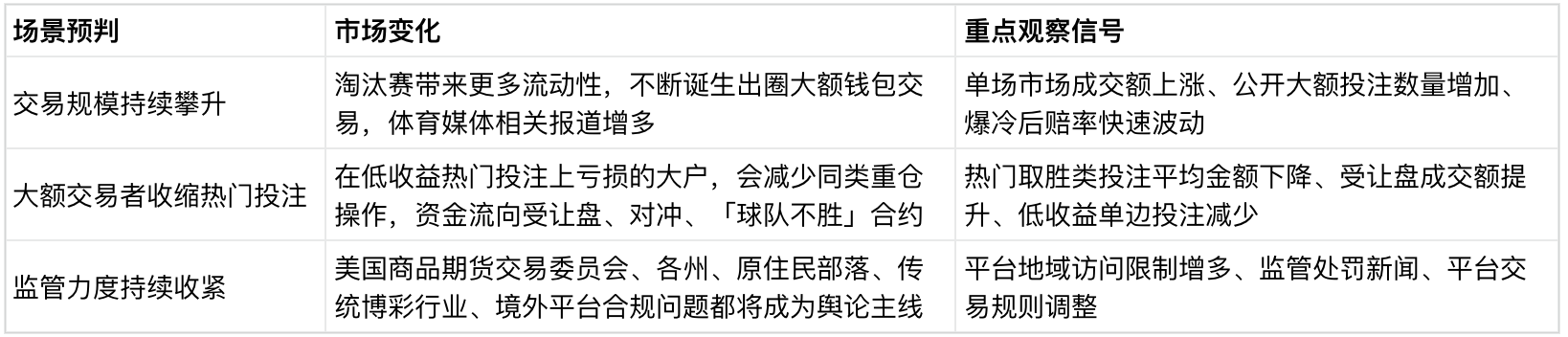
Scenarios of large traders scaling back bets can be anticipated: many traders, like those betting on Spain to win, will invest millions in principal but can only expect tens of thousands in returns. After consecutive losses, they will reduce unilateral heavy positions, and funds will shift towards hedging against draw risks with handicap bets and reverse betting contracts.
Regulatory resistance will further accelerate this trend. The U.S. Commodity Futures Trading Commission released a new regulatory draft on June 10, planning to establish a federal-level prediction market regulatory system while recognizing that sports contracts possess price discovery value. However, various U.S. states, tribal nations, and the traditional betting industry collectively oppose this regulatory scheme. Research from the American Gaming Association shows that 85% of Americans consider these prediction contracts to be gambling.
As early as late May, Spain briefly banned Polymarket and Kalshi due to compliance issues. This shifted public focus from market growth to regulatory disputes: should anonymous wallets and multi-million dollar sportsbooks be subjected to the same regulatory standards as financial derivatives?
It is currently unclear whether fishalive’s massive profits stem from accurate market judgment, pure luck, or exploiting pricing loopholes in unilateral winnings contracts — conclusions cannot be drawn solely from Polymarket's on-chain ledger. However, the ledger clearly records the flow of funds from certain victory bettors to traders who understand the risks of football draws in one match after another.
免责声明:本文章仅代表作者个人观点,不代表本平台的立场和观点。本文章仅供信息分享,不构成对任何人的任何投资建议。用户与作者之间的任何争议,与本平台无关。如网页中刊载的文章或图片涉及侵权,请提供相关的权利证明和身份证明发送邮件到support@aicoin.com,本平台相关工作人员将会进行核查。


