Author: Zhou, ChainCatcher
Starting from the evening of June 14, there has been concentrated criticism from the Chinese community regarding the service quality of Binance's VIP customer service.
Several long-term high-volume users reported that after contacting the VIP exclusive customer service, there was a long period without any response, and after the assigned account manager left or was replaced, no new staff took over to handle their inquiries. This discussion quickly spread, and more users followed up with similar experiences.
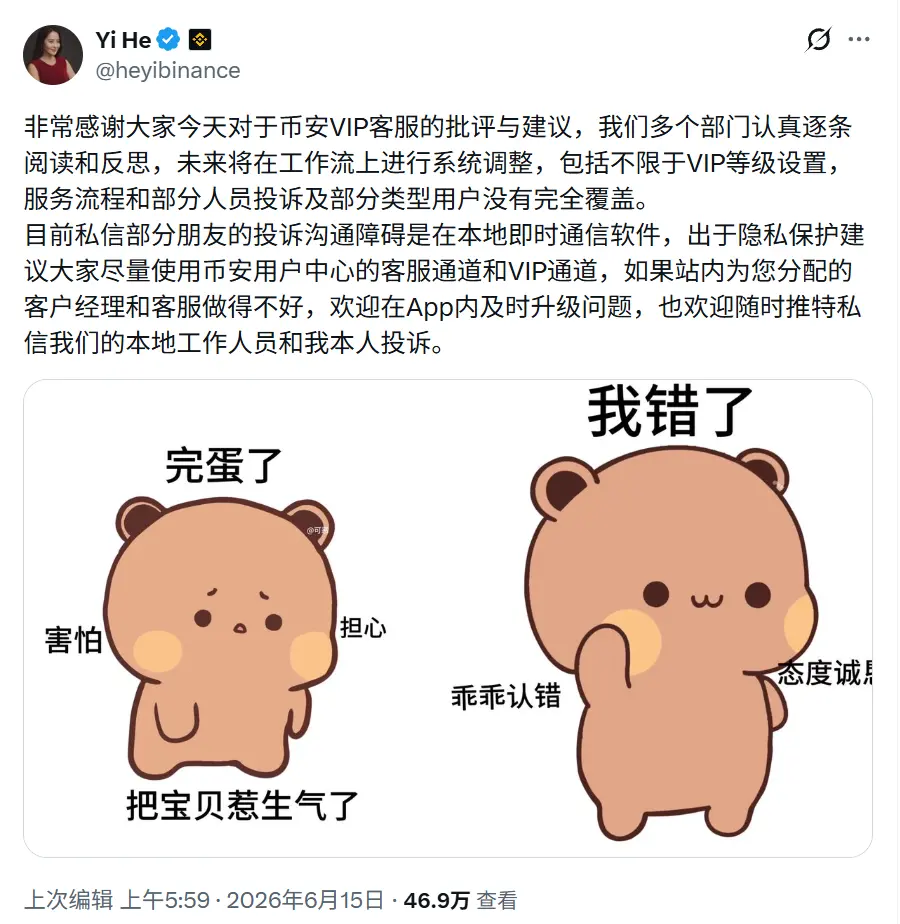
On Monday, Binance co-founder He Yi publicly responded. She admitted that the KPI design has long focused on the response speed and satisfaction of regular customer service, while the service resources for VIP and KOL users are relatively scarce, and promised systematic adjustments at the workflow level, including equipping VIP users with dedicated customer service managers within 24 hours and fixing system failures in the VIP channel.
Since the beginning of this year, major exchanges have gradually lowered the VIP thresholds to expand the base of high-net-worth users. This incident actually points to a mismatch between the incentive methods of exchanges and the service delivery capabilities.
Structural Mismatch Between KPIs and Business Contribution
He Yi mentioned in her response that in the past, KPIs mainly assessed the resolution speed and satisfaction of regular customer service, which led to the VIP and KOL groups being relatively overlooked in resource allocation. There appears to be a collaborative disconnection between customer service and VIP support, resulting in some users experiencing lost information after switching channels in the app, leading to worse experiences than regular users; a dedicated pathway that was supposed to enhance service ultimately became a burden.
This mismatch is not uncommon in rapidly expanding platforms. When a large amount of resources is used to cover a broader base of regular users, the top users, who contribute the vast majority of transaction volume and fee revenue, are more likely to be in a marginal position within the routine service system.
Lowering the thresholds allows more users to enter the VIP sequence, but the high-connectivity resources such as dedicated managers and problem closure processes are difficult to expand proportionately in a short time. Rate discounts are merely an adjustment of a line of code, while customer managers need to be recruited, trained, and integrated, making the expansion speed inherently slower.
As a result, top users feel the service squeeze first. They have higher requirements for platform stability and stronger voices, leading their issues to more easily manifest at the community level.
Incentive Wars Are Easy, Delivery Wars Are Hard
ChainCatcher mentioned in an article published in April titled“Cryptocurrency Exchanges Kick Off the Battle for VIP Clients” that in March this year, Binance directly lowered the entry-level VIP 1fundingthreshold by almost 80%.In the bear market, exchanges collectively lowered the VIP thresholds, bringing the private banking model of client cultivation into exchanges.
This incentive logic does indeed play a significant role in attracting liquidity and short-term retention, but as the VIP base rapidly expands, the organizational capacity for service delivery, system support, and feedback loops become bottlenecks.
Crypto traders @yuyuvkx mentioned that as a long-term high-volume user, they once experienced a situation where the VIP department did not respond for half a month. Other users also reported having raised concerns about unreasonable contract index components, receiving no feedback both on the platform and Twitter.
This gap is not an isolated case; it is a result of the incentive logic outpacing the organizational execution capacity. VIP users already enjoy corresponding rights in terms of fees and limits, but when encountering specific issues, the difficulty of finding stable contacts and predictable resolution pathways increases.
After the incident escalated, He Yi quickly responded, and multiple departments reviewed feedback in detail, proposing adjustment directions that include the setup of VIP levels, optimization of service processes, and improvement of user coverage. At the same time, Binance customer service team member Sisi also publicly stated that they would continue to follow up on the issues, emphasizing that regardless of the size of the user base, they welcome direct contact.
Many voices in the community recognized the swiftness of this response, believing that for a company of such a large scale, it is not easy to provide a clear statement within a day.
However, conversely, if the service issues for VIP and KOLs can only be noticed by upper management through the fermentation on social media, it indicates that the regular account manager reporting and ticket escalation mechanisms are not functioning effectively.
Attitude problems can be addressed by a public response, but certainty at the process level requires verifiable systems, not one-off commitments. Just as X user @taresky said, holiday greetings without meaningful care are pointless; what is truly needed is the ability to find a real person to address issues when problems arise, along with a clear guarantee of resolution timelines.
When Processes Are Unreliable, Relationships Matter
From another perspective, when users’ actual capabilities in addressing issues also begin to stratify, the situation transcends mere service experience issues and becomes a matter of who can push their issues forward and who can find the right person in charge.
The current organizational structure of exchanges exacerbates this uncertainty to some extent. After the public uproar, Sisi's team revealed the contact lists of different business lines such as VIPs, plazas, wallets, and communities.
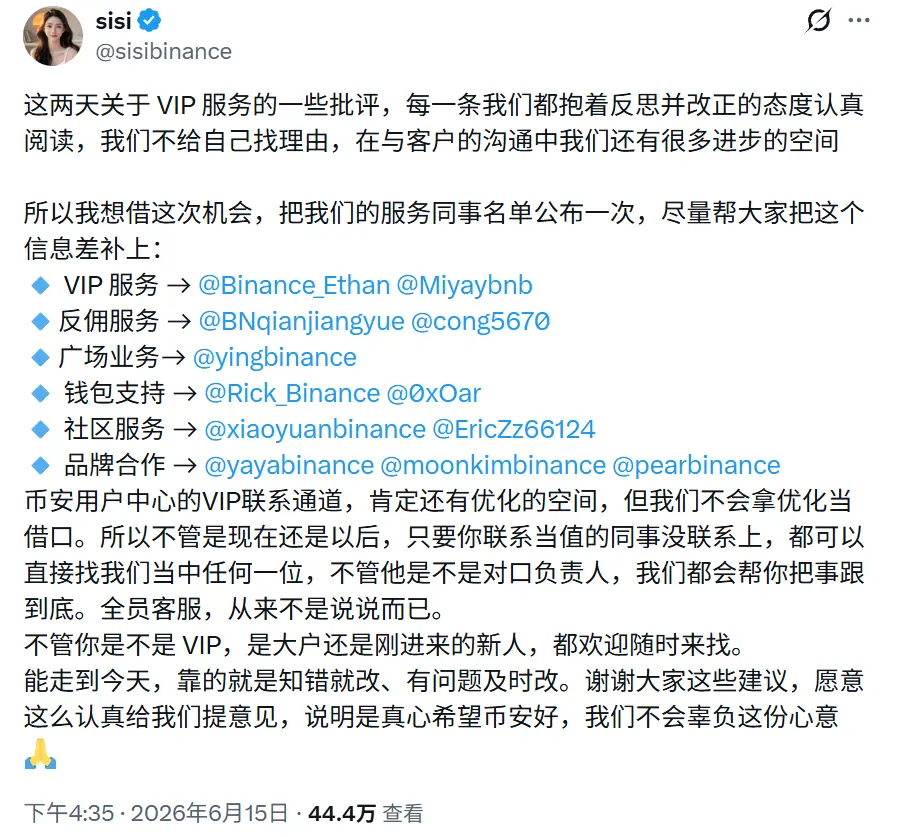
User issues were originally treated separately by department, but once issues require cross-department coordination, the platform lacks a unified upgrade pathway and responsible parties.
In this structure, private chats, Telegram, and X direct messages have become common informal escalation channels. Crypto KOL Australia’s Big Lion mentioned that years ago, they met Sisi due to account compliance issues, and when similar issues arose afterwards, having her confirm was often faster and more reliable than following the formal process. Many KOLs also reported having resolved business issues through similar means.
In places where processes fail, “relationships” have become the actual effective system. A contrary example is the posts that spread most during this public discourse, which came from @yuyuvkx, who claims to have assets in the tens of millions of dollars and a long-standing trading volume in the hundreds of millions, yet was ignored for half a month until they publicly criticized on X and were noticed.
This indicates that whether one can navigate private channels is less about asset scale or influence and more about knowing the right person at the right time. However, the variable of private channels is harder to grasp than asset scale and more difficult to institutionalize, which is the danger of judgment related to relational governance.
This model may have been an advantage when the platform was smaller, allowing founders to directly perceive users' real experiences. But as the user base expands to Binance's current scale, relying on the personal efforts of founders and a few employees to fill the gaps in processes is no longer a sustainable arrangement.
It may cover the loudest group, but it fails to support the silent majority.
The exchange has already reached a level comparable to global infrastructure; whether customers can have their issues addressed equally still depends on whether they know the right people or have a loud enough voice. If this gap is not filled by institutionalization, it will only widen with further expansion.
Conclusion
In the end, this incident stems from the organizational capacity of the exchange not keeping pace with the speed of business expansion.
Looking deeper, this kind of dislocation is almost inevitable. Companies that have risen to today’s scale in the crypto industry have relied on the quick, flexible, and unbound response capabilities typical of the entrepreneurial phase. However, to truly complete the transformation from a startup to an institution, this “human touch” needs to be integrated into stable operational systems.
This is also a lesson that all exchanges pursuing scale must learn as they move towards becoming mature financial infrastructures.
免责声明:本文章仅代表作者个人观点,不代表本平台的立场和观点。本文章仅供信息分享,不构成对任何人的任何投资建议。用户与作者之间的任何争议,与本平台无关。如网页中刊载的文章或图片涉及侵权,请提供相关的权利证明和身份证明发送邮件到support@aicoin.com,本平台相关工作人员将会进行核查。


