The World Cup betting markets are transforming from "odds" into "information markets," and humanity's desire to price the future will always exist.
Written by: Alan, Biteye Content Team
Today is the fifth day after the start of the 2026 World Cup in the USA and Mexico, and there has already been a shocking upset. The favorite to win, the Spanish team valued at 500 million euros, was held to a 0-0 draw by Cape Verde's 40-year-old goalkeeper, whose worth is only 50,000 euros. Netizens joked: How could a human foot possibly outperform "Buddha's foot"?
I want to ask those who bet on the favorite Spain: How is your heart and wallet?
With strong teams unstable, dark horses emerging, and late-game drama, this 48-team World Cup, right from the start, has flatly contradicted the "paper strength theory." In other words, perhaps the true charm of competitive sports lies in underdogs defeating the strong.
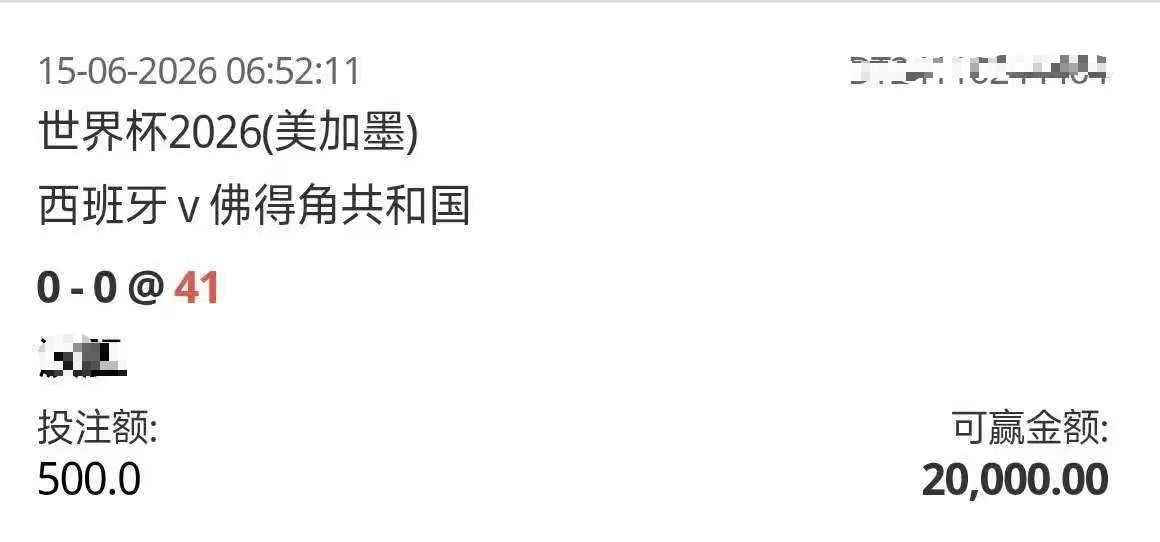
So the question arises: Have you supported your home team and predicted the score in your friends' group? Have you participated in betting either online or on compliant platforms?
In fact, the opening of the World Cup is not just a battle among 48 teams on the green pitch; it's also a battle of several prediction products in the same arena.
If you open Polymarket, you'll find it's prominently featuring a gold football icon for the World Cup in the top navigation. Continuing to click, you’ll see the entire World Cup's matches, gameplay, team matchups, and maps lined up neatly.
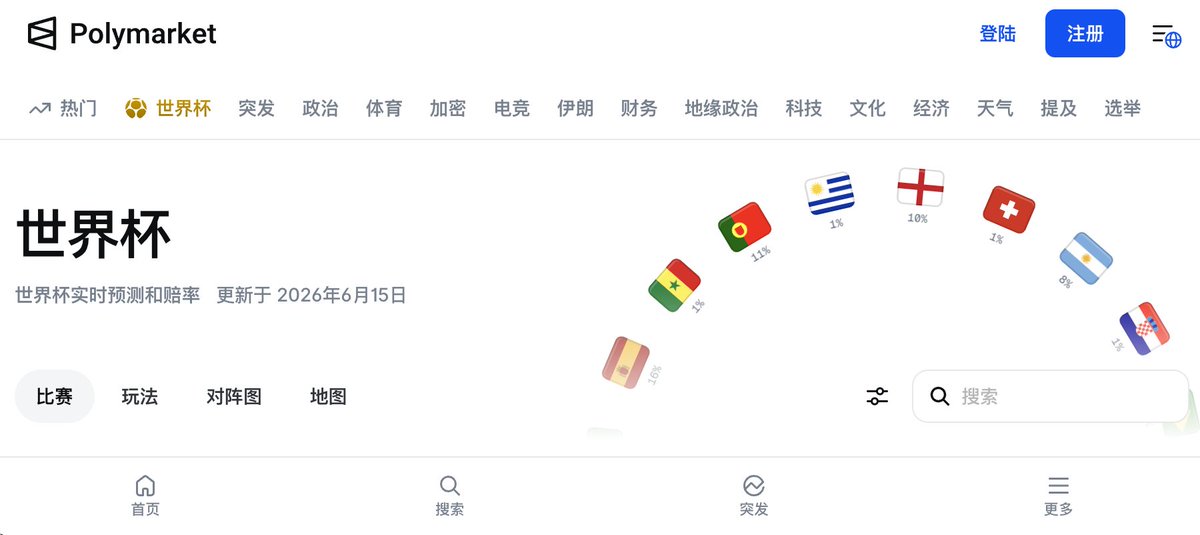
Currently, there are roughly three different prediction methods for World Cup betting: first, traditional official lottery; second, traditional online betting platforms; and third, the emerging crypto prediction markets, which can be further divided into the relatively mature Polymarket @Polymarket.fun and Kalshi @Kalshi, and the on-chain newcomers Opinion @opinionlabsxyz and Predict.fun @predictdotfun.
While they are all predicting the World Cup, they superficially seem to be answering the same question: Who will win? However, the product logic, transparency, compliance path, and user experience behind each vary greatly.
Next, Biteye will provide a thorough review of the overall experience of betting through four different channels and multiple platforms for the 2026 World Cup.
First, the "From Hot to Not" Table
To prevent everyone from getting dizzy in a bunch of odds, contracts, bonus indices, and other jargon, we will directly rank from hot to not based on five dimensions:
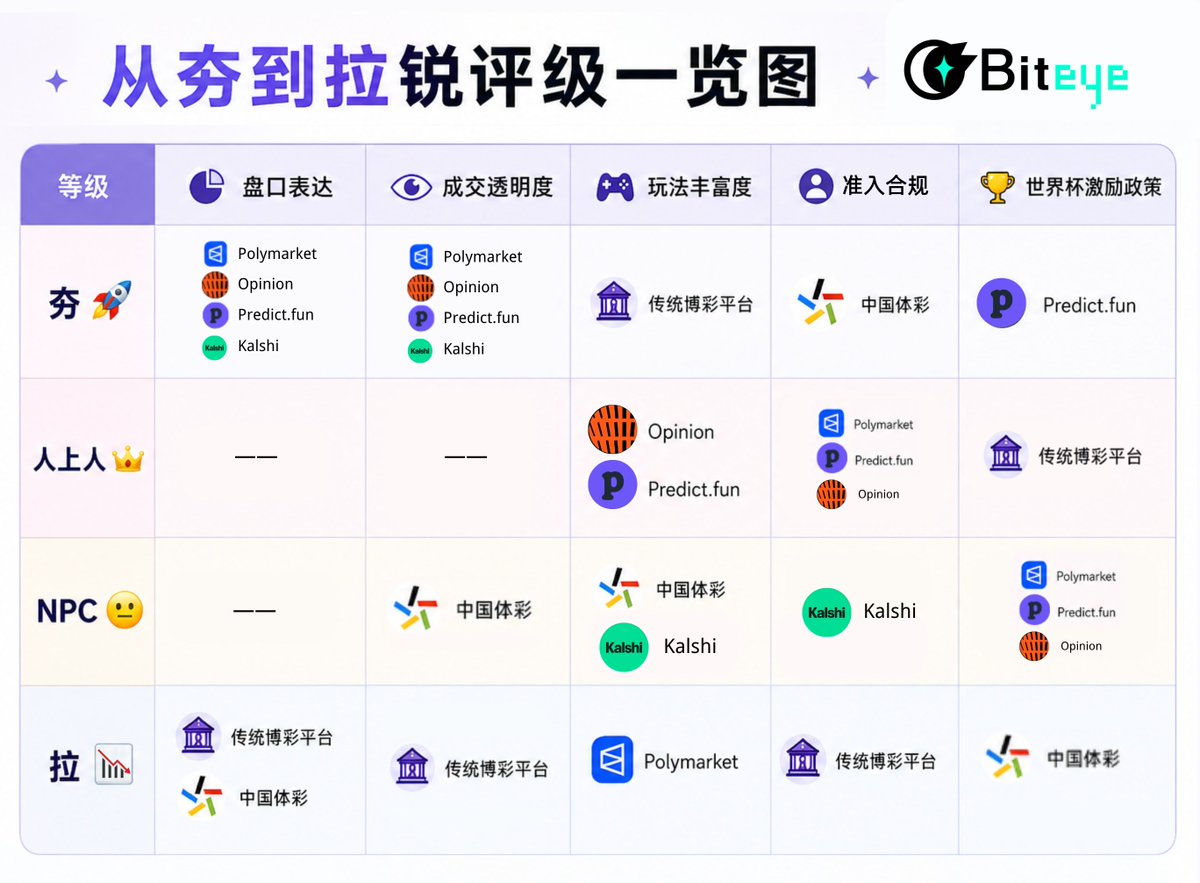
In a nutshell:
Polymarket leads the World Cup betting search rankings, with Opinion following closely. Predict.fun is the most generous NFT activity operator on the BNB Chain for the World Cup, while Kalshi acts like a trading exchange suited for viewing matches in suits. Traditional betting platforms are the complete betting supermarkets with a wealth of gameplay options, while the lottery is officially sanctioned viewing accessories.
Odds Expression: Can I understand what it is selling?
If this is your first encounter with World Cup betting, the odds on traditional betting platforms might leave you a bit confused.
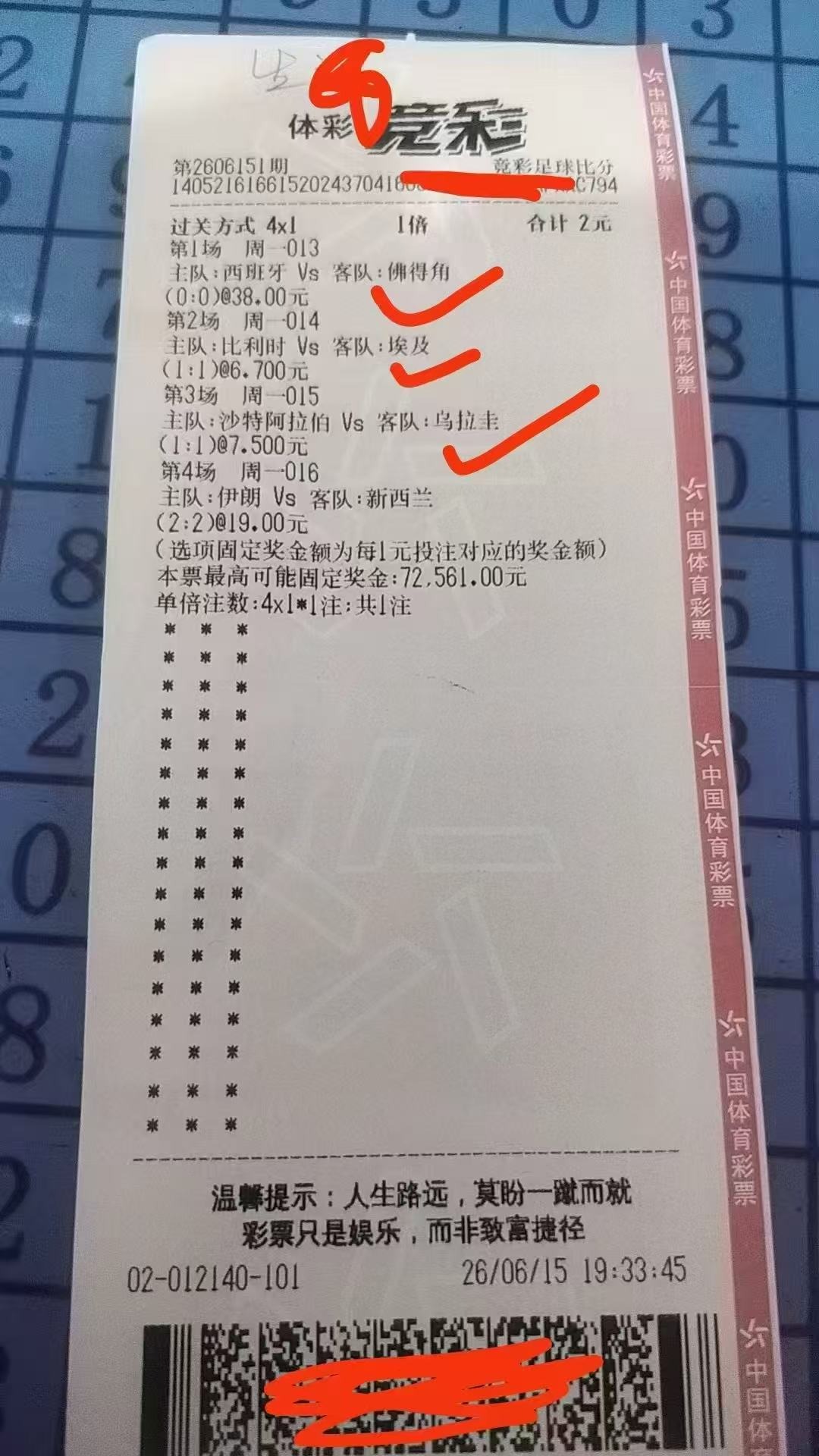
Traditional betting platforms use the most classic odds language, such as +450, +850, +1000. Veteran players might catch on immediately, while new users could be puzzled for three seconds; these numbers look tempting, but why does it require such complicated math? Similarly, China's lottery system essentially also follows an odds menu that requires conversion, rather than being straightforward market prices.
Whether it’s the established prediction platform Polymarket or the self-proclaimed event contract exchange Kalshi, or the newcomers Opinion and Predict.fun, the communication advantage of prediction markets lies in that they do not require odometer conversion and do not require predictors to understand a raft of betting terms; instead, they turn the World Cup into a visible, real-time probability curve.
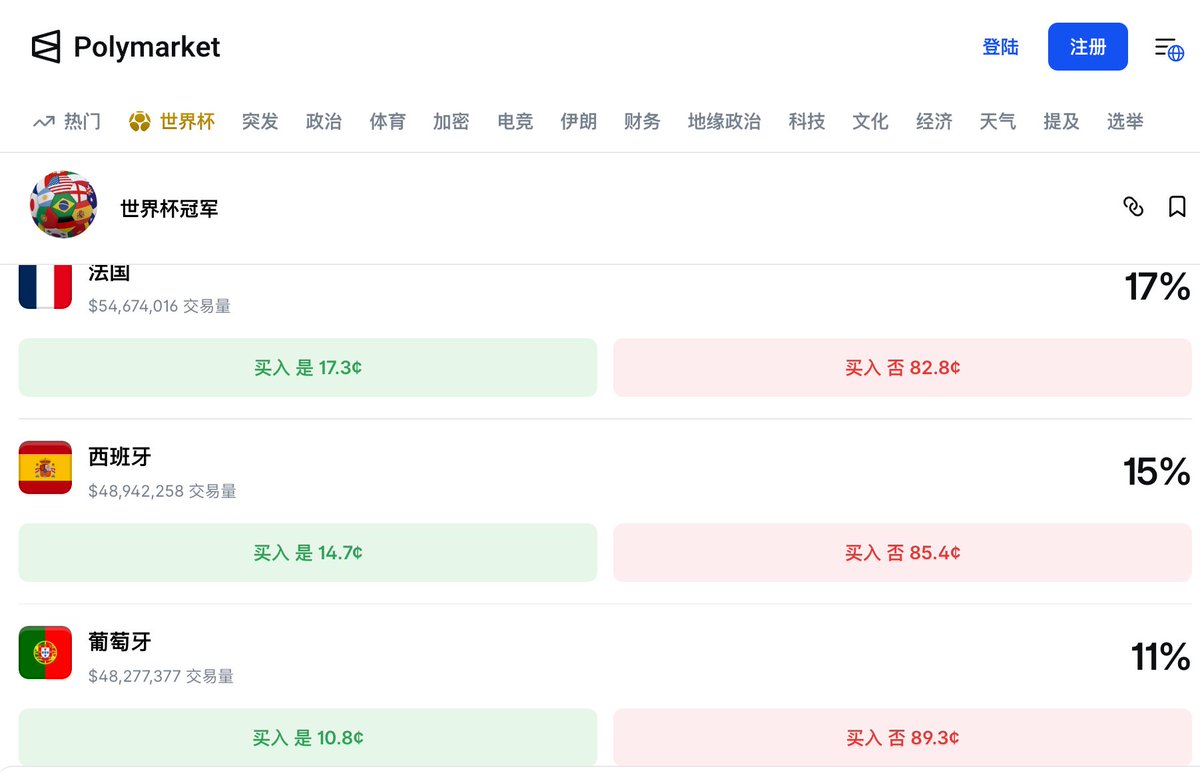
For example, Spain is at 16¢, France at 16¢, Portugal at 11¢, which corresponds to the market believing their championship probabilities to be roughly 16%, 16%, and 11%. If the Spain you supported at this moment ends up winning, you would experience a multiple increase from 16% to 100%, roughly 6.17 times.
This form of odds language is very friendly for newcomers wanting to engage in World Cup predictions. It’s not so much about making betting easier, but about making it easier to judge market sentiment.
At the same time, such prediction market data is naturally suitable for being cited in the media because it transforms the subjective judgment of "which team is stronger" into a real-time price based on monetary voting.
This round is quite complex and relies heavily on user habits, initially from a communication attributes perspective:
- Hot: Polymarket / Kalshi/Opinion/Predict.fun, probability is price, best for communication.
- High-tier: /
- NPC: /
- Not: Traditional betting platforms / Lottery, the odds menu is unfriendly for newcomers.
Transaction Transparency: Can I see how others are betting?
Understanding the price is just the first step. The real key is: where does this price come from?
This is also the most fatal strike of emerging prediction markets against traditional betting establishments. While prediction market data does not necessarily represent "truth," at least we can visually see how the market is trading.
Polymarket publicly displays price, transaction volume, order book, liquidity, price curves, and market heat. Kalshi, Opinion, and Predict.fun are similar, all exhibiting market data, transactions, and price changes. In comparison, due to compliance requirements, Kalshi presents data more like formal financial statements, while Opinion and Predict.fun resemble comprehensive event sections in new on-chain projects.
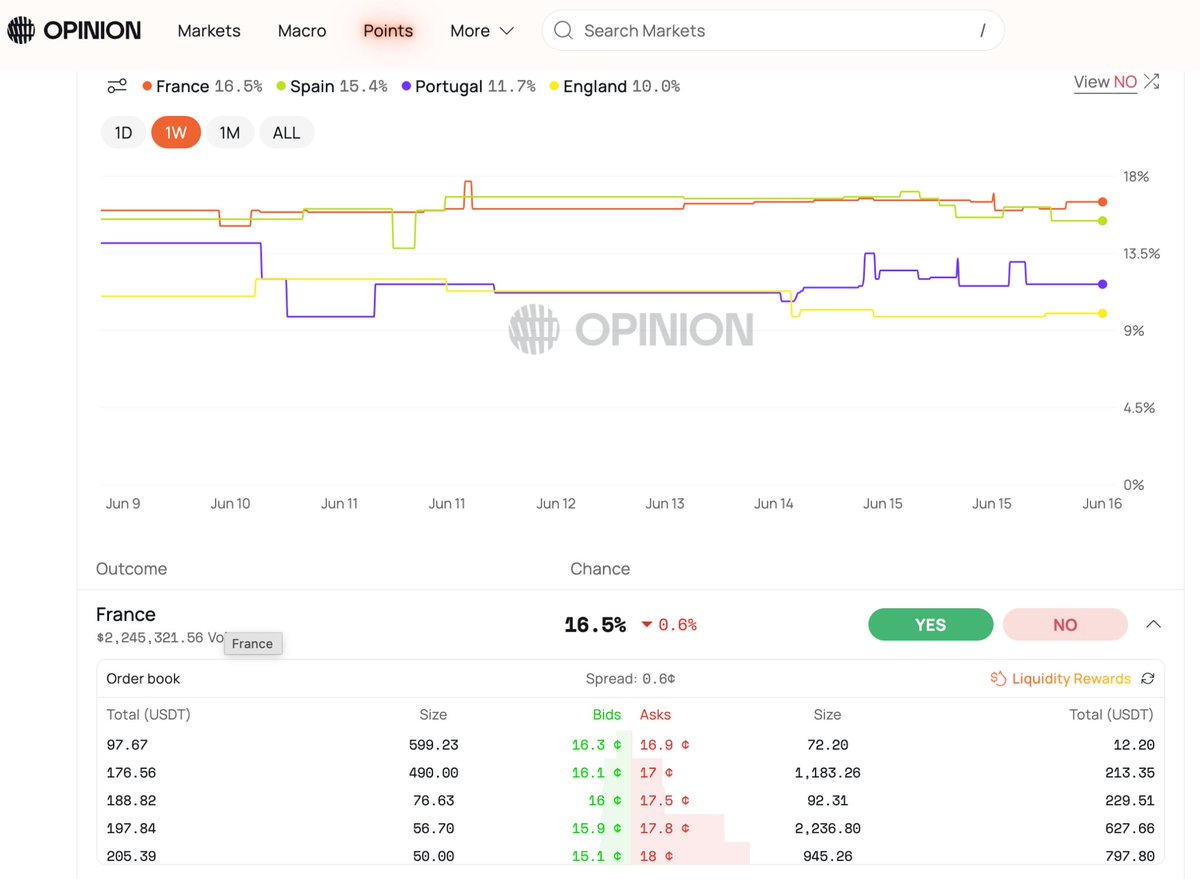
Traditional betting platforms are different. Betters can see bonus indices or odds, but it's difficult to see how much has actually been transacted behind a particular bet, how funds flow, and how deep the market is; traders primarily rely on trusting the platform's credibility for their bets. This does not mean they lack liquidity, but rather the real problem is that this liquidity is not transparent to the average user. It's like you enjoy a delicious Huangmen chicken but have to worry if it's a frozen pre-made dish.
The Chinese lottery has a macro-level regulation, meaning that excessively outrageous behavior is unlikely to happen; however, behind each odds movement remains an opaque black box that is hard to discern.
So this round of sharp review is quite simple:
- Hot: Polymarket / Kalshi/Opinion/Predict.fun, cornerstone of prediction markets.
- High-tier: /
- NPC: Chinese lottery, official endorsement, large scale, but the process is opaque.
- Not: Traditional betting platforms, completely black box.
Richness of Gameplay: Can I choose to bet on details I like?
If it comes down to who is the most resourceful, then traditional betting platforms are still the old hands.
Championship betting, handicap, total goals, scores, half/full time, corner kicks, yellow cards, player goals, golden boot, parlays, same-game parlays, live betting, early cash-out... traditional betting platforms have essentially broken down almost every detail of World Cup matches into items displayed on its betting supermarket shelves, dazzling users.
This is also where traditional betting platforms are the strongest and most dangerous: the more gameplay options, the more likely users feel “there's always some angle I can understand.” But for betting platforms, the finer the options, the longer users stay, the higher transaction frequency, and consequently, the more profit they make.
The Chinese lottery is not lacking in this regard. During the World Cup, options such as champion, runner-up, win/loss, score, total goals, half/full time, etc., can basically cover the betting needs most familiar to Chinese users.
In comparison, Kalshi is moving in this direction, beginning to introduce more single match, total goals, and both teams scoring event contracts.
Polymarket, on the other hand, is more restrained, primarily focusing on core markets like championships, progressions, and match outcomes. For example, by June 15, the trading volume on Polymarket for predictions on World Cup champions had already exceeded 2 billion dollars. In contrast, the liquidity for total goals, handicap, and other split bets lagged substantially, with few corresponding bets found in traditional multi-game betting options.
Opinion and Predict.fun are more active on new on-chain platforms, both offering markets for champions, group stages, knockout stages, golden boot, and assist king.
So for this round:
- Hot: Traditional betting platforms, a buffet for betting.
- High-tier: Opinion / Predict.fun, active in market capture.
- NPC: Kalshi, adding more options / Lottery, adequate official packages.
- Not: Polymarket, strong signature dishes but fewer options.
User Access and Compliance: How do I get in & can I get out?
This is especially important for users in the Chinese-speaking region.
The advantage of the lottery is its clearly defined compliant identity and familiar Chinese context; with just a short walk, you can find a physical outlet with a lottery sign. However, its drawbacks are also evident: it can't be engaged by just opening a webpage; compliant channels still emphasize offline physical points.
Polymarket, Opinion, and Predict.fun operate with a more Web3 access logic. Wallets, stablecoins, on-chain assets are relatively convenient for those with a crypto background; however, for the average fan, wallets, private keys, USDC, and regional limitations present barriers. Simultaneously, all three face the issue of regulatory compliance in the crypto prediction market.
In contrast, Kalshi leans more towards the logical framework of compliant financial accounts in the U.S. Its rules are clear and primarily focus on regulated event contracts, but KYC, regional and account requirements mean it is not aimed at all global users.
Traditional betting platforms may seem to offer numerous entry points in many regions, but they also present the most problems: regional restrictions, deposit and withdrawal risks, account risk management, and uneven platform compliance. Even though some markets in Europe and the U.S. have mature licensing systems, users from Chinese-speaking regions need to exercise caution.
Thus, what matters most is not which platform is the most exciting to bet with, but rather:
Where does the money come in? How do the results settle? Can the money get out? If there are issues with the platform, who can you turn to?
In this round:
- Hot: Chinese lottery, the most legitimate and familiar in the Chinese-speaking area, but requires offline channels.
- High-tier: Polymarket/Opinion/Predict.fun, friendly for crypto users, but barriers exist for regular users, and compliance needs verification.
- NPC: Kalshi, access limited to U.S. users, clear compliance.
- Not: Traditional betting platforms, most vigilance required regarding deposit, withdrawal, and compliance risks.
Incentives: Should I bet more for rewards?
As a newcomer in on-chain prediction markets, Predict.fun has invested 2 million dollars in specialized incentive activities during the World Cup. It has created the Predict Cup on the BNB Chain, with a generous prize pool, using Fan Points, team lineups, leaderboards, and round rewards to create a series of activities for an enjoyable World Cup experience.
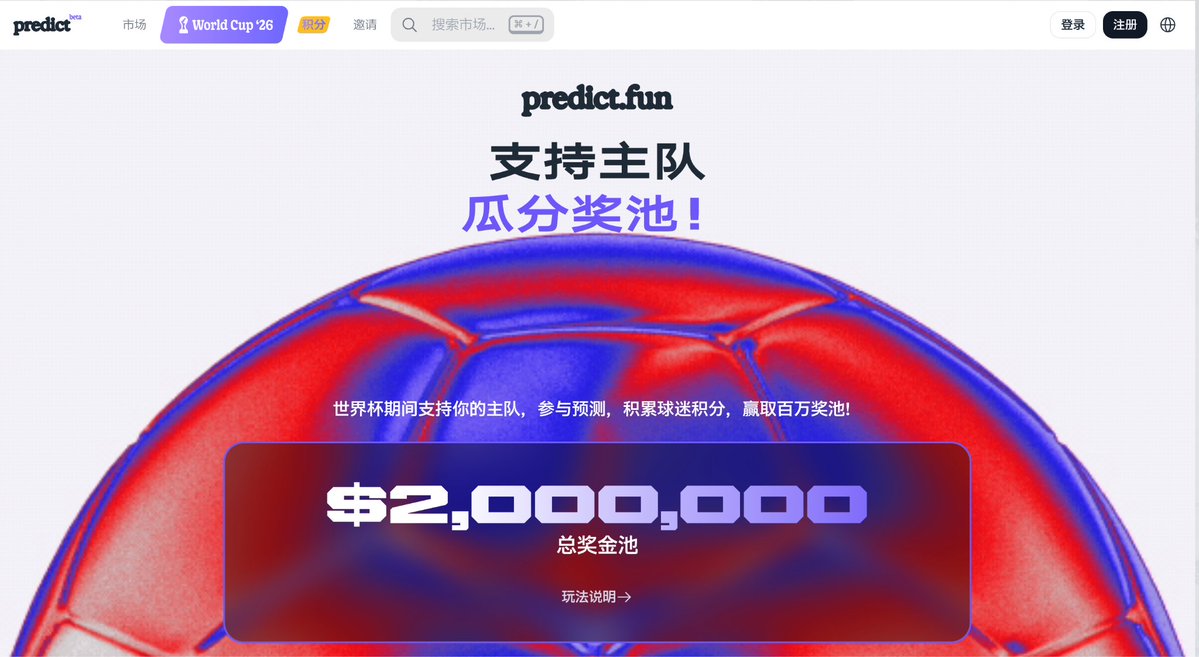
This is very appealing to users: not only do you predict the match outcomes, but you can also earn points, climb the rankings, and win rewards.
Traditional betting platforms are also pulling out all the stops for the World Cup, as it represents a four-yearly fan frenzy, with traffic nearly equating to revenue.
Meanwhile, Polymarket, Kalshi, and Opinion maintain a focus on the market itself: prices, transactions, odds, and communication, without individual incentive schemes for the World Cup.
The lottery emphasizes public welfare and rational purchasing; although there are frequent promotions, they are not suitable for a guiding introduction in Chinese-speaking contexts.
However, amid the excitement, we must also ask: Am I enjoying the match, or trading for points? Am I looking at odds or being pushed by the leaderboard?
In this round:
- Hot: Predict.fun, the most vigorous in World Cup specialized operations.
- High-tier: Traditional betting platforms, a golden period for the World Cup.
- NPC: Polymarket / Kalshi/Opinion, incentives are not the main selling point.
- Not: Lottery, emphasizing rationality and public welfare attributes.
Conclusion
The 2026 World Cup has laid several product logics on the same table.
- China's lottery says: Matches can be interactive viewing under the official public welfare lottery framework.
- Traditional betting platforms say: Matches are highly developed entertainment products.
- Polymarket says: Matches are real-time fluctuating probability markets.
- Kalshi says: Matches are regulatory event contracts.
- Opinion says: On-chain prediction markets can also be presented like comprehensive event sections.
- Predict.fun says: The World Cup is not just about odds, but can also be an on-chain point game.
However, what’s truly worth noting might not be who can replace whom, but rather that World Cup betting is evolving from closed odds products into an open, real-time, and communicable information market.
Sports is merely the stage. The bigger business is humanity's everlasting desire to price the future and to price its own judgments.
免责声明:本文章仅代表作者个人观点,不代表本平台的立场和观点。本文章仅供信息分享,不构成对任何人的任何投资建议。用户与作者之间的任何争议,与本平台无关。如网页中刊载的文章或图片涉及侵权,请提供相关的权利证明和身份证明发送邮件到support@aicoin.com,本平台相关工作人员将会进行核查。


