
Author: Nancy, PANews
The battle of Hyperliquid has "burned" to Wall Street, and the internal structure of the ecosystem is accelerating differentiation.
Thanks to the permissionless market deployment capability brought by HIP-3 and the continuous enrichment of trading asset varieties, Hyperliquid has quickly broken out this year, becoming a new battlefield for "weekend warriors."
While the market size of HIP-3 is expanding rapidly, its ecosystem is experiencing a brutal reshuffling. Trade.XYZ, taking advantage of its first-mover advantage, has almost monopolized the market, occupying over 90% of the market share; while the survival space of other ecosystem projects is continuously being squeezed, with multiple projects including Feilx and Ventuals already announcing their shutdowns in succession.
HIP-3 secures over $300 billion in trading volume, Trade.XYZ monopolizes 90% of the market
The rise of HIP-3 has opened a new growth curve for Hyperliquid.
Hyperscreener dashboard data shows that in the past 24 hours, the total Perp trading volume on the Hyperliquid platform reached $8.77 billion, with the HIP-3 market contributing about $3.5 billion, accounting for 39.9% of the total trading volume. In other words, for every approximately $10 of perpetual contract trading volume generated on Hyperliquid, nearly $4 came from HIP-3.
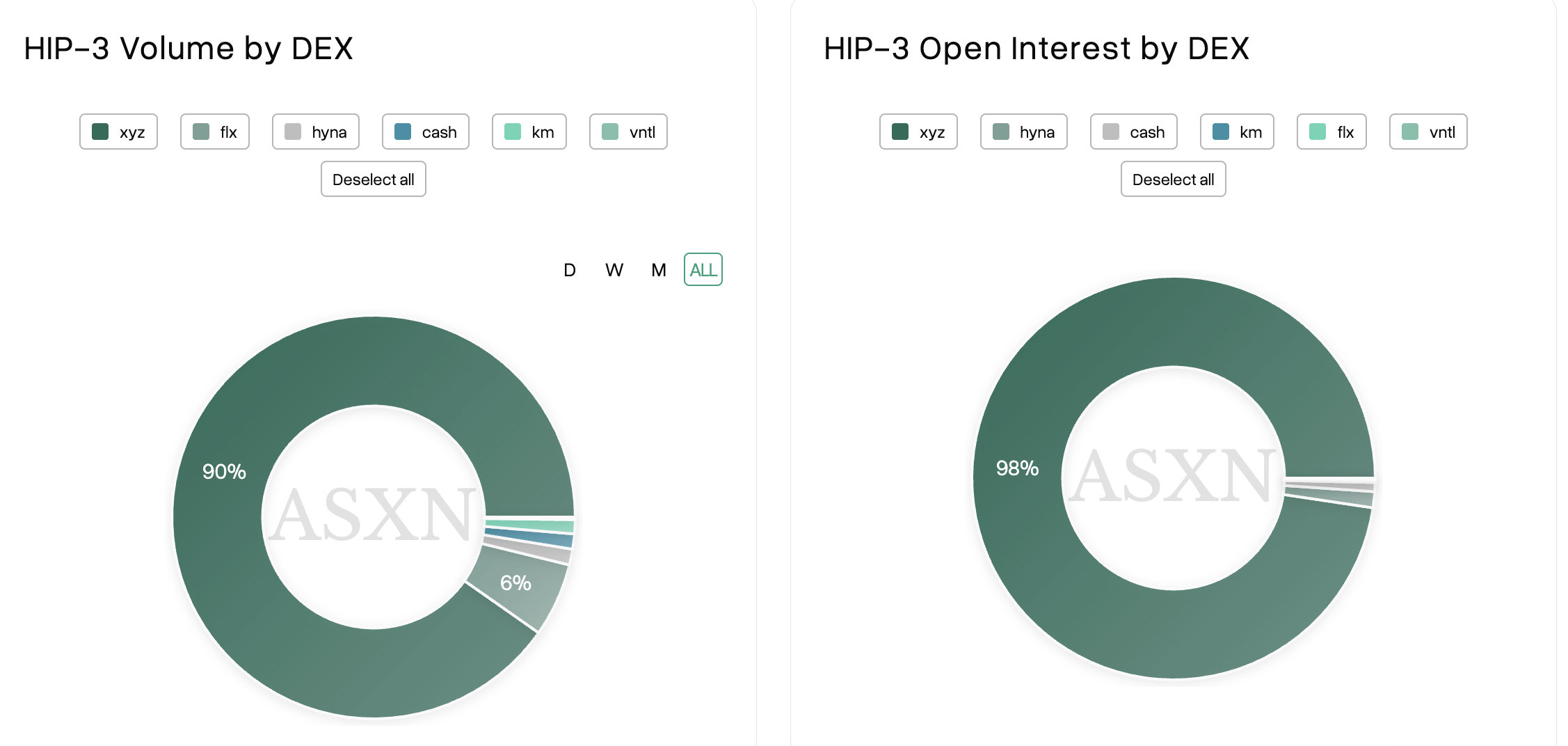
In fact, since its launch in October last year, HIP-3 has accumulated a trading volume of over $319.8 billion in just over six months, a growth rate far exceeding market expectations. However, what is expanding alongside the trading scale is not a flourishing ecosystem but an increasingly apparent head effect, with Trade.XYZ almost devouring the entire market increment cake.
From the perspective of open contracts, Hyperscreener data shows that as of June 16, the cumulative open contract size in the HIP-3 market is about $29.4 billion, with Trade.XYZ contributing $28.7 billion, giving it a market share of 97.6%. In contrast, other projects like DreamCash, HyENA, Ventuals, and Felix account for mostly less than 1%, which can almost be ignored.
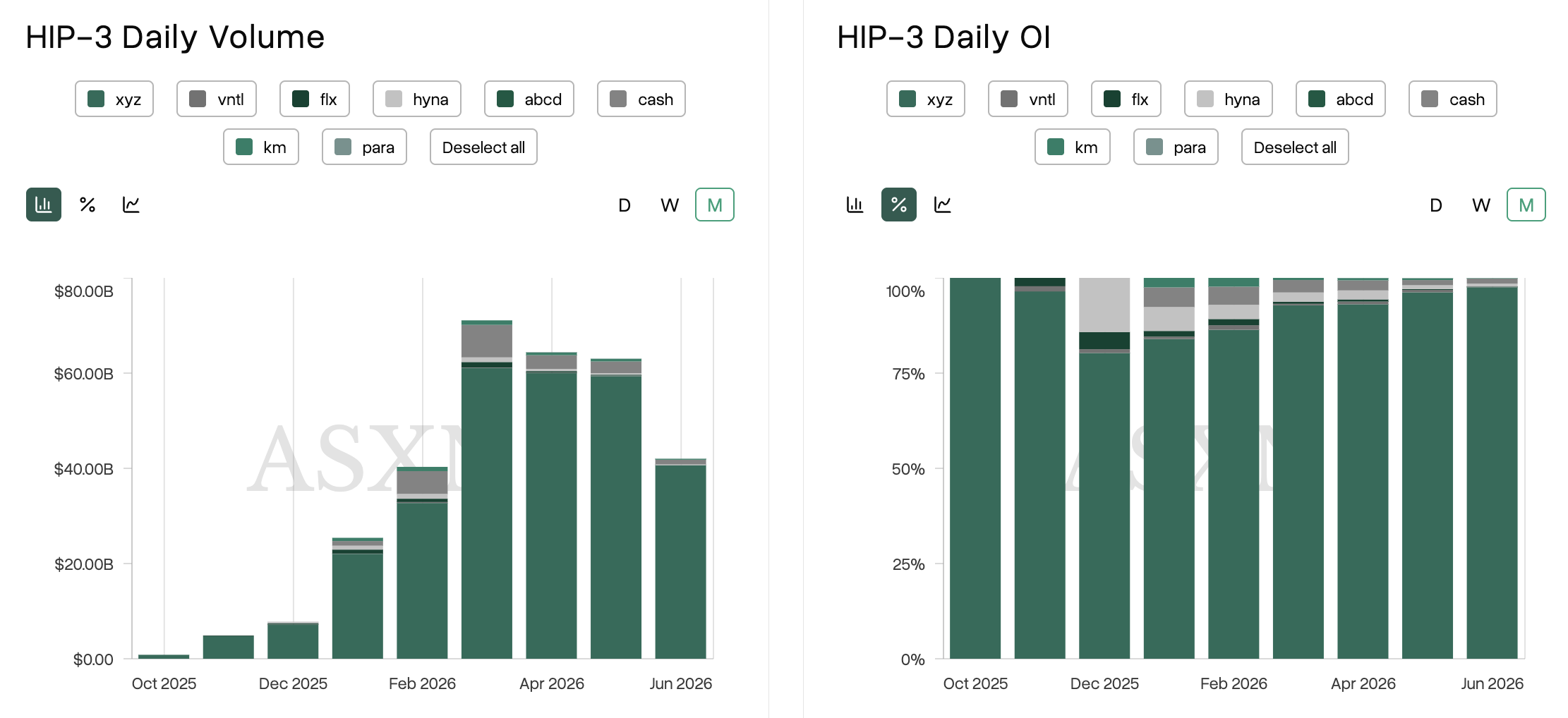
The trading volume dimension also confirms this trend. From the historical cumulative trading volume perspective, Trade.XYZ holds about 90% of the market share, with DreamCash ranking second at about 6%, and the remaining projects collectively vying for less than 5% of the market space. Just in June, the head effect further intensified, with Trade.XYZ’s market share climbing to 96.65%, while the remaining seven markets, including Felix Exchange, Ventuals, and HyENA, only accounted for 3.35%, with some projects even accounting for less than 0.1%.
Furthermore, from the trading activity of assets, this gap is even more intuitive. This month, the cumulative trading volume of all assets on HIP-3 reached $11.21 billion, with Trade.XYZ’s core product XYZ100 (tracking an index of the top 100 companies) contributing $10.64 billion, with a single asset almost supporting most of the trading activity of the entire HIP-3 market.
The differentiation in user activity is also very evident. Data shows that this month Trade.XYZ attracted over 46,000 independent trading addresses to participate in trading, while independent traders in other markets mostly number in the hundreds, with some even less than a hundred. In terms of trading frequency, Trade.XYZ has accumulated over 22.03 million trades this month, while most of the other markets had only tens of thousands to a little over a hundred thousand trades, showing a significant disparity from the top platform.
To some extent, the current growth story of HIP-3 can almost be seen as the growth story of Trade.XYZ alone.
HIP-3 opens elimination rounds, ecosystem projects successively withdraw
As Trade.XYZ continues to siphon market liquidity, HIP-3 is shifting from an open innovation arena to an elimination competition dominated by top players, making it increasingly difficult for newcomers to get a share.
Recently, several HIP-3 projects have successively shut down. Last week, Felix co-founder Charlie announced that the HIP-3 DEX and all spot markets under Felix would start shutting down on June 19 and complete all offline operations by June 20, requiring all traders to close their positions before then. This adjustment will not affect Felix’s lending and stock business, as it will focus on core products in the future, and does not rule out a return as a HIP-3 deployer after finding a new user growth path.
Charlie candidly reflected that although Felix had relied on its first-mover advantage in markets such as crude oil, gold, and silver to accumulate about $3 billion in trading volume and gained significant fee income, its market share began to be surpassed after Trade.XYZ launched similar markets priced in USDC.
In his view, Trade.XYZ's ability to quickly establish a moat lies in its choice of more liquid USDC instead of USDH, seizing the first-mover window of HIP-3, rapidly expanding the number of markets, and the brand effect and liquidity flywheel brought by the expectations of airdrops. As USDH gradually exits the historical stage, it has become difficult to maintain a differentiated competitive edge in HIP-3 deployments, leading the team to decide to retract related businesses.
Felix is not an isolated case. Soon after, Ventuals, one of the largest participants in providing private company stock trading on Hyperliquid, also announced plans to gradually cease operations, with the team joining another construction team within the Hyperliquid ecosystem. The platform will soon close markets for OpenAI, Anthropic, commodities, indices, etc., and vHYPE holders can redeem HYPE at a 1:1 ratio and receive staking rewards. Ventuals will also terminate its points and referral programs and confirm that it will not issue tokens.
Ventuals disclosed that during its operation, it raised over 500,000 HYPE, with trading volume exceeding $650 million, becoming one of the most representative innovative applications in the Hyperliquid HIP-3 ecosystem.
Although the team did not publicly explain the reasons for the shutdown, the market generally believes that the siphoning of liquidity from Trade.XYZ regarding popular assets, along with the inherent liquidity and pricing challenges faced by Pre-IPO assets, are significant reasons for the project’s eventual exit.
Most deployers take four years to break even, HIP-3 ecological pressure intensifies
In addition to the competitive pressure brought by the head effect, the deployment mechanism of HIP-3 itself is further compressing the survival space for newcomers.
According to HIP-3 rules, any team wishing to create a DEX must first stake 500,000 HYPE as a security deposit. Based on the current price, this amount reaches approximately $35.89 million, and the deployment must be locked for at least 183 days after completion. At the same time, only the first three assets deployed by each deployer are exempt from auction; subsequent new assets must obtain deployment rights through a Dutch auction, with a starting price of 500 HYPE (currently worth about $36,000, but a significant drop from 1,750 HYPE earlier this year), with HYPE paid in the auction being directly burned by the protocol.
For new entrants, with liquidity highly concentrated among top players, the high upfront investment, continuously increasing expansion costs, and lengthy payback periods are becoming burdens that are increasingly difficult to bear. It is noteworthy that Hyperliquid disclosed in May that it will gradually lower the staking threshold of 500,000 HYPE.
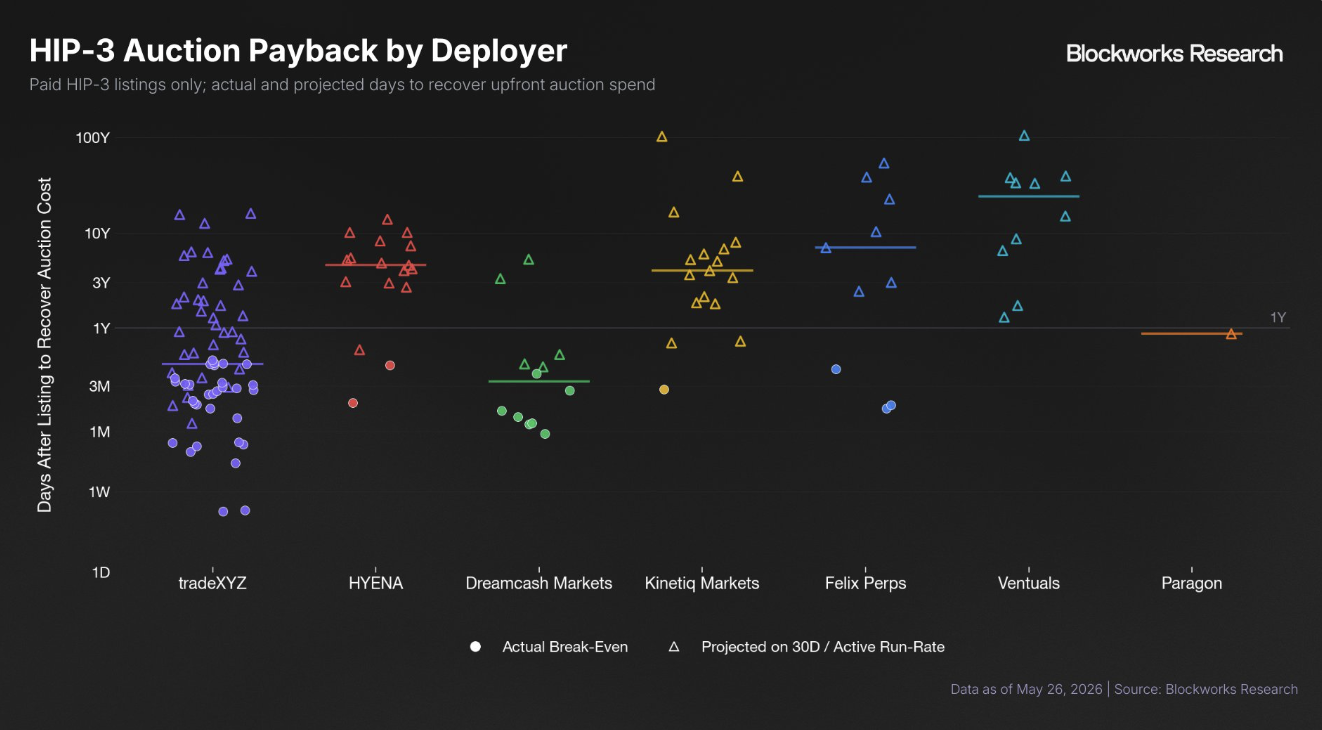
According to Blockworks Research analyst Shaunda Devens, apart from Trade.XYZ, most HIP-3 deployers, based on the annual yield of staked HYPE being close to or even below 1%, have a median payback period for market auction costs of up to four years. In contrast, Trade.XYZ is a notable exception, with its estimated yield for staked HYPE reaching 74%, and the median payback period for auction costs requiring only five months.
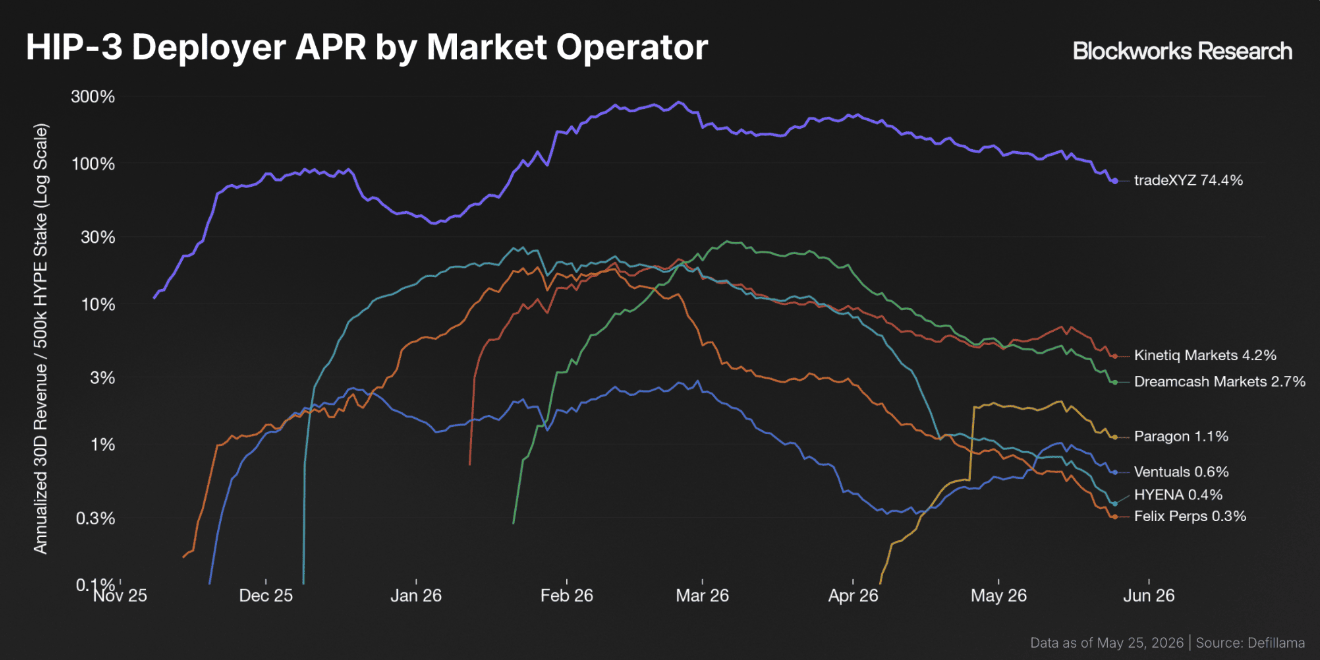
In other words, Trade.XYZ's success comes not only from the product itself but also from a continually strengthening network effect. More users lead to stronger liquidity, stronger liquidity attracts more assets to go live, and more quality assets further solidify its market position. At the same time, marginal deployers, due to low returns, lack the motivation to continue expanding, weakening both the demand for new HYPE staking and the enthusiasm to participate in market auctions.
For Hyperliquid, this situation is not without concern.
Undeniably, Trade.XYZ has brought tremendous incremental space to Hyperliquid, even becoming the most successful model case of HIP-3. However, if the rights and liquidity of most popular assets are concentrated in the hands of a single deployer, the competition in HIP-3 will remain at the top level, making it difficult to evolve into an open and diverse ecological competition.
In the long run, this will not only compress the survival space for innovative projects but may also trap Hyperliquid in the single narrative of perpetual contracts. Especially as competition in the Perp DEX sector intensifies, relying solely on perpetual contract trading makes it hard to build a sufficiently rich on-chain application ecosystem and sustainable network effects. Notably, Hyperliquid has already ventured into the currently popular prediction market through HIP-4, attempting to further enrich its business territory.
To address the current predicament, Shaunda Devens has proposed two mechanism optimization suggestions to enhance the sustainability of market creation and strengthen the value capture ability of HYPE.
First is to introduce a tiered exchange mechanism. Allow new deployers to start HIP-3 DEX with a threshold lower than the current 500,000 HYPE but correspondingly limit their permissions, such as setting lower open contract limits, lower leverage ratios, and stricter risk control rules; as deployers increase their staked HYPE, gradually unlock higher-level functions.
Second is to adjust the market auction economic model of HIP-3. Before the new market recovers the auction costs, allow deployers to receive up to 100% of trading fee income; or before the total DEX revenue covers auction costs, prioritize returning the fees to deployers, and only restore the 50:50 standard revenue-sharing mechanism between the protocol and deployers once breakeven is achieved.
For Hyperliquid, HIP-3 has already proven that decentralized market creation is a viable path, and Trade.XYZ’s success not only validates the demand for the product but has also become an important growth engine for Hyperliquid at this stage.
But compared to relying on a super application to continuously siphon liquidity, a more resilient and healthier open ecosystem may be needed to ensure that innovators at different stages and types can find survival space, allowing new assets, new gameplay, and new business models to continue emerging.
免责声明:本文章仅代表作者个人观点,不代表本平台的立场和观点。本文章仅供信息分享,不构成对任何人的任何投资建议。用户与作者之间的任何争议,与本平台无关。如网页中刊载的文章或图片涉及侵权,请提供相关的权利证明和身份证明发送邮件到support@aicoin.com,本平台相关工作人员将会进行核查。


