The next two days require close attention.
Written by: Ye Zhen
Source: Wall Street News
On the second day of trading, SpaceX's stock price continued its strong momentum from the first day, pushing its market value to surpass 2.5 trillion dollars, officially ranking among the top six publicly listed companies globally by market value. This unprecedented super IPO, along with an extremely low initial free float, is bringing a rare chip game to the global capital markets.
SpaceX's stock closed at 192.46 dollars on Monday, skyrocketing nearly 20%, up over 42% from the IPO issue price of 135 dollars, with a single-day market value increase of 412 billion dollars.
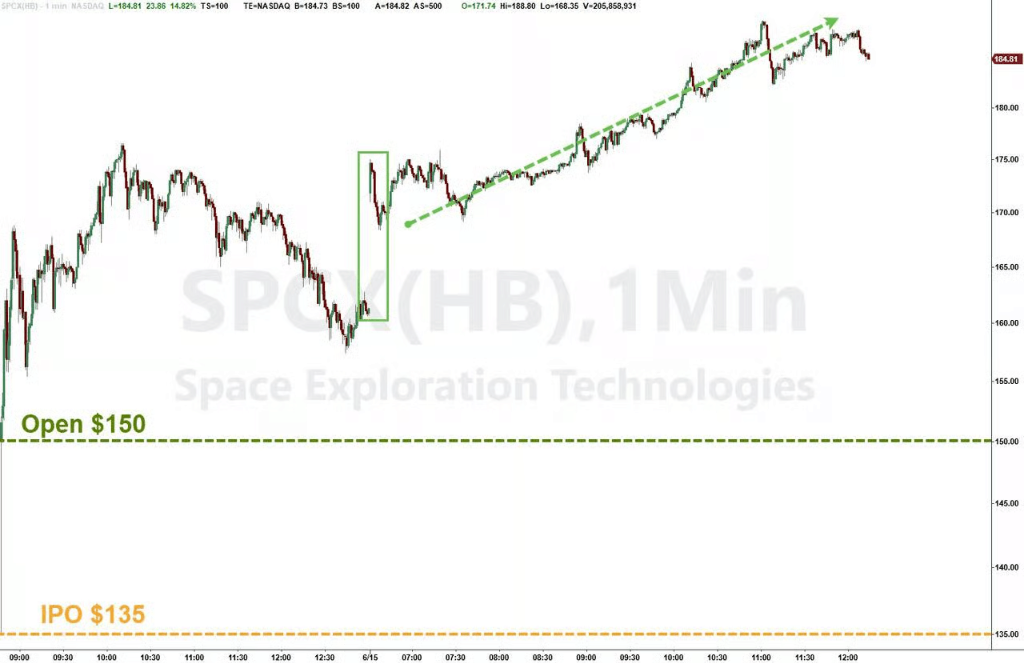
After the underwriters fully exercised their over-allotment option (green shoe mechanism), the company's total fundraising amount reached 86.2 billion dollars, with a net amount raised of 85.7 billion dollars after deducting underwriting fees. This strong market performance not only directly boosted confidence in the artificial intelligence sector that has driven the market's rise this year but also laid the foundation for the revaluation of tech giants.
The market's frenzied demand has made founder Elon Musk the world's first trillionaire, with a net worth exceeding three times that of the world's second-richest person, Google co-founder Larry Page. This successful listing has significantly alleviated Wall Street's concerns about the market's ability to absorb massive IPOs and has paved the way for potential listings of large artificial intelligence competitors like Anthropic and OpenAI within the year.
However, despite a strong start and expectations for passive buying, market observers warn that the stock's volatility will sharply increase in the coming months. In this capital feast, meticulously designed by Wall Street, investors need to pay close attention to two key time nodes in July, which not only involve the collision of massive passive funds and a vacuum of chips but also may expose a larger merging chess game behind Musk's business empire.
Retail Buying Frenzy and Macroeconomic Resonance
In the first two trading days after the IPO, retail investors' enthusiasm for buying surged dramatically.
According to data from Vanda Research, the number of SpaceX shares bought by retail investors in the first two days was comparable to the total retail buying volume in the entire U.S. stock market last week. Max Gokhman, Senior Vice President of Franklin Templeton Investment Solutions, pointed out that there has been a substantial accumulation of investors who previously had no investment channels. This initial massive demand is not surprising.
Beyond the inflow of funds at the micro level, the macro geopolitical and liquidity backdrop has also provided support for the surge in stock prices.
As the United States and Iran announced an agreement to reopen the Strait of Hormuz, and expectations for moderate easing under new Federal Reserve Chairman Kevin Warsh increased, both the S&P 500 and Nasdaq 100 indexes recorded significant gains. Angelo Kourkafas, Senior Global Investment Strategist at Edward Jones, stated that the macro backdrop is becoming more favorable, and declining yields may encourage investors to continue to expand outward on the risk curve.
July 7: Nasdaq Inclusion Colliding with Extremely Low Free Float
As the initial frenzy from the IPO cools down, the market is about to face the first key trading node of significant trading value: July 7.
Former Wall Street analyst Alexandra Mertz pointed out that the A shares issued by SpaceX account for only 4.3% of its total market value, meaning that the free float at the start of the listing is extremely tight.
July 7 is the first trading day after the Independence Day holiday and is the 15th trading day after the IPO, when the Nasdaq 100 will officially include SpaceX. According to Bloomberg, the index rebalancing forecasting agency Intropic estimates that due to rapid inclusion plans by major indices, the proportion of shares held by passive investors is expected to surge to about 30% after 15 trading days.
At that time, large index funds such as Vanguard CRSP and FTSE Russell will have to passively build positions in the public market without conditions, based on the free float adjustment mechanism. The market estimates this portion of passive buying could range from 8 billion to 18 billion dollars. Since early shareholders are still under a lock-up period and cannot sell, the market's free float will drop to its lowest point.
Analysts warn that the collision between passive capital building across the U.S. and historically low free float, combined with AI model predictions, could drive the stock price to extreme heights during this period.
Late July: Real Selling Pressure After Earnings Report Lock-up Period and Institutional Bottom Lines
The second key time node that requires close attention falls on the two trading days following the second-quarter earnings conference call, which is expected to be held in late July. The normal IPO lock-up period typically uses a simple fixed duration, but SpaceX's unlock schedule has been meticulously tied to the Q2 earnings meeting.
There are rumors in the market that a large-scale release of up to 30% of early insider shareholders will occur after the earnings meeting. However, Alexandra Mertz clarifies that about 50% of the shares among these early insiders belong to Musk himself, and as the founder, he is subject to a 366-day absolute lock-up period. Therefore, the potential new shares flowing into the public market will only be about 10% to 15%.
More critically, the selling willingness of early major shareholders is extremely low.
Notable investor Ron Baron has clearly stated that he will not sell and plans to increase his position in the public market by 1 billion dollars. BlackRock has also publicly expressed intentions to buy between 5 billion and 10 billion dollars. As Renaissance Capital's Senior Strategist Matt Kennedy mentioned, this stock has been “priced to near perfection,” and when the demand rocket booster from retail investors falls off, the stock price will start to be affected by the selling gravity of institutional investors and employee unlocks, making marginal buyers extremely important.
Capital Chess Game: 7 Billion Dollar Tax Event and "Equal Merger" Speculation
Behind the precise IPO arrangements, Wall Street is closely tracking Musk's personal financial timeline.
Musk must exercise his stock options from the 2018 Tesla compensation plan before August 15 of this year, which will trigger a massive personal tax event of up to 7 billion dollars. The higher the stock price of his assets before this critical date, the more favorable it will be for equity net settlement or pledged loans.
Market analysts have extrapolated a "Goldilocks scenario": during the window period when the Nasdaq buying pushes SpaceX's stock price to a peak, and the influx of fresh stocks post-earnings report unlock period at the end of July, SpaceX and Tesla may announce an equal merger via "stock-for-stock." Through this public market arbitrage mechanism, it will perfectly alleviate Musk's tax funding pressure.
This speculation seems to have left clues in SpaceX's underwriting list. This IPO unusually brought in Charles Schwab, Morgan Stanley, and JPMorgan as core underwriters. Market observers believe that granting these institutions, which once voted against Tesla's compensation plan, a substantial share of the IPO underwrites may be to secure their support for potential merger voting at Tesla's shareholder meeting in November.
Furthermore, the governance structure outlined in SpaceX's prospectus provides logical support for this potential merger.
SpaceX's Class B shares have 10 times super voting rights, and all shareholder lawsuits must be compelled through private arbitration, which creates a perfect "founder's defense fortress." Analysts believe that merging Tesla into SpaceX under this legal framework fundamentally protects Musk's business empire from disruption by activist investors and local courts, representing the ultimate capital solution.
免责声明:本文章仅代表作者个人观点,不代表本平台的立场和观点。本文章仅供信息分享,不构成对任何人的任何投资建议。用户与作者之间的任何争议,与本平台无关。如网页中刊载的文章或图片涉及侵权,请提供相关的权利证明和身份证明发送邮件到support@aicoin.com,本平台相关工作人员将会进行核查。


