Due to uncontrolled internal AI usage and projected spending of billions by 2026, Meta has urgently restricted Token consumption, established a central dashboard, and mandated employees to switch to the in-house developed tool MetaCode to reduce reliance on external vendors. Zuckerberg issued a rare apology for this, promising to rectify the organizational crisis to prevent talent loss.
Written by: Zhang Yaqi
Source: Wall Street Journal
Meta is applying brakes to its AI ambitions. After strongly encouraging employees to use AI tools for months, the social media giant is now limiting internal AI token consumption and addressing an internal crisis caused by aggressive restructuring—out-of-control costs and collapsing employee morale are simultaneously pressuring management.
According to an internal memorandum reviewed by The Information, Meta disclosed this week to approximately 6,000 employees that spending on internal AI use alone is projected to reach billions by 2026, and plans to officially implement a token management system based on budgets and quotas in 2027. Meanwhile, CEO Mark Zuckerberg acknowledged in another internal memo that the company "made mistakes" in using AI to drive team restructuring and promised to offer "meaningful positions" to affected employees.
The release of these two memorandums reflects the dual pressures Meta faces during its AI transformation: on one hand, internal AI costs are rising exponentially; on the other hand, employee dissatisfaction from aggressive restructuring has reached a tipping point—one employee publicly vented with profanity during a live all-hands meeting, exposing the internal conflict to public view.
This development has attracted market attention. AI researcher Gary Marcus pointed out, "tokenmaxxing is giving way to tokenminimizing," and predicted that this trend will cause third-quarter revenues for Anthropic and OpenAI to underperform compared to the second quarter. For Meta, finding a balance between controlling costs and retaining AI talent has become the most pressing management challenge.
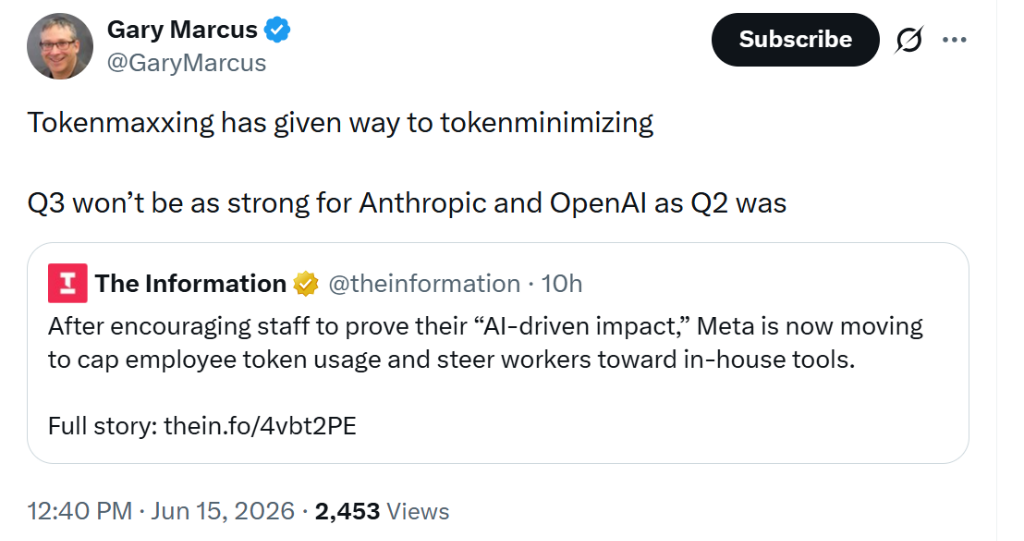
Uncontrolled Internal Usage, Token Consumption Hits Record Levels
The rapid expansion of internal AI usage at Meta has far exceeded expectations. In April this year, an internal leaderboard titled "Claudeonomics" showed that Meta employees consumed a total of 60.2 trillion tokens in 30 days, which later further climbed to 73.7 trillion. Named after Anthropic's flagship product, this leaderboard tracks AI usage among over 85,000 employees and lists the top 250 "super users" by consumption, with the highest individual user consuming as many as 281 billion tokens in 30 days; based on Anthropic's public pricing, this could cost millions of dollars.
This leaderboard has given rise to a phenomenon called "tokenmaxxing," where employees compete to maximize their token consumption to showcase their AI usage capabilities; some even instruct AI agents to run multiple tasks simultaneously, artificially inflating their consumption. Employees can receive gamified incentives through various medals like bronze, silver, gold, platinum, jade, and titles such as "Session Immortal" and "Token Legend."
Meta's Chief Technology Officer Andrew Bosworth warned in April that "no one should use AI just for the sake of using AI," emphasizing that "token consumption itself is not a measure of influence in any sense." The company subsequently shut down the Claudeonomics leaderboard. Now, an internal memorandum further disclosed that Meta is building a central dashboard called "AI Gateway" to monitor employee AI usage and spending in real-time, and will introduce an automatic alert system for abnormal consumption while tracking current costs to predict future spending for resource planning and vendor negotiations.
Shifting to In-House Tools, Reducing Dependence on External Vendors
Another avenue for controlling costs is to encourage employees to switch to in-house developed AI tools. The aforementioned internal memorandum indicates that Meta plans to guide employees to transition from third-party AI programming tools (especially Anthropic's Claude) to the company's internally developed programming assistant MetaCode (formerly known as Devmate).
Reportedly, Meta's newly established Applied AI Engineering (AAI) department has arranged for engineers to specifically enhance MetaCode's capabilities, including generating high-quality reinforcement learning data—training MetaCode's programming response capabilities by having it repeatedly solve programming challenges. At the same time, the company stated it will still allow employees access to third-party AI models.
Meta is currently facing dual financial pressures: on one hand, the company plans capital expenditures of up to $145 billion this year, part of which is to expand data centers, AI chips, and talent reserves; on the other hand, investors are continuously pressuring the company to derive returns from its massive AI investments. Meta has already launched paid subscription tiers on Facebook, Instagram, and WhatsApp, signaling potential charges for businesses using its AI commercial agents. In this context, the strategic value of reducing internal operating costs is becoming increasingly evident. Notably, Meta is not alone in this: reportedly, Uber and ServiceNow exhausted their annual budgets for Anthropic tools within the first few months of 2026, and several venture capital firms have also set limits on employee AI usage due to daily token costs reaching thousands of dollars.
Mandatory Job Transfers Ignite Internal Crisis, Employees Protest Publicly
Beyond cost issues, a more significant crisis within Meta stems from organizational restructuring driven by AI transformation. The Applied AI department was established in March 2026 and currently has about 6,500 engineers and product managers, with many employees being forcibly reassigned with little warning. In May of this year, Meta laid off approximately 8,000 employees under the pretext of advancing AI transformation, while around 7,000 others were transferred to new AI-related projects.
Engineers who were forcibly reassigned now primarily generate puzzles, write programming challenges, and conduct model testing assessments to provide data for AI model training. For engineers previously accustomed to product development and feature launches, this shift is widely regarded as a career downgrade. One employee described:
“You suddenly lose your life goals, hardly interact with anyone, and just mechanically repeat these tasks week after week.”
Another employee bluntly stated:
“Most people find this type of work suffocating.”
The excessive flattening of the organizational structure exacerbated the conflicts. It is reported that in some teams within the Applied AI department, each manager has to directly manage about 50 employees, resulting in a lack of support for employees, ambiguous paths for promotion, and difficulty being noticed by management. The pent-up dissatisfaction exploded during a live all-hands meeting this week: one attendee lost control of their emotions, interrupted the speaker with profanity, and demanded that those present convey criticism to a certain AI executive, directly pointing out "he is an asshole." Prior to this, over 1,600 Meta employees had petitioned to halt an internal project that collects AI training data by recording American employees' mouse clicks, keyboard inputs, and screen operations; Meta subsequently reduced the scale of the project slightly under pressure.
Zuckerberg Acknowledges Mistakes, Management Urgently Seeks Repair
In the face of a continuously escalating internal crisis, Meta's senior management has made a series of public statements. Instagram's Chief Product Officer Chris Cox described the past few months as a "difficult" and "brutal" period, comparing employees' situation to "running a marathon in hail while being swapped out by teammates mid-race, with someone recording the whole time." He gave a rare calm assessment of AI itself:
“It is neither a god nor a devil. It is neither as good as you think, nor as bad as you think.”
Zuckerberg was even more direct in an internal memo: “Given the complexity of these adjustments, we made mistakes.” He promised to provide "as much stability as possible," announcing a large-scale hackathon in July and beginning to adjust the management structure of the Applied AI department. According to Reuters, Zuckerberg also stated that he does not expect any further company-wide layoffs this year.
Analysts point out that this series of statements shows that Meta's leadership has realized that this round of restructuring poses a substantial threat to its talent pool. Engineering talent is the most scarce resource in the current AI competition, and if core employees continue to feel marginalized, the risk of losing them will create significant long-term consequences at critical competitive junctures. Whether the current repair measures can truly stabilize employees remains to be seen.
免责声明:本文章仅代表作者个人观点,不代表本平台的立场和观点。本文章仅供信息分享,不构成对任何人的任何投资建议。用户与作者之间的任何争议,与本平台无关。如网页中刊载的文章或图片涉及侵权,请提供相关的权利证明和身份证明发送邮件到support@aicoin.com,本平台相关工作人员将会进行核查。


