Hash Global believes that the target price for BNB is $2,968, expected to surpass ETH and become the second largest digital asset after BTC.
Written by: Jessica Feng, James (KK) Shen, Hash Global
Summary
1) The positioning of BNB is further upgrading from a public chain ecosystem token to a core asset of open financial infrastructure.
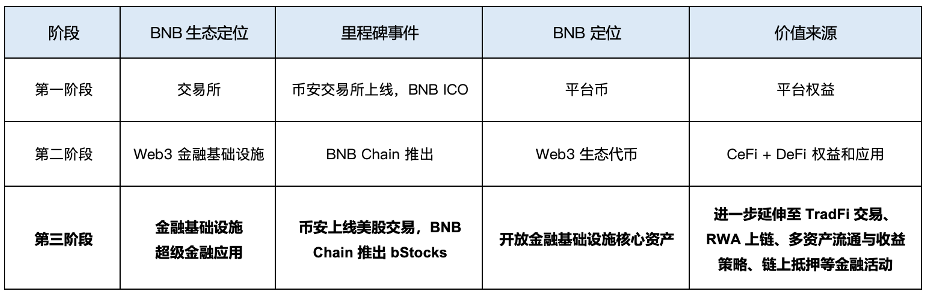
Looking back over the past nine years, the value positioning of BNB has gone through two significant upgrades:
- The first was from an exchange platform token, evolving into an ecosystem token centered around BNB Chain;
- The second is currently taking place. As the BNB ecosystem gradually incorporates traditional assets, global investment users, and on-chain application scenarios, BNB is further upgrading from an ecosystem token to a value-bearing asset of global open financial infrastructure.
- The uniqueness of the BNB ecosystem lies not only in its public chain performance but also in its backing from a global user network of over 300 million from Binance, while also having a complete financial closed loop consisting of wallets, trading, payments, DeFi, stablecoins, and RWA. We believe it is currently one of the Web3 ecosystems closest to "internet-like financial infrastructure."
2) RWA is the key business driver for BNB’s expansion from 300 million users to 3 billion users.
- The Binance management team has proposed a goal of expanding from 300 million users to 3 billion users. We believe this target cannot be achieved solely through the native trading of crypto assets. The largest increment will come from a broader category of financial assets, a lower friction global account system, and cross-border fund flows driven by stablecoins.
- Over the past year, the BNB ecosystem has gradually paved the way for RWA development: stablecoins provide funding entry, globally quality asset providers offer asset supply, and BNB Chain supports on-chain circulation and DeFi protocol combinations; the two main wallets, Binance Wallet and Trust Wallet, as well as the Binance exchange, provide access to global users and funds.
- The recent launch of US stock trading with bStocks has further opened the channel for traditional financial assets to enter the BNB ecosystem and established a replicable standard model, expected to become a key catalyst for accelerating the development of this pathway.
- Therefore, we believe the BNB ecosystem will enter a new growth cycle, with the new value ultimately settling into the core value carrier of the ecosystem—BNB.
3) We have raised the BNB valuation to $2,968. This report also introduces a traditional investment framework, estimating BNB's valuation floor at $1,471.
- In this update, we first introduce the valuation perspective of traditional capital markets, calculating BNB's value based on "holder returns," yielding a target price of $1,471, corresponding to an approximate market cap of $200 billion. We hope to understand the foundational value of BNB in a manner that is more familiar and easily acceptable to investment institutions. Since BNB also includes other functional value and ecosystem value, we suggest viewing this result as the valuation lower limit for BNB.
- On this basis, we continue to use the monetary equation MV=PQ model to assess the complete value of BNB as an ecosystem token. Traditional valuation methods cannot fully capture the various functional values that ecosystem-based assets possess. We define such assets as "value-functional tokens" and recommend using the monetary equation for valuation. Over the past seven years, we have consistently released five BNB valuation reports using this method. This report updates important parameters to reflect changes in the BNB ecosystem regarding narrative, value positioning, strategic direction, and business development, ultimately concluding that the latest valuation for BNB is $2,968.
4) The maturity of the digital asset market, the increase in the weight of "value" relative to "narrative," and the deepening of the institutionalization process will collectively drive the value discovery of BNB. We believe that BNB has the potential to surpass ETH in market cap.
- As the industry matures, investors will place greater emphasis on real users, real revenue, and clear value capture mechanisms. BNB is one of the few assets in the digital asset space with a clear value investment logic.
- The combination of RWA, stablecoins, US stock trading, and BNB Chain is expanding BNB's narrative from a core infrastructure of the crypto market to a global open financial infrastructure.
- Institutions are the main force behind the development of the RWA market. As the global RWA business rapidly develops, institutions' awareness and demand for allocation in BNB are expected to increase synchronously and become an important driving force for the next stage of BNB’s value discovery.
- If BNB reaches $2,968, corresponding to a market cap of $400 billion, it would give BNB the potential to surpass Ethereum and become the second largest digital asset. This also continues our judgment from earlier this year: BNB will maintain relative strength over the past few years, continuing to outperform ETH by about 40% this year, with the BNB/ETH relative price rising from 0.28 to 0.40. Viewed over three years, BNB has the opportunity to surpass ETH in market cap, corresponding to a BNB/ETH relative price of about 0.90.
Review of the Fifth Report: Target Price Not Yet Reached, but Fundamentals Steadily Improving
Since the release of the last BNB valuation report, a year has passed. BNB has not yet reached our previously set target price of $2,039. We believe the main reasons include:
1) The overall development speed of the digital asset industry is slower than expected, with a decline in the supply of quality new assets, leading to an overall sluggish market; 2) Funds continue to flow towards sectors like AI that have clearer growth expectations, significantly suppressing the valuation recovery in the crypto market; 3) Institutional understanding and investment in the BNB ecosystem are progressing slower than we anticipated.
Before updating the valuation, we reassessed the actual changes in the BNB ecosystem over the past year. Overall, while some indicators are below expectations, more key fundamental indicators continue to show steady improvement.
Indicators Below Expectations
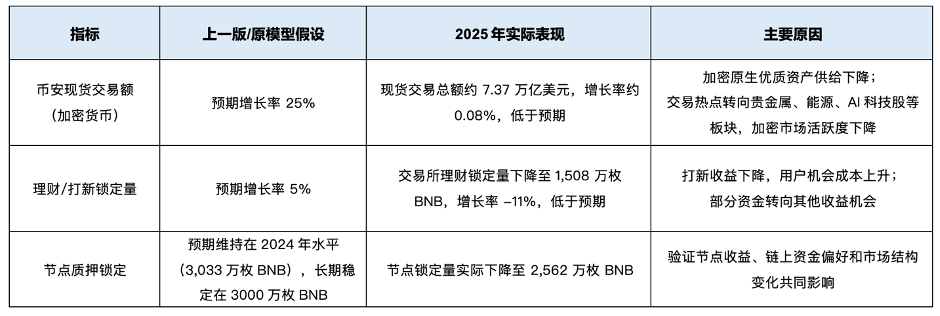
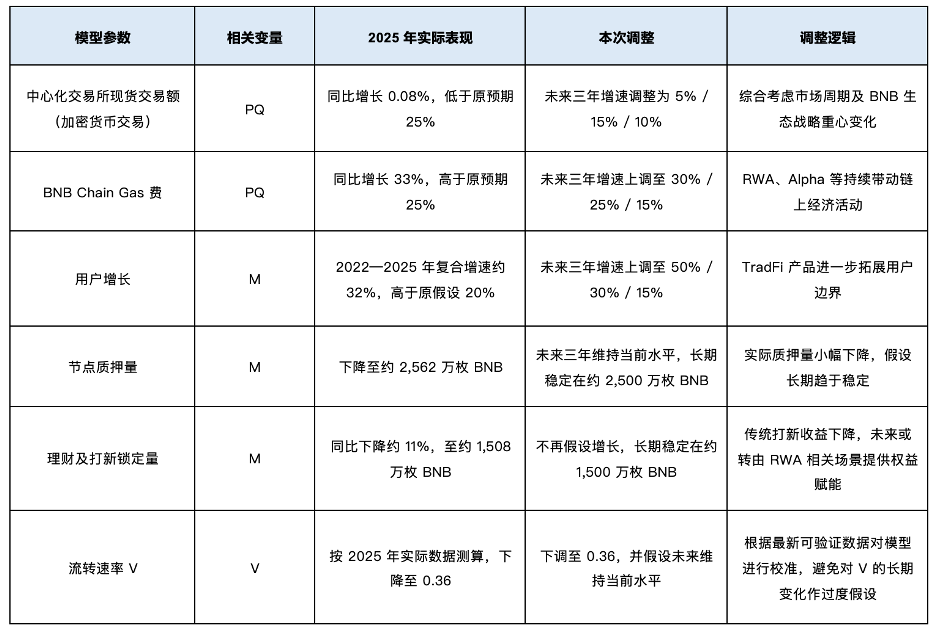
Among them, the most noteworthy is the slowdown in spot trading volume growth. This indicator reflects that Binance's business is still affected by market cycles and the overall performance of the cryptocurrency industry, also indicating that the BNB ecosystem needs to find new growth points.
The slowdown in trading volume does not necessarily mean a shrinkage in trading demand, but rather reflects the insufficient supply of quality assets. In the future, this gap may be filled by more quality RWA assets, thus opening new growth boundaries for the BNB ecosystem.
Indicators Exceeding Expectations
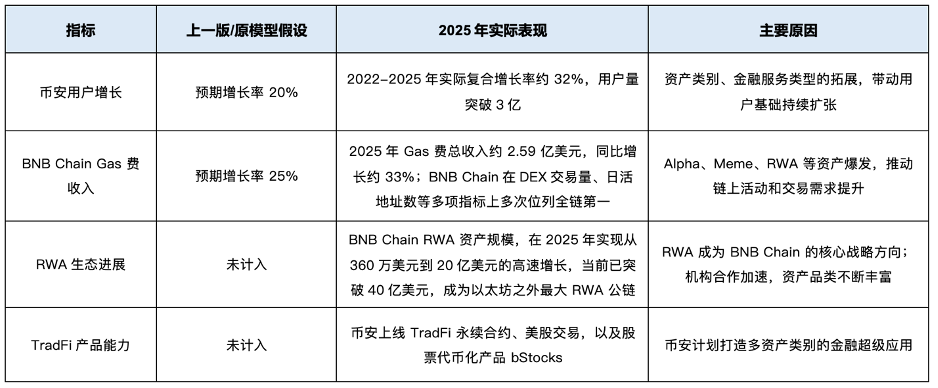
Meanwhile, key operational indicators such as user scale and BNB Chain Gas revenue are experiencing rapid growth, showing that the BNB ecosystem still has a healthy expansion foundation.
By integrating multiple indicators, we can see that in the context of a sluggish market performance and overall pressure on industry development, the fundamentals of the BNB ecosystem still maintain strong developmental resilience.
From 300 Million to 3 Billion Users: RWA and Stablecoins Are the Core Drivers
For Binance to move from 300 million users to 3 billion users, it cannot rely solely on crypto trading but needs to provide users with more complete financial services. Ordinary users need payment, storage, investment, and asset allocation; institutional users need compliance, liquidity, asset quality, and risk management.
To truly get the global financial infrastructure up and running is crucially to connect three types of elements:
- Funds: stablecoins. Allow global users to enter the on-chain financial system at a lower cost;
- Assets: RWA. Bringing quality assets such as stocks, bonds, gold, funds, and real estate benefit rights onto the chain;
- Ecology: BNB Chain + DeFi. Allowing assets to be traded, mortgaged, lent, made markets, and combined.
This strategic direction began to gradually clarify in 2025. With its user base, network performance, liquidity, ecological support, and brand advantages, the BNB ecosystem has achieved rapid breakthroughs on three levels of funds, assets, and ecology:
- On the funding side: BNB Chain is becoming one of the most active networks for stablecoin activities globally. As of now, the scale of stablecoins on BNB Chain has exceeded $17 billion, growing by about 150% since the beginning of 2025; it also carries about 40% of the global stablecoin transaction volume, serving about 20 million stablecoin users monthly, with high activity ranking among all public chains.
- On the asset side: RWA asset scale on BNB Chain is rapidly increasing. Since 2025, traditional financial institutions like Circle, BlackRock, Franklin Templeton, and VanEck have successively deployed related assets onto BNB Chain; meanwhile, the BNB ecosystem is collaborating with top projects like Ondo and xStocks to continuously expand on-chain asset supply.
- On the ecological side: in 2025, BNB Chain ranked first across several core indicators such as daily active address numbers, address growth rate, and DEX trading volume multiple times. Its application landscape not only completes DeFi infrastructure but also extends to AI, RWA, and consumer-level applications.
These advancements collectively drive BNB Chain to become one of the fastest-growing ecosystems for RWA in the past year: the total scale of on-chain RWA assets skyrocketed from $3.6 million at the start of 2025 to $2 billion in the fourth quarter, currently surpassing $4 billion, making it the largest RWA public chain outside of Ethereum.
US Stock RWA: The Most Important Product Validation Recently
In 2026, the BNB ecosystem will further deepen RWA integration and achieve significant progress in the realm of TradFi and RWA products:
- Binance launched TradFi perpetual contracts, covering multiple asset types including commodities (precious metals, energy), US stocks and ETFs, Pre-IPO equity, allowing global users to gain traditional financial asset price exposure through stablecoins;
- Binance Wallet launched tokenized securities in collaboration with Ondo Global Markets, providing users with US stocks and ETF tokens;
- Binance launched real US stock trading. Users do not need to open additional traditional brokerage accounts; they can trade real equity assets on the Binance platform by holding stablecoins.
Among these, the launch of the US stock product has significant product implications: Binance is integrating one of the largest capital markets globally into the existing cryptocurrency account system and global liquidity network. For users, this service breaks the long-standing triple barriers to cross-border investment: account opening thresholds, funding entry, and trading experience, representing a groundbreaking iteration and upgrade of the underlying financial infrastructure and investment model.
At the same time, Binance has also introduced the tokenized product bStocks, enabling users to convert their held real stocks into tokens and integrate them into BNB Chain, allowing static asset holdings to enter the "second lifecycle" of the on-chain financial system.
With this, the BNB ecosystem has established a complete link of asset acquisition, trading, on-chain issuance, and DeFi combination applications. Ecosystem synergy is the core moat of the BNB ecosystem. By integrating CEX traffic ingress, real asset supply, public chain circulation capabilities, and DeFi combination scenarios into the same system, the BNB ecosystem is forming a super-ecosystem that is difficult for any single brokerage, exchange, public chain, or RWA protocol to replicate.
BNB Valuation: Value Foundation Based on Holder Returns
The BNB ecosystem has a grand narrative, but the value of BNB comes not only from the narrative but also from a clear value capture mechanism. BNB is one of the few assets in the digital asset space with a clear value investment logic, and part of its value can be understood and measured within the traditional financial framework.
It should be noted that BNB does not represent an equity stake in Binance and does not directly distribute company profits, therefore should not be understood as a security, nor can traditional equity valuation methods such as PE or PS be directly applied. BNB draws more from the operational mechanisms of BTC and ETH, connecting ecosystem participants through a new ecological organization method based on interest binding and co-creation. After nearly nine years of development, the value capture mechanism of BNB has been continuously optimized and has become the de facto engine driving the development of the BNB ecosystem.
From a practical economic effect perspective, BNB has two clear types of holder returns. We take these as an entry point for understanding the value of BNB within a traditional valuation framework.
Automatic Destruction: BNB features a long-term deflationary property in its token economic design, reducing supply through quarterly automatic destruction. This mechanism is determined by on-chain activities and token supply-demand, rather than being tied to company income or profit buybacks; however, its feedback loop also serves to reduce total supply, thereby increasing the unit value for remaining holders.
New Project Returns: BNB holders can obtain new project tokens through activities such as Launchpool, HODLer Airdrop, and Megadrop. This type of "participatory" equity distribution is not traditional cash dividends, but essentially conveys ecosystem rights to BNB holders.
According to Binance's official data and the actual data from Hash Global's BNB yield fund, in 2025, the automatic destruction amount for BNB will be $4.425 billion, and the new project returns will be about $1.317 billion, resulting in a total holder return of $5.742 billion. If we take the shareholder return rate of traditional financial infrastructure companies, i.e., the proportion of cash dividends and share buybacks (if any) to market value, we can backtrack to derive the theoretical market value and price of BNB. Considering that BNB ecosystem business is no longer limited to trading, we select traditional infrastructure companies encompassing trading, payment networks, multi-asset accounts, asset issuance, and asset management as comparable samples, to more comprehensively reflect BNB ecosystem's value positioning as a comprehensive financial infrastructure. By taking the median valuation result of the sample, we arrive at a reasonable price for BNB of $1,471, corresponding to an approximate market cap of $200 billion.
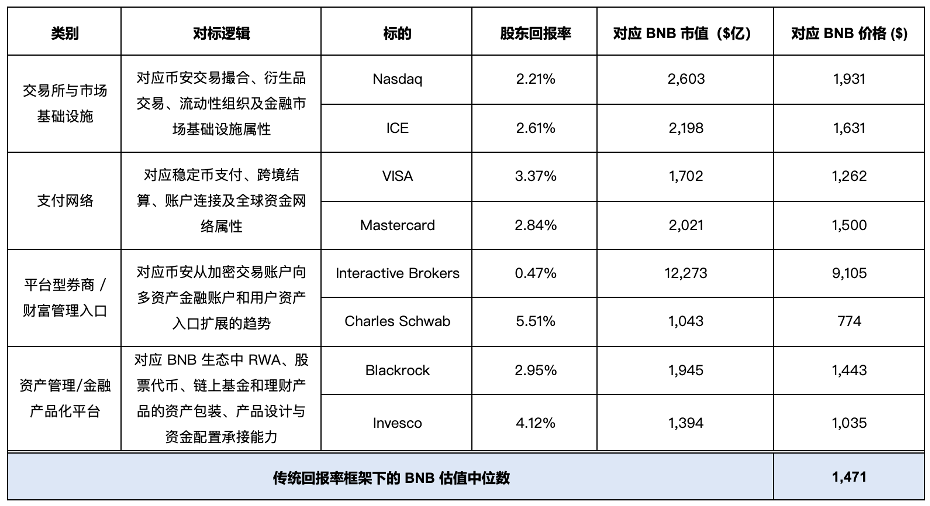
This method quantifies BNB's ability to provide returns to its holders and refers to market pricing levels against similar returns, providing a set of reference prices within a traditional valuation framework for BNB. The advantage of this method lies in its limited assumptions and clear logic, but it also has the following limitations:
- The benchmark return may have deviations. Sample assets have a certain comparability in business positioning; however, compared to traditional financial infrastructure companies, BNB exhibits higher growth potential and generational advantages while also facing higher growth risks under new models. The market may struggle to accurately assign corresponding premiums or discounts.
- A static model cannot fully reflect future growth. This model is based on actual data from the past year. Given the limited historical data for BNB holder returns and its significant impact from market cycles, project supply, and token prices, introducing substantial subjective assumptions is needed for long-term forecasts. Therefore, this section takes a static approach, aiming to provide a verifiable and comparable price reference with fewer assumptions.
- The traditional valuation framework cannot fully capture the entire value of new Web3 assets. BNB not only possesses the "asset value" reflected in holder returns but also has functional value as an "ecosystem token," including transaction fees, Gas, and the value generated by demands such as ecological participation. These values cannot be fully captured by current models.
Thus, traditional valuation methods can only estimate the clearest and most quantifiable parts of BNB's intrinsic value. The result is more suitable as a reference for a valuation lower limit that has solid theoretical support.
The Value of BNB as a Core Asset of Open Financial Infrastructure: Calculated Based on the Monetary Equation
To further assess the complete value borne by BNB as an ecosystem token, we continue to employ the value-functional token valuation model that Hash Global has used for several years. Since the release of the first BNB valuation report by Hash Global in 2019, this valuation model has been sufficiently validated by the market.
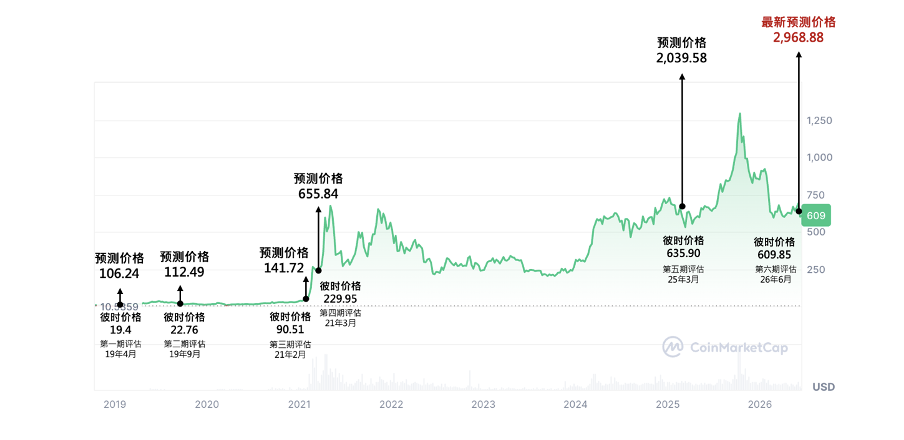
This model is based on the monetary equation MV=PQ and measures BNB’s monetary demand from three dimensions: ecosystem economic activity (PQ), total monetary circulation of BNB (M), and currency turnover efficiency (V), discounting future value increments to the current point in time. Compared to traditional valuation frameworks, this method better reflects BNB’s monetary value in scenarios like trading, Gas, payments, staking, and ecological participation.
The core of this valuation update is to incorporate the latest value positioning for BNB and the incremental value brought by open financial scenarios into BNB's value assessment. At the same time, we adjust previously conservative or optimistic parameters based on the BNB ecosystem's actual performance over the past year to more accurately reflect fundamental changes.
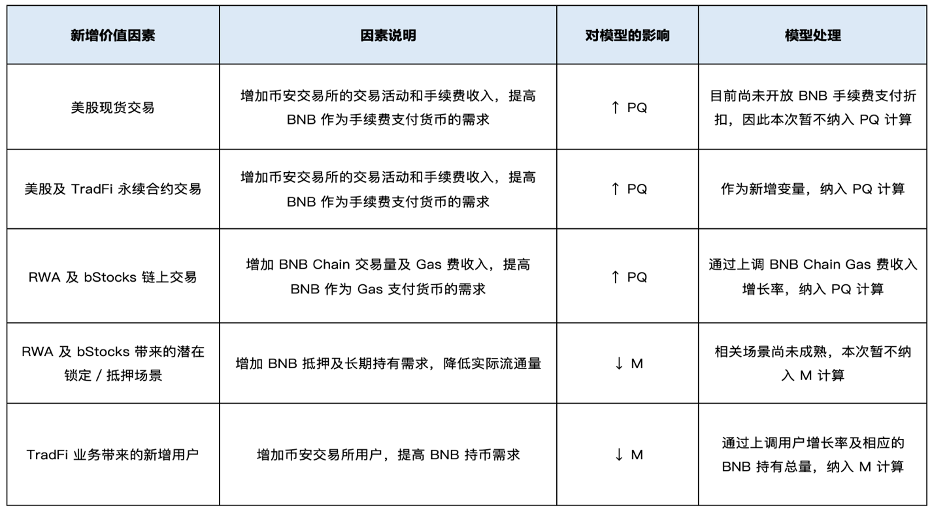
Model Update: Incremental Value of Core Assets in Open Finance
The value of BNB as a core asset of open financial infrastructure will be incorporated into the model through variable adjustments:
Parameter Adjustments: Calibrated Based on Latest Business Data
BNB Theoretical Price Calculation
PQ: Total Economic Value of the BNB Ecosystem
Total economic value of the BNB ecosystem (PQ) = economic value of Binance exchange + economic value of BNB Chain
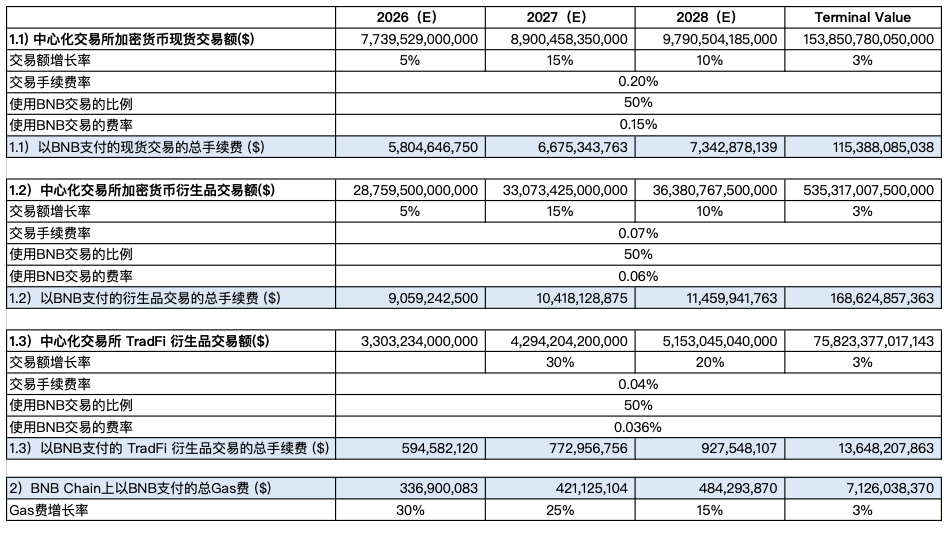
M: Total Monetary Circulation of BNB
Total monetary circulation of BNB (M) = Actual BNB circulation × BNB price
Actual BNB circulation = theoretical circulation - locked volume
Theoretical circulation = total supply - team holdings - historical cumulative destruction (see previous reports)
Locked volume = volume locked for trading discounts + BNB Chain verification node pledges + exchange wealth management / new project lock-up
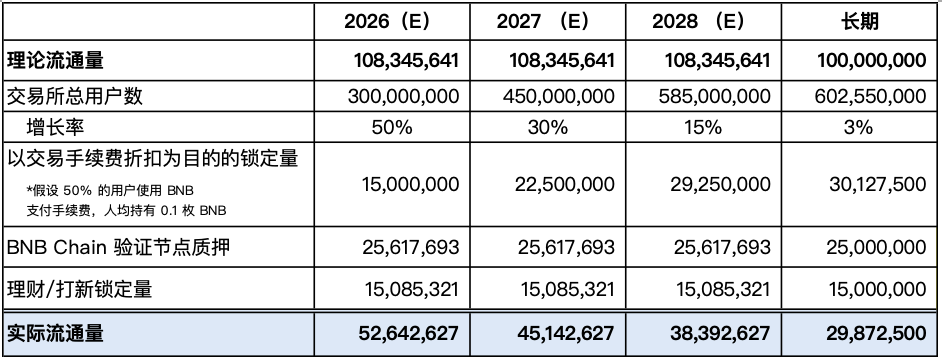
BNB Theoretical Price
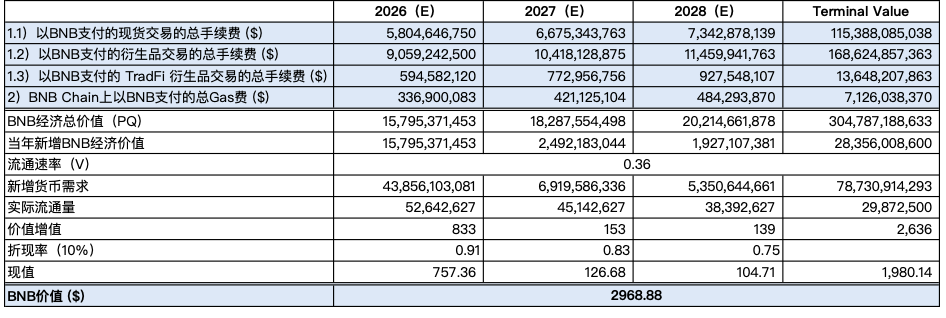
Valuation Conclusion Explanation
Based on the updated assumptions for PQ, M, and V, we estimate the current reasonable value of BNB to be $2,968. This result reflects an intrinsic value judgment based on currently visible data and model assumptions, rather than a short-term price forecast, and does not account for external factors like market liquidity, risk preference, and macro environment.
This valuation increase mainly stems from three incremental aspects:
- New business driving user growth;
- TradFi derivatives trading bringing new trading volume to Binance exchange;
- RWA, bStocks, and other businesses potentially stimulating economic activity on BNB Chain.
It is important to emphasize that $2,968 is not the terminal price accounting for all potential benefits. For factors that are difficult to quantify, lack verifiable data or are still in the early stages, this model has taken a relatively conservative approach. The following potential increments have not been included in this valuation:
- Potential increase in trading fee income from Binance US stock spot trading impacting PQ;
- Potential decrease in M from BNB staking/locking scenarios on BNB Chain;
- Potential decrease in M from institutional holdings in DAT, ETF, etc.;
- In terms of user growth, we still adopt a relatively conservative growth assumption compared to the long-term target of 3 billion users proposed by the Binance management team;
- The calculation of turnover rate V assumes consistency with 2025, not accounting for potential actual declines in turnover rates due to deepened institutional adoption and continuously enriched application scenarios in the future.
Therefore, the current valuation still retains room for further upward revisions. Future tracking should focus on the following variables:
- Whether BNB will be used for fee payments for US stock spot trading (↑PQ);
- Whether TradFi perpetual contract trading volume can continue its current growth trend and become a stable new increment in Binance trading business (↑PQ);
- After the launch of bStocks, whether it truly stimulates on-chain trading, lending, market making, and combination strategy economic activities (↑PQ);
- Whether new mortgage or locking demands will form in RWA and bStocks related scenarios (↓M);
- Progress on institutional allocation in DAT, ETF, etc. (↓M);
- The actual impact of new business on user growth (↓M).
If the above variables continue to show positive trends, the theoretical valuation of BNB still has room for further upward adjustments.
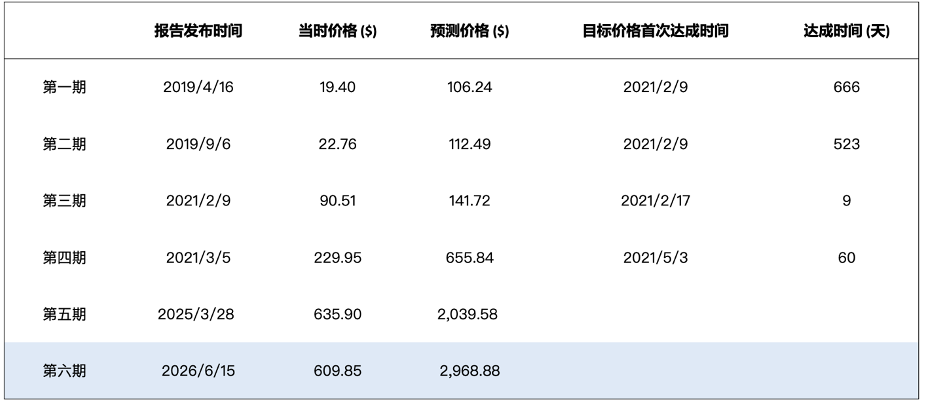
Future Outlook: Enhancing Value Weight and Institutional RWA Development Will Drive BNB Value Discovery
One of the significant driving forces for BNB’s value discovery is the digital asset market is rebalancing the weight of "narrative" and "value."
The market remains in a sluggish phase, but a downturn is not necessarily a bad thing. It accelerates the industry's rebalancing of narrative and value. In the past, the market was willing to pay a high premium for grand narratives; now, institutions and long-term funds will pay more attention to real users, real income, and real assets, and whether value can be effectively captured by tokens. We believe that as the digital asset market continues to mature, the weight of value will gradually rise.
Since 2019, we have firmly supported BNB, primarily because it is one of the few assets in the digital asset space with a clear value capture mechanism and value investment logic. The BNB ecosystem also boasts the largest cryptocurrency exchange globally, as well as one of the most active public chain ecosystems, with a huge user base and high-frequency economic activity. Multiple scenarios like platform equity, Launchpool, wealth management, payments, Gas, and on-chain applications continuously empower BNB. Compared to many assets still primarily driven by narrative, BNB's sources of value are more direct and verifiable.
The rapid development of RWA and the maturation of open financial narratives will drive institutions to reevaluate BNB.
In the past, global institutions had relatively limited channels for understanding BNB. They are more familiar with BTC and ETH narratives as investment assets, and less from a traditional investment framework and the inherent business to understand the value of digital assets. Simultaneously, the progress of institutional channels for digital assets like DAT and ETFs also requires time, leading to institutional adoption of BNB ecosystems being ahead of their investment allocation in BNB itself. Therefore, the current institutional penetration rate of BNB is still very low, far below Bitcoin's 15% and Ethereum's 10%. However, this also means that BNB still has significant room for institutional allocation and growth. With mainstream institutions like VanEck advancing BNB ETFs, we expect the institutional holding ratio of BNB to gradually rise, accelerating the value discovery of BNB.
Institutions are the main force behind the global RWA business push. The deepening of RWA business will provide a significant opportunity for BNB to enter the institutional value assessment radar.
The combination of RWA, stablecoins, US stock trading, and BNB Chain makes BNB’s narrative more complete: becoming a core asset of the global open financial infrastructure. Compared to narratives internal to the crypto market, this narrative is easier for institutions to understand and is more likely to serve as an entry point for institutions to reevaluate BNB.
The target price of $2,968, corresponding to a market cap of $400 billion, indicates that BNB has the potential to exceed ETH and become the second largest digital asset after BTC.
We have always believed there are three "one of its kind" assets in the digital asset space: BTC, ETH, and BNB. They represent entirely different asset properties, each possessing immense value. We pay particular attention to the relative price of BNB to ETH, as it reflects the market's judgment on changes in the weights of "value" and "narrative" when evaluating digital assets.
ETH remains important. It is still one of the most decentralized and widely accepted smart contract assets. However, the narrative around ETH is strong, and its actual value capture still requires more verification and observation. We believe ETH is a great thing, similar to Linux; however, to become a Linux-like existence, there may inherently be some tension between neutrality and value capture ability.
At the beginning of the year, we predicted that this year, BNB would continue to outperform ETH by about 40%, with the BNB/ETH relative price rising from 0.28 to 0.40. Viewed over three years, we believe BNB has the opportunity to surpass ETH in market capital, corresponding to a relative price of about 0.90.
Conclusion
BNB is entering a new phase of value. This change is not driven by a single product but is the result of a set of structural trends: the goal of moving from 300 million to 3 billion users, stablecoins becoming the global funding entry point, RWA expanding the supply of digital assets, the verification of product paths through US stock business, and BNB Chain undertaking on-chain circulation and DeFi combinations.
Several fundamental indicators for BNB have surpassed our expectations. The temporary slowdown in spot trading is not the end but reflects a transitional period for asset supply and business structure. With more quality RWA assets entering the BNB ecosystem, the ecological value of BNB will gain new sources of growth; demands from payments, staking, and long-term institutional allocations will further enhance the structural demand for BNB.
We maintain a strong bullish outlook on BNB and set $2,968 as a three-year target price. If this judgment is realized, BNB will no longer be confined to the frameworks of "exchange platform token" or "Web3 ecosystem token," but is expected to become one of the most important open financial infrastructure assets after BTC.
免责声明:本文章仅代表作者个人观点,不代表本平台的立场和观点。本文章仅供信息分享,不构成对任何人的任何投资建议。用户与作者之间的任何争议,与本平台无关。如网页中刊载的文章或图片涉及侵权,请提供相关的权利证明和身份证明发送邮件到support@aicoin.com,本平台相关工作人员将会进行核查。


