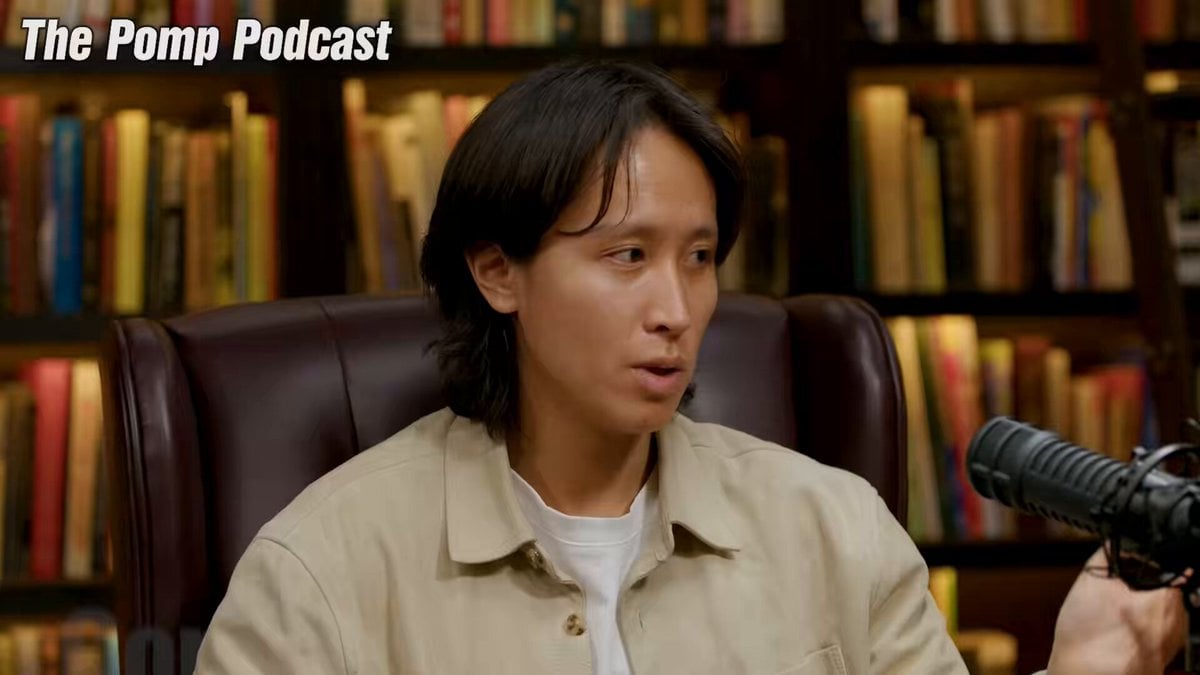
Source: "Anthony Pompliano"
Compiled by: Felix, PANews
Andrew Kang is a seasoned cryptocurrency investor and CEO of RoboStrategy, a public closed-end fund focused on the robotics industry (Nasdaq stock code: BOT). This conversation will delve into why Andrew is shifting funds from cryptocurrency to humanoid robots and why he believes the robotics market is poised to rival the human labor market. Additionally, it will discuss the robotics competition between China and the U.S., as well as potential job losses in the robotics industry.
PANews has organized the highlights of the conversation.

Host: Why shift attention and capital to a market that most people may not yet fully understand?
Andrew: There are many reasons, but the most important is that we are finally going to have real robots. This was once only a dream in science fiction, but we have now reached the stage where it is becoming a reality. This is not something that will take 50 or even 20 years; it will likely just take 3 to 5 years before you see humanoid robots in daily life.
Host: In your vision, how do you see humanoid robots integrating into our future?
Andrew: I think almost all scenarios are possible in the future. Humanoid robots will participate in and take on work in the same way that humans do. Some of them may focus on specific tasks, like being waiters in restaurants; some may work in specific factory roles; some might become personal assistants in your home. I believe the beauty of humanoid robots lies in their adaptability to the everyday world. They can move around in the same buildings as we do and use the same tools as we do. Overall, they are very versatile and highly adaptable. This is what distinguishes humanoid robots from those that are designed for specific applications.
You can look at the prevalence of similar concepts in everyday life, like your smartphone. It is very versatile; you can use it to play music, navigate with large maps, and make phone calls. Likewise, humanoid robots possess such vast general versatility that it is entirely logical for them to permeate every aspect of daily life.
Host: What do you think the market size for humanoid robots will be?
Andrew: To understand this, you must consider the total size of the human labor market. The human labor force accounts for approximately 50% of global GDP, estimated between 40 trillion to 60 trillion dollars. That is a staggering figure. My way of thinking is that humanoid robots will be capable of performing everything humans can, but they do not need breaks, do not need coffee breaks, do not need vacations, and will not quit on you. So you don't have to keep hiring and retraining new employees due to turnover. Many jobs in factories are tedious and demanding, resulting in high turnover rates, leading to high indirect management costs for the physical workforce, which robots do not have to face. Therefore, a robot could theoretically take on the work of about three people (assuming it can support multi-shift continuous work).
From this perspective, if robots are to replace most manual labor, you can also perform a "bottom-up" analysis: Suppose a robot sells for $50,000. In contrast, human employees require a salary every year, whereas robots are a one-time expense, followed by potentially just a small electricity bill and minor maintenance costs. When you calculate this down to the hourly cost and expect that the robot could serve for several years, this math comes out to about $2 per hour. In the U.S., considering the comprehensive costs of a typical worker, including year-end bonuses, insurance, and all related benefits, it would roughly require $35 to $40 per hour. Therefore, it is undisputed that choosing robots is favorable in terms of cost structure. Even when compared to low-income countries like India, the Philippines, or Indonesia, $2 per hour is still very hard to beat, especially when considering all the additional advantages we just discussed.
From this, you can form a realization: the number of robots in the future will be vast. Just as billions of smartphones, hundreds of millions of PCs, and cars are sold each year, a similar volume of robots may also be sold in the future. Even if we take a step back and assume that only 100,000 robots sell at $50,000 each, that would yield revenue of about $5 billion. If you can generate this much revenue and assume a decent profit margin, you could already be a company valued at over $100 billion.
Now, what if you sell 1 million units? That would bring in $50 billion, which is close to the scale of some of the world's largest companies. But 1 million robots is actually not much, as Amazon itself employs millions of people, and Walmart has millions of employees too. And if you were to sell tens of millions of units? That could yield $500 billion in revenue. You can see a very clear path of how it is feasible to achieve trillions of dollars in revenue, corresponding to several tens of trillions in market value.
This does not even take into account the "Jevons Paradox": when you lower the labor cost of a certain product, you are actually expanding the total size of the market. Because now, things that were previously too expensive to undertake become economically feasible. This “top-down” market size projection can be quite illuminating. Just like Apple, if before the iPhone came out in 2006, you told someone it would be a $3 trillion company, people would think you were crazy. Because at that time, it seemed like just a $50 billion company, and $3 trillion would be larger than most of the giants combined at that time. Hence, people often very much underestimate the value creation potential that true transformative technological leaps can bring.
Host: As far as I know, you have invested huge personal capital over the past few years, even writing eight-figure personal checks to invest in these private companies. What has made you confident that these humanoid robots will really become so popular?
Andrew: It's interesting because when I started investing in humanoid robots, particularly Figure AI, at the end of 2023, it was absolutely not a market consensus. At that time, ChatGPT had just come out, and it was clear that the development of AI would accelerate dramatically, and we would not only achieve digital AGI (Artificial General Intelligence) but also physical AGI. Intelligence has always been the bottleneck in manufacturing robots, and this problem is about to be solved. I approached my traditional VC network, and they all told me not to invest because historically, the iteration cycles, high costs, and chaotic deployment of the hardware and robotics industry rarely produce massive venture capital returns. But I believe that the development of physical intelligence will change all of this, and many investors do not recognize it. Initially, I invested through four SPVs (special purpose vehicles), and I even wondered if I was being scammed, questioning why the world’s top VCs weren't investing. Upon deeper investigation, I found that they were just unwilling to deviate from their comfortable investment narratives. I was very confident of the product-market fit, which led me to increase my initial investment from $1 million to $5 million, and ultimately to $19 million. Although I hadn’t yet spoken directly with the founder Brett (founder of Figure AI), after researching his background and the world-class team he assembled, I knew they had a strong likelihood of success.
Host: Tell us more about Figure AI; what sets them apart, or what is their competitive moat?
Andrew: There are so many aspects. First is the caliber of the team that Brett has assembled. When Figure was established, although some humanoid robot companies had been around longer, Figure’s iteration efficiency and execution speed are unparalleled. Month over month and quarter over quarter, you can see significant progress.
If you take a step back and think about the challenge in front of you: how do you solve the general robot problem? This is one of the hardest challenges in the world. You need a PhD in computer vision, a PhD in robotics behavior, an expert in hand engineering, and experts in developing fleet orchestration software. You have so many different specialties, and in each specific domain, there may only be a few hundred truly proficient individuals in the world, and you need to attract all of them to the same company. This is extremely difficult.
Therefore, you need a founder with that kind of charisma, and he also needs to be able to raise the tens of billions in funding required for the company to succeed. Brett is one of the very few founders I discovered who had the capability to do this. At that time, other than Tesla, no humanoid robot company could compare with them.
Host: This reminds me of the drone industry, where some tech teams can innovate hardware but struggle to build a business around it. Yet, the current humanoid robot teams seem to possess both technical acumen and experience in constructing business operations?
Andrew: Yes, while technical experience is important, investors sometimes overvalue academic talent. Look at Brett's background; his first company, Veter, focused on recruitment, so he understands how to attract top talent very well. His second company, Archer, went public via SPAC with a market cap in the billions, innovating a type of complex machinery that had never before existed in business. In the U.S., due to long-term outsourcing of hardware design and manufacturing to China, this skillset that can create step-change improvements is extremely rare.
Host: Speaking of China, China excels in hardware manufacturing and has even held robotic half-marathons and Olympics. Do you think American companies can beat China in this field?
Andrew: This is a big topic. First, China is undoubtedly the strongest in manufacturing, and I believe they will continue to maintain this advantage. But I would evaluate a robotics company based on three core capabilities: first, the ability to execute efficient large-scale manufacturing; second, hardware design; and third, AI capability.
On the manufacturing side, as we’ve discussed, China is very strong. In the U.S., companies like Tesla and Figure are also becoming very strong on the manufacturing side. In terms of hardware design, I believe Figure and Tesla in the U.S. are at the top. In China, there may be more than 100 different robotics companies, each with varying degrees of excellence in their hardware design. If you look at Yushu, their hardware is great for research and entertainment, and you can see them doing backflips and dancing. But you can't just take the same G1 robot and put it in a factory to lift 30-pound objects; it will fall apart. This doesn't mean Yushu can't design more durable robots; it's just that this is not their preferred market entry point at the moment.
Nevertheless, I think the most underrated aspect, where the U.S. is currently leading, is in the AI portion, specifically physical intelligence. The top physical AI labs in the U.S. have a technological advantage over those in China. Without the "brains" of the robots, they are essentially useless. If this trend continues, we may indeed see Chinese robotics companies developing some dependence on U.S. physical intelligence.
Another equally underrated point is that technological development does not always equate to a 1:1 relationship with the commercial value created. China can produce incredibly stunning robotic technology, the entire industry can thrive, but that does not always mean it translates into the largest market cap or delivers the biggest win for shareholders. You have seen similar precedents in the automotive, electric vehicle, and smartphone industries.
China produces exceptionally fine smartphones and outstanding electric vehicles. Look at BYD; many people rave about their cars, and their sales surpass Tesla, yet their market cap is only a fraction, maybe 1/10 or 1/20 of Tesla's, and their profit margins are notably lower. This is a common issue faced by all Chinese hardware companies: they exist in an environment of intense competition and extreme internal scrupulousness. This is somewhat encouraged by the government, which provides these companies with subsidies and support, hoping for a broad range of competitors in the market.
However, I believe the ultimate outcome tends to benefit consumers within the society and country, rather than the companies themselves. Clearly, these companies must succeed and generate economic value, but that does not mean they can grow to the scale of America's largest companies. For example, despite Huawei and Xiaomi producing great smartphones, Apple remains the largest smartphone company in the U.S.
Host: Beyond the capital markets, the regulatory environment is also interesting. The American society has various controversies and scrutiny over these technologies, whereas companies in China seem to receive substantial government subsidies. In the long run, could American companies competing in a free market without subsidies actually be an advantage?
Andrew: There is some truth to that, but I still believe that government support is very positive for the industry, and the U.S. should have more government support. In China, there are instances where companies form joint ventures with local governments to gather training data and procure robots. While this drives down profit margins and leads to technology outflow, it also promotes innovation. For the U.S., re-industrialization and reducing supply chain dependencies is a tremendous push. Just like the Biden administration imposing 100% tariffs on Chinese electric vehicles and the FTC banning vehicles from certain countries over telecommunications equipment and software security issues, robots are similarly filled with audiovisual and telecommunications equipment, making it hard to imagine the U.S. government allowing foreign robots to dominate in the U.S. market. Currently, there are also pushes for legislation to prohibit federal funds from purchasing robots from specific countries, which may extend into daily life.
Host: Are these bills driven by protectionism or national security considerations?
Andrew: Both. Just like with the TikTok experience, when robots enter people's homes or the Pentagon, potential surveillance risks become a significant national security issue. At the same time, the U.S. government should also heavily incentivize the domestic robotics industry through direct investment, favorable loans, and educational programs. We are somewhat lagging behind in policy. This is also why we founded Robo Strategy; the U.S. needs to invest billions into this most crucial future industry.
Host: In software AI, we see both general models and dedicated workflows succeeding. In the robotics field, there are both general applications like Figure and companies like Physical Intelligence that are possibly more focused on specific applications. How do you view general versus specialized?
Andrew: This has happened many times in history, just like smartphones replaced GPS and MP3s, but the watch industry still exists; GPUs and ASIC chips each have trillions of markets. Many people think a perfect world should have everything customized, but that's not the case. The advantage of general robots lies in economies of scale: they can be manufactured at an astounding scale, providing substantial unit economics that you cannot achieve with a single application, potentially reducing production costs by 80%. Of course, specialized robots (such as Path Robotics for welding, or home construction robots) will also exist and will all represent large markets. But in a constantly changing world, the production processes in factories can change at any time, so you need a general device (like humanoid or wheeled dual-arm robots) that is maximally adaptable to handle various tasks.
Host: There is a startup in New York offering free apartment cleaning services, provided that the workers wear cameras to gather training data. Could this turn into a global treasure hunt for the best training data?
Andrew: The data issue is very interesting. Previously, people thought we needed to collect all the physical environment data from scratch like large language models (LLM), which would be incredibly time-consuming and labor-intensive. However, recent developments have changed my perspective: video generation models (world models) trained on internet video data, such as Sora or China's Kling, have learned to understand the world, physics, and fluid dynamics. When you knock over a glass cup, how will the water flow? This data already exists in internet videos, and it has proven to be a valuable backbone for robotic foundational models. Of course, we still need to collect specific environmental data not available on the internet (like manufacturing a specific book in a factory), but the scale required is much smaller than previously thought.
Host: Amazon has approximately 1.5 million human employees but reports having 750,000 non-humanoid robots. In warehousing or autonomous vehicles, could these non-humanoid specialized robots serve as a sort of "Trojan horse," pioneering adoption and ultimately leaving the largest market to humanoid robots?
Andrew: Yes, designing a robot to perform a specific task is undoubtedly easier than training it to do 50 tasks, so you will first see the proliferation of specialized application robots. However, the development of humanoid robots is exponential, and soon we will see humanoid robots manufacturing other humanoid robots. Companies like Tesla, Figure, and Apptronik have already hinted at this. Just as AI can help in AI research, robots will aid in robot development, and the latest models, like Claude 3.5 Sonnet (Opus 4.8), can also assist in robotic AI training.
Host: What will the lives of ordinary people look like in the next decade? Will we trust these humanoid robots to clean, walk our dogs, or even care for sleeping children?
Andrew: This involves the debate between remote operation (Teleop) and full automation. Remote operation means someone at a distance controls a robot wearing an exoskeleton, often used for data collection. However, I am skeptical about this approach entering homes because you would not want a stranger seeing and hearing everything in your house through a robot; it would invade personal space. When these robots become fully automated, the situation will be similar to how people today interact with ChatGPT or Claude; they will even share personal information with them that they wouldn’t tell friends. Children growing up alongside robots they rely on will blur the boundaries between humans and machines, much like how many children talk to Alexa as if she were a human proxy; humanoid robots in the physical world may even outperform humans in tasks for which they have been specifically trained, being more charming.
Host: What do you think about Tesla's performance in the public market and their Optimus robot? Can they win this market?
Andrew: There is no doubt that Tesla will be the big winner in the humanoid robot field; I would never bet against Musk. Although the Optimus project has faced some setbacks over the past year or two and they have yet to show the incredible capability of sorting packages automatically for nine consecutive days like Figure, they will catch up eventually. Moreover, there is no one in the U.S. who can beat him in terms of manufacturing capability. Their hardware taste and styling are very important and enable them to sell at a premium. Hand design is the most complex part of a robot, requiring extreme precision and enduring years of wear, and Tesla may still be redesigning it in pursuit of perfection.
Host: As all this develops, should humans start to worry about the negative impacts on jobs?
Andrew: Absolutely. Some tech CEOs will romanticize history, saying each technological revolution brings new jobs. But this time is different; previously you just needed to move up on the cognitive stack to do things that required more thought and planning; now, AI is completely replacing human cognitive and physical abilities, and there is no retreat. This will destroy a lot of white-collar and blue-collar jobs, and to cope with this unstoppable technological wave, we need a government safety net like Universal Basic Income (UBI).
Host: With the rise of humanoid robots, will the physical world (e.g., factory layouts) change to accommodate them?
Andrew: For decades, robots (like various coffee machines and collaborative robots) have actually worked alongside humans. Collaborative robots have been around for 20 years, but currently, the global installation volume each year is only about 500,000 units (most of them in China, with very few in the U.S.), as the cost of programming them and ensuring reliable operation 24/7 is extremely expensive, often exceeding the cost of the robot itself. But when we make these robots intelligent, deployment costs will drop significantly, making them much more economically viable around the world.
Host: Can you talk about your investment portfolio? Besides Figure, who else have you invested in?
Andrew: Our focus goes far beyond humanoid robots themselves and includes many excellent robotics companies that do not build humanoid robots at all. One typical example is Standard Bots; another example is Dino Robotics and its portfolio. Dino is building some humanoid-like hardware with wheels, and they are also one of the top research teams in the industry constructing the robot “brains” (algorithm layer).
Additionally, there are enormous opportunities within the supply chain. While I firmly believe that most of the industry's value will eventually settle at the supply chain's end (the complete machine brand), there will definitely be some giant enterprises producing core components in certain specific supply chains. For example, actuators currently account for 30% to 50% of the BOM (Bill of Materials) cost of a humanoid robot. However, this sub-technology area of actuators has not seen any substantial foundational technological advancements in the past 50 years. Therefore, there exists a massive space for technological innovation in certain specific segments.
Related reading: Dialogue with the founder of Figure Robotics: The ambition behind a $39 billion valuation is to mass-produce millions of units
免责声明:本文章仅代表作者个人观点,不代表本平台的立场和观点。本文章仅供信息分享,不构成对任何人的任何投资建议。用户与作者之间的任何争议,与本平台无关。如网页中刊载的文章或图片涉及侵权,请提供相关的权利证明和身份证明发送邮件到support@aicoin.com,本平台相关工作人员将会进行核查。


