Can Wall Street embrace uncontrollable on-chain governance?
Written by: Thejaswini M A
Translated by: Saoirse, Foresight News
When we think of competition, what often comes to mind is "survival of the fittest." Upon hearing this phrase, a brutal image of everyone fighting each other emerges in my mind: the strongest predator wins by excluding all other opponents.
But now I begin to doubt that a sustainable ecosystem is formed through this model. At the beginning of the 20th century, biologist and philosopher Peter Kropotkin refuted this concept in his essay on the evolution of the theory of mutual aid. Kropotkin observed that species that survived extreme climate changes relied on a sophisticated model of collective cooperation. From the perspective of long-term evolutionary processes, the power of mutual support far outweighs the struggles between individuals. The true "fittest" are those who understand cooperation, build stable shared frameworks, and thus respond to unpredictable environments.
This principle applies across all industries.
Currently, all crypto projects are identifying their positions; those protocols that survived the bear market have also made key decisions regarding future development.
Some development teams choose to return to their original core philosophies, pursuing absolute anti-censorship and pure decentralization; others add centralized control permissions to maintain basic liquidity; while a few teams focus on building exclusive ecosystems, consolidating internal liquidity into mutually isolated expanding chains.
In contrast, ZKsync has taken a completely different route centered on mutual cooperation: it is building infrastructure specifically for banks.
The Boston Consulting Group (BCG) predicts that the tokenized asset market will fully migrate to blockchain systems, with the market size reaching $10 trillion to $16 trillion by 2030. Major mainstream banks have already begun related pilot projects, with some institutions moving from the pilot phase to formal operational stages. The infrastructure solutions currently finalized will determine the flow of trillions of dollars and who can control this underlying circulation track.
Today, ZKsync is a highly competitive Layer 2 solution on this financial underlying track. Even if you haven't been paying attention to Layer 2 networks since the last bull market, its development direction is still worth noting.
Why are banks entering the blockchain space? And why choose ZKsync in particular?
The ZKsync environment used by Deutsche Bank is completely sealed off from ordinary crypto users. The bank relies on ZKsync's Prividium suite and has built a private, permissioned Layer 2 network - Memento ZK Chain, with Memento.
Prividium is a commercial product offered by ZKsync for institutions, supporting privacy transactions, tiered permission controls, and built-in compliance tools; all transactions can ultimately be settled on Ethereum. After comparing five blockchain ecosystems, Memento ultimately selected ZKsync. With this solution, the funding deployment cycle has been shortened from the original two to three months to two to three weeks.
The core reason banks favor zero-knowledge technology: it can prove the validity of a statement without disclosing underlying private information. Banks can complete transaction verification without revealing sensitive information such as the names of the transacting parties, transaction amounts, or corresponding assets. This privacy architecture allows banks complete control over data viewing permissions, protecting corporate business secrets while clearly providing evidence to regulatory agencies, perfectly fitting Wall Street's existing operational model.
The Tradable platform has carried $1.7 billion in private credit products on ZKsync, launching nearly 30 investment targets aimed at institutions with annual yields ranging from 8% to 15.5%. In October 2024, the capital city of Argentina, Buenos Aires, quietly migrated its entire digital identity system to ZKsync Era, granting 3.6 million citizens encrypted official identity credentials overnight; the local government cannot track related data, making it the world's first city to implement this application.
By the end of 2025, the global private credit market size will reach $3.5 trillion, while the Tradable platform's size is less than 0.05% of the overall market. In the future, the tokenized credit sector must either capture a significant market share or remain a niche scale, but current data shows that this sector is in a growth phase. Regardless, there remains a substantial gap between the current on-chain funding volume and the overall market total scale.
Let's consider the choices from the perspective of enterprise risk control teams: they have three paths to choose from - a fully autonomous controlled isolated exclusive network, an enterprise alliance system bound by contracts, or a public network managed by an online community.
JPMorgan's Kinexys is a privately controlled network completely managed internally; this business has been independently building its blockchain system since 2019, cooperating with institutions like BlackRock and Siemens to handle repurchase transactions, cross-border payments, and asset settlement. JPMorgan operates its own servers and manages its ledgers, completely avoiding public crypto communities. Transaction fees will not arbitrarily change due to token holder voting, and system upgrades strictly follow internal planning; all governance rights of the network entirely belong to JPMorgan.
However, the bank's own data exposed the shortcomings of this solution: Kinexys processes an average of about $5 billion in transactions daily, while JPMorgan's payment department has daily transactions up to $10 trillion. Five years after launch, its blockchain business only carried 0.05% of the bank's payment operations. The bank with the highest control over the infrastructure has the lowest penetration rate. Complete self-control did not resolve the core issue of scaled landing.
Another competitor, R3 Corda, has completed $10 billion in tokenized real asset settlements, processing one million transactions daily. It consists of an alliance of more than 200 financial institutions, all rules are mutually agreed upon before going live; any updates must be consented to by all members. All banks had a seat at the rule-making table before the first transaction took place.
These platforms may be competitors of ZKsync, but ZKsync possesses unique advantages that exclusive alliance chains and private chains cannot replicate: achieving publicly verifiable transactions without leaking privacy data while having a settlement layer independent of any single entity's operational status. Once an institution shuts down its internal blockchain business, on-chain assets immediately fall into operational risk; however, the assets anchored on ZKsync ultimately settle on the Ethereum mainnet, with no business executive able to order the shutdown of the network. This fundamental isolation is its most core differentiated advantage, but how to balance this with the risks brought about by open governance rights remains a topic of ongoing industry debate.
Before fully transitioning to institutional business, ZKsync launched an incentive program called Ignite to subsidize decentralized financial protocols to maintain on-chain activity. After the strategic adjustment, the project terminated the Ignite program, clearly shifting focus to enterprise clients, and on-chain activity also declined along with the incentives.
Almost concurrently, the first generation network ZKsync Lite, launched in 2020, was permanently shut down. Matter Labs had signaled this as early as December 2025 and announced the exact shutdown date by the end of February the following year. User assets can be permanently withdrawn, and all institutional business deployments were not built on ZKsync Lite, so they were unaffected.
The leading lending DeFi protocol Aave proposed to shut down its lending market on ZKsync Era, primarily due to poor revenue data: over a span of 30 consecutive days, ZKsync generated only $714 in fee revenue for Aave. In contrast, the Base chain brought $300,000 in fees during the same period, with Ethereum's mainnet reaching as high as $7.7 million. The governance forum ultimately concluded that this Layer 2 chain does not truly meet the market demand for retail DeFi, and proposed a new rule — in the future, any public chain with annual fee income reaching the $2 million threshold would be considered by Aave for market deployment.
During the peak of retail Layer 2 expansion, ZKsync Era's on-chain locked assets maintained several hundred million dollars; now its total locked value in public DeFi is only about $15 million. By comparison, leading Layer 2 networks aimed at retail generally see locked asset sizes in the billions.
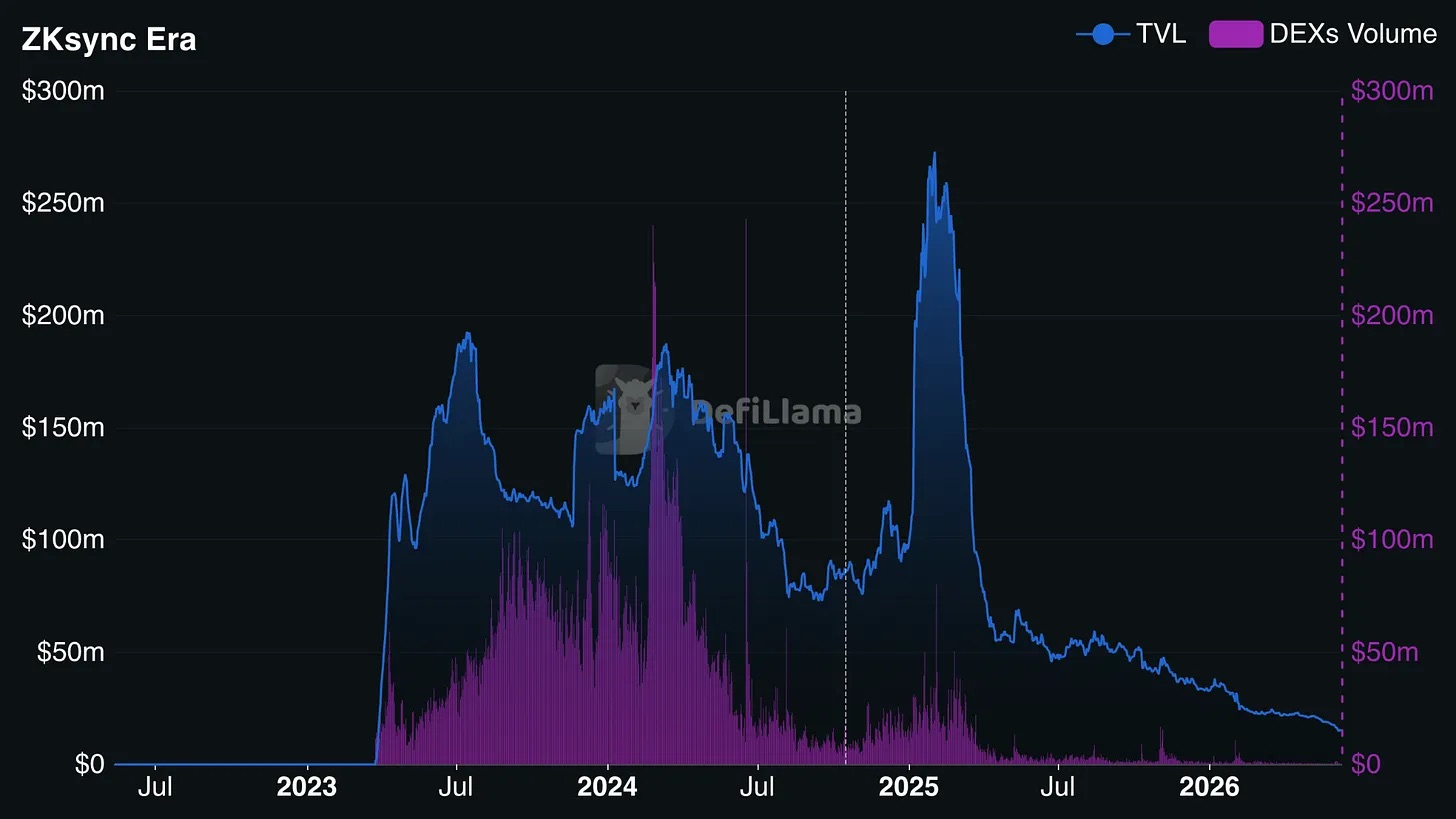
Since its launch in 2023, ZKsync Era's on-chain locked asset TVL (blue line) and decentralized exchange trading volume DEXs Volume (purple column) peaked in early 2025 and have continued to decline significantly, while retail DeFi activity has been extremely low by 2026. Source: @defillama.com
If the retail ecosystem continues to languish, the entire chain's development will entirely hinge on institutional business as its mainline. Is the Layer 2 network a retail crypto paradise gradually infiltrated by banks, or merely a corporate financial track relying on Ethereum for settlement? The answer to this question will determine ZKsync's ultimate fate.
Earlier this year, Matter Labs CEO Alex Gluchowski announced a roadmap, explicitly shifting the project focus to building heavyweight financial infrastructure for traditional markets.
This is also confirmed by product iterations: the team first launched Prividium, creating a dedicated environment for banks that is isolated from the public network and does not leak transaction information; next, they launched the Bank Stack suite, collaborating with institutions like Cari Network to attract regional banks managing hundreds of billions in traditional deposits. Therefore, Aave’s exit from the ecosystem was not a surprise to the development team.
As for Cari Network's deployment plan: this institution was established under the leadership of the former U.S. Office of the Comptroller of the Currency, planning to conduct pilots with five regional banks in the next quarter, which together manage over $600 billion in deposits.
If this pilot is successfully launched, the volume gap caused by the retail DeFi applications’ withdrawal will be completely filled by massive bank transactions; but if the pilot fails, ZKsync will become an advanced yet experimental tool without real mainstream users, retaining only a few enterprise pilot projects.
The v31 protocol upgrade, passed by the ZKsync governance forum vote, was officially launched in early May.
The ZKsync official account released updates on X platform to remind that this protocol upgrade has been submitted for governance forum review. The v31 upgrade includes multiple core updates, using ZK tokens as a universal pricing unit to enable native interoperability across all ZK layer expansion chains.
Highlights of the announcement: The ZKsync protocol upgrade proposal (ZIP-16) has been submitted for governance forum voting:
- ZKsync interoperability protocol: enabling native cross-chain interaction across all ZK layer expansion chains;
- Phase One supports scalability chains that can complete settlement on Ethereum Layer 1;
- Expanding the compatibility scope of the ZKsync operating system.
According to the v31 upgrade rules, each cross-chain call between different ZK chains is uniformly charged 10 ZK tokens, and this fee standard is determined by a decentralized autonomous organization vote. Banks have been dealing with various cost fluctuations for years—such as blockchain gas fees, cloud server computing expenses, foreign exchange spreads, etc., and these fluctuating costs are the norm for operations.
Not only the fee standard but the entire fee operation mechanism can be rewritten through the same governance forum, and project parties have no obligation to inform on-chain cooperative institutions in advance.
The ZK Nation governance forum is already discussing the next phase of adjustment plans, currently discussing topics like transaction fees for node operators, staking rules, and customized pricing for zero-knowledge proof verification. Any of these topics can initiate community voting, which could change the cost models for all cross-chain business of institutions like Deutsche Bank and Tradable; anyone can view all discussions publicly on forum.zknation.io.
In contrast: JPMorgan's Kinexys system permissions are entirely under its own control; R3 Corda's rule adjustments also have formal contracts clarifying conditions and processes for changes.
So why would banks opt for ZKsync over JPMorgan's private chain? Because ZKsync can provide publicly verifiable proof of transaction validity without disclosing privacy data.
If JPMorgan were to shut down its blockchain business tomorrow, all on-chain assets would be locked; even if the development company Matter Labs behind ZKsync were to collapse, the network would still operate normally because all assets are ultimately anchored to Ethereum for settlement. But enjoying this foundational security comes at the cost of accepting that the network does not belong to any single entity. A network without an owner sees governance rights belonging to all voting token holders.
The current trading price of ZK tokens is approximately $0.01, peaking at $0.3285 in June 2024, down 96% from its peak. Based on the cross-chain transaction fee of 10 ZK tokens, the cost of a cross-chain transaction at the peak of the bull market was about $3.28, while it is now only $0.1. Token price fluctuations can still be managed through hedging measures, but the mechanism allowing community votes to change the rules makes long-term stable budgeting difficult for corporate financial planning.
Layer 2 network rating agency L2Beat classifies ZKsync Era as a stage 0 network: the independent security committee can bypass the complete DAO voting process to directly suspend or modify smart contracts. In contrast, mature stage 1 Layer 2 networks like Arbitrum do not possess such centralized intervention authority. Corporate risk management typically favors emergency stop-loss mechanisms to reduce losses from smart contract vulnerabilities; however, this control power is in the hands of the Web3 security committee, completely detached from traditional corporate management systems.
Sygnum has tokenized the $50 million of enterprise treasury assets of Matter Labs, integrating it with Fidelity's liquidity fund on ZKsync; subsequently, Fidelity also launched a money market fund for institutions on this network. The development team injected initial transaction volume by investing their own funds to create core enterprise landing cases. This asset flow process operates smoothly, but the entire business layout directly serves the project founding team.
The entire core infrastructure is still subject to the independent security committee, which holds the highest system permissions. In emergencies, the committee can completely bypass the usual delay processes without prior notice, directly modifying smart contract parameters or freezing relevant functions. The practical control rights of the network are divided between the security committee and the active token governance community, which means the banks that enter can only conduct business based on a continuously dynamically adjusted governance system, rather than signing fixed, unchangeable enterprise cooperation agreements.
ZKsync has bet its entire existence on a group that has never led the development of crypto projects – licensed traditional financial institutions. Banks do not care about token prices and will not participate in governance forum voting.
However, once a bank selects a core infrastructure to build its business, it often becomes long-term bound and difficult to migrate. This landing path has a higher initial threshold, but once rooted, it is hard to replace.
ZKsync will either become the first crypto project to achieve this goal or prove through high trial and error costs that banks will ultimately choose to develop their own blockchains and then abandon external public chain solutions. The market will provide an answer in the next 18 months.
In the crypto industry, many projects have solid technology but stumble in governance mechanisms and long-term sustainability, ultimately fading away. The large-scale test of governance models with ZKsync is still ongoing.
免责声明:本文章仅代表作者个人观点,不代表本平台的立场和观点。本文章仅供信息分享,不构成对任何人的任何投资建议。用户与作者之间的任何争议,与本平台无关。如网页中刊载的文章或图片涉及侵权,请提供相关的权利证明和身份证明发送邮件到support@aicoin.com,本平台相关工作人员将会进行核查。


