Author: Ada, Deep Tide TechFlow
Last week, the US stock market's AI sector displayed a bizarre scene, with records being refreshed one after another, and stocks being sold off one after another.
On June 1, Alphabet, which had hundreds of billions in cash, announced one of the largest equity financings in history; after the market on June 3, Broadcom reported its best quarterly earnings, and the next day the stock price collapsed; on June 5, the Nasdaq fell sharply by 4%, with the semiconductor sector evaporating nearly a trillion dollars in market value in a single day; after the market on June 10, Oracle's revenue and backlog both set records, yet the stock price continued to decline; on June 11, the largest SpaceX IPO in history entered the pricing phase. The figures in the earnings reports themselves are not the issue, but the way these figures were achieved: more and more money is being borrowed into this AI infrastructure competition in increasingly complex ways. When the market starts to count this bill, even records cannot save the stock price.
The same script: first set records, then get hit
Broadcom follows the script. According to the company's earnings report and multiple media reports, for the second quarter ended May 3, Broadcom had revenue of $22.219 billion, a year-on-year increase of 48%, AI chip revenue of $10.8 billion, a year-on-year increase of 143%, with earnings per share exceeding Wall Street's expectations. But the market only focused on one gap: the company's guidance for the next quarter's AI chip revenue was $16 billion, lower than analysts' expectations, and CEO Hock Tan did not raise the annual AI revenue target, mentioning that Google might diversify its chip supply chain. However, the next day, Broadcom's stock price fell about 15%, evaporating nearly $280 billion in market value in one day, marking one of the largest single-day market value evaporations in Wall Street's history.
A week later, it was Oracle's turn. According to the company's earnings report and CNBC, for the fourth quarter ended May 31, Oracle had revenue of $19.2 billion, a year-on-year increase of 21%, with cloud infrastructure revenue of $5.8 billion, a year-on-year increase of 93%, and adjusted earnings per share of $2.11, higher than analysts' expected $1.95. The backlog was even more astonishing, with remaining performance obligations (RPO) reaching $638 billion, an explosive year-on-year increase of 363%, far exceeding analysts' expectations of $595.7 billion. But the stock price did not respond favorably, falling about 9% after hours.
Sandwiched between the two earnings reports was a comprehensive sell-off on June 5. According to TheStreet and CNBC, the Nasdaq Composite fell 4% that day, marking the worst single day since the tariff turmoil in April 2025, triggered by Broadcom's cautious AI chip outlook, leading AMD and Intel to drag down the entire semiconductor sector.
It is noteworthy that the sharp decline on June 5 was not solely due to "AI skepticism." That day, the US non-farm payrolls increased by 172,000, far exceeding expectations, which raised interest rate expectations and led funds to shift from overvalued growth stocks to defensive sectors like healthcare and essential consumer goods, while AI stocks, which had the highest valuations, suffered the most significant declines. In other words, macro interest rates and sector rotation are one driving force, while doubts about AI capital expenditure are another, with both overlays rather than a single cause.
It’s not the profit and loss statement being hit, but the cash flow statement
Putting the three segments together reveals a common point: the profit and loss statement is still recording "records," while the market has started to read the cash flow statement and balance sheet. The pricing focus has shifted from "how much was earned" to "how much has to be burned and borrowed to earn this."
Oracle is the most straightforward example. According to the company's earnings report, FY2026 full-year operating cash flow reached a record $32 billion, a year-on-year increase of 54%, but free cash flow was negative $23.7 billion, with a total financing of $43 billion in debt and $5 billion in equity for the year. What truly undermined sentiment was its outlook for the future. According to CNBC, Oracle plans to refinance about $40 billion in fiscal year 2027, through a combination of debt and equity. A company that had just completed nearly $50 billion in financing and has negative free cash flow, now forecasting another $40 billion in financing, along with the "record" certainly raises market concerns.
Broadcom’s logic is similar, just manifested elsewhere. According to Barron's, Broadcom lowered its gross margin guidance for the third quarter from 77% to 74%, due to the rising proportion of lower-margin AI chips in revenue. Coupled with the retreat from "selling complete systems" to "only selling chips," and customer demands for renting chips to shift financing pressure, the market sees a rapidly growing business, but with deteriorating profit margins and capital occupation.
Goldman Sachs provided a framework for this shift. According to their research report, investors' tolerance for capital expenditure growth depends on the intensity of profit and the visibility of AI monetization; the same report pointed out that Alphabet's stock price rose due to an upward revision of profit guidance, while Meta fell due to flat guidance. The market no longer uniformly rewards "growth," but differentiates winners and losers based on "can it be monetized."
The financing chain has become the protagonist: even the players with the most cash are borrowing money
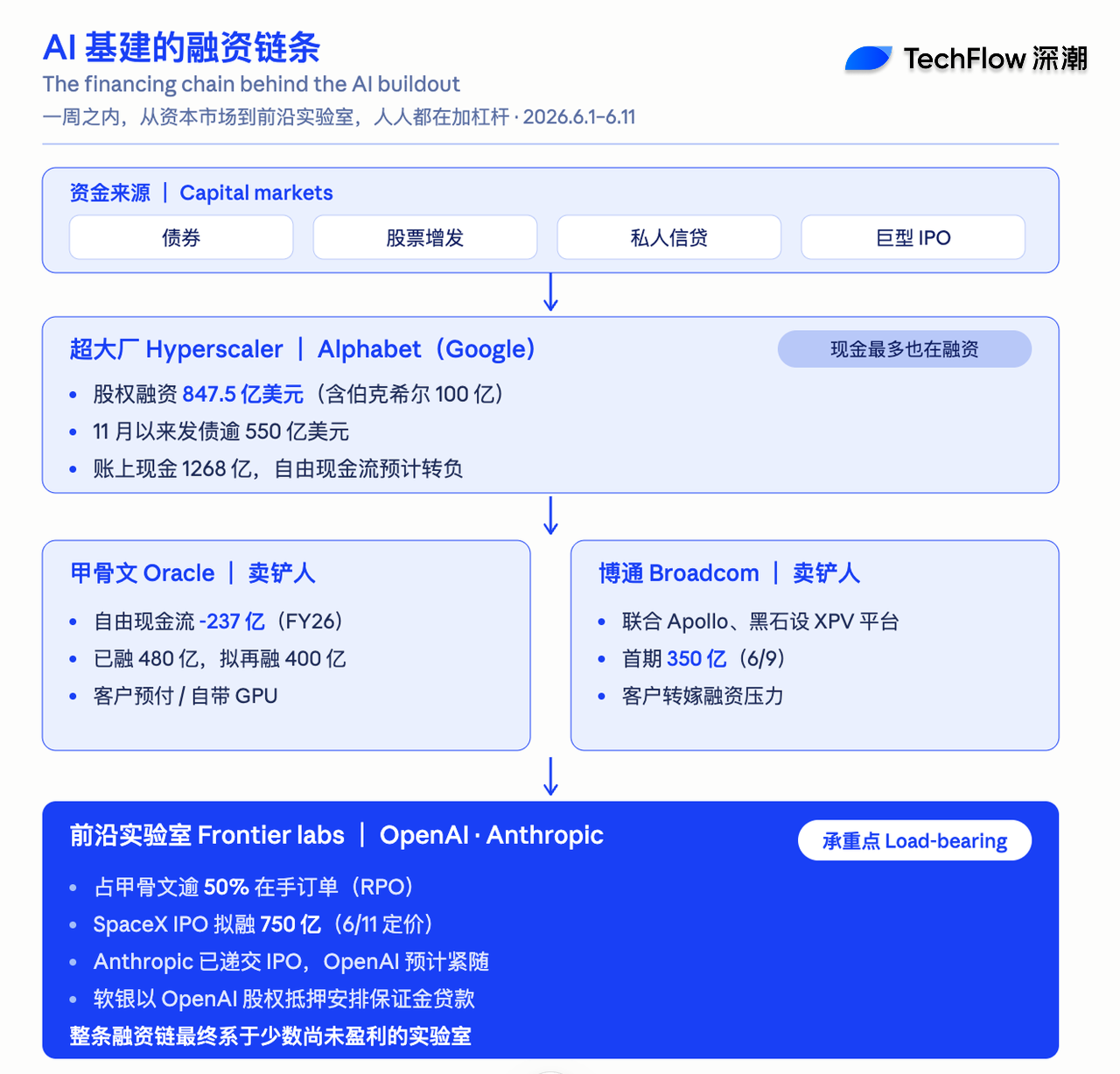
If the profit and loss statement is facade, the financing chain is the true protagonist of this week. From the upstream to the downstream, almost every link is paying for the same AI infrastructure in a leveraged or diluted equity manner.
The most convincing example is Alphabet. According to its filings with the SEC, on June 1 it announced an $80 billion equity financing, which was adjusted and priced at $84.75 billion the next day, including a $10 billion private investment from Berkshire Hathaway. The abnormality lies in the fact that this company does not lack cash at all. According to multiple media reports, Alphabet had $126.8 billion in cash as of March 2026 and an annual operating cash flow of $174 billion, and has issued over $55 billion in new debt since November. Nevertheless, Melius Research estimates that Google's free cash flow will turn negative in the coming years. Investor Dan Niles commented that capital is not infinite, and that Google, having "the strongest tech stack in all of AI," still requires significant financing highlights the intensity of this investment cycle.
Looking downstream, every link in the chain is doing the same thing. The new cloud vendor Oracle has negative free cash flow, relying on both debt and equity financing, and prompting customers to prepay GPU payments or provide their own GPUs to reduce its own construction financing; Broadcom, the chip provider, on June 9, collaborated with Apollo and Blackstone to establish the AI XPV Platform with an initial target of $35 billion, aiming to support over 20 gigawatts of computing power by 2028, serving cutting-edge laboratories including Anthropic and OpenAI. Meanwhile, the laboratories at the end of the chain are also using more aggressive tools: it has been previously reported that SoftBank arranged margin loans secured by OpenAI equity, while SpaceX is now sprinting towards its goal of a $75 billion Nasdaq IPO, and Anthropic has secretly submitted a listing application, with OpenAI expected to follow soon.
The total amount of investment is also rapidly expanding. According to CreditSights, the total capital expenditure for mega firms in 2026 is estimated to be around $750 billion, an increase of about 67% compared to 2025; while another estimate by Goldman Sachs states that the 2026 capital expenditure forecast for mega firms has been revised upwards from $314 billion at the beginning of the year to $518 billion. Regardless of which figure is used, the direction is the same: expenditure is accelerating, while the portion that can be covered by operating cash flow is shrinking, and the gap needs to be filled by the capital market.
The burden of the chain is resting on a few unprofitable laboratories
Leverage itself is not scary; what is frightening is who the leverage ultimately rests upon. Pulling this financing chain to its end reveals that its burden point is highly concentrated.
Oracle's $638 billion in backlog seems unassailable, but according to Bank of America, over 50% comes from OpenAI alone; at the same time, Oracle also disclosed that a large majority of the RPO increment over the past two quarters came from large AI contracts, where the customer either prepaid GPU payments or procured GPUs themselves and handed them to Oracle. Similarly, Broadcom's six major custom chip clients are concentrated among just a few companies: Google, Meta, Anthropic, and OpenAI. In other words, from the financing of mega firms to the orders from chip suppliers, and then to the injection of private credit and insurance funds, the final payers in the entire chain converge onto a small handful of unprofitable, cutting-edge laboratories like OpenAI and Anthropic that are also in line for financing.
Record revenues are real, and the $638 billion in backlog is also real; however, the buyers of these orders are highly concentrated and are themselves relying on financing to survive, leading the leverage of the entire chain to be re-evaluated by the market. This week, the market did not deny the growth of AI; it only began to demand clarity on who will pay this growth bill and how. SpaceX will price after the market on June 11 and list on Nasdaq on June 12 at a price of $135 per share, with a valuation of about $1.77 trillion. Whether this largest IPO in history can be digested smoothly will be the next stress test for this financing chain.
免责声明:本文章仅代表作者个人观点,不代表本平台的立场和观点。本文章仅供信息分享,不构成对任何人的任何投资建议。用户与作者之间的任何争议,与本平台无关。如网页中刊载的文章或图片涉及侵权,请提供相关的权利证明和身份证明发送邮件到support@aicoin.com,本平台相关工作人员将会进行核查。


