Author: Aaron, Think AI
SpaceX is about to go public, grabbing the spotlight and becoming the hottest topic in the market.
Not only because this IPO will be the largest in U.S. history and globally.
Whether in terms of market capitalization or fundraising amount, it has set historical records, with a valuation set at 1.77 trillion U.S. dollars and fundraising of 75 billion U.S. dollars, every number stimulating public nerves.
More importantly, Musk's firm stance against investment banks has rewritten IPO rules, propelling this IPO to its peak.
This IPO reserves 30% of new shares for retail investors, far exceeding the typical 5-10% for U.S. IPOs, breaking the monopoly of institutions over quality assets.
Additionally, Musk has pressured investment banks to reduce their overall underwriting fees to below 0.75%, lower than the usual 1% for large IPOs, creating a new low for massive IPO fee rates.
Global capital is rushing to reserve quotas, betting on the space narrative, resulting in the most fervent U.S. IPO market in decades. Previously, a Chinese company, Alibaba, held the record for IPO fundraising in U.S. history.
That was the era when Jack Ma said no competitors could be found even with binoculars, creating the largest fundraising record in U.S. history in 2014, a record that has only just been broken.
How did that globally sensational IPO happen? What has Alibaba experienced over the past decade?
Feast from a Decade Ago
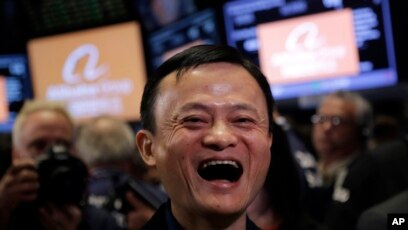
On September 19, 2014, Alibaba officially listed on the New York Stock Exchange.
The issue price reached the upper limit of 68 U.S. dollars, and on the first day of trading, Alibaba's opening price hit 92.70 U.S. dollars, climbing about 36% above the issue price, eventually closing at 93.89 U.S. dollars. The closing market capitalization reached 230 billion U.S. dollars, surpassing Amazon and Facebook, becoming the fourth largest tech company in the world.
Initially intending to raise 21.76 billion U.S. dollars, due to overwhelming global capital demand, underwriters exercised their over-allotment option, ultimately raising over 25.03 billion U.S. dollars, topping the global IPO fundraising chart at the time.
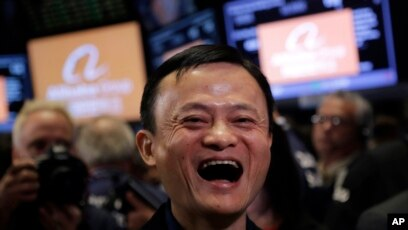
At that time, Alibaba was a conglomerate of Taobao, Tmall, Alipay, Cainiao, Alibaba Cloud, and China's e-commerce infrastructure.
It represented a rapidly rising Chinese middle class, a continuously digitalizing consumer market, and a Chinese growth story that global investors long imagined but found difficult to invest in directly.
In a sense, Alibaba in 2014 was the company closest to the “gateway of the era” in the eyes of capital markets at that time.
Alibaba's listing made global investors realize that China could also have world-class internet platforms, entering the top tier of global tech companies, and its impact remains profound to this day. Meanwhile, it propelled the golden age of Chinese concept stocks, igniting a rush of Chinese internet companies going public.
Conversely, it also forced the Hong Kong capital market to make changes.
Alibaba initially did not overlook Hong Kong, but its partnership system conflicted with the Hong Kong Stock Exchange's "same share, same rights" rule, leading Alibaba to choose a U.S. listing.
Years later, the Hong Kong Stock Exchange reformed its listing system, allowing new economy companies with different rights shares to go public, enabling Xiaomi, Meituan, and others to list, while Alibaba later also conducted a secondary listing in Hong Kong.
Subsequently, Alibaba's e-commerce empire entered a golden expansion period, peaking at a market value of 630 billion U.S. dollars in October 2020, reaching historical highs. During that phase, Alibaba laid down a hidden card, not yet becoming the main player, until the AI era helped Alibaba successfully transform.
From "Choice One" to Being Surpassed by Pinduoduo
Just one month after Alibaba's market value peaks, Ant's IPO was halted, and the dream of a trillion-dollar valuation for its financial listing abruptly ended. This also marked the beginning of Alibaba's decline.
In 2021, Alibaba was fined 18.228 billion yuan for platform "choice one" monopoly, setting a record for domestic antitrust penalties.
The reason for the hefty fine was that Alibaba, before 2015, abused its market dominance by requiring merchants on its platform to only open stores on the Alibaba platform or participate in promotional activities, severely harming merchants' rights, constituting monopolistic behavior.
Subsequently, in December 2023, it was ruled to compensate JD.com 1 billion yuan, ending a 10-year feud over "choice one."
During this period, Alibaba suffered from the illness of big corporations. Formalism and bureaucratism became prevalent, with little innovation left. A sexual harassment incident involving female employees stirred up nationwide public opinion, leading to several senior executives resigning in disgrace, and CEO Zhang Yong publicly apologized, casting serious doubts on Alibaba's value system.
Moreover, multiple strategic misjudgments during expansion resulted in Alibaba losing not only hundreds of billions but also its core e-commerce moat. Alibaba bet on consumption upgrades, losing the "cheap" mindset for Taobao, which allowed Pinduoduo to occupy the market. Taobao and Tmall's market share plummeted from 66% in 2019 to around 30% now;
After proposing a new retail strategy 16 years later, pouring hundreds of billions to try to bridge online and offline, investing in or acquiring Intime, Suning.com, and others, all of which led to significant losses, alongside the boom of short videos and live e-commerce.
The big entertainment sector lost 60 billion, its industry position continuously declined, and after acquiring Youku, it slipped from first in the industry to fourth, being completely surpassed by Tencent Video and iQIYI, while Xiami Music was shut down in 2021, operating the creative industry with a technology and capital mindset, lacking a content gene.
Local life continued to be suppressed by Meituan. Then, at the end of November 2023, Pinduoduo's market value first surpassed Alibaba's, prompting Jack Ma to respond on the internal network, stating, “Alibaba will change, Alibaba will adapt” and mentioned "the era of AI e-commerce has just begun."
Alibaba faced its darkest hour, and AI became Alibaba's new remedy.
Layout in the AI Era
Currently, Alibaba has a strong presence in the AI field, with the Tongyi Qianwen model's monthly active users reaching a maximum of 300 million, Alibaba Cloud's Q1 revenue reaching 41.6 billion yuan, a 38% year-on-year increase, with AI-related product revenue accounting for 30%;
Alibaba Cloud has maintained its leading position in China's public cloud IaaS market for several consecutive years, becoming the core infrastructure for AI development in China.
Self-developed chips have been put into AI training, and large models are now embedded in platforms like Taobao, Alipay, Amap, and Feishu, accelerating commercialization. However, current challenges are still evident.
The C-end is still suppressed by ByteDance, with Doubao's monthly active users far surpassing Qianwen, and users showing higher stickiness. After the Spring Festival activities, the active users of Qianwen dropped to around 150 million.
The departure of Tongyi Qianwen leader Lin Junyang caused turmoil in the team, the competition for top AI talent intensified, and Alibaba's attractiveness decreased; Alibaba wavered between the AI traffic entry (C-end users) and the AI industry network (ToB services), failing to form a clear differentiated positioning, and its technical route wavered.
Looking back at Alibaba's rise and fall in twelve years since its listing, one can clearly see the fate of giant companies.
In 2014, the capital market gave Alibaba an extremely high valuation, betting on the era dividend of China's consumer internet;
Subsequent years of setbacks stemmed from blindly diversifying strategic advances, decision-making delays due to the maladies of large enterprises, and underestimating the era misjudgments brought by emerging tracks;
Ultimately, relying on AI for recovery once again confirms that hard-core technology is the underlying strength that enables tech companies to weather cycles.
免责声明:本文章仅代表作者个人观点,不代表本平台的立场和观点。本文章仅供信息分享,不构成对任何人的任何投资建议。用户与作者之间的任何争议,与本平台无关。如网页中刊载的文章或图片涉及侵权,请提供相关的权利证明和身份证明发送邮件到support@aicoin.com,本平台相关工作人员将会进行核查。


