The market bets on a mere 3% probability of a rate cut, yet he asserts against the trend that the newly appointed Federal Reserve Chairman Warsh will very likely announce a direct rate cut at the upcoming meeting.
Written by: Xu Chao
Source: Wall Street Watch
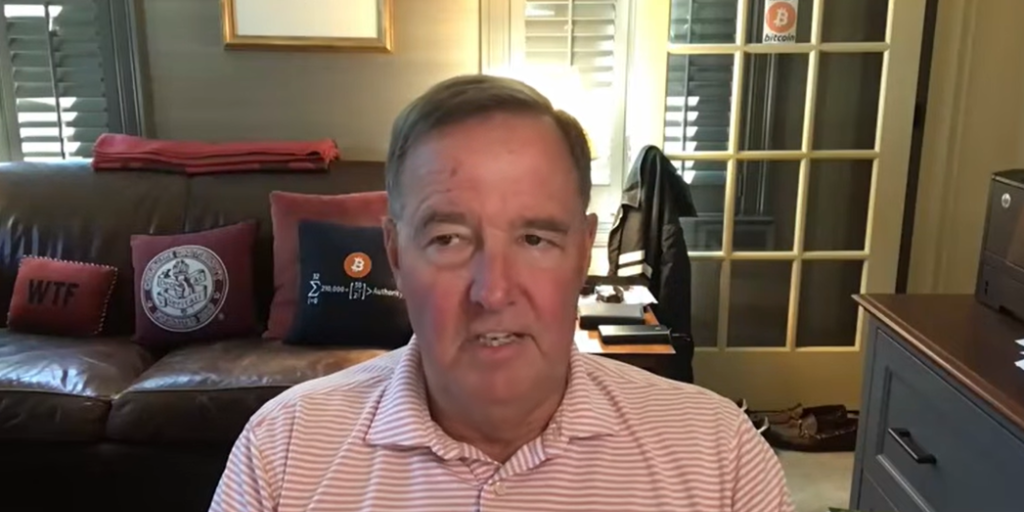
In 2026, at the crossroads of the global macro economy, sovereign debt pressure coexists with technological frenzy. Senior fund manager and author of "The Big Print," Lawrence Lepard, recently visited Thoughtful Money for an interview with host Adam Taggart, engaging in an in-depth conversation.
Lepard pointed out that the current financial system is on the brink of "Defcon 2" danger. He provided a striking "non-consensus" prediction: the newly appointed Federal Reserve Chairman Kevin Warsh is not the purely hawkish figure the market has portrayed; rather, he is very likely to forcibly open the door to rate cuts in the near term. At the same time, he is confident that a new supercycle of commodities has been established, asserting that after breaking through the historical ceiling of $50 for silver, the long-term target will aim directly at $100 to $200.
Summary of Key Points
"The Big Print" is irreversible: The pace of debt growth across society far exceeds the underlying GDP growth. To maintain the massive credit structure, the Federal Reserve will ultimately be forced to choose to print money; the emergency moment of "breaking glass" for a market rescue is approaching.
The "non-consensus" timeline for Federal Reserve rate cuts: Currently, the market bets a mere 3% probability of a rate cut in June, but Warsh might unexpectedly announce a cut using excuses like the "Dallas Fed trimmed average PCE" (which has fallen to 2.3%) and "AI boosting social productivity." He has a very high probability of choosing to announce a rate cut directly at the upcoming meeting.
De facto yield curve control (YCC): Faced with the sell-off of "bond vigilantes," the U.S. may ultimately mimic World War II and implement absolute subjective control, locking in short- and long-term rates and completely abolishing the SLR (Supplementary Leverage Ratio) restrictions, forcing major banks to take on government debt.
Silver will see a "century breakout": Global silver has been in absolute supply-demand deficit for five consecutive years. After breaking through the $50 ceiling and surging to $120 before experiencing a correction, the current price around $76 serves as a strong bottom, potentially leading to multiple explosive movements in the future. The next truly magnificent vertical uptrend will inevitably ignite simultaneously in the silver and gold markets at some point this year.
1. Debt growth far exceeds GDP; "The Big Print" becomes the only endgame for the credit system
Lepard pointed out that in a credit-driven financial system, all new money is essentially created out of thin air through "borrowing." Therefore, the money supply must continuously grow at a certain rate to support the ever-expanding credit within the system.
However, the fundamental problem facing society right now is that the growth rate of debt far exceeds the endogenous growth rate of GDP. This extreme overextension will ultimately lead to a sovereign debt crisis or a currency crisis for the dollar. To support this expansive credit structure that is growing much faster than GDP, the only ultimate solution for officials is to print money.
Lepard believes that although policymakers will do their utmost to avoid reaching this point out of concern for triggering high inflation, when the system reaches a balancing crossover point—where they can no longer bear the cost of not printing money and are about to witness a domino-like collapse of the entire financial structure—every rule will be cast aside, and their only choice will be to print money furiously.
History has already clearly proven this twice: in 2008, the entire commercial banking system was on the verge of collapse due to the real estate credit bubble, and during the COVID-19 pandemic in 2020, a much larger printing effort was initiated in response to the economic paralysis across society. Lepard emphasized that former U.S. Treasury Secretary Hank Paulson recently broke his long silence, publicly signaling that dangerous moments are about to surface, which strongly corroborates the underlying mathematical accounts that cannot be hidden and the crisis that is boiling beneath the surface.
2. The Federal Reserve under Warsh: A "non-consensus" path for rate cuts beneath a hawkish facade
Regarding the market's current labeling of newly appointed Federal Reserve Chairman Kevin Warsh as a hawkish figure intent on tightening the balance sheet, Lepard offered a highly disruptive "non-consensus" prediction. He believes Warsh is very likely to choose to directly announce a rate cut at the upcoming meeting, or even directly cut rates by 50 basis points.
Lepard analyzed that Warsh has already laid out two perfect political and economic excuses for his policy path in his previous public speeches:
Introducing the Dallas Fed trimmed average PCE: Warsh emphasized that the official traditional PCE indicator is not precise enough. As of April, the national traditional PCE data stood at 3.8%; however, if the trimmed PCE from the Dallas Fed is considered, the data directly becomes 2.3%. Using the 2.3% figure brings it just a step away from the Federal Reserve's 2% inflation target, thus obtaining a statistically perfect reason for rate cuts.
Replicating Greenspan's "productivity leap" strategy: Warsh is loudly proclaiming that advancements in AI (artificial intelligence) technology will truly achieve a tremendous surge in social productivity in the coming years. In monetary economics, to prove that "lowering interest rates will not trigger stagflation," the core theoretical support is that "the whole society simultaneously experiences a significant productivity leap." This is akin to former Federal Reserve Chairman Greenspan’s strategy in 1996, who used advancements in internet technology as an excuse to push for rate cuts, ultimately inflating the "internet bubble."
Combining the Trump administration's strong desire for the Federal Reserve to immediately implement significant rate cuts with Treasury Secretary candidate Bentsen's indication that high inflation is just a "temporary situation," Lepard asserts that in order to promote a capital-intensive "manufacturing return and aggressive national industrial policy," the Federal Reserve will inevitably cut rates substantially to inject "lubricating oil" into the economy, even at the cost of allowing the entire macro economy to run excessively hot in persistent high inflation.
3. The complete reversal of bond vigilantes and the return to World War II-style "yield curve control"
Taggart raised a question: If the Federal Reserve forcibly cuts rates without completely eliminating inflation, will the "bond vigilantes" holding up big sticks comply?
Lepard answered negatively. He pointed out that the latest data shows that foreign investors, represented by Japan and China, are massively selling U.S. Treasury bonds at record levels. Once the Federal Reserve embarks on the path of forcibly cutting rates, the 10-year Treasury market will surely erupt in full rebellion, causing yields to uncontrollably soar higher. To cope with this scenario, the U.S. government will ultimately adopt an extreme industrial policy—implementing absolute subjective control and yield curve control (YCC).
This perfectly parallels the macro background during World War II. In 1942, faced with a debt-to-GDP ratio strikingly similar to the current situation, the government directly intervened and brutally announced a locking of short-term rates at 0.375% and long-term rates at 2.5%, and used the patriotic duty of the populace to justify government profit-taking.
Lepard predicts that once the Treasury market experiences a full-scale sell-off, the Federal Reserve will also be forced to implement YCC, taking over all U.S. debt, leading to catastrophic, uncontrolled expansion of the balance sheet. Before this extreme moment arrives, the Federal Reserve is expected to very quickly abolish all SLR (Supplementary Leverage Ratio) regulatory limits, directly wiping away the hard ceiling on government debt held on commercial banks' balance sheets, thereby forcing major banks to take over for the Federal Reserve, creating covert mechanisms similar to the BTFP (Bank Term Funding Program) of the past to pump massive amounts of money back into the entire financial system.
4. The trillion-dollar AI funding tsunami: replicating the euphoria of 2000 and rigid constraints from physical resources
Discussing the current capital frenzy, Taggart quoted a core Wall Street research report indicating that capital spending in the AI sector across the U.S. is approaching $1 trillion to $1.2 trillion, creating a strong cardiac stimulant effect on the real economy and stock market in the short term.
Lepard highly agrees with this perspective, stating that the current situation perfectly mirrors a blend of the 2000 internet mania and the 2008 financial crisis. The trends of Nvidia and a number of high-computing technology giants are reminiscent of Dell and Intel back in the day. In today's fiat currency system, the system requires increasingly high nominal asset prices to barely maintain debt stability; thus, Lepard indicates he has completely given up on being a rigid bear on U.S. stocks. Just like in the early Weimar Republic, the stock market often presents a dazzling appearance in terms of nominal prices at the initial stages of currency collapse.
However, Lepard emphasizes that the tsunami of liquidity created by massive fiat money is facing relentless correction from the physical world:
Physical copper mine gap: To realize the more than $1 trillion worth of AI data centers and associated super grid constructions planned by major giants, it is necessary to forcefully increase the current global production of physical copper by 2 to 3 times from present levels based on objective mathematics and physics.
Strategic consumption of silver: Macro strategies, such as SpaceX's plan to deploy a vast network of super solar panels in space, will inevitably lead to an instantaneous consumption of the extremely frightening reserves of physical silver on Earth.'
Lepard asserts that while capital can be generated by striking keys on a keyboard from thin air, physical resources cannot be created from nothing. Humanity has thoroughly bid farewell to the previous era of low inflation and is now living in a world characterized by high inflation and a bullish market for physical commodities.
5. The asymmetric gamble on silver: supply-demand deficit and the $50 century breakthrough
In specific asset allocation dimensions, Lepard analyzes the fundamental differences between silver and gold. He points out that silver is far more volatile and whimsical among these two precious metals, being both an ancient financial currency metal and an indispensable core strategic metal for heavy industry.
Lepard emphasizes that silver is currently facing an epic asymmetric explosion space:
- Ongoing five-year absolute supply-demand deficit: The global supply-demand structure of physical silver has been in severe absolute deficit for five consecutive years, with annual mining totals long unable to keep pace with relentless consumption from industrial and financial investment.
- Breaking the half-century iron lid ceiling: In the history of international commodities, silver has carried a 50-dollar absolute historical red line for half a century. During last year's major uptrend surge, silver smashed through this ceiling and peaked at $120. After experiencing a significant technical correction recently, the price has since retreated and is firmly resting above the 200-day moving average support around $76.
- Reversed sentiment indicators reaching extremes: Authoritative data indicates that the bullish positions of U.S. investment advisors in gold and silver have plummeted from a hot 80%-90% at the beginning of the year down to a terrifying -30%. The phenomenon of many professional advisors urging clients to short hard assets represents a classic market sentiment opportunity, where desperation creates a fertile ground for bottoming.
Lepard referenced former Goldman Sachs commodity research chief Jeff Curry's commodity formula, stating that when such core commodities trigger a "century breakthrough" lasting decades, their nominal prices usually double, triple, or even quadruple from that breakthrough point (i.e., $50). This suggests that the derived long-term nominal price target for silver will point towards astonishing figures of $100, $150, or even $200.
Though silver mining stocks have recently experienced a near 50% retracement from high levels, for investors with sufficient risk appetite, silver currently represents a wealth gamble with greater explosive potential and asymmetric option characteristics than gold.
免责声明:本文章仅代表作者个人观点,不代表本平台的立场和观点。本文章仅供信息分享,不构成对任何人的任何投资建议。用户与作者之间的任何争议,与本平台无关。如网页中刊载的文章或图片涉及侵权,请提供相关的权利证明和身份证明发送邮件到support@aicoin.com,本平台相关工作人员将会进行核查。


