Recently, U cards are becoming increasingly popular, but many reviews actually stay at the promotional level of the official website: 0 fees, up to 8% cashback, and extremely high limits look appealing, but once you start using them, you'll find that many costs and restrictions are hidden in the details.
This time, the editor has organized a summary of 16 U cards, some based on personal experience and others referencing community testing and public information.
Therefore, this article aims to explain clearly in one sentence: who is this card really suitable for, what are its core advantages, and where are its biggest pitfalls.
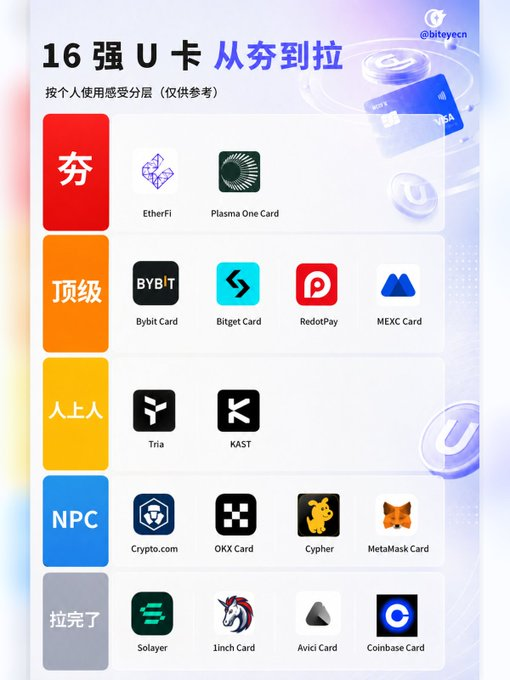
From basic to advanced: A simple tier classification of 16 U cards
Basic: Can be used as a primary card for daily transactions
EtherFi, Plasma One Card
EtherFi excels in providing a complete overall experience: free, 0 recharge fees, real cashback, funds are withdrawable, and balances can continue to earn interest, making it suitable for people who want to use stablecoins for daily consumption in the long term.
Plasma One Card's strength lies in supporting Apple Pay / WeChat / Alipay, making payment scenarios more familiar to Asian users, suitable for those with passports, who can complete KYC, and want to use U as their everyday currency.
1. EtherFi
EtherFi is currently one of the U cards with a strong overall experience, boasting advantages of being free, 0 recharge fees, real cashback, and interest-earning balances, while allowing for withdrawals, thus not locking funds in like some other cards.
From user feedback, its everyday consumption experience is quite close to that of a regular Visa card, with smooth transactions for card swipes, subscriptions, and offline purchases, and cashback is in the form of real assets like eETH / wETH, making it more suitable for users who want to utilize stablecoins for daily spending without sacrificing fund efficiency.
2. Plasma One Card
Plasma One Card is one of the U cards that has gained a good reputation in the Chinese user community for everyday consumption, with the advantage of being friendly to holders of Chinese passports and supporting mobile payment scenarios like Apple Pay / WeChat / Alipay, while focusing on cashback and earning interest on balances.
However, opening an account usually requires an invitation code, an overseas mobile number, and proof of address, making the KYC threshold higher than that of regular exchange cards.
Top-tier: Strong cards with clear use cases
Bybit, Bitget, RedotPay, Tria, KAST, MEXC
Bybit and Bitget are friendlier to Chinese users, especially covering scenarios like AI subscription services, linking with WeChat / Alipay, and everyday online consumption. RedotPay is suitable for large payments, cross-border spending, travel payments, and ATM withdrawals.
MEXC essentially is the MEXC ×ether.fi co-branded card, with a user experience similar to that of ether.fi, plus the MEXC entrance and additional benefits.
3. Bybit Card
Bybit Card is better suited for users already in the Bybit ecosystem. Its advantages include integration of exchange accounts and card spending, smooth Apple Pay experience, and certain attractiveness in subscription benefits and cashback. For those who already have funds on Bybit and frequently use exchange services, this card has a low entry cost, making it suitable for daily small transactions.
The downside is that funds are held by the exchange, and issues like account risk control, withdrawal restrictions, and source of funds scrutiny need to be considered.
4. Bitget Card
Bitget Card requires looking at two sets of logic: one is the exchange card, which leans more toward platform ecosystem benefits; the other is the wallet card, which focuses more on self-custody payments.
The exchange card is suitable for users who are already trading on Bitget, holding BGB, or reaching a certain level, but there will be transaction fees for each purchase; the Wallet Card has no monthly or annual fees, no recharge fees, but may incur standard card fees of about 1%–2.2% in different regions once exceeding the free limit.
However, it is important to note that as per the Fiat24 notice, starting today, Fiat24 will suspend new user account services in mainland China. As a result, new users in mainland China will temporarily be unable to apply for the Fiat24 card through Bitget Wallet.
5. RedotPay
RedotPay resembles a tool card for large payments and global use rather than a cashback card. Its strengths lie in its extensive coverage, large volume, and strong usability, making it suitable for those who need to use stablecoins for payments across multiple countries and regions.
From community feedback, RedotPay is particularly popular in emerging markets and cross-border payment scenarios. Many users do not use it primarily for cashback, but rather for everyday spending, cross-border payments, travel payments, and ATM withdrawals, or even using stablecoins as a store of value in environments where local currency depreciates, then spending through the card directly.
6. MEXC Card
MEXC Card needs to differentiate between the old and new versions. The old version is generally unappealing, with fees, benefits, and user experience not particularly outstanding, and its independent value is low.
What truly deserves attention is the MEXC ×ether.fi Card, which essentially resembles an ether.fi card with added MEXC rewards.
High-tier: Usable for ecosystem users
Tria, KAST
Tria is more suitable for users making large and frequent purchases, especially those who want higher cashback through high-tier cards. Its highlights include 0 recharge fees, high cashback rates on advanced cards, and substantial limits, making it suitable for paying large bills, travel expenses, or high-frequency spending scenarios.
However, Tria also has obvious problems: high-tier card annual fees are not low, cashback often has lock-in periods, and the rules for points and rewards are relatively complex.
Medium-tier: Usable for ecosystem users, but not necessary to pursue
Crypto.com, OKX, Cypher, MetaMask Card
Crypto.com is suitable for long-time users already in its ecosystem; OKX is good for veteran OKX users as a free backup card.
Cypher is geared more towards high-end users and large spending scenarios, with the Premium tier targeting higher limits, lower fees, metal cards, and priority support; however, the advantages of the regular tier are not significant, making it less suitable for everyday primary card use for regular users.
MetaMask Card is suitable as a backup card for heavy wallet users, but the annual fee and cost-effectiveness are average.
9. Crypto.com Card
Crypto.com Card is a relatively established U card product that initially attracted many users with high cashback, subscription benefits from Spotify / Netflix, and airport lounge perks.
However, its good benefits now rely more on CRO staking or subscriptions, and the benefits available to regular users are clearly not as attractive as in the early days.
10. OKX Card
OKX Card is more suitable for veteran OKX users as a free backup card, with advantages of 0 annual fees, 0 recharge fees, and a smooth experience when linked with Apple Pay / Google Pay, allowing for direct deductions from OKX Pay. However, cashback mainly revolves around USDG spending, and limits on cashback for regular users are relatively low, with certain restrictions on asset support and regional support, and it does not support ATM withdrawals.
In simple terms, it suits small-scale spending within the ecosystem, but is not suitable as a high cashback primary card.
11. Cypher
Cypher leans towards high-end users, with limits and advanced benefits being its primary selling points. The Premium tier may be more suitable for those with higher spending limits, hoping to obtain better FX conditions or additional benefits. However, for regular users, the advantages of the standard tier are not obvious, making it hard to demonstrate value if spending amounts are low.
12. MetaMask Card
The biggest advantage of MetaMask Card is the ability to spend directly from a MetaMask wallet, suitable for users who are already deeply using MetaMask and are familiar with on-chain wallet operations.
In terms of cost-effectiveness, its advantages are not outstanding, especially as the cost of the metal card at $199/year is quite high, and its cashback and fee structure does not clearly outperform other competitors.
Finally: Not worth prioritizing at this time
Solayer, 1inch, Avici, Coinbase
Solayer is more like a points card, with average cost-effectiveness for daily spending; 1inch Card is more like an ecosystem supplement; Avici has a good concept but is still in its early stages; Coinbase Card is acceptable for U.S. users but not very friendly to most Chinese users.
13. Coinbase Card
Coinbase Card is relatively friendly to U.S. users, especially when using USDC or dollar balances for spending, with relatively clear costs, and the 0 annual fee lowers the entry barrier.
Its advantages are compliance, high brand recognition, and convenience for users in the U.S. However, the drawbacks are also obvious: the product is clearly biased towards the U.S. market, making it not a priority consideration for non-U.S. users.
14. Avici Card
Avici Card's concept is quite crypto-native, focusing on self-custody, multi-chain USDC consumption, and a better on-chain payment experience.
15. 1inch Card
1inch Card is more like a supplementary product in the 1inch ecosystem, rather than a strong U card aimed at the general public.
However, when looking solely at card spending, its appeal is not strong: the 1.75% conversion fee and 2% FX will eat into some of the cashback earnings, making the cost-effectiveness low.
16. Solayer
It initially attracted a group of users through the Solana ecosystem, sUSD earnings, and Emerald Points, but now the $20/year subscription fee, 0.5% recharge fee, and inability to withdraw balances present notable restrictions.
The real experience of everyday card use feels more like exchanging for points rather than using an effective spending card. If it’s just for small tests or casually seeking out potential airdrops, it could be worth looking at.
In Conclusion
Finally, it's worth reminding that a higher cashback does not necessarily mean that card is the most suitable for everyone.
For Chinese users, what's more important is: can they open an account, how difficult is the KYC, can they link WeChat / Alipay / Apple Pay, can they subscribe to AI tools, can funds be smoothly withdrawn, and can customer service handle issues during risk control.
Therefore, this list serves more as a "subjective reference from the perspective of Chinese users," rather than an absolute ranking.
Some content comes from the editor's own experience, while others reference official information, community testing, and user feedback from X / YouTube / Xiaohongshu. Different regions, identities, KYC conditions, app versions, and platform policies may all affect the actual experience, and rates, cashback, and card eligibility may adjust at any time.
Actual card opening experiences are subject to the latest rules on the official website and in the app. Different regions, identities, KYC conditions, app versions, and platform policies will impact card eligibility, rates, cashback, limits, and available scenarios.
This summary is only for information organization and community observation purposes; it does not constitute any advice on card applications, investments, or fund management.
免责声明:本文章仅代表作者个人观点,不代表本平台的立场和观点。本文章仅供信息分享,不构成对任何人的任何投资建议。用户与作者之间的任何争议,与本平台无关。如网页中刊载的文章或图片涉及侵权,请提供相关的权利证明和身份证明发送邮件到support@aicoin.com,本平台相关工作人员将会进行核查。


