
Author: Emily Sands
Translation: Peggy, BlockBeats
This article comes from Stripe's redefinition of "AI economic infrastructure": In the past, payment infrastructure mainly served human users and software companies; now it must serve machine entities as well. Agents need to be able to understand prices, complete payments, call wallets, and deploy services; AI companies also need to establish new billing, risk control, and settlement mechanisms around token consumption.
The Machine Payments Protocol, Link, Stripe Projects, Metronome, Tempo, and streaming payments mentioned in the article essentially point to the same trend: AI Agents are transitioning from "tools" to new economic participants on the internet. They are both buyers and builders; they will create software and consume resources. Therefore, the traditional SaaS business model of charging by seats, invoicing after the fact, and manual checkout is being replaced by new models that enable real-time measurement, real-time settlement, and machine-readable formats.
This is not only Stripe's product narrative, but also a broader industry judgment: If a significant amount of software consumption in the future is initiated by Agents, then payment, billing, wallet, risk control, and deployment processes all need to be redesigned. AI is changing not just production efficiency but also the organizational way of business itself.
The following is the original text:
Agents are becoming buyers and builders. This will fundamentally change the way business operates.
In the past few years, Stripe has been building economic infrastructure for AI. This involves several levels: we help the fastest-growing AI companies around the world accelerate development through payment, billing, checkout, fraud prevention, and tax infrastructure; we deploy AI into every part of the payment process to help businesses increase profit; and we enable Stripe to be natively embedded into the AI tools used by developers.
But in the past six months, the meaning of the concept "AI economic infrastructure" has changed. Agents are becoming new actors on the internet. This also brings us two new tasks: one is to help Agents purchase and build on behalf of individuals and businesses; the other is to help businesses adapt to the new economic models brought by token consumption. In other words, Stripe is empowering Agents to become independent actors; at the same time, it is helping businesses monetize products created and consumed by Agents that are heavily reliant on tokens.
Agents as Buyers
E-commerce was initially designed for humans. Humans browse websites, click on price pages, enter credit card information, and complete the checkout process. But Agents do not operate that way. They need a programmatic method that understands when a service requires payment, how much the fee is, and how to complete a payment without human interaction with the checkout interface.
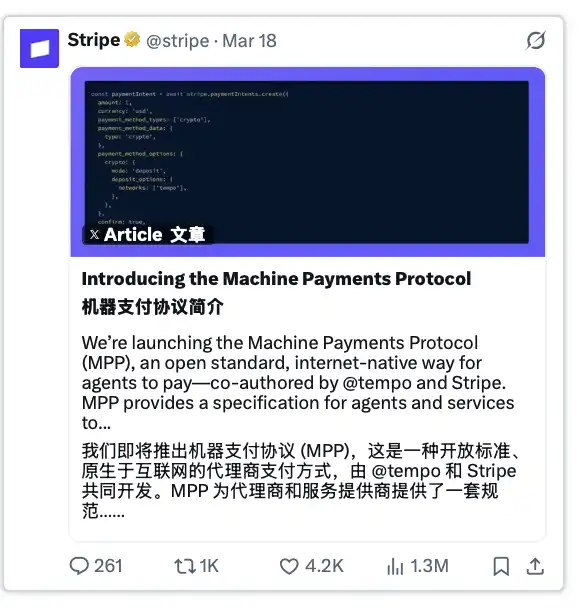
This is exactly why we partnered with Tempo to create the Machine Payments Protocol. It allows businesses to programmatically accept payments from Agents directly, without human intervention. There are no account registrations, no checkout pages, and no human operators in the process; only a machine-readable payment method that allows Agents to purchase services from businesses.
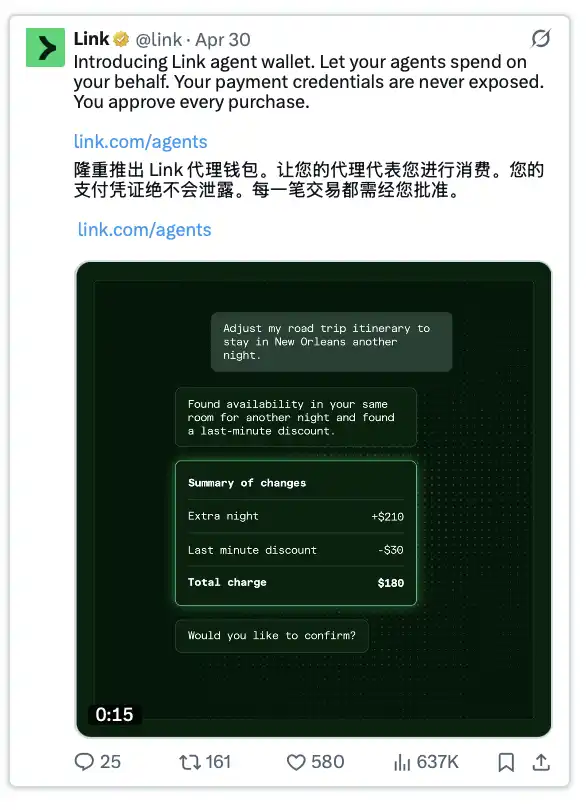
Once businesses can accept payments from Agents, the next equally important question is: how do consumers securely authorize Agents to spend money on their behalf? This is where our consumer wallet Link comes into play.
Currently, over 250 million people are using Link. We are enabling Link to also serve Agents, allowing users to authorize Agents to securely complete payments on their behalf. Humans still retain control, while Agents gain the ability to spend on behalf of users.
Helping Agents make purchases on the internet is one way we empower them. Another way is to help them build.
Agents as Builders
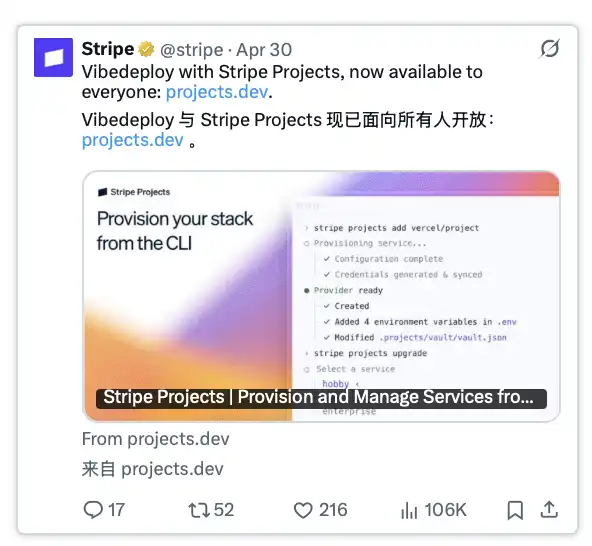
Today, vibe-coding is already quite easy, but vibe-deploying is not. Agents can generate an application in minutes, but deploying it on the internet still requires a lot of manual integration: creating accounts, configuring services, managing credentials, accessing APIs, and switching back and forth between different consoles.
Stripe Projects allows developers and their Agents to register, manage, and integrate all types of services needed to deploy applications directly through the command line. The goal is simple: to make vibe-deploying as easy as vibe-coding.
Token Monetization
As Agents begin to become buyers and builders, businesses also need to adapt to a new world: the inference cost of products or the token cost will change dynamically. This will alter the economic model of software.
In SaaS models, serving one additional user usually incurs very little extra cost. However, in AI products, every prompt input, every API call, and every task performed by an Agent incurs real marginal costs behind it. Therefore, businesses can no longer simply charge by seat; they need to measure usage in real-time and bill based on the actual resources consumed by customers.
This is also why usage-based billing has become central to AI monetization. Businesses can charge based on the value truly recognized by customers: usage, workflow, outcomes, or any billing unit that fits their product best.
Lovable is a good example. It initially adopted a simple subscription model on Stripe to achieve quick commercialization after launch. As the company grew, its billing model also evolved. Now, when customers exceed the usage limit included in their subscription plan, Lovable charges based on the AI tokens consumed. ElevenLabs has followed a similar path: it initially adopted a subscription model on Stripe and later introduced pay-as-you-go pricing as the product shape and customer usage patterns changed.
Token Theft
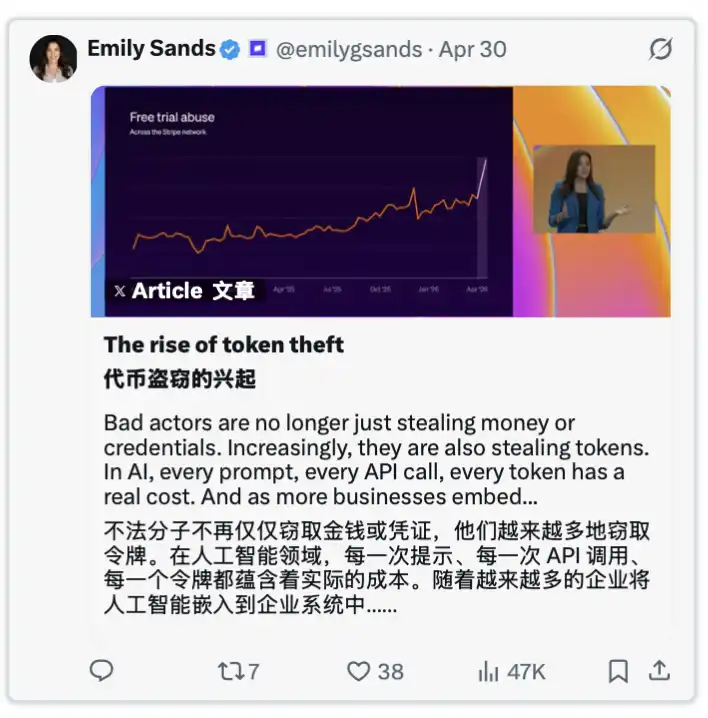
However, usage-based billing assumes that businesses can really collect the money back. Nowadays, fraudsters are no longer just stealing funds or account credentials; more and more often, they are stealing tokens. As long as they can register accounts, quickly consume a large number of tokens, and then disappear before the bill is due, the economic model of AI products will quickly collapse.
Token theft is one of the most under-discussed issues in today's AI industry. Stripe Radar, as our fraud protection product, can assess new accounts in real-time, predict which free trials may be abused, and identify unpaid risks during the accumulation of usage.
Streaming Payments
When customers themselves are Agents, the abuse problem becomes even more complicated. Agents can consume tokens at machine speed, making traditional billing methods too risky and even unbearable.
Businesses can require users to prepay and stop services once the usage limit is reached. This approach can protect the business but results in a worse customer experience and prevents quality customers from increasing their consumption. Businesses can also allow usage to continue accumulating, and then issue a unified bill later. This provides a better experience for customers, but the bill may ultimately never be collectible, and by that time, the tokens will have already been consumed.
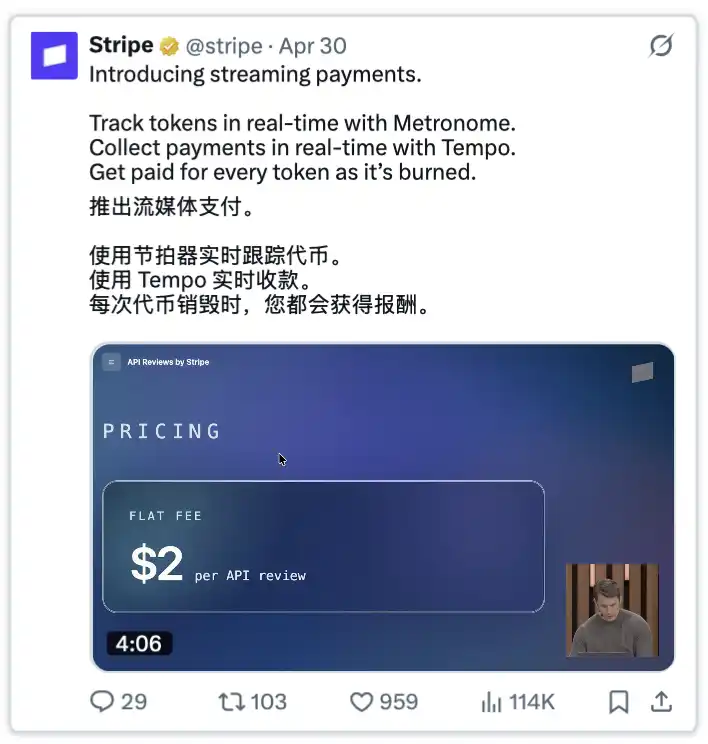
The better answer is actually quite clear, but achieving it is technically very complex for businesses: real-time tracking of usage and real-time payment collection. This is exactly the capability that Metronome and Tempo can achieve when combined.
Metronome is a company acquired by Stripe that mainly serves the most complex usage billing models. It can track usage in real-time while tokens are being consumed. Tempo supports low-cost, high-frequency stablecoin payments and enables instant settlement. Together, AI companies can complete charging while tokens are consumed, without having to choose between a "hard cap" and "uncollectible bills."
We call this streaming payments: a new business model for AI-native businesses that adapts to machine-speed software consumption.
All of the above is what today's "AI economic infrastructure" needs to support.
It is no longer just about providing payment services for AI companies, but about providing a business system for Agents, providing wallets for Agents, allowing Agents to deploy software, supporting billing around tokens, preventing fraud and abuse in token usage, and providing streaming payment capabilities for Agents.
AI is changing business and how businesses are constructed. Therefore, the infrastructure must also change.
Stripe is building all of this.
免责声明:本文章仅代表作者个人观点,不代表本平台的立场和观点。本文章仅供信息分享,不构成对任何人的任何投资建议。用户与作者之间的任何争议,与本平台无关。如网页中刊载的文章或图片涉及侵权,请提供相关的权利证明和身份证明发送邮件到support@aicoin.com,本平台相关工作人员将会进行核查。


