
Author: Arrakis
Translation: Felix, PANews
This article analyzes the cross-platform lead-lag relationship among 29 cryptocurrency perpetual contract markets and delves into the architecture of Perp DEX.
Introduction
Hyperliquid is the largest on-chain perpetual contract platform by trading volume and open interest. Its business has expanded from crypto perpetual contracts to real-world assets (RWA), prediction markets, and permissionless DeFi technology stacks. You may have heard it said that Hyperliquid has replaced Binance as the main platform for cryptocurrency price discovery.
This article verifies that claim. Inspired by Hoffmann, Rosenbaum, and Yoshida (2013), a modified Hayashi-Yoshida lead-lag estimator was run between three platforms (Hyperliquid, Binance, and Lighter).
Verification Content
Question: How long does it take for asset price movements on one trading platform to be reflected on other platforms?
Each trading platform publishes transaction records that include timestamps of all trades. The simplest way to measure cross-platform lead-lag is to take two transaction records, offset one relative to the other by a certain amount within a range, and select the offset that results in the closest alignment of price trends on both transaction records. The offset that achieves the best alignment indicates the lead-lag relationship between the two trading platforms.
If Hyperliquid's timestamps are shifted back by 700 milliseconds to perfectly align its price movements with Binance, it means Binance leads by 700 milliseconds. The Hayashi-Yoshida estimator used here is designed for two price series with irregular and asynchronous transaction times. For each candidate time shift value, it calculates:
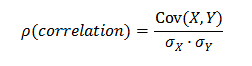
where Cov(X, Y) denotes the covariance between X and Y; in this case, X and Y represent the transaction return sequences of the two trading venues being compared. σ_X and σ_Y are the standard deviations of these two distributions.
To avoid noise from bid-ask spread fluctuations at sub-second resolution, the estimator is run separately for buy-side transactions (buy orders) and sell-side transactions (sell orders). For each platform pair, ρ values are calculated over a grid from -2,000 milliseconds to +2,000 milliseconds (in 100-millisecond intervals), then the shift value at which ρ peaks is read. A positive lag means that the platform in front is leading.
This article analyzes the assets ranked in the top 29 by market capitalization that are traded on all three trading platforms:
$BTC, $ETH, $BNB, $XRP, $SOL, $TRX, $DOGE, $HYPE, $ZEC, $ADA, $XMR, $BCH, $LINK, $TON, $XLM, $LTC, $SUI, $AVAX, $HBAR, $NEAR, $TAO, $DOT, $UNI, $ONDO, $WLFI, $ASTER, $ICP, $MORPHO, $AAVE.
The analysis window covers 16 days ending February 26, 2026, and the platform pairs tested are: Hyperliquid vs Binance, Hyperliquid vs Lighter, and Lighter vs Binance.
All analyses reached consistent conclusions:
- Out of 29 assets, 29 assets: Binance leads Hyperliquid
- Out of 29 assets, 27 assets: Lighter leads Hyperliquid
- Out of 29 assets, 23 assets: Binance leads Lighter
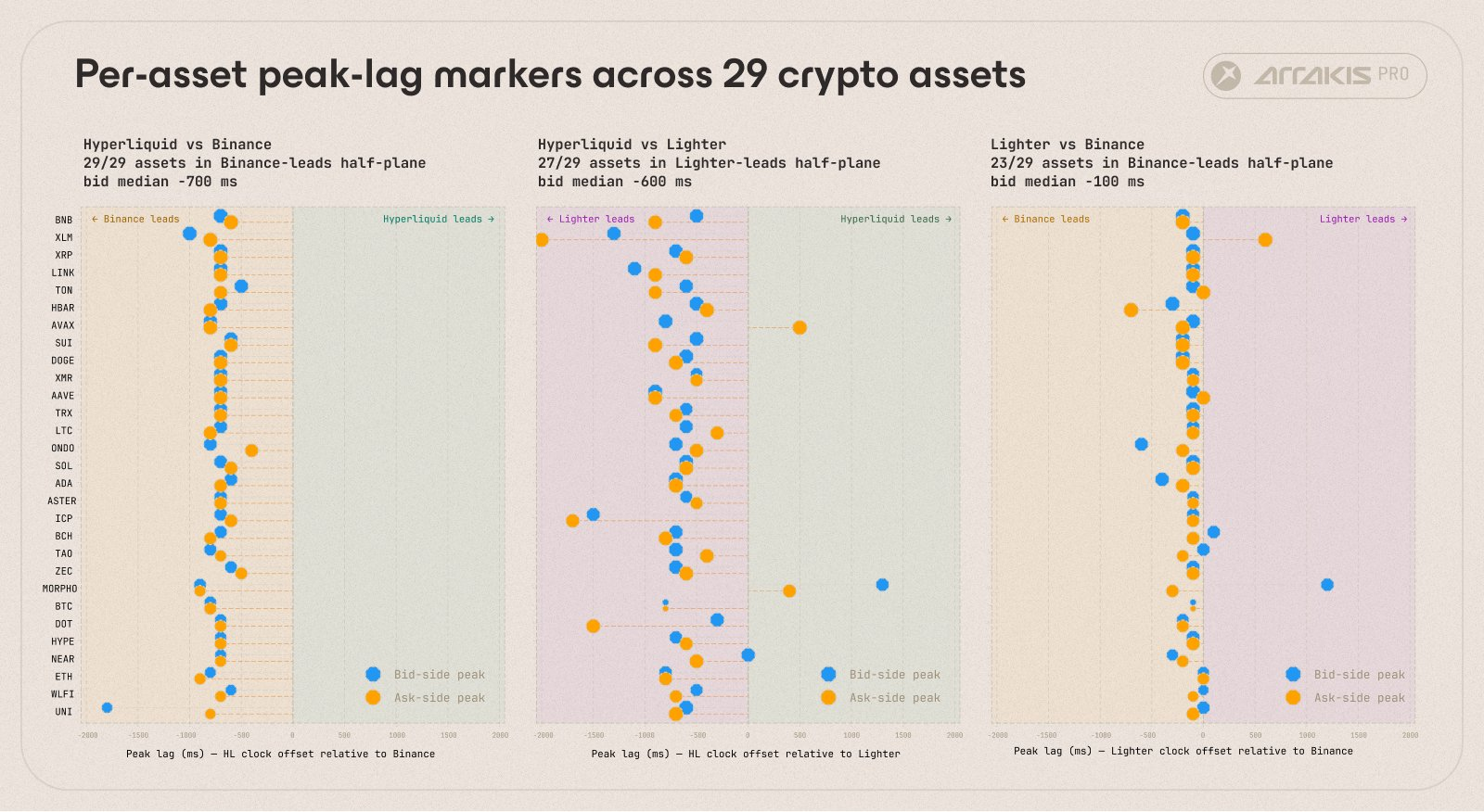
(Chart Description: Peak lag markers for each asset across the three platforms; asset order in each panel is the same. Both Hyperliquid panels look almost identical no matter which platform is compared on the other side. The Lighter vs Binance panel forms a tight cluster at the negative lag edge.)
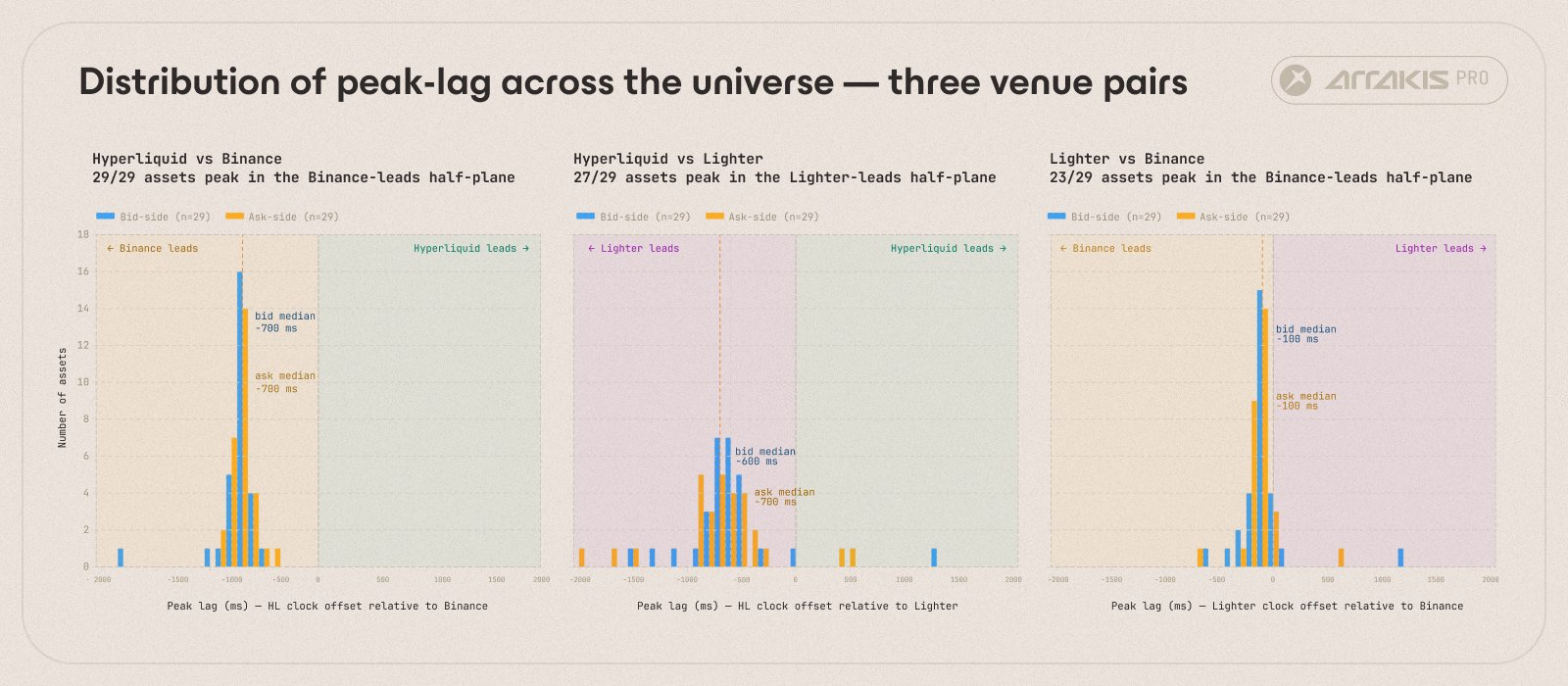
(Chart Description: Distribution of peak lag ranges for 29 benchmark assets, ranging from -2000 to +2000 milliseconds, in 100-millisecond intervals. Both Hyperliquid panels peak between -600 and -700 milliseconds. The Lighter vs Binance panel peaks at -100 milliseconds.)
The two Hyperliquid panels look nearly identical: regardless of which platform is compared, data is tightly clustered around -700 milliseconds. From Hyperliquid's perspective, the delays from Binance and Lighter are very similar, and both lead it by roughly the same margin. The compactness of the Lighter vs Binance panel exceeds the order of magnitude, around -100 milliseconds, which is also the minimum incremental unit for testing lead-lag relationships in the analysis.
Observing BTC transactions on a single asset level, this can be clearly seen. The correlation in Hyperliquid vs Lighter and Hyperliquid vs Binance consistently peaks at -800 milliseconds, indicating that Hyperliquid is always lagging behind both platforms at these levels.
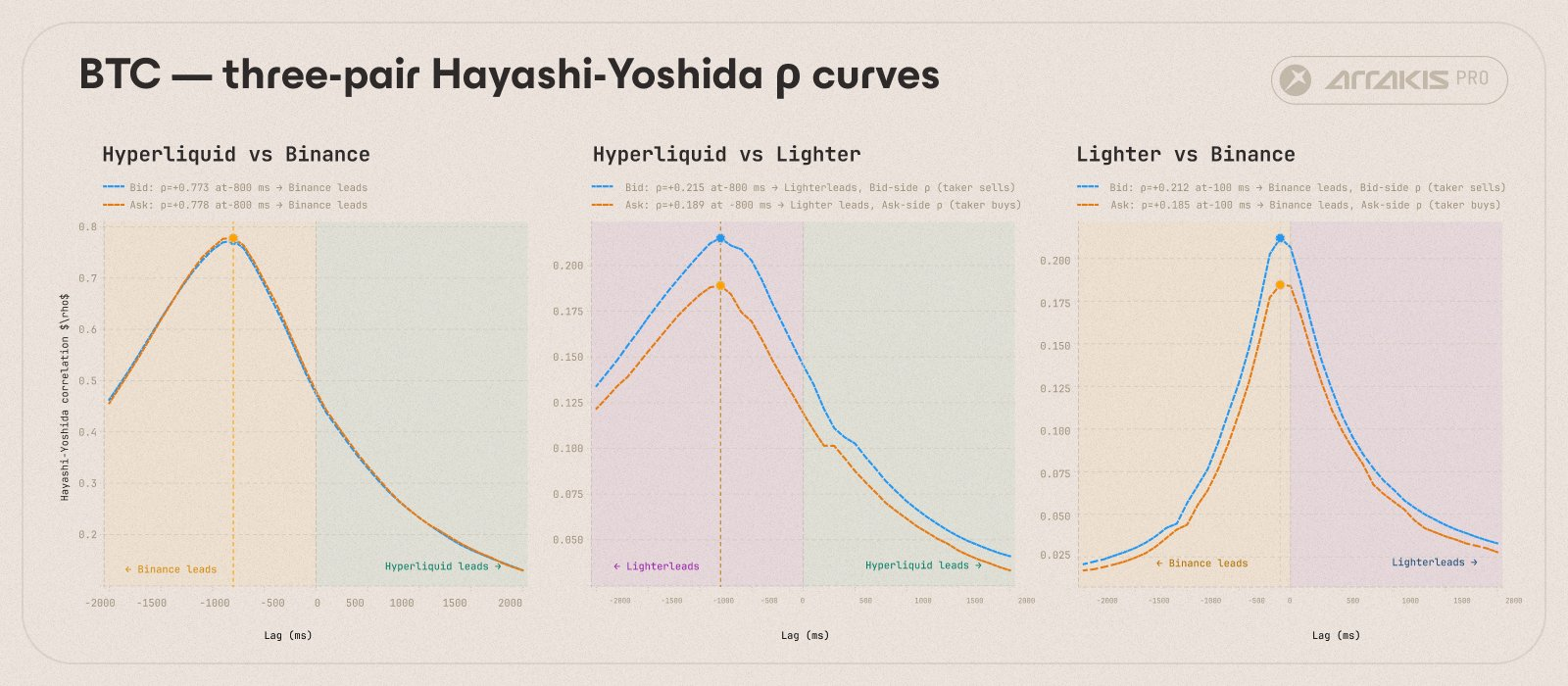
(Chart Description: The ρ lag time curve for BTC among the three platforms. The lag direction is consistent: -800 milliseconds on both Hyperliquid panels, -100 milliseconds on the Lighter vs Binance panel.)
Transitivity Test
If the lags reflected in these pairwise comparisons indicate the same underlying microstructure, they should be additive: the lag from Binance → Hyperliquid should equal (Binance → Lighter) + (Lighter → Hyperliquid). This was verified among the 29 markets analyzed.
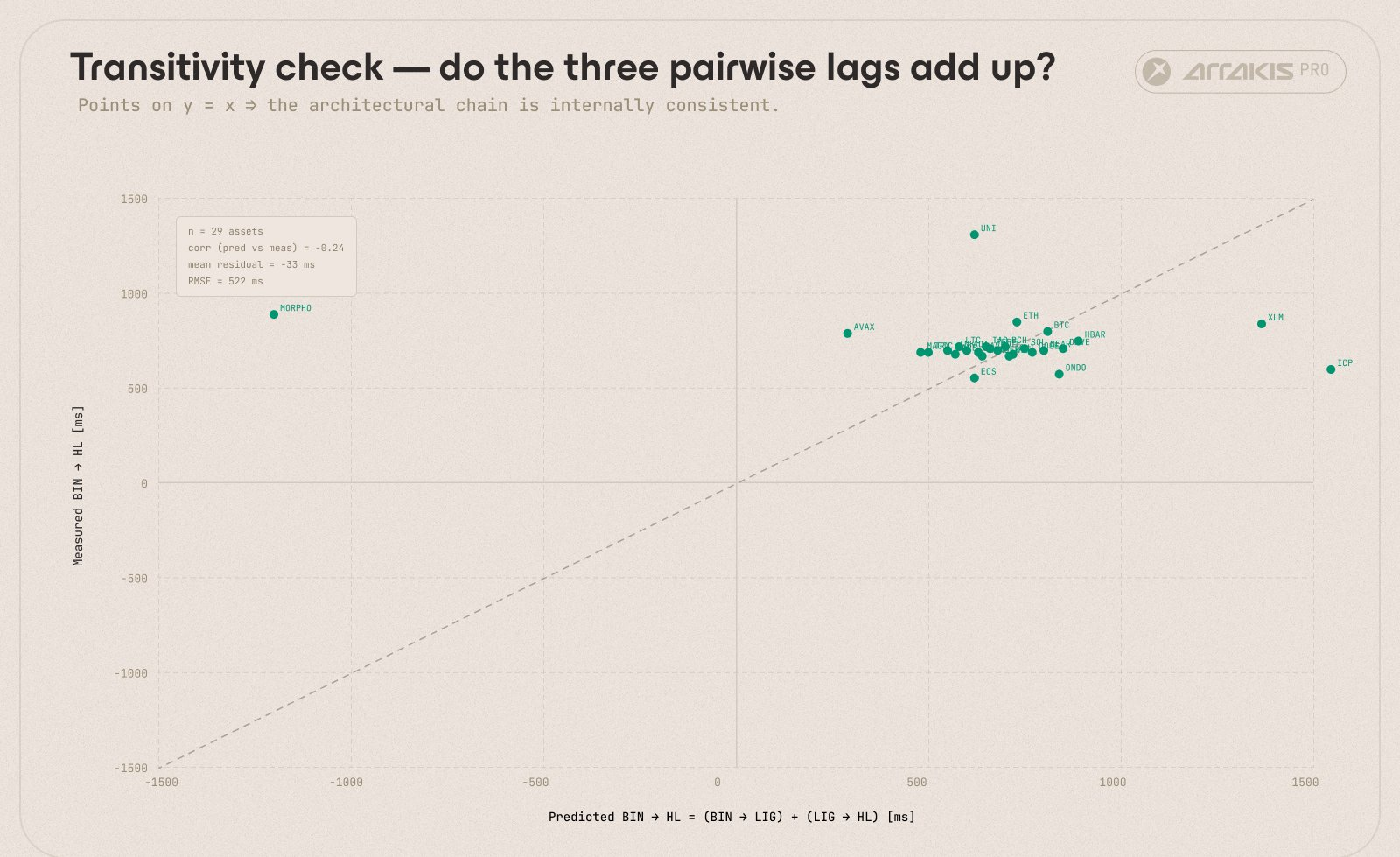
(Chart Description: The predicted Binance → Hyperliquid lag value on the X axis and the actual measured Binance → Hyperliquid lag value on the Y axis. Each point represents an asset. The overall median residual is -33 milliseconds)
The median residual is only -33 milliseconds, indicating that the transitivity holds for these assets. The outliers (MORPHO, ICP, XLM, UNI) exist because their lag-correlation curves never really peaked within the ±2000 milliseconds window, preventing the estimator from deriving a clear lead-lag value for them.
All other markets conform to this transitive relationship. This consistency suggests that the lead-lag phenomenon is determined by the structural way these platforms match and settle trades, rather than any inherent flaws in single trading pairs.
Where does Hyperliquid's delay come from?
The three platforms operate three different matching architectures.
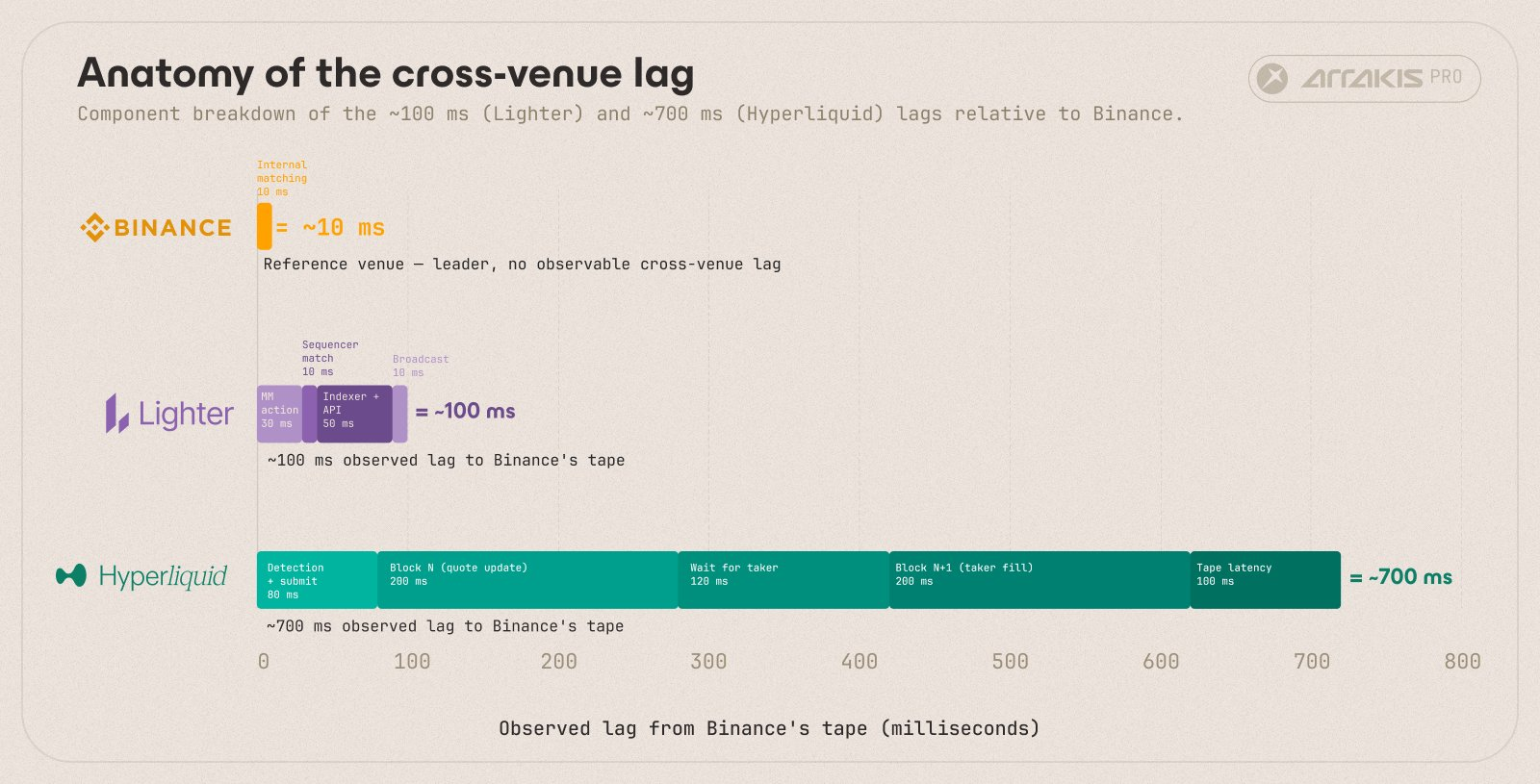
(Chart Description: Cross-platform lag analysis. Binance is the benchmark. Lighter has about 100 milliseconds of lag, mainly due to the Sequencer → Indexer → API process. Hyperliquid has about 700 milliseconds of lag, primarily caused by two complete HyperBFT consensus cycles, one for market makers updating quotes (block N) and another for natural takers' transactions (block N+1).)
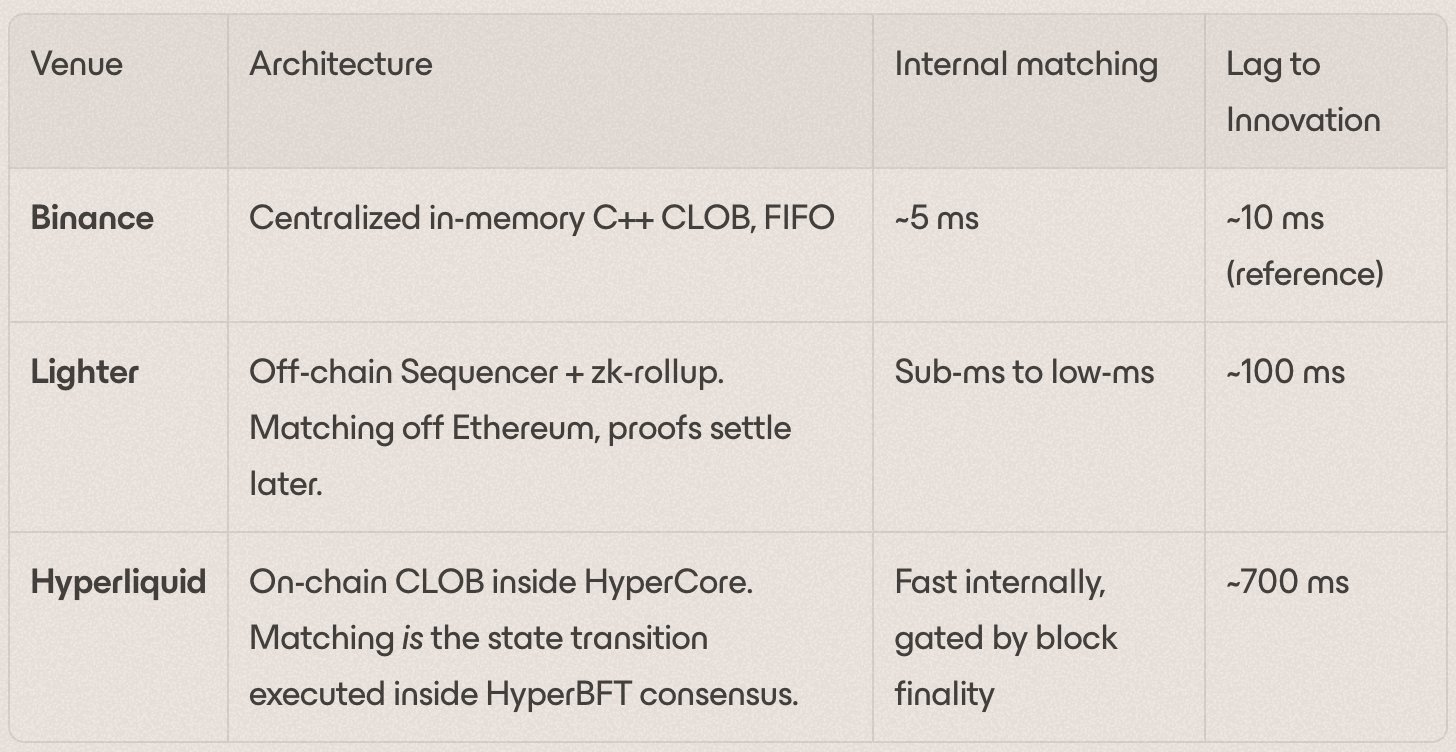
Binance and Lighter perform matching in millisecond memory, while Hyperliquid's matching itself is a HyperBFT state transition, so each transaction needs to wait for about 200 milliseconds of block finality (according to Hyperliquid's official documentation). However, the observed lag in transactions is around 700 milliseconds, not 200 milliseconds. This additional approximately 500 milliseconds comes from round-trip communication between market makers and traders.
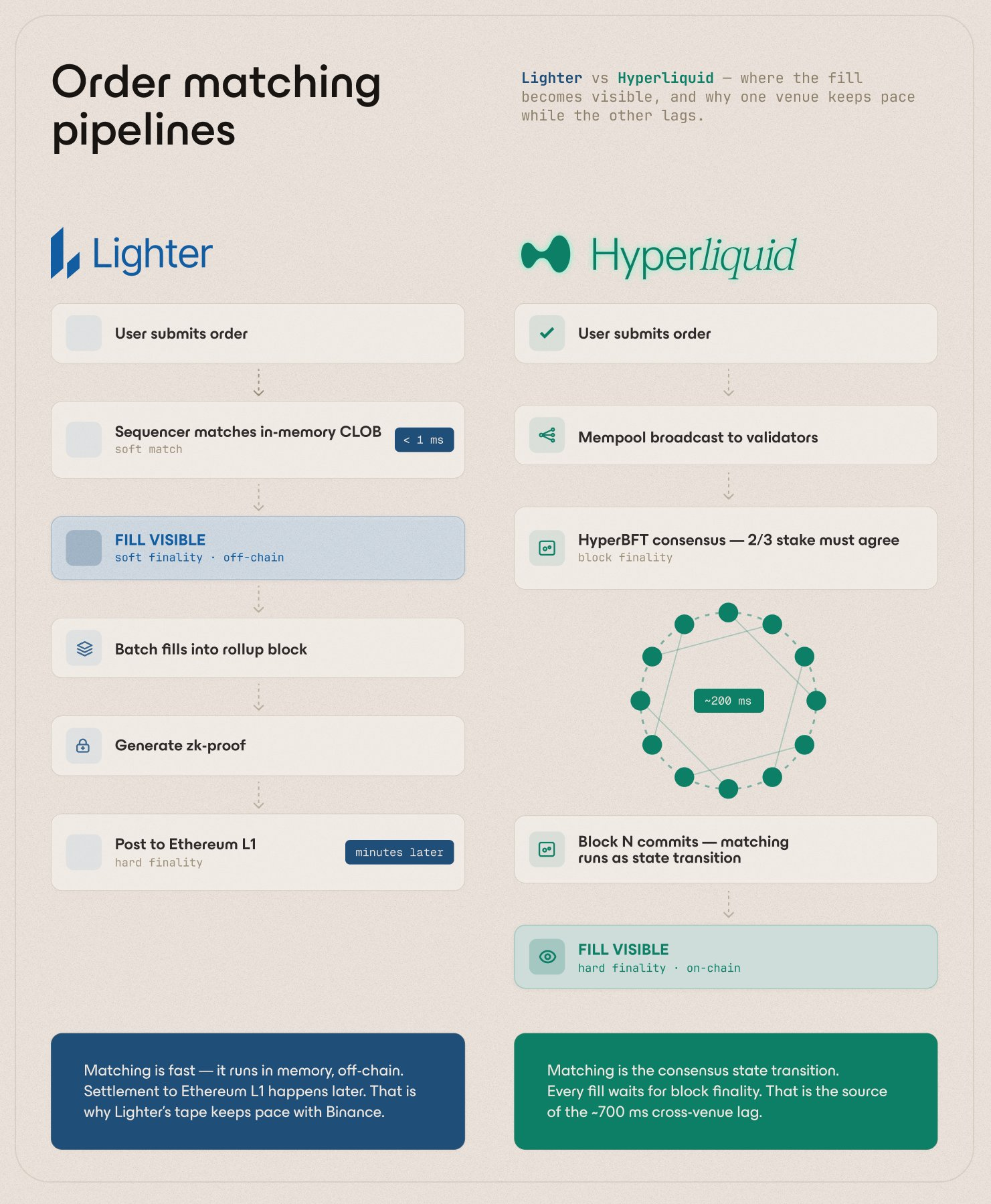
The most plausible explanation is that a "limit order-taker" round trip crosses two consecutive blocks. Here’s the sequence of events after a price change occurs on Binance:
- Outdated liquidity remains on Hyperliquid. Relative to Binance's new price, the market maker quotes that are still open show pricing errors.
- Mempool competition. Arbitrageurs speculatively send a large number of IOC (Immediate or Cancel) orders targeting the anticipated outdated liquidity. Market makers trigger "cancel and replace" trades to refresh their quotes, which is designed to push them to the top of the block. Market makers that fail to refresh quotes in this block are arbitraged.
- Block N is submitted at about 200-300 milliseconds. The cancellation removes the market maker's outdated quotes, and new orders issue refreshed quotes. Surviving IOC orders consume the remaining outdated liquidity at the old price, so the transactions in this block generally occur at outdated prices relative to Binance.
- At this point, Hyperliquid's order book has been cleared, but no one has traded against these updated quotes yet.
- Takers start trading at the now-updated prices.
- Block N+1 is submitted at about 500-700 milliseconds. The taker matches with the refreshed quotes. This is the first transaction with new price information, which is the transaction captured by the estimator related to Binance's lagged price innovation.
- This means that a price change on Binance requires at least two complete HyperBFT cycles to appear in Hyperliquid's transaction data.
In contrast, Lighter completely skips this step. Its sequencer matches in memory; quote updates and trades against that quote happen within the same millisecond. The approximately 100 milliseconds of lag reflects the delay of the indexer and API, which is also the minimum granular unit for testing lead-lag relationships in the estimator.
What does Lighter prove?
Lighter's pricing closely follows Binance, with only slight lag relative to Hyperliquid. This overturns the assumption that "Hyperliquid must lag because it is a DEX," as Lighter is also a DEX. Lighter's order flow into a centralized off-chain sequencer, but through zero-knowledge proofs (zk-proofs) settled on Ethereum, the entire system is a verifiably decentralized architecture.
The difference is where decentralization is executed. Hyperliquid executes it at the matching layer: every order, cancellation, and transaction is submitted by a validator set; while Lighter executes it at the settlement layer: the sequencer matches in memory and then proves its correctness to Ethereum after transactions.
Lighter trades speed for moving the trust boundary from the matching layer to the settlement layer. Hyperliquid keeps the trust boundary at the matching segment, paying the cost of delays for it.
Areas for Improvement for Hyperliquid
To improve its pricing latency compared to price discovery platforms like Binance, Hyperliquid could make the following modifications to its current design:
- Tighter HyperBFT pipeline: Reduce block time to below 200 milliseconds through tighter leader rotation, parallel voting, or network optimizations. Every millisecond saved compresses the time for two blocks in the round trip process. While this cannot eliminate the structural causes of lag, any substantial improvement in block time can significantly enhance price delays.
- Pre-confirmation or soft finality layer: Establish a separate fast track that pre-confirms blocks, while the finality of HyperBFT reaches asynchronously. Market makers publish quotes against the pre-confirmed state, effectively reducing tick delays. The trade-off is that: pre-confirmation is a trusted commitment, requiring reliance on trusted infrastructure or margin supported by a forfeiture mechanism. Both reintroduce trust assumptions currently absent from Hyperliquid.
- Decouple matching from consensus: This is the most ambitious and costly solution. Running an off-chain fast matching layer to generate preliminary transactions and then batching them for consensus structurally aligns more closely with Lighter's design. This would greatly compress the latency lower bound, but trust assumptions would significantly change compared to the current laissez-faire validator model.
Each path requires invasive modifications to the architecture at different layers and introduces trust assumptions not currently present in the system. Is the delay reduction these methods offer worth the cost of introducing extra trust assumptions? This is a question for the team and the community to decide.
What Does This Mean?
Hyperliquid has established its leading Perp DEX position in terms of liquidity, open interest, and retail participation. It has pioneered a unique frontier in DeFi, introducing new types of markets not present in TradFi: such as weekend trading of stocks and commodities, perpetual equity markets before IPOs, and prediction markets on inflation outcomes.
However, as the market matures and more participants join, the next round of on-chain Perp competition will unfold in terms of latency. Hyperliquid has built the most liquid platform upon a decentralized on-chain matching engine. The question now is whether it can maintain its position as the main "price discovery" platform for these new types of markets while sticking to this design.
Further reading: HYPE market cap rushes into the top ten, ICE publicly praises, Hyperliquid may be "crowned"?
免责声明:本文章仅代表作者个人观点,不代表本平台的立场和观点。本文章仅供信息分享,不构成对任何人的任何投资建议。用户与作者之间的任何争议,与本平台无关。如网页中刊载的文章或图片涉及侵权,请提供相关的权利证明和身份证明发送邮件到support@aicoin.com,本平台相关工作人员将会进行核查。


