
In the last seven issues, we have followed the same line: how cryptocurrency companies moved from sidelines advertising to the World Cup (a brief history of sponsorship), how stars signed endorsement deals with exchanges (celebrity endorsements for five years), how clubs formed fan enthusiasm into tokens (fan tokens), how collectibles evolved from star cards to on-chain assets (Sorare and FIFA Collect), how predictive markets became new competitors to traditional bookmakers (market structure), and how a "championship probability" is actually produced (odds methodology).
All seven issues discussed the same thing—how cryptocurrency gradually entered football. Now, with just six days before the match starts, we shift our focus from history to the present moment, looking at just one question: by the eve of the match, what scale have these on-chain markets accumulated?
Data is as of June 5, 2026. All prices and trading volumes are subject to change, and may have varied at the time of publication.
Act One · One Platform, One Contract, 1.6 Billion
First, let's look at a number.
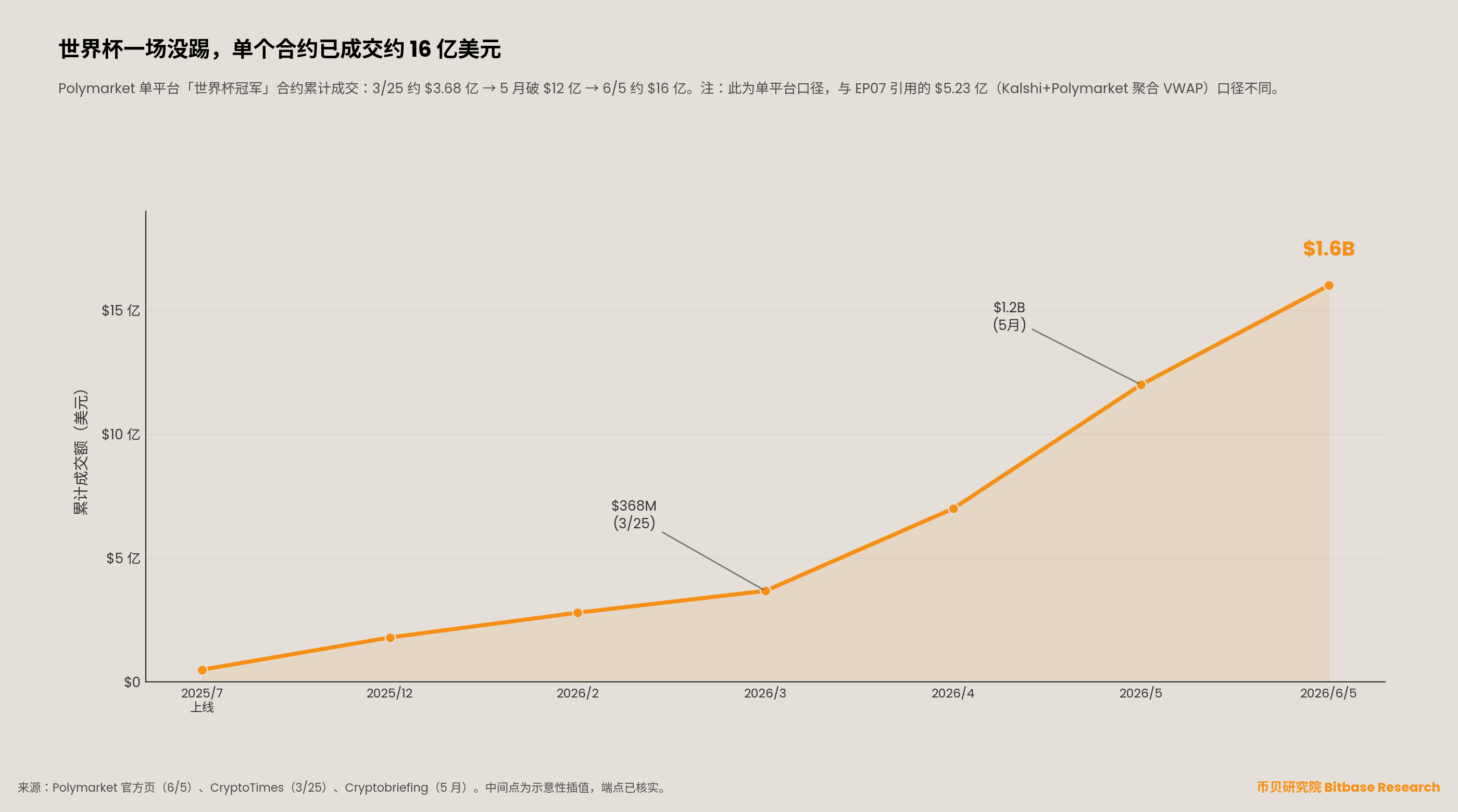
Just on the Polymarket platform, the "World Cup Winner" contract has accumulated a trading volume of approximately $1.6 billion as of June 5 (Polymarket's official market page shows "$1.6 billion in total trading volume," and this contract was launched in July 2025) [1].
No matches have been played in the World Cup yet.
This did not appear overnight but is a clear ascending curve:
March 25: approximately $368 million [2]
May: exceeded $1.2 billion [3]
June 5: approximately $1.6 billion [1]
The last two months before the start of the tournament saw the steepest part of this curve—approaching the start, rosters announced, and warm-up match results released, each new piece of information pushed trading volume higher.
Zooming out to the entire sector: the annual trading volume of the predictive market industry is expected to grow from about $16 billion in 2024 to about $64 billion in 2025, roughly quadrupling [2]. Analysts predict it may soar above $300 billion in 2026 [2].
Four years ago, the 2022 Qatar World Cup was when Polymarket first saw "significant trading volume" for a major event [5]. Four years later, just a single championship contract has reached the scale of $1.6 billion. From a niche experiment to a multi-billion dollar market, it only took one World Cup.
Act Two · How Contracts Come Alive with Match Results
$1.6 billion is for the "champion" contract. But after the match starts, what truly comes alive are the individual contracts covering each match.
Polymarket's World Cup category has about 100 markets, covering all 104 matches; combined with Kalshi, the two platforms have opened hundreds of contracts—from champion and golden boot to each group’s advancement and the outcomes of each match [6].
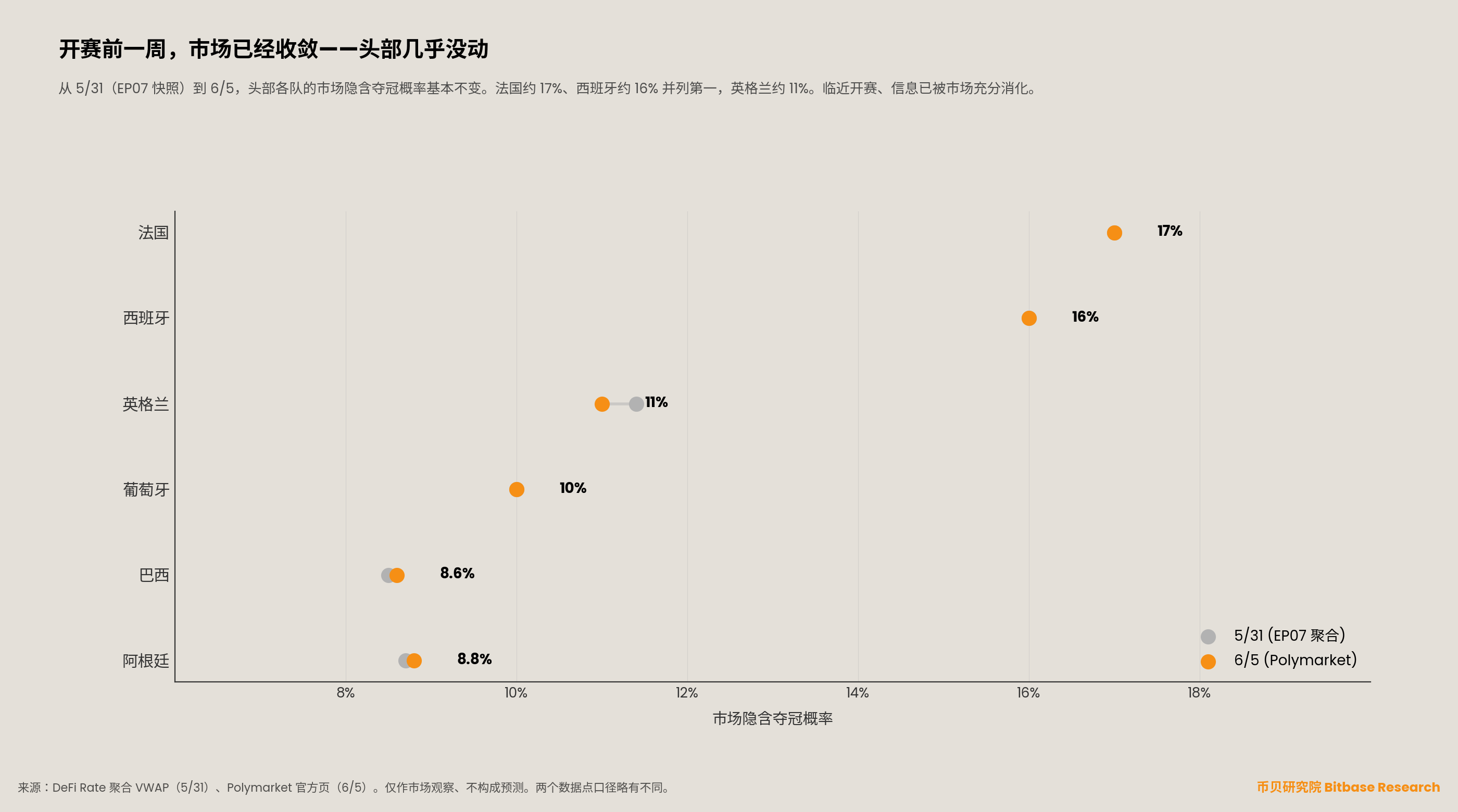
Group contracts are already trading. For example, Group A as of June 4: Mexico about 53%, South Korea about 23.5%, Czech Republic about 18.5%, South Africa about 6.3%; Group B Switzerland about 56%, Canada about 31%; Group D USA about 39%, Turkey about 33% (all implied market probabilities for observation only, not predictions) [6].
The first match is already listed: Mexico vs. South Africa on June 11 at Estadio Azteca in Mexico City (renamed Estadio Ciudad de México during the event), at 3 PM Eastern Time. The contracts not only ask "who wins," but also break down into sub-markets like "first-half win/draw/loss" [7].
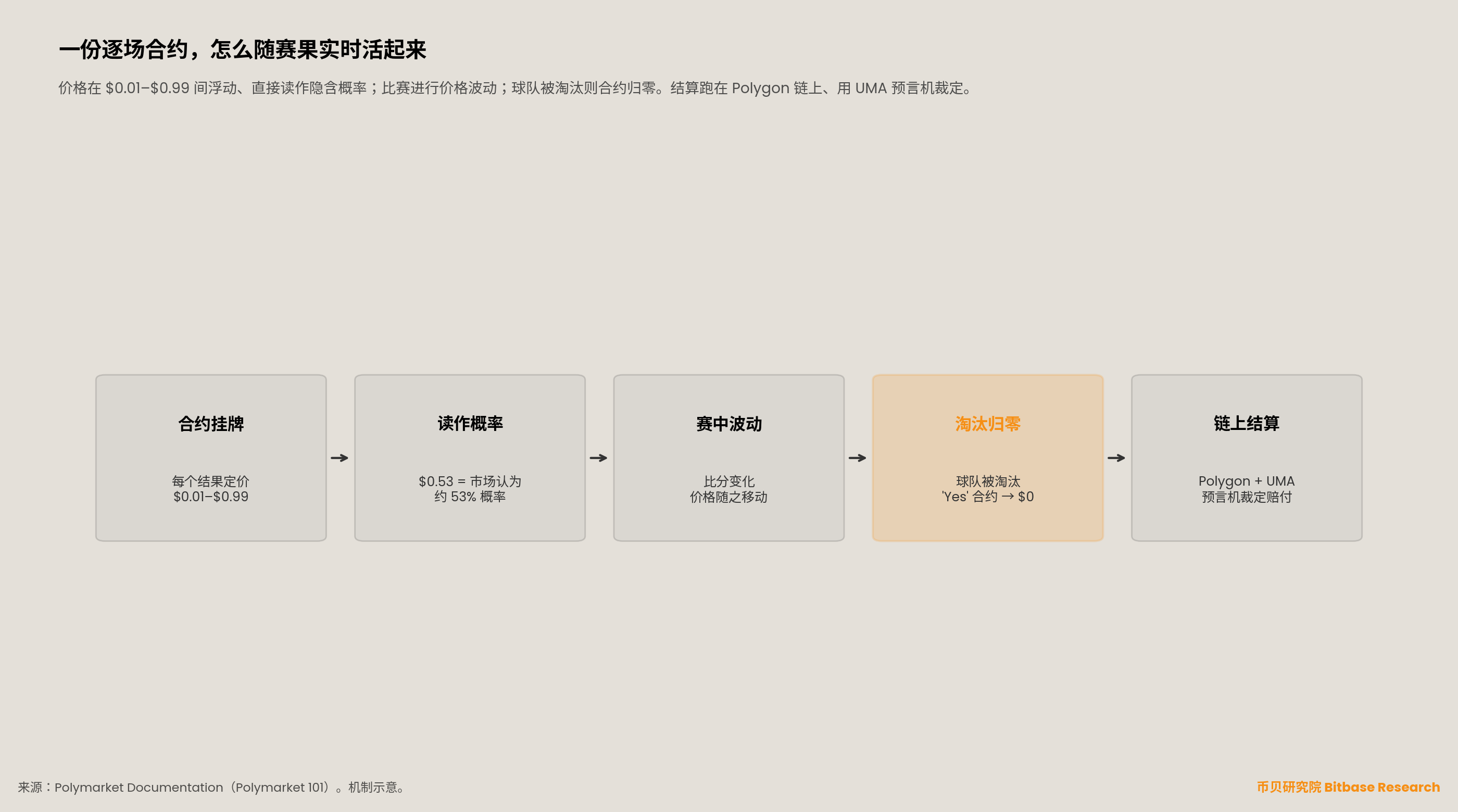
How do these contracts change with match results? The mechanism is actually quite straightforward: each contract price fluctuates between $0.01 and $0.99, and the price directly reads as implied probability—$0.53 means the market believes there is about a 53% probability. As the match progresses and the score changes, prices fluctuate accordingly; once a team is mathematically eliminated, its "championship Yes" contract immediately goes to zero, and the same applies to the "progression Yes" contract. Settlement relies on the blockchain: contracts operate on the Polygon chain, using Gnosis's conditioned token framework (a type of token standard called ERC-1155) to record positions, and UMA's optimistic oracle determines payouts once the match results are confirmed [8]. Each correctly guessed contract pays out $1, while incorrect guesses go to zero.
This mechanism provides a perspective that traditional sports media does not cover. Polymarket has one contract asking: Will Mexico's hosting venues be relocated due to security reasons? This market launched in late February, with about 96% of the funds betting "no," accruing a total trading volume of about $116,000 [6]. Pricing "event operational risks" as a tradable contract—this is something unique to on-chain predictive markets; ESPN won't give you a "relocation probability."
Act Three · Predictive Markets are Being Integrated
If trading volume speaks to "scale," then several events that occurred in the months leading up to the start of the tournament indicate "this market is being recognized by serious infrastructure and official entities."
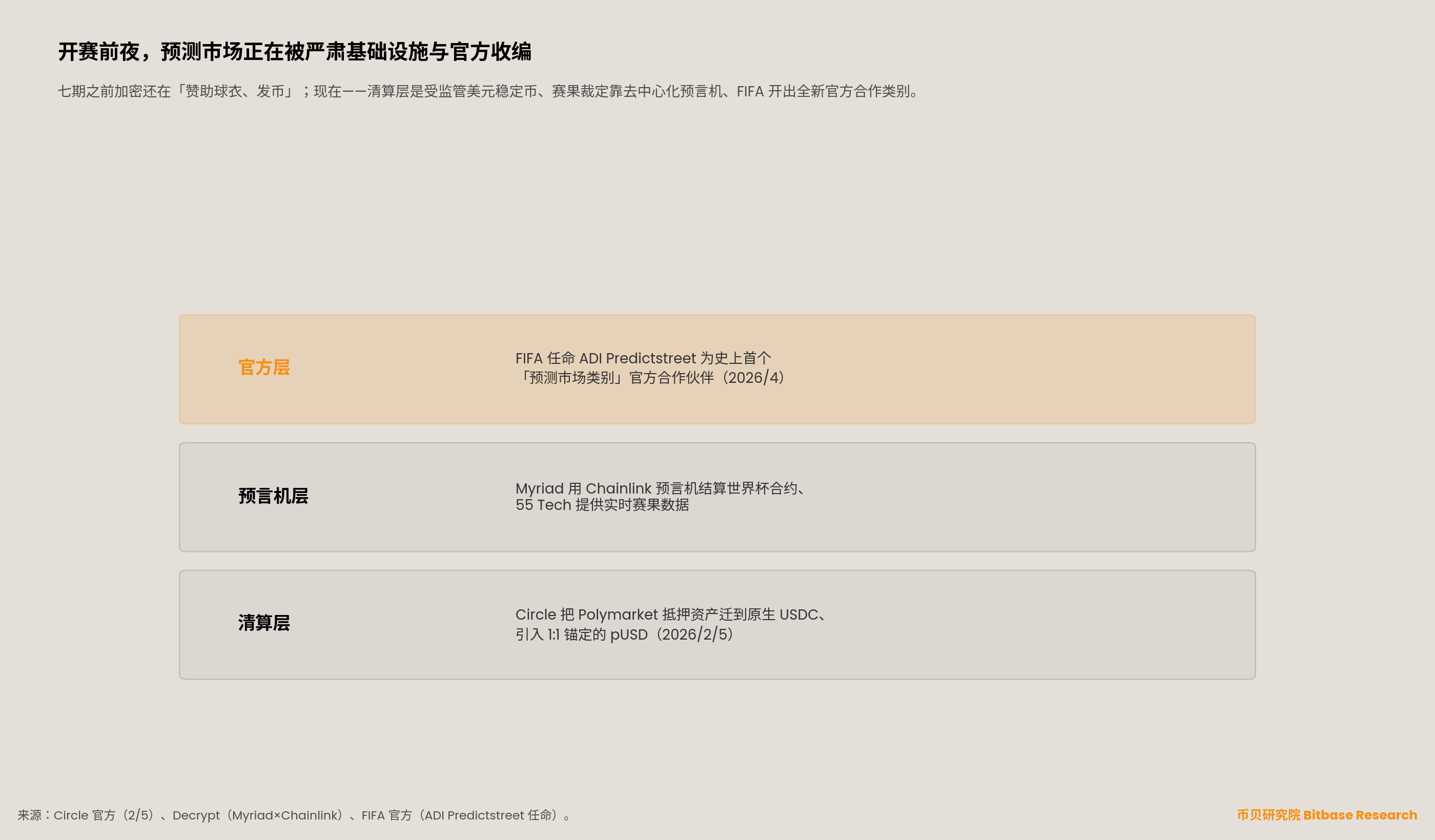
The clearing layer has switched to stablecoins. On February 5, stablecoin issuer Circle announced a partnership with Polymarket, migrating the platform's collateral from "bridged version USDC" (USDC.e) to "native USDC," and introducing a settlement unit pUSD pegged 1:1 to USDC [9]. The difference is: the bridged version relies on third-party cross-chain bridges for transport across different blockchains, which have traditionally been weak points for attacks; native USDC is directly issued by Circle's licensed entity and can be redeemed 1:1 for dollars. Polymarket founder Shayne Coplan called this an "infrastructure upgrade" [9]. In other words, the money in predictive markets now has a regulated U.S. dollar stablecoin as its clearing layer.
Oracles have come in. Myriad (operated by Dastan, the parent company of Decrypt) launched a World Cup market with over 75 contracts covering each match before the start in June, using Chainlink's oracles for result settlements, with real-time data sourced from sports data providers 55 Tech [10]. The oracle addresses a simple yet crucial question: how do on-chain contracts "know" the true results of matches in the real world—by relying on this decentralized data feeding and automatic settlement.
FIFA has also accepted it. In April 2026, FIFA appointed ADI Predictstreet (a licensed predictive market platform in Gibraltar) as the first official partner in the "predictive market category" in World Cup history [11]. Due to jurisdictional issues with the CFTC, ADI Predictstreet cannot operate directly in the U.S., so it is entering the U.S. market through Fanatics Markets.
Looking at these three developments together, a pattern emerges: before seven issues ago, cryptocurrency’s position in football was limited to "sponsoring jerseys and issuing tokens"; after seven issues, on the eve of the start, it has progressed to—the clearing layer is a regulated dollar stablecoin, result determinations rely on decentralized oracles, and even FIFA has opened a brand new official partnership category to integrate it. This represents a fundamental shift in cryptocurrency's position in football.
Asset Snapshot on the Eve of the Start
Now, let's take a look at the state of cryptocurrency assets directly related to football as we approach the start:
Chiliz (CHZ, the chain behind fan tokens): approximately $0.033–$0.035 (various sources in early June, slight variations across sources) [12]
National team fan tokens: Argentina (ARG) approximately $0.41, Portugal (POR) approximately $0.37; Belgium (BELG) issued at $1 on June 3 [12]
Conclusion · An Entity Not on the Sponsorship List, but Already Penetrated into the Underpinnings
It is important to clearly differentiate between two types of things: predictive markets (such as Kalshi, Polymarket, following the "event contract" regulatory path of the U.S. CFTC) and sports betting (following state licensing paths)—the legal characterization of the two is different, which is the core discussed in this series EP06. As of the eve of the start, this regulatory line remains in significant flux: Massachusetts issued a ban on Kalshi's sports contracts in January, Nevada has filed enforcement against Polymarket's parent company, and Polymarket has exited that state, while Arizona has brought multiple criminal charges against Kalshi; the Ninth Circuit is expected to make a ruling by mid-2026 that may diverge from the previous Third Circuit ruling supporting Kalshi, potentially leading to the Supreme Court [13][14].
The legality of the same World Cup contract can vary completely across different jurisdictions. Some U.S. states prohibit it, Mainland China bans any gambling, the path under the EU MiCA framework is still evolving, and some countries have blocked relevant platforms. Please check the rules applicable to your location.
After seven issues, the on-chain data as of the eve of the start tells us one thing: this World Cup, cryptocurrency companies are not on FIFA's top sponsorship list (that spot is held by Coca-Cola, Visa, Adidas, and U.S. Bank in the banking category)—but they have already infiltrated the clearing layer, prediction layer, and official partnership directory of this World Cup.
The World Cup kicks off on June 11. However, the on-chain market has already played for a year.
免责声明:本文章仅代表作者个人观点,不代表本平台的立场和观点。本文章仅供信息分享,不构成对任何人的任何投资建议。用户与作者之间的任何争议,与本平台无关。如网页中刊载的文章或图片涉及侵权,请提供相关的权利证明和身份证明发送邮件到support@aicoin.com,本平台相关工作人员将会进行核查。


